-
-
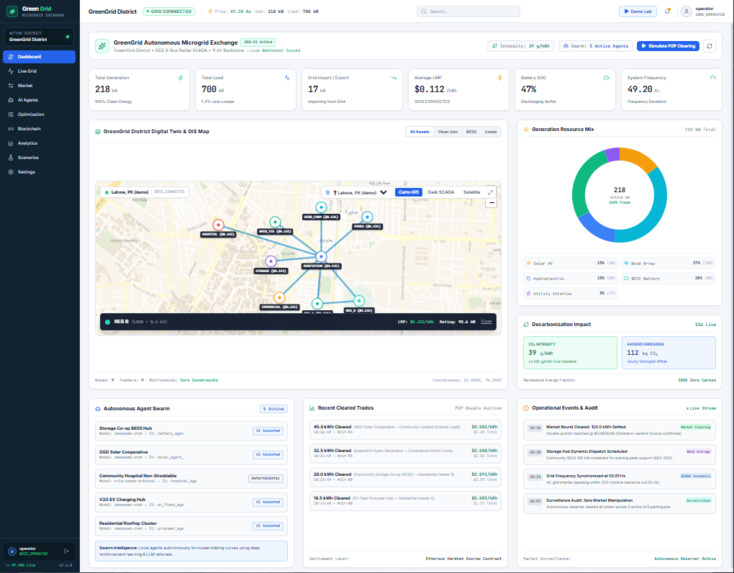
dashboard
-
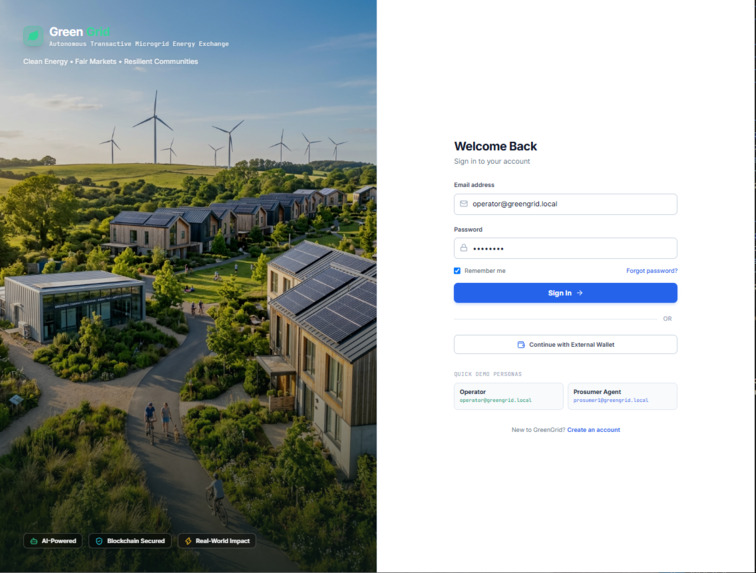
login
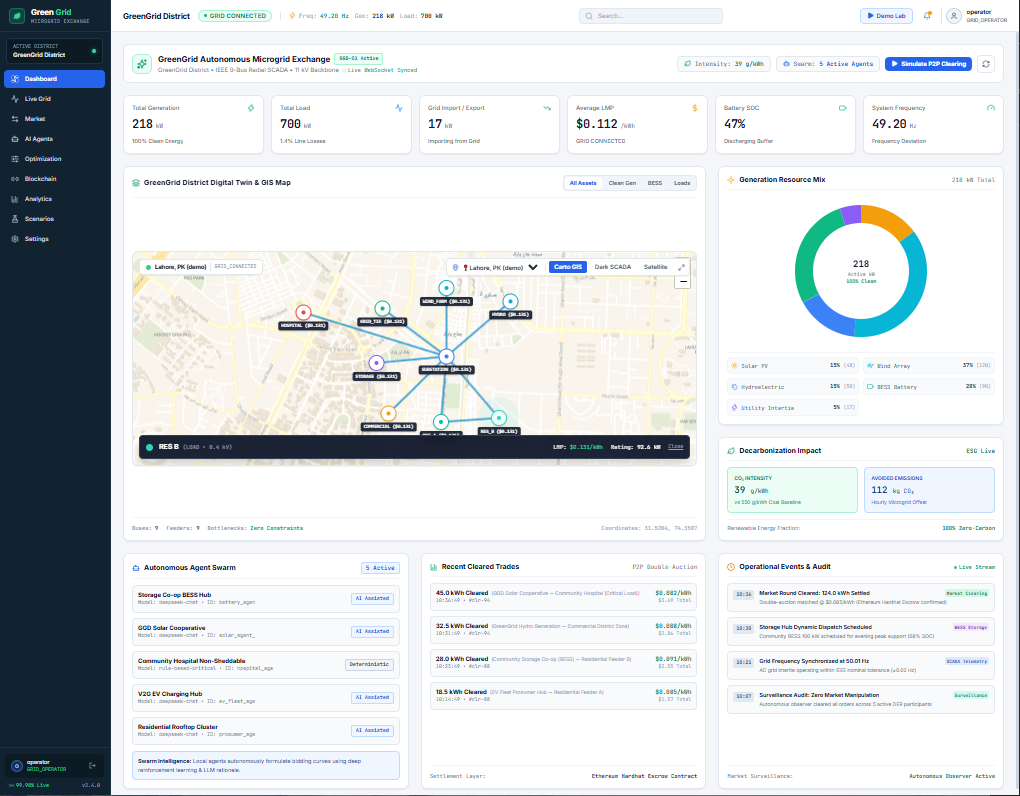
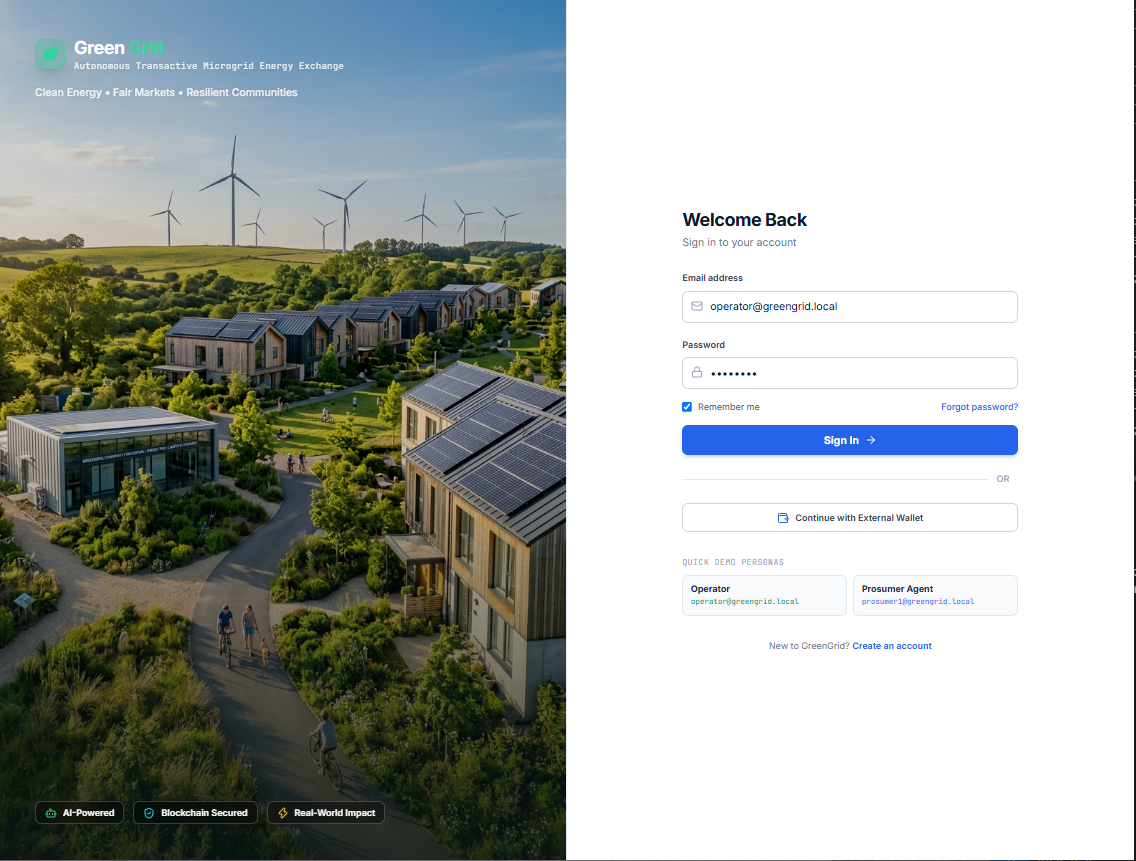
GreenGrid District: Autonomous Transactive Microgrid Energy Exchange
The Inspiration
The energy transition is changing how electricity is generated and consumed. Rooftop solar panels, battery storage systems, electric vehicles, and renewable energy generators are becoming increasingly distributed, yet coordinating these resources efficiently remains a significant challenge.
A household might generate more solar energy than it needs during the day, while a nearby business faces peak demand. A battery could store excess renewable energy for later use, and an electric vehicle could provide additional flexibility. However, without intelligent coordination, these resources may operate independently, leading to wasted renewable energy, higher electricity costs, and unnecessary pressure on the distribution grid.
We wanted to explore a different approach: What if every solar panel, battery, EV charger, business, and building could participate in an intelligent local energy market while respecting the physical limits of the electrical grid?
That question inspired GreenGrid District, an autonomous transactive microgrid platform designed to coordinate distributed energy resources through AI-driven decision-making, transparent market mechanisms, mathematical optimization, and verifiable energy settlement.
Our vision is to transform distributed energy assets from passive grid participants into coordinated contributors to a more efficient, resilient, and renewable energy ecosystem.
What We Built
GreenGrid District is an end-to-end cyber-physical energy exchange that connects local energy production, consumption, storage, trading, and settlement into one coordinated system.
The platform brings together seven core capabilities:
- Autonomous AI agents: Specialized agents develop energy trading and dispatch proposals based on asset conditions, forecasts, and market opportunities.
- Deterministic safety guardrails: Explicit rules validate proposed actions against battery limits, equipment capacities, network constraints, and critical-load requirements.
- Continuous double-auction market: Buyers and sellers submit bids and offers, which are matched using price-time priority and midpoint pricing.
- Physical grid feasibility: Network flow constraints help prevent market commitments from exceeding available transfer capacity.
- Optimal economic dispatch: A multi-period linear programming model coordinates generation, storage, EV charging, and demand to minimize operating costs.
- Authenticated smart-meter verification: HMAC-SHA256 signatures authenticate meter readings used to verify physical energy delivery.
- Transparent financial and environmental settlement: Double-entry accounting, escrow workflows, and renewable Energy Attribute Certificates (EACs) connect completed trades with their financial and environmental records.
Rather than treating AI, electricity markets, grid engineering, and blockchain as separate features, GreenGrid integrates them into a single workflow.
Our guiding principle is:
AI predicts and proposes. Deterministic guardrails validate. Markets discover local prices. Optimization schedules dispatch. Grid constraints govern transfers. Smart meters verify delivery. Settlement enforces economic commitments.
How We Built It
1. Designing an Autonomous Multi-Agent Energy System
We designed specialized agents to represent different participants in the microgrid, including solar generators, battery storage, EV fleets, residential prosumers, commercial facilities, and critical infrastructure such as hospitals.
Each agent evaluates its operational context and develops a proposed action, such as buying energy, selling surplus generation, charging a battery, or discharging stored energy.
Forecasts, battery state of charge, local prices, and asset constraints inform these decisions. The architecture supports AI-assisted strategies alongside deterministic and shadow-AI operating modes.
However, autonomy cannot mean unrestricted control over physical infrastructure.
We therefore designed a deterministic policy guard that checks proposals before they reach the market. It enforces operational limits, validates battery and thermal constraints, and protects critical loads. Invalid proposals can be clamped, rejected, or handled through rule-based fallback logic.
This separation between probabilistic reasoning and deterministic enforcement is one of the central architectural decisions behind GreenGrid.
2. Creating a Local Energy Market
We implemented a continuous double-auction market where energy consumers submit buy bids and generators or flexible assets submit sell offers.
Orders follow price-time priority. When a compatible bid and offer meet the matching condition, the trade price is calculated using their midpoint:
$$ P_{\text{trade}}=\frac{P_{\text{bid}}+P_{\text{ask}}}{2} $$
The market records the matched energy quantity, execution price, buyer, seller, and settlement status.
But economic compatibility alone is not enough. A proposed trade must also be physically feasible. GreenGrid evaluates transfer capacity through a network model before allowing commitments to proceed.
This allows the market to account for local energy availability and distribution bottlenecks rather than assuming electricity can move without restriction.
3. Connecting Market Decisions to Grid Physics
We developed a digital representation of the district's electrical network, including buses, feeders, distributed generators, storage assets, consumers, and the utility interconnection.
The system uses graph-based transfer-capacity analysis with the Edmonds-Karp maximum-flow algorithm. Available transfer capacity and feeder limits help determine whether proposed bilateral energy transfers can be supported by the modeled network.
We also incorporated locational marginal pricing concepts to represent how local energy prices can differ when network congestion or other modeled costs affect particular locations.
The platform includes operational modes for normal grid-connected operation, islanding, emergencies, and recovery. These capabilities allow us to explore how a microgrid might respond when the utility connection becomes unavailable or a feeder's capacity is reduced.
An interactive GIS digital twin and SCADA-style control room make these relationships visible through network topology, power-flow indicators, asset telemetry, voltage and frequency displays, and local price information.
4. Optimizing Energy Across Time
Energy decisions cannot be made independently for every instant. A battery charged now may reduce expensive imports later, while an EV must retain enough energy to meet its departure target.
To address these dependencies, we built a multi-period linear programming model using PuLP and the COIN-OR CBC solver.
The optimizer evaluates a rolling 24-hour horizon divided into 96 fifteen-minute intervals. Its objective accounts for modeled generation and import costs, export revenue, battery degradation, unserved demand, and renewable curtailment.
The optimization also incorporates constraints for:
- Generation, consumption, charging, and discharging balance.
- Battery state-of-charge evolution and operating limits.
- EV charging requirements and departure deadlines.
- Network and reserve considerations represented in the model.
- Strong protection priorities for hospital critical loads.
This turns energy scheduling into a coordinated planning problem rather than a collection of isolated decisions.
5. Verifying Delivery and Settling Transactions
A market commitment is only meaningful if the promised energy is delivered.
GreenGrid connects trade commitments with authenticated smart-meter readings. HMAC-SHA256 signatures provide a mechanism for authenticating readings, while a delivery-verification workflow compares measured delivery against contractual obligations.
The settlement architecture includes escrow workflows, a double-entry financial ledger, delivery-shortfall handling, and Renewable Energy Attribute Certificates (EACs).
When delivery is verified, the settlement workflow can release escrowed funds and issue corresponding renewable energy certificates. When delivery falls short, the system supports penalty and reconciliation workflows.
The project also includes blockchain integration points and smart-contract escrow architecture. These components connect market commitments with financial settlement and renewable-energy provenance.
Together, these mechanisms demonstrate how a local energy market can link a trading decision to evidence of physical delivery and an auditable settlement record.
6. Building the Full-Stack Experience
We built the platform with a Python-based backend and a React-based frontend.
Backend
- Python 3.11
- FastAPI and Pydantic v2
- SQLAlchemy 2.0 Async and Alembic
- SQLite or PostgreSQL
- PuLP and COIN-OR CBC
- NetworkX
- WebSockets and Redis Pub/Sub relay
Frontend
- React 19 and TypeScript
- Vite and React Router
- TanStack React Query and Zustand
- Leaflet-based GIS visualization
- Tailwind CSS and Lucide icons
The application includes an executive dashboard, SCADA control room, energy marketplace, AI-agent monitor, optimization workspace, settlement and certificate interface, scenario simulator, analytics dashboard, and system settings.
A deterministic simulation clock advances the district in fifteen-minute intervals. Each tick updates modeled environmental conditions, agent observations, market activity, dispatch, and meter readings. WebSocket streaming and frontend query invalidation help keep the interface synchronized with backend state.
This full-stack structure lets us inspect the system from multiple perspectives, from individual participant decisions to district-wide operational behavior.
Challenges We Faced
Balancing AI Autonomy With Physical Safety
One of the most important design challenges was allowing AI agents to make useful decisions without giving probabilistic outputs unrestricted authority over physical assets.
We addressed this through a separation of responsibilities: AI agents propose actions, while deterministic validation enforces operational constraints before execution. Rule-based fallback behavior provides another layer of control when proposals fail validation.
This architecture makes safety a system-level responsibility rather than something dependent on an AI model always producing the correct answer.
Reconciling Economic Trades With Physical Network Limits
A buyer and seller can agree on a price even when the electrical network cannot support the requested transfer.
GreenGrid therefore connects market matching with network feasibility checks. Maximum-flow analysis evaluates transfer capacity, while feeder constraints and locational pricing help represent the economic effects of congestion.
The challenge is not simply finding a profitable trade; it is finding a trade that the modeled grid can support.
Coordinating Decisions Across Multiple Time Periods
Batteries, EVs, renewable generators, and critical loads have different operational requirements. Optimizing them independently can produce schedules that look attractive locally but perform poorly across the whole district.
The multi-period optimization model addresses this by considering energy balance, storage dynamics, future demand, EV deadlines, and operating costs over a shared planning horizon.
Connecting Digital Commitments to Physical Evidence
Energy trading requires more than recording a transaction in a database or blockchain. The system must also establish whether the committed energy was delivered.
We designed the meter-authentication, delivery-verification, escrow, and ledger workflows to connect those stages. This introduces the additional challenge of maintaining consistency between trade commitments, measured quantities, financial records, and renewable certificates.
Making a Complex System Understandable
GreenGrid combines several technical domains that are difficult to explain through code alone. We addressed this by organizing the interface around distinct workflows and visualizing the relationships between energy flows, market prices, asset constraints, AI decisions, and settlement status.
The digital twin, control room, market order book, agent inspector, and scenario simulator help make the system's internal behavior easier to observe and evaluate.
What We Learned
Building GreenGrid strengthened our understanding of how AI, optimization, market design, electrical network constraints, and transaction verification can work together.
Our most important lessons were:
AI autonomy needs explicit boundaries. A capable decision-making agent is not a substitute for deterministic validation when its actions affect physical infrastructure.
Markets must respect physical reality. Price discovery and trade matching need to be connected to the capacity and constraints of the network that delivers the energy.
Optimization is inherently time-dependent. Decisions about storage, renewable generation, and flexible demand become more meaningful when evaluated across a shared time horizon.
Trust requires evidence. Authenticated telemetry, delivery verification, balanced financial records, and traceable certificates help connect digital commitments with measurable outcomes.
Resilience must be designed and tested. Cloud shocks, transmission congestion, utility outages, and delivery failures are valuable scenarios for evaluating how the system responds under stress.
Observability is essential in complex systems. A clear interface helps developers, operators, and evaluators understand not just what the system decided, but also which constraints and conditions influenced that decision.
What's Next
GreenGrid District provides a foundation for further research and development in autonomous local energy markets.
Future work could include validating the dispatch and network models against higher-fidelity electrical simulations, integrating real smart-meter and inverter hardware, evaluating larger networks, and testing the system against a broader range of renewable-generation and demand scenarios.
Additional work on real blockchain deployment, smart-contract security, and interoperability with utility systems could help move the settlement architecture toward real-world pilots.
The next step is to evaluate the platform under increasingly realistic operating conditions and quantify its performance against conventional coordination approaches.
Conclusion
GreenGrid District explores a future in which distributed energy resources can participate in a coordinated, locally responsive, and auditable energy ecosystem.
By combining autonomous agents with deterministic guardrails, double-auction market clearing, grid-constrained transfers, multi-period optimization, authenticated meter readings, and transparent settlement workflows, we have brought together the key components of an intelligent transactive microgrid.
Our goal is not simply to make energy trading autonomous. It is to make autonomous energy coordination physically constrained, economically meaningful, operationally resilient, and verifiable.
We believe this approach can contribute to a future where communities make better use of renewable energy, distributed flexibility becomes a valuable resource, and local energy systems become more intelligent and resilient.
GreenGrid District — turning distributed energy assets into coordinated participants in a smarter energy future.
Built With
- agent
- backend
- blockchain
- fastapi
- frontend
- llm
- python
- react
- solidity


Log in or sign up for Devpost to join the conversation.