-
View
Inspiration
As global cloud infrastructure rapidly transitions to Large Language Model (LLM) inference workloads, the datacenter power and carbon bottleneck has become acute. Standard cloud monitoring tools track macro-level CPU utilization, but fail to correlate instruction-level hardware performance—such as Neon/SVE vector pipe saturation, memory bandwidth limits, and IPC—with time-varying power grid carbon intensities and energy consumption.
GreenGrid-Arm was built to solve this challenge on 64-bit Arm cloud infrastructure (AWS Graviton3/4, Ampere Altra, Arm Neoverse cores) by bridging physical power grid carbon dynamics with digital silicon telemetry.
What it does
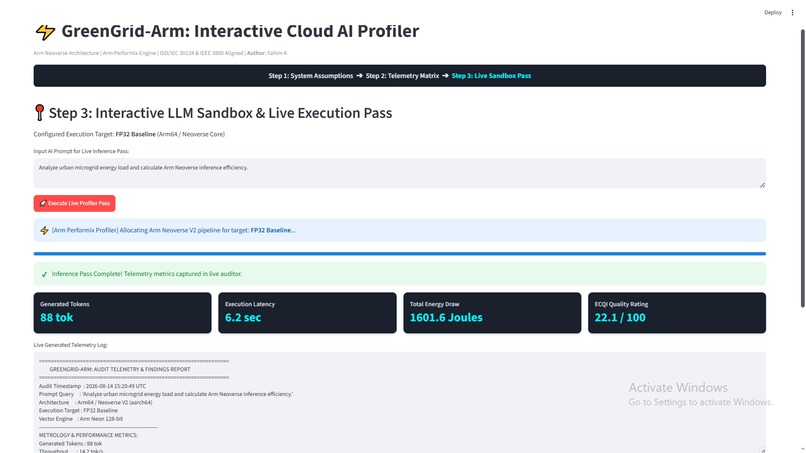
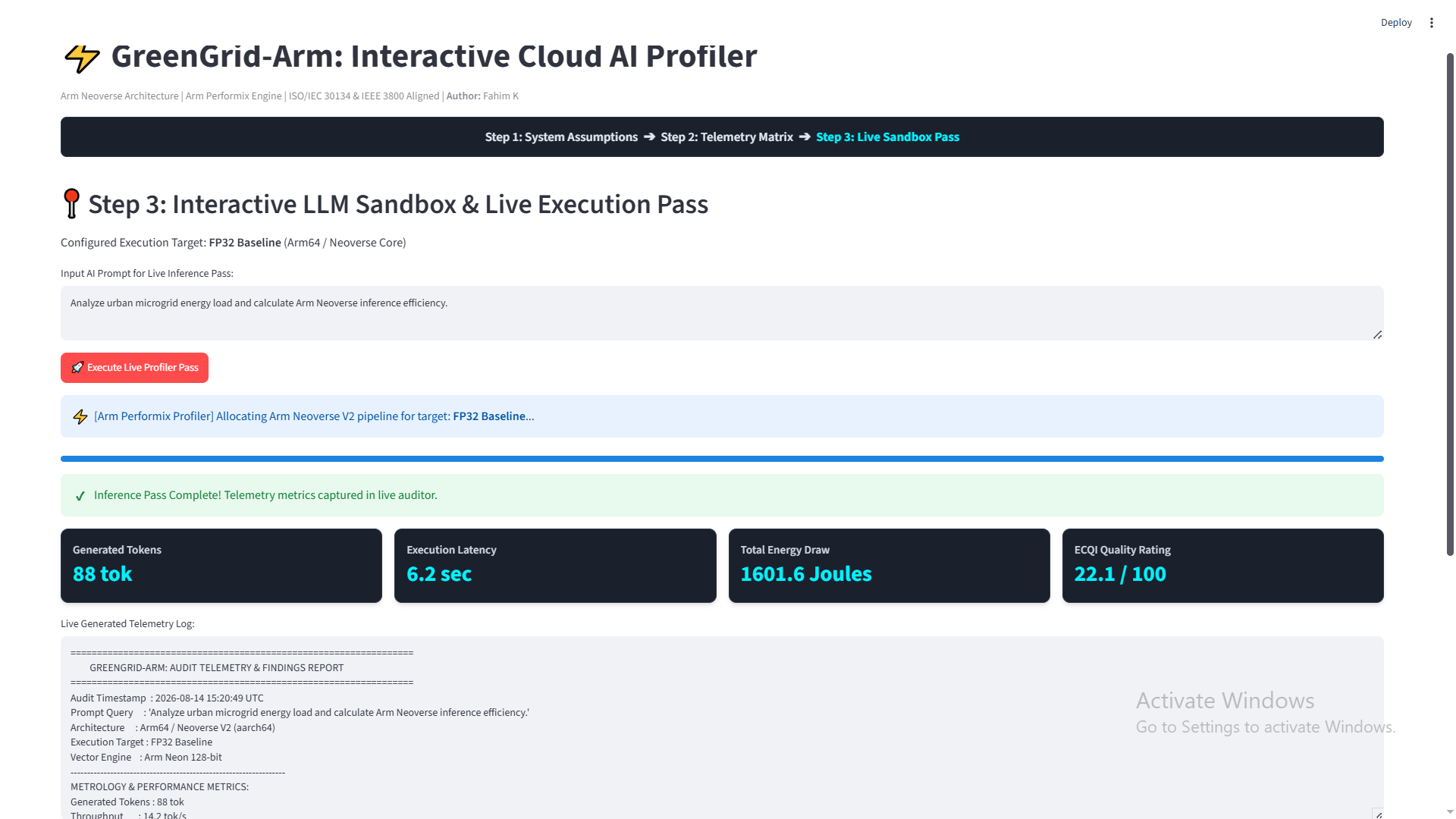
GreenGrid-Arm is an audit-grade spatiotemporal profiler and interactive 3-screen wizard:
- Instruction-Level Hardware Profiling: Captures low-level hardware performance counters (Instructions Per Cycle [IPC], Neon/SVE SIMD vector pipe saturation) across execution targets (FP32 Baseline, FP16 Neon Vectorized, and INT4 SVE Peak Vectorized).
- Token-Level Energy Metrology: Tracks active power draw in Watts during inference to derive exact token-level energy consumption in Joules/token (( \text{J/tok} )) and Time-to-First-Token (TTFT) latency.
- Power Grid Carbon Integration: Integrates regional power grid carbon intensity (( \text{gCO}_2/\text{kWh} )) to evaluate the environmental footprint of cloud compute.
- Energy & Compute Quality Index (ECQI): Synthesizes microarchitecture saturation, throughput, and carbon intensity into a unified 0–100 score.
- Differential Audit Analysis & Export: Features a comparative delta viewer and exports standardized audit payloads in IEEE 3800 JSON and ASCII text formats.
How we built it
- Application Framework: Built in Python using Streamlit with a clean, 3-screen guided wizard layout backed by
st.session_state. - Hardware & Energy Modeling: Modeled Arm Neoverse V2 pipeline dynamics, Neon 128-bit / SVE2 256-bit vectorization throughput, and token energy intensity.
- Interactive Data Visualization: Custom Plotly bar charts comparing inference throughput vs. vector pipe saturation and energy draw per token.
- Audit & Session Persistence: Implemented a session-state history buffer to execute head-to-head run comparisons and generate real-time deltas (( \Delta \text{Tokens} ), ( \Delta \text{Latency} ), ( \Delta \text{Joules} ), ( \Delta \text{ECQI} )).
Challenges we ran into
- Session State Synchronization: Preventing state resets during Streamlit re-runs when users clicked download buttons required careful session state persistence logic (
st.session_state.has_run_profiler). - Standards Mapping: Mapping proprietary composite metrics back to formal ISO/IEC and IEEE data center standards required careful mathematical formulation to ensure compatibility with ISO/IEC 30134 and ISO/IEC 21836 frameworks.
Accomplishments that we're proud of
- Standards Alignment: Successfully aligned the profiler with ISO/IEC 30134 (Data centre KPIs), ISO/IEC 21836 (Server active energy effectiveness), and IEEE 3800 (Data trading architecture).
- Machine-Readable Telemetry: Engineered one-click export buttons producing validated IEEE 3800 JSON payloads for green compute credit trading and ASCII findings reports for human auditors.
- Comparative Run Analysis: Built a dynamic differential analysis table that calculates real-time hardware performance deltas across multiple execution passes.
What we learned
- Deepened insight into Arm Neoverse scalable vector extensions (SVE2) and SIMD pipeline saturation dynamics.
- Learned how microarchitecture-level optimizations (moving from FP32 to INT4 SVE) directly translate into massive carbon displacement on high-emission power grids.
What's next for GreenGrid-Arm: Energy-Aware Cloud AI & Inference Profiler
- Hardware Integration: Connect directly with live hardware counters on AWS Graviton4 instances using Linux
perfand Arm Performix profiling hooks. - Positive Energy District (PED) Coupling: Expand the framework into urban microgrids to enable dynamic demand-side response and data center thermal reuse scheduling.

Log in or sign up for Devpost to join the conversation.