Inspiration
The growing urgency around climate change and the rising costs of electricity inspired us to build Greengrid.AI. We wanted to create an intelligent, user-friendly system that empowers homeowners to optimize their energy usage, generate savings, and contribute to sustainability. Leveraging AI and multi-agent systems felt like a powerful approach to bring automation and smart decision-making to everyday energy management.
What it does
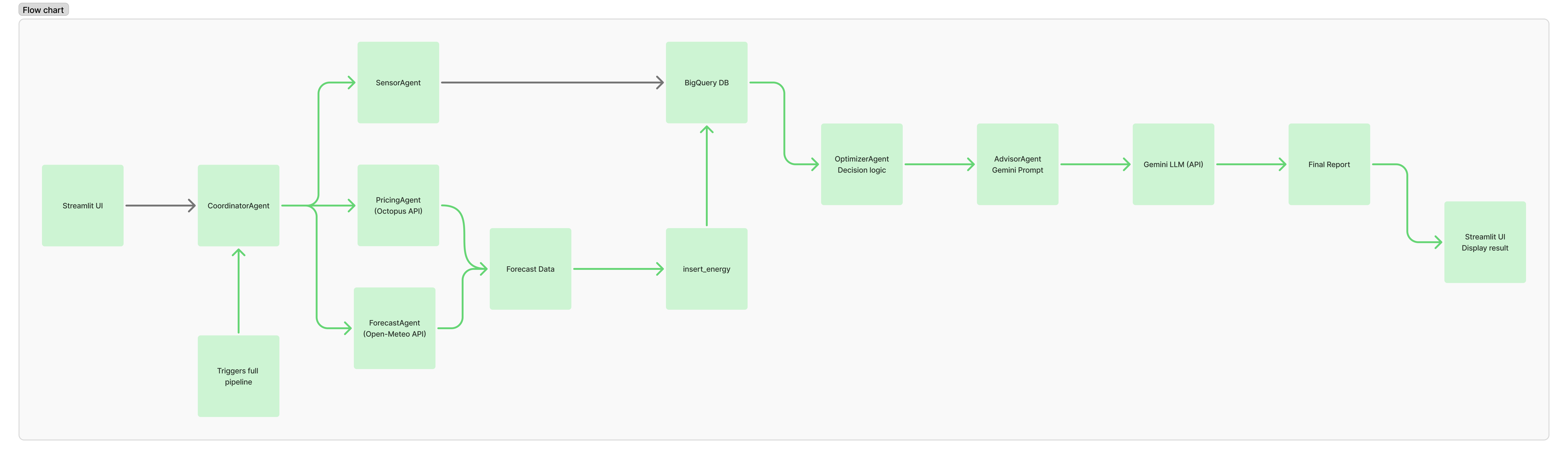
Greengrid.AI orchestrates a suite of specialized software agents that continuously monitor energy consumption and solar generation, forecast future energy needs and solar availability, fetch dynamic electricity pricing, and optimize battery storage actions. It then delivers clear, actionable recommendations to users via an interactive dashboard, helping them reduce costs and maximize renewable energy use seamlessly.
How we built it
I developed the system in Python, using the Agent Development Kit (ADK) to create modular, autonomous agents responsible for sensing, forecasting, pricing, optimizing, and advising. Real-time and historical data are stored in Google BigQuery, enabling scalable and efficient analytics. I integrated external APIs like Open-Meteo for weather forecasts and Octopus for electricity pricing. The user interface is a Streamlit dashboard, designed for intuitive interaction and visualization. I also incorporated Google’s Gemini LLM API to generate natural language reports from technical data.
Challenges we ran into
- Ensuring reliable and timely data capture, especially when simulating real-world energy usage scenarios.
- Coordinating asynchronous communication and workflow between multiple autonomous agents.
- Designing optimization algorithms that balance simplicity and effectiveness in real-time decision-making.
- Handling inconsistencies and rate limits in external APIs.
- Crafting prompts for the LLM to produce clear and contextually relevant user advice.
Accomplishments that we're proud of
- Successfully implemented a modular multi-agent architecture that orchestrates complex workflows.
- Seamless integration with cloud services, enabling scalable data storage and AI-powered reporting.
- Delivering a user-friendly dashboard that turns complex energy data into actionable insights.
- Utilizing a cutting-edge LLM to bridge the gap between technical outputs and user communication.
- Building a foundation for future expansion into advanced optimization and predictive analytics.
What we learned
- The power and complexity of multi-agent systems in managing distributed tasks.
- Best practices for working with cloud-native services like BigQuery and API integrations.
- The challenges and rewards of combining AI-driven decision-making with human-centered design.
- Effective prompt engineering techniques to leverage large language models.
- The importance of user experience in presenting technical data clearly and meaningfully.
What's next for GreenGrid.AI
- Expanding sensor integration to support a wider variety of energy sources and devices.
- Improving the dashboard with richer visualizations and customizable alerts.
- Exploring partnerships with energy providers to incorporate demand response programs and incentives.


Log in or sign up for Devpost to join the conversation.