-
-
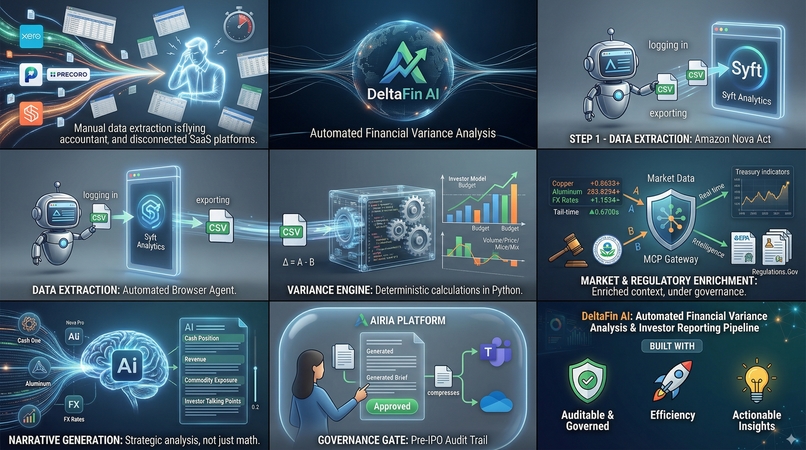
DeltaFin AI
DeltaFin AI: Automated Financial Variance Analysis
An AI-powered pipeline that extracts consolidated financial data, runs automated variance analysis against investor models, enriches with market and regulatory intelligence, and generates governance-audited investor briefs — built on Airia, Amazon Nova, and Amazon Bedrock.
Inspiration
Finance teams run on disconnected SaaS platforms — accounting in Xero, procurement in Precoro, reporting in Syft Analytics. Every month, someone manually exports reports, reconciles across entities, pulls commodity prices, compares actuals to the financial model investors underwrote, and stitches everything into a brief. It takes a full day.
The real pain isn't data extraction — it's variance analysis. Investors and boards don't just want numbers. They want to know: are we tracking to the model we raised on? Every monthly data point either builds or erodes confidence ahead of a listing.
We tried automating with APIs. Xero's OAuth was fragile. Precoro's coverage was limited. Syft had no meaningful programmatic access. The "modern data stack" approach — ETL pipelines, data warehouses, dbt, BI layers — was a multi-month infrastructure project for a lean finance team.
DeltaFin AI started from a simple question: What if an AI agent could extract consolidated financials, compare them against the investor model, flag material variances, layer in market and regulatory context, and generate a narrative brief — all within an enterprise-governed platform that provides the audit trail a pre-IPO company needs?
What It Does
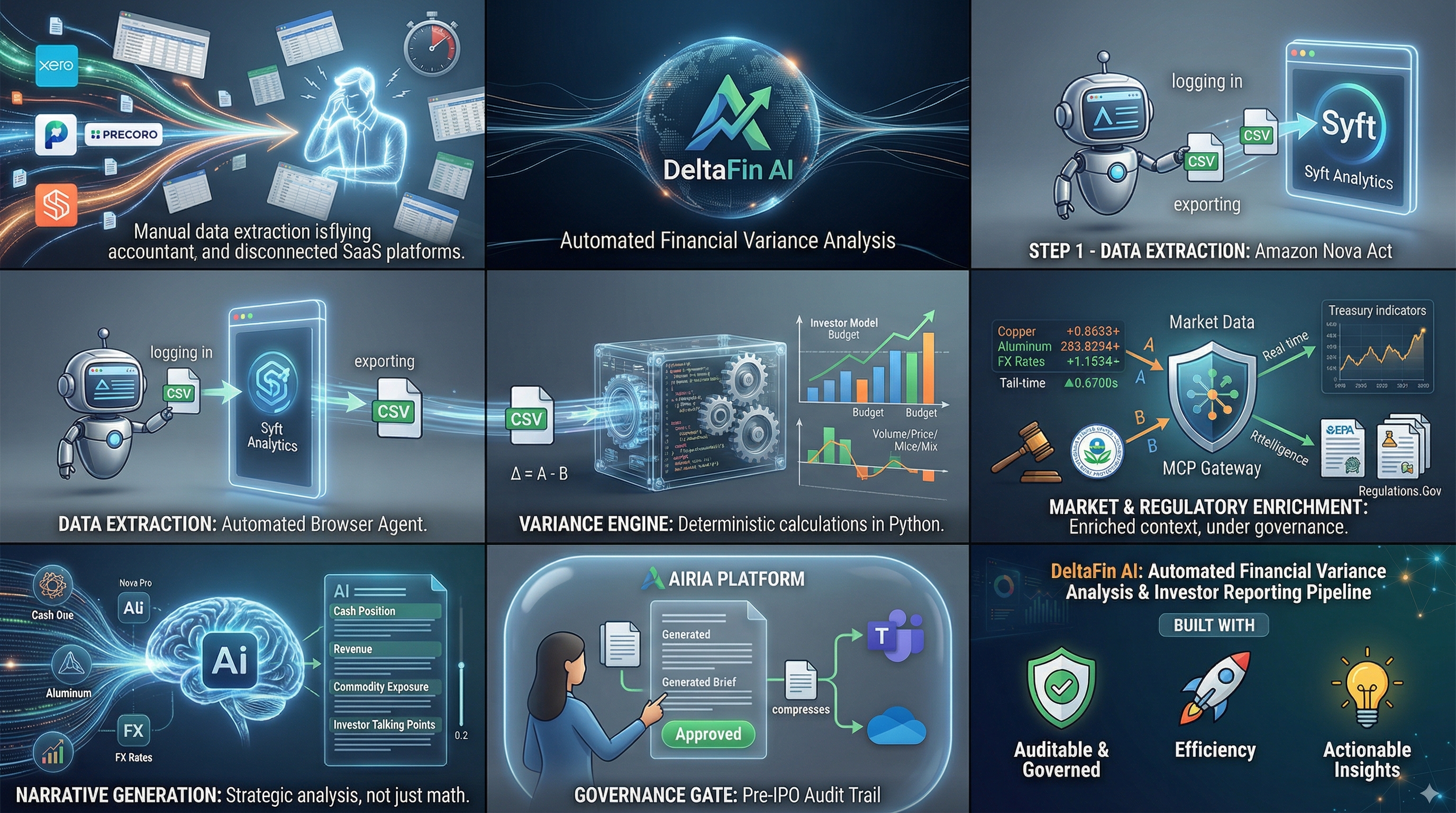
Stage 1 — Data Extraction (Amazon Nova Act)
A browser automation agent logs into Syft Analytics — the BI consolidation layer that aggregates data across legal entities — and exports consolidated P&L, balance sheet, and cash flow as CSVs. By targeting Syft instead of extracting from each upstream system separately, we collapse multiple extraction agents into one.
Stage 2 — Variance Engine (Python + Airia Workflow)
Extracted actuals flow into Airia's agent workflow where Python steps perform quantitative analysis:
- Normalize CSVs to a standard chart of accounts
- Match each actual line item against the corresponding budget from the financial model
- Calculate variances and flag items exceeding materiality thresholds:
$$\Delta_i = A_i - B_i, \quad \%\Delta_i = \frac{A_i - B_i}{|B_i|} \times 100$$
- Decompose revenue variance into volume, price, and mix:
$$\Delta_{\text{Rev}} = \underbrace{(V_a - V_b) \times P_b}{\text{Volume}} + \underbrace{(P_a - P_b) \times V_b}{\text{Price}} + \underbrace{(V_a - V_b)(P_a - P_b)}_{\text{Mix}}$$
- Compute updated runway using a 3-month rolling average burn rate:
$$\text{Months Remaining} = \frac{\text{Cash}{t}}{\overline{\text{Burn}}{3\text{mo}}}$$
Stage 3 — Market & Regulatory Enrichment (MCP Gateway)
Through Airia's governed MCP Gateway, two enrichment sources run in parallel:
- AlphaVantage MCP — live commodity prices (copper, aluminum, nickel, lithium), FX rates (USD/SGD, USD/AUD), macro indicators (Fed Funds Rate, CPI, Treasury yields), and equity data for listed peer companies. All market data flows through Airia's audit layer rather than raw API calls.
- Regulations.Gov MCP — pulls active federal rulemaking, proposed rules, and public comment periods relevant to the company's sector. For industries like battery recycling and critical minerals, this surfaces regulatory developments — EPA compliance requirements, DOE funding opportunities, defense procurement rules — that directly impact financial projections and risk disclosures.
Stage 4 — Narrative Generation (Amazon Nova Pro via Bedrock)
All structured data feeds into Nova Pro through Airia's Bedrock integration, generating a six-section monthly brief:
- Cash Position & Runway — actual burn vs. modeled, updated months-of-runway
- Revenue & Collections — actual vs. projected with volume/price/mix decomposition
- Cost Variance Analysis — material variances flagged with root cause interpretation
- Commodity & Macro Exposure — how price movements affect unit economics
- Regulatory Watch — new or pending regulations that could impact projections or risk profile
- Investor Talking Points — CEO-ready narrative plus "questions investors will ask"
Stage 5 — Governance Gate + Delivery (Airia MCP Gateway)
The brief hits a human approval gate — investor-facing materials should never be fully autonomous. Upon approval, Airia's MCP Gateway delivers to Microsoft Teams and uploads to OneDrive for the board and investor syndicate.
How We Built It
Architecture
┌──────────────────┐     ┌──────────────────────────────────────────┐
│  Amazon Nova Act  │     │            AIRIA PLATFORM                 │
│                   │ CSV │                                          │
│  Browser Agent   ─┼────▶│  Agent Workflow:                         │
│  • Login to Syft  │     │  1. Ingest CSVs                         │
│  • Export reports  │     │  2. Python → Normalize + Variance Calcs │
│                   │     │  3. MCP → AlphaVantage (market data)    │
│  (EventBridge     │     │  4. MCP → Regulations.Gov (regulatory)  │
│   scheduled)      │     │  5. Nova Pro → Narrative Generation      │
└──────────────────┘     │  6. Human Approval Gate                  │
                          │  7. MCP → Teams + OneDrive               │
                          │                                          │
                          │  All MCP calls governed: audit trail,    │
                          │  policy enforcement, cost monitoring     │
                          └──────────────────────────────────────────┘
Model Selection
| Model | Role | Why |
|---|---|---|
| Nova Pro | Variance interpretation + narrative | 300K context, strong financial document analysis |
| Nova Micro | CSV classification + validation | Lowest latency, minimal cost for lightweight tasks |
| Nova Act | Syft browser extraction | Reliable UI automation where APIs don't exist |
Core design principle: all quantitative calculations happen in Python; Nova Pro only interprets and narrates. We never ask an LLM to be our calculator.
Why Airia
- Audit trail. Every model call, MCP request, and data input is logged — critical when listing brokers ask "how was this brief generated?"
- Human-in-the-loop as a workflow primitive. The approval gate is a native step with full audit logging, not a bolt-on.
- Governed MCP Gateway. AlphaVantage, Regulations.Gov, Microsoft Teams, and OneDrive all flow through a single secure gateway with credential management, access controls, and complete audit logging of every tool call.
Challenges We Faced
The consolidation problem. Our original design called for parallel Nova Act agents extracting from Xero, Precoro, and Syft simultaneously. We realized Syft had already solved the consolidation problem. Collapsing to a single extraction point eliminated two-thirds of the complexity.
Financial model as a living reference. The investor model isn't static — it's refined continuously pre-listing. We treat it as a versioned data source with change detection, and each report stamps the model version it ran against.
Prompt engineering for financial precision. Early Nova Pro attempts produced generic commentary. The breakthrough was feeding pre-computed variance data and asking Nova Pro to interpret and contextualize rather than calculate. Temperature at 0.2, with explicit instructions to flag any metric it cannot derive rather than estimate.
Regulatory signal vs. noise. Regulations.Gov returns a high volume of filings. Filtering to material regulatory developments — those that could actually impact financial projections or risk disclosures — required careful prompt engineering in the enrichment step. We scope queries to specific docket categories and use Nova Micro to pre-classify relevance before passing results to Nova Pro for narrative integration.
Governance vs. speed. The human approval gate adds hours to what could be fully automated. But for a pre-listing company, ungoverned AI-generated investor materials are a liability. We optimized for trust over speed.
What We Learned
Browser automation is the last-mile for enterprise finance. Most finance tools don't have clean APIs. Nova Act's browser-first approach bypasses this entirely — if a human can do it in a browser, an agent can too.
Atomic commands beat high-level prompts. Broad instructions like "export the P&L" were unreliable. Precise atomic steps improved success rates dramatically. Nova Act rewards specificity.
Separate calculation from narration. All math runs deterministically in Python before the LLM sees anything. LLMs are unreliable calculators but excellent analysts when given pre-computed data with context.
MCP as the governed data backbone. Routing all external data — market prices, regulatory filings, delivery channels — through Airia's MCP Gateway means every data source gets the same audit treatment. This is architecturally cleaner than mixing raw API calls with governed workflows, and it means adding a new data source is a configuration change, not a code change.
Governance is a feature, not overhead. For pre-IPO companies, a governed, auditable AI pipeline is a competitive advantage — not a limitation.
What's Next
- Scheduled monthly execution via EventBridge with briefs queued for approval before board meetings
- Interactive MCP Apps dashboard rendering variance analysis as a filterable interface within Airia
- Expanded templates for board decks, due diligence responses, and use-of-funds tracking
- Procurement Guardian agent monitoring purchase orders for budget compliance and price anomalies
- Regulatory alert agent that triggers on high-impact Regulations.Gov filings between monthly cycles, pushing real-time alerts to Teams
- Post-IPO adaptation to continuous disclosure — the pre-IPO governance trail becomes the listed entity's compliance backbone
Built With
airia · amazon-nova-pro · amazon-nova-micro · amazon-nova-act · amazon-bedrock · python · alphavantage-mcp · regulations-gov-mcp · mcp · aws-eventbridge · microsoft-teams · onedrive
DeltaFin AI was built for the Amazon Nova hackathon to solve a real finance automation problem — automated variance analysis for pre-IPO companies running on disconnected SaaS finance platforms.
Built With
- alphavantage
- nova
- regulations.gov

Log in or sign up for Devpost to join the conversation.