Inspiration
Jane Street workers usually travel by car, and we wanted to think about what it would take to change that. Our answer was to stop lecturing people about the planet and make the sustainable choice the easiest and most rewarding one. We wanted a program that shows employees what they personally gain from changing how they commute and makes them work towards a common goal. If all 16 workers followed their recommendation, we'd save about 47 kg of CO2 a day, roughly 10 tonnes a year over 220 working days. Next we'd add real login, verified carpools and a web or mobile interface.
What it does
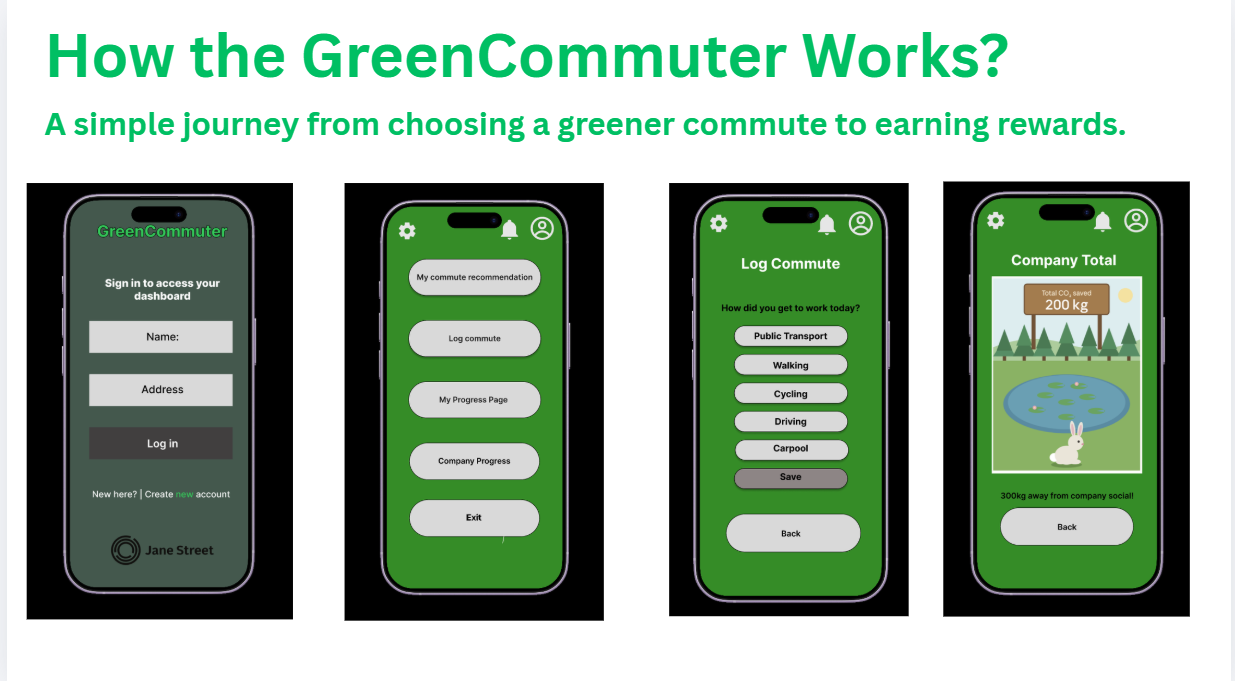
GreenCommuter makes the greener choice the easy one, and the fun one too. Tell it where you live and it picks your best route in: walk, cycle, bus or carpool with a colleague down the road. It shows exactly how much CO2 you'd save compared with driving alone. Every green commute earns points, and points unlock real rewards: a free coffee, a free lunch, even half a day off. Carpool two days running and you earn double. Then it goes further. Your savings feed into one shared company total, and every kilogram of CO2 grows a forest around our bunny mascot. Hit the company goal and the whole office gets a celebration lunch. For the employee, the benefits are cheaper commutes, fitter mornings and actual perks. For the company, it's a measurable cut in emissions and a team that's in it together.
How we built it
GreenCommuter is a Python desktop app with a tkinter interface: a login screen, then tabs for your recommendation, logging a commute, your personal progress and the company-wide page.
Data: three CSV files hold the areas (distance to the office, nearest stop and how far it is), the workers, and every logged commute. Logic: a simple rule chain picks the greenest realistic option. It suggests walking up to 2 km, cycling up to 5 km, public transport if a stop is within 500 m, then carpooling with colleagues from the same area, and driving alone only as a last resort. CO2 maths: we compare each mode against driving alone using per-kilometre emission factors for cars and public transport. Carpool savings scale with how many people share the car, up to four. Gamification: 10 points per kg of CO2 saved, double points for back-to-back carpools, three reward tiers for individuals and a shared company goal with progress bars.
Challenges we ran into
Making the recommendation fair and realistic. A bus is useless if the nearest stop is a long walk away, so we had to combine distance and stop proximity, and fall back to carpooling when there's a colleague nearby.
Working out the carpool CO2 saving. Savings depend on how many colleagues share the car, so the maths had to adapt as more people join an area.
Balancing the points. We wanted walking and cycling to feel rewarding without making the rewards too easy to unlock.
Turning a console program into a proper app. Moving every input and output into a tkinter interface whilst keeping the underlying logic needed to be careful.
Accomplishments that we're proud of
A high developed user interface and working back end of code using tkinter. A reward system that gives employees a clear personal payoff as well as an environmental one. Building it together as a team.
What we learned
Communication and delegating tasks when working with such an open-ended project. Narrowing down all our ideas and making sure they aligned into one thing that is coherent amongst us all. Showing people their own numbers, such as kg of CO2 saved and points earned motivates people. Small design choices, like the double-points carpool bonus, can shift social behaviour. Simpler, clean data structures and clear rules make a project much easier to build and delegate as a team in such a short amount of time.
What's next for GreenCommuter
Real transport data: use live bus information, extending to global offices in New York, Hong Kong etc. Weather-aware suggestions to recommend cycling on dry days and a bus or carpool when it's wet. Leaderboards and team challenges between departments.
Built With
- figma
- python
- tkinter
