-
-
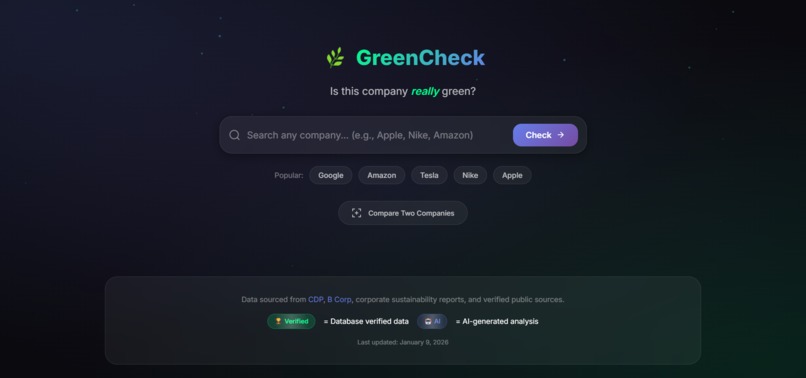
Homepage
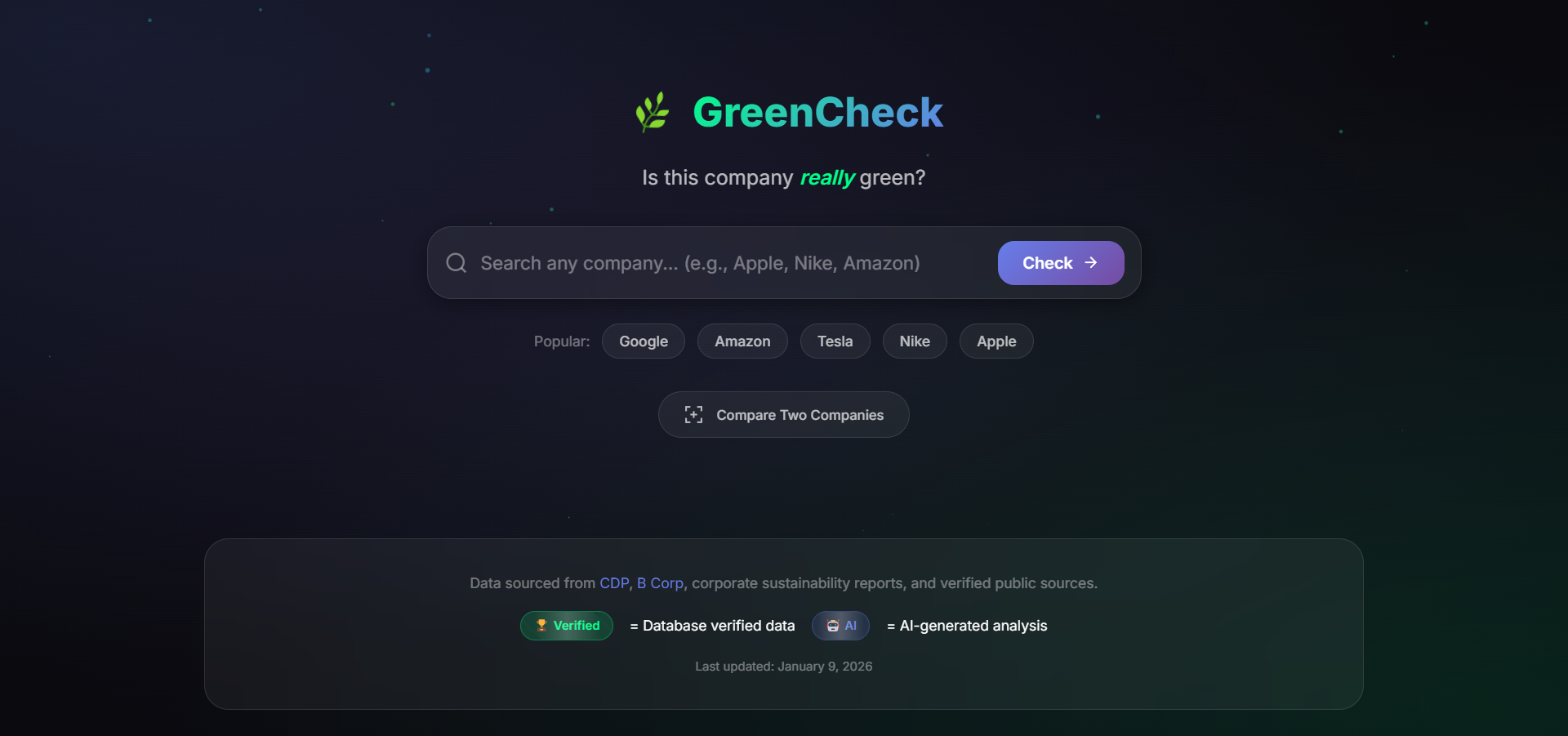
Inspiration
I started thinking about this project after realizing something frustrating: almost everyone I know wants to buy from sustainable companies, but nobody actually knows which companies are truly green and which are just pretending. The statistics say 75% of consumers prefer sustainable brands, yet greenwashing is everywhere. Companies throw around words like "eco-friendly" and "carbon neutral" without any accountability. I wanted to build something that cuts through the noise. A simple tool where you type a company name and immediately see if they're actually walking the talk or just marketing.
What it does
GreenCheck gives you a sustainability score for any company in seconds. You search for a brand, and you get a clear rating from 0 to 100 based on real data, not marketing claims. The app breaks down each company across five categories: emissions, renewable energy use, transparency in reporting, labor conditions, and recycling practices. For each category, you can see specific positive actions the company has taken and areas where they're falling short. Everything links back to official sources so you can verify it yourself. There's also a compare feature where you can put two companies side by side. This is really useful when you're deciding between brands. And for companies that aren't in the database yet, the app uses AI to analyze publicly available information and generate a report on the spot.
How we built it
I built GreenCheck using a modern AI-assisted development workflow. My IDE of choice was Antigravity, a multi-agentic coding environment that integrates with various AI models. I worked primarily with Claude Opus 4.5(thinking), using it as a collaborative partner throughout the development process. I would describe what I wanted to build, and the AI would write the code while I directed the overall architecture and made design decisions. This approach let me focus on the product vision and user experience rather than getting stuck on implementation details. The AI handled the vanilla HTML, CSS, and JavaScript while I made sure everything aligned with my goals for the project. The tech stack is intentionally simple with no frameworks or build tools. This means the app loads instantly and works everywhere without any dependencies. The design uses a dark theme with glassmorphism effects to make the data visually appealing. I spent time iterating on the interface to make sure it doesn't feel overwhelming even though there's a lot of information to display. Building the database was the most time-intensive part. I researched sustainability reports, CDP disclosures, B Corp certifications, and news articles for over a hundred companies. Every data point had to be verified from an official source. For the AI fallback feature, I integrated Groq to handle companies that aren't in the main database. The hosting is on GitHub Pages, which keeps everything free and fast.
Challenges we ran into
The biggest challenge was data quality. Sustainability reporting isn't standardized at all. Some companies publish detailed carbon footprints while others just have vague statements about "commitment to the environment." Trying to score them fairly on the same scale was tricky. Another issue was keeping the AI grounded. When generating reports for unknown companies, AI models tend to make things up if they don't have enough information. I had to carefully design the prompts to make sure the output stays factual and includes appropriate caveats. Balancing design and information density was also harder than expected. Too much data makes the interface confusing, but too little defeats the purpose. Finding that middle ground took several iterations.
Accomplishments that we're proud of
The thing I'm most proud of is that this actually works and feels polished. It's not a half-finished prototype with placeholder content. There are over a hundred verified companies in the database, each with real sourced data. The UI came out better than I expected. It looks modern and premium without being distracting from the actual content. The compare feature is particularly satisfying to use because it makes the difference between companies so visual and obvious. I'm also proud that the entire app has zero dependencies. No npm install, no webpack, no build step. You just open the HTML file and it works. That simplicity made development faster and the final product more reliable.
What we learned
Working on this project taught me how messy the sustainability space really is. There's no single source of truth, and companies have a lot of freedom in how they present their environmental impact. This is exactly why a tool like GreenCheck is needed. I realized that presentation matters a lot when dealing with complex data. People won't engage with sustainability information if it feels like homework. Making it visually interesting is just as important as making it accurate.
What's next for GreenCheck
The immediate next step would be a browser extension. Imagine seeing a sustainability score pop up automatically when you're shopping online. That would be much more useful than having to search manually. I'd also like to add barcode scanning so you can check products in physical stores. This would require building a mobile app, The ultimate goal is to make checking sustainability as normal as checking reviews. If enough people start making informed choices, companies will have to actually improve instead of just improving their marketing.
Built With
- antigravity
- claude
- css3
- groq
- html5
- javascript

Log in or sign up for Devpost to join the conversation.