-
-
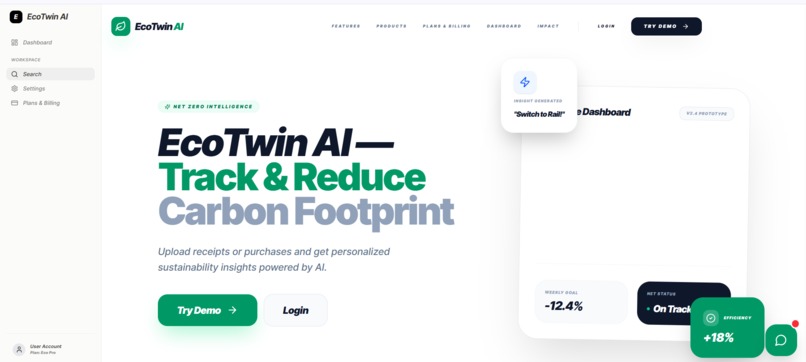
Home Page
-
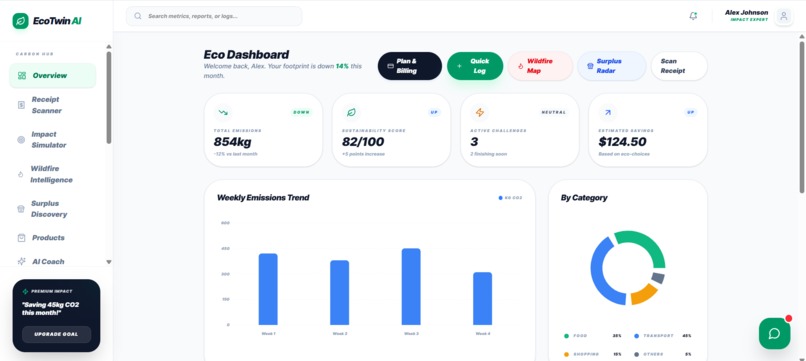
Demo page
-
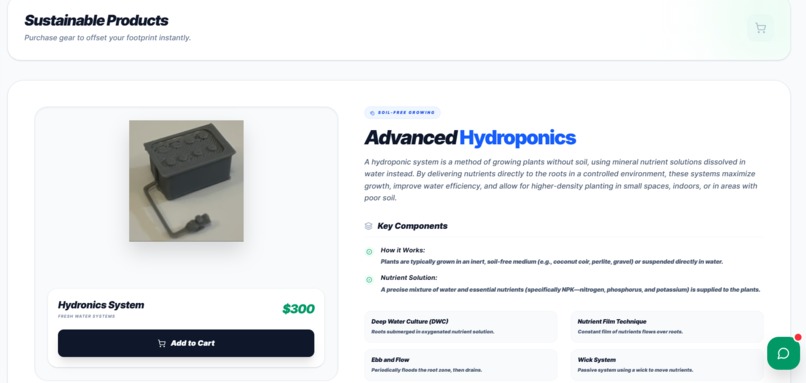
Products
-
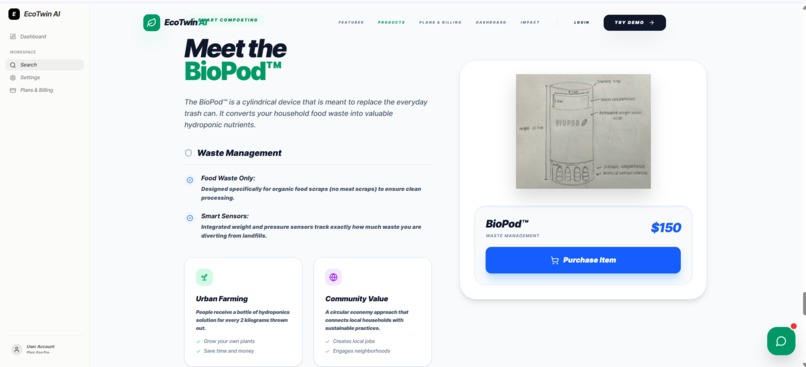
Products


Inspiration
Climate change is one of the most urgent challenges facing our world today. Many people want to live more sustainably, but it is often difficult to understand how everyday decisions affect the environment.
From buying groceries to ordering products online, daily activities contribute to a person's carbon footprint. However, most individuals do not have tools that clearly show the environmental impact of these choices.
If people could easily see the environmental impact of their actions, they would be more empowered to make sustainable decisions.
This inspired us to build EcoTwin AI, a platform that uses artificial intelligence to transform everyday purchase data into meaningful sustainability insights.
Our goal was to create a personal sustainability assistant that helps people understand their environmental impact and make smarter choices for the planet
What it does
EcoTwin AI analyzes everyday purchases and translates them into environmental insights.
Users can upload receipts or purchase data, and the system uses AI to identify items and categorize them into environmental impact groups. The system then estimates the carbon emissions associated with those purchases and visualizes the results through an interactive dashboard.
Key Features:
- AI Receipt Analysis – extracts and categorizes items from receipts -Carbon Impact Dashboard – visualizes emissions by category and time -AI Sustainability Chatbox – provides personalized sustainability advice -Impact Simulator – predicts how lifestyle changes could reduce emissions -Environmental Digital Twin – models a user’s environmental behavior
Example Chatbox Interaction User: How can I reduce my carbon footprint this month? AI Assistant: Switching to public transportation twice per week could reduce your emissions by approximately 32kg CO₂. The AI chatbox makes sustainability insights conversational and easy to understand.
How we built it
EcoTwin AI combines modern AI technologies, agent-based systems, and environmental datasets.
AI Models We integrated: -OpenAI API -Google Gemini API
These models help: -interpret purchase data -categorize products into environmental groups -estimate carbon emissions -generate sustainability recommendations -power the AI chatbox assistant
Using multiple AI models improves reliability and produces richer insights.
Agent Architecture with Railtracks
To coordinate complex AI workflows, we used the Railtracks agent framework.
Different agents handle different tasks: -Data Analysis Agent – processes purchase data -Carbon Impact Agent – estimates emissions -Recommendation Agent – generates sustainability suggestions -Chat Interaction Agent – powers the AI assistant This modular architecture allows agents to collaborate and solve sustainability analysis tasks more efficiently.
Google AI Studio
We used generative media tools to assist with creating dashboards and visualizations.
These tools help generate: -carbon impact charts -sustainability dashboards -visual data summaries This makes complex environmental data easier for users to understand.
Advanced Hydroponics Integration
EcoTwin AI introduces a conceptual Advanced Hydroponics System designed to connect sustainable lifestyle choices with future food production technologies. Hydroponics is a method of growing plants without soil by using nutrient-rich water solutions. Compared to traditional agriculture, hydroponic systems can significantly reduce water usage, land requirements, and transportation emissions. Our concept integrates sustainability insights with hydroponic food systems by helping users understand how their dietary choices influence environmental impact.
For example: If a user replaces meat-based meals twice per week with plant-based foods grown through hydroponic systems, their overall carbon footprint can decrease due to lower agricultural emissions and more efficient food production.
EcoTwin AI models these potential changes through its sustainability analysis tools, allowing users to explore how sustainable food systems like hydroponics could reduce environmental impact. In the future, the platform could integrate with smart home hydroponic systems, helping individuals track the environmental benefits of locally grown produce and encouraging more sustainable food habits.
BioPod Environmental Simulation
We also introduced the concept of BioPods. BioPods are hypothetical environmental modules that simulate how individual behavioral changes can scale across communities and ecosystems. If thousands of users adopt AI-recommended habits, BioPod simulations can estimate how those changes may reduce global emissions.
Antigravity Optimization
EcoTwin AI also explores Antigravity-inspired optimization techniques. Environmental decisions often involve competing factors:
- cost
- convenience
- environmental impact
Antigravity optimization helps the system evaluate these variables simultaneously and generate recommendations that balance sustainability and practicality.
Data Sources
EcoTwin AI uses publicly available environmental datasets, including:
- EPA Greenhouse Gas Emissions Data
- Environmental research on food production emissions
- Consumer goods sustainability datasets
- Transportation emission studies
These sources allow the system to map everyday purchases to estimated environmental impact.
Challenges we ran into
One major challenge was translating complex environmental datasets into insights that everyday users can understand.
Carbon emission data varies widely between industries and products, making it difficult to map everyday purchases to specific environmental impact values.
Another challenge was designing an interface that communicates environmental impact clearly without overwhelming users with technical information.
We solved this by focusing on: -simple visual dashboards -conversational AI explanations -intuitive data visualizations
Integrating multiple AI systems into a coordinated agent-based architecture also required careful system design.
Accomplishments that we're proud of
We are proud of building a system that combines multiple advanced technologies into a unified sustainability platform.
Our key accomplishments include:
- Creating an AI-powered carbon footprint tracking system
- Building an interactive sustainability dashboard
- Developing a conversational AI sustainability assistant
- Implementing an agent-based architecture using Railtracks
- Designing the Environmental Digital Twin Hypothetic System
- Introducing the BioPod environmental simulation concept
- Exploring Antigravity-inspired sustainability optimization
These components demonstrate how AI can be applied to real-world environmental challenges.
What we learned
Through this project we learned how artificial intelligence can be used to address complex sustainability problems.
We gained experience working with:
- large language models
- environmental datasets
- agent-based AI architectures
- generative visualization tools
We also learned that clear communication and user experience design are essential when presenting complex data. Even small improvements in everyday decisions can create meaningful environmental impact when scaled across large communities.
What's next for EcoTwin AI
EcoTwin AI is just the beginning of what a personal sustainability platform could become.
Future improvements could include:
- real-time purchase tracking through financial integrations
- more accurate carbon footprint datasets
- mobile applications for easier daily use
- expanded environmental simulations
- AI-powered sustainability planning tools
Our long-term vision is to build a global network of environmental digital twins that help millions of people understand and reduce their environmental impact.
EcoTwin AI demonstrates how artificial intelligence can empower individuals to make smarter decisions and contribute to a more sustainable future.
Built With
- fastapi
- gemini
- generative-media
- google-cloud
- javascript
- openai
- pandas
- plotly
- postgresql
- python
- railtracks
- react.js

Log in or sign up for Devpost to join the conversation.