-
-

GreenStudio AI: Turning every AI conversation into measurable environmental impact
-

Inspiration
The inspiration for GreenStudio AI came from Priya, who is currently working on CO₂ tracking for airplanes. While learning how emissions are measured and optimized in aviation, it sparked an important question:
If we can transparently track environmental impact in physical systems, why not do the same for AI systems?
At the same time, concerns around the water usage of large language models (LLMs) and data-center cooling have grown significantly in recent discussions. This combination led us to explore how AI interactions themselves could become more transparent and sustainable.
What it does
GreenStudio AI is an eco-aware AI interface that:
Generates concise, useful AI responses
Tracks token usage per interaction
Estimates energy, water, and CO₂ savings
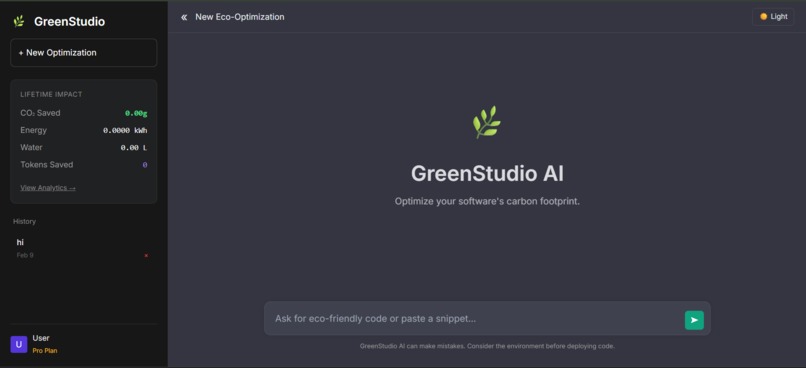
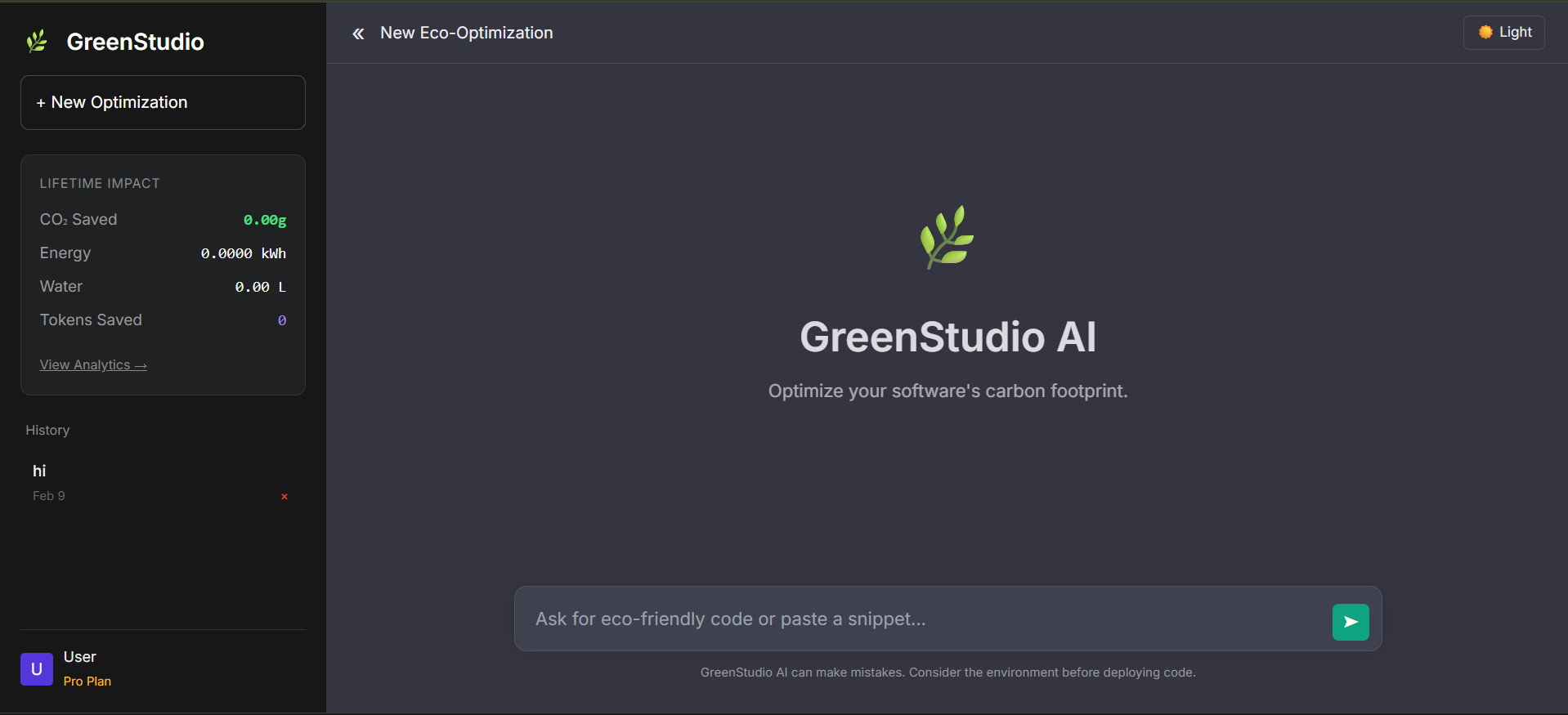
Displays real-time sustainability metrics in a clean dashboard
Each assistant response includes a small Eco Impact Summary, helping users understand the environmental cost of their query.
How we built it:
GreenStudio AI was built using a frontend–backend architecture:
- Backend
Integrated the Gemini API for AI responses
Designed a lightweight Express server to proxy requests securely
Estimated environmental impact using token-based heuristics:
Tokens ≈ Characters/4
Energy (kWh) = Tokens × 5 × 10^−5
Water (L) = Tokens × 0.002
CO₂ (g)=Tokens × 0.001
These estimates allow real-time feedback without expensive monitoring tools.
- Frontend
Built with React + TypeScript
Created a dashboard UI showing:
Carbon Offset
Tokens Saved
Energy Saved
Water Footprint
Implemented:
Collapsible Eco Impact Reports
Per-message sustainability stats
Dark mode
Clean, minimal chat layout inspired by modern AI tools
Challenges we ran into:
API instability and model availability: Gemini models frequently returned 404/503 errors, requiring careful fallback handling.
Environment configuration issues: Managing API keys and runtime differences (Node v22, ESM vs CJS) caused repeated debugging.
Balancing accuracy vs simplicity: Environmental metrics are estimates, so we had to avoid false precision while still being informative.
UI complexity creep: Keeping the interface clean while adding sustainability data required multiple redesigns.
Accomplishments that we're proud of :
A working AI system that makes environmental impact visible
A clean, modern dashboard that updates in real time
Successfully integrating sustainability metrics into everyday AI use
Turning a conceptual concern into a functional product
What we learned :
Sustainability isn’t just about hardware — software decisions matter
Even small UX changes can encourage more efficient AI usage
Clear visualization helps users understand abstract concepts like energy and water usage
Building with constraints leads to better design
What's next for Green Studio AI:
More accurate, region-aware environmental models
Comparison between standard AI vs eco-optimized AI
Organizational dashboards for enterprise AI usage
Carbon offset integrations and sustainability reports
Open-source toolkit for eco-aware AI development
Built With
- api
- css3
- express.js
- gemini
- git
- github
- googleaistudio
- html5
- node.js
- react
- typescript
- vite
- vscode


Log in or sign up for Devpost to join the conversation.