-
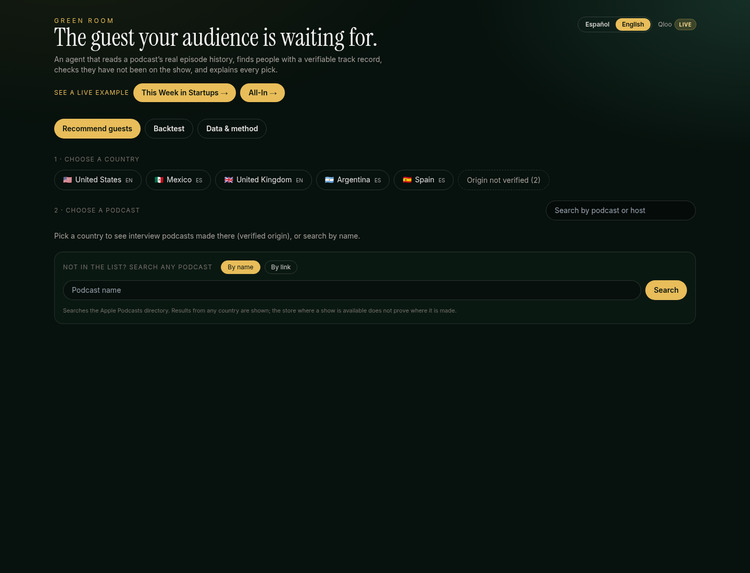
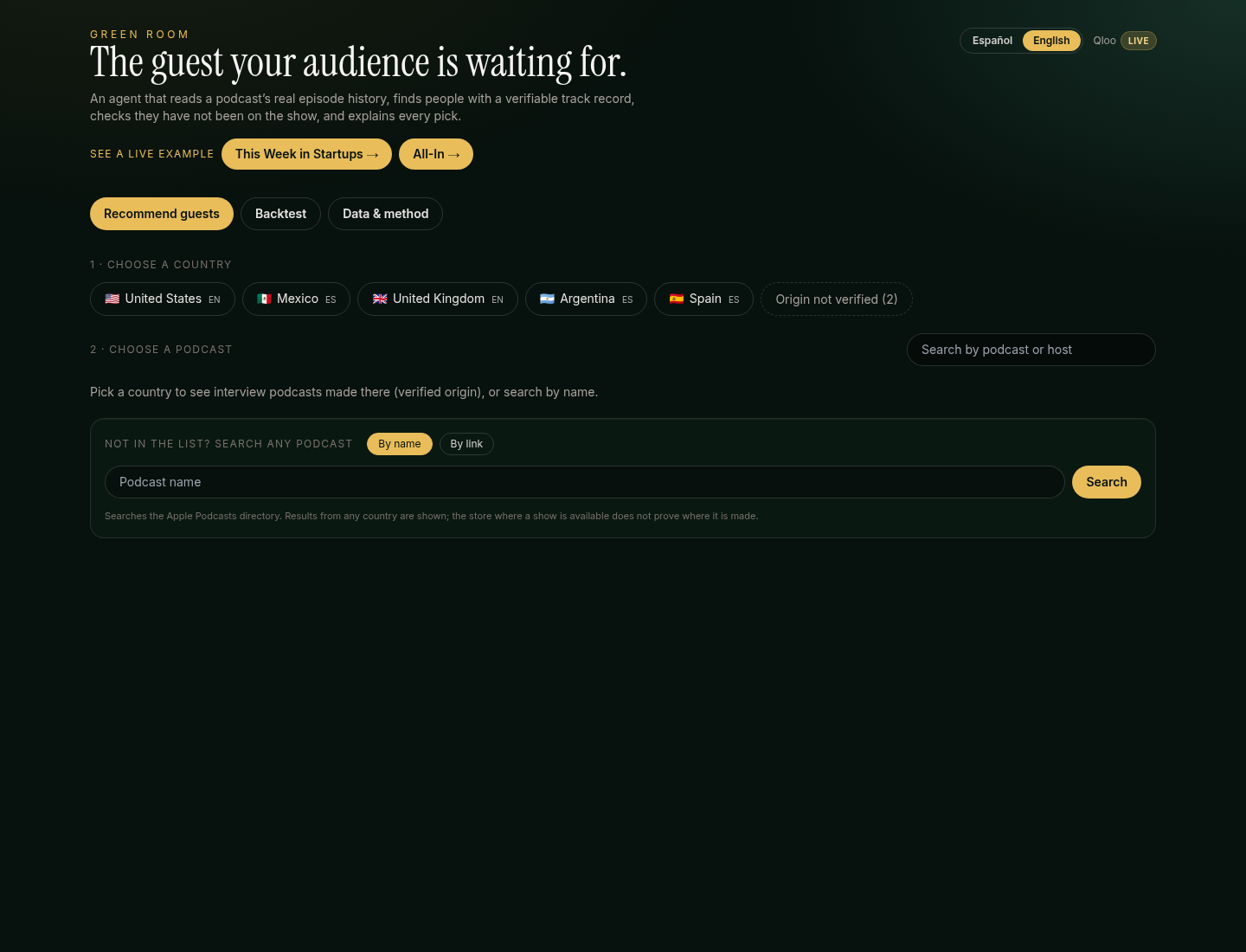
Home: pick a country and a podcast, or press a live example.
-
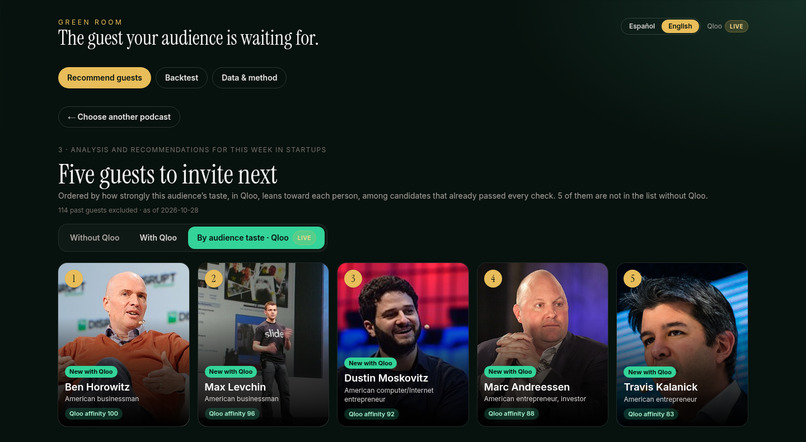
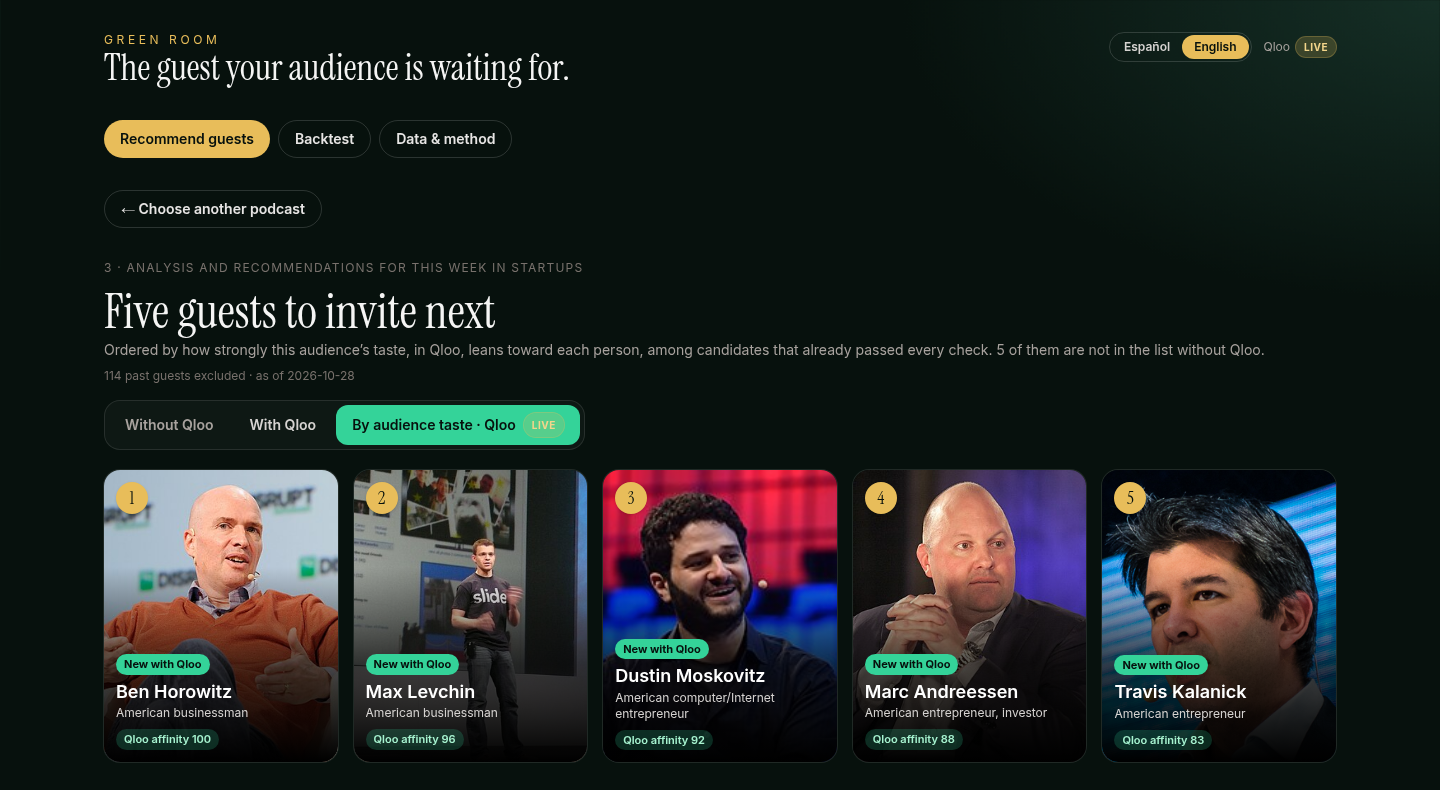
This Week in Startups: five portraits in Qloo’s taste order, each with its Qloo affinity.
-
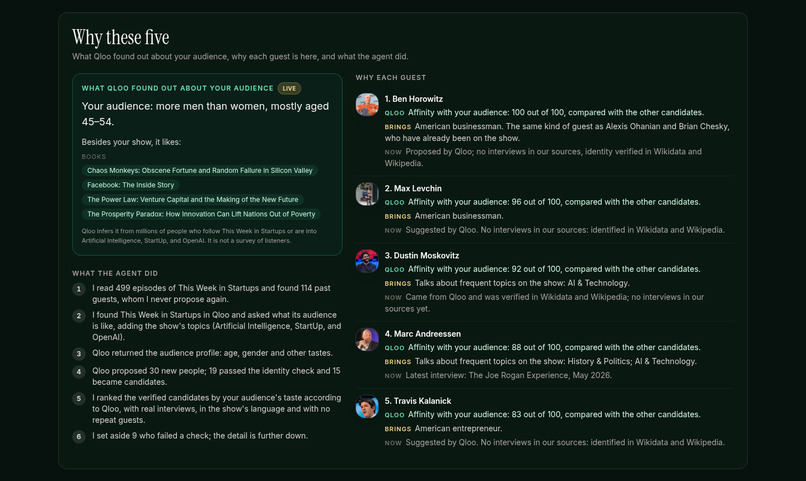
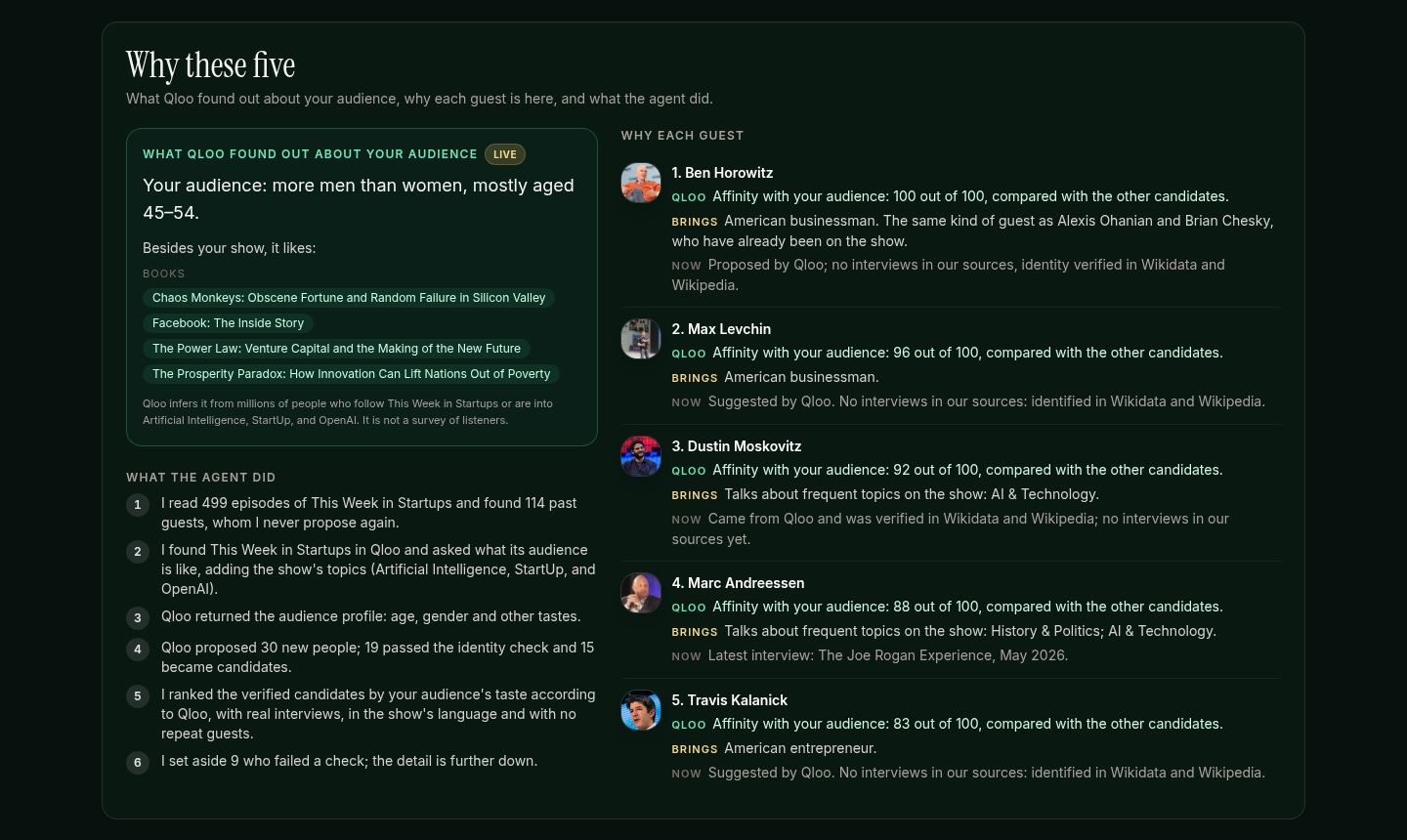
“Why these five”: what Qloo found out about the audience, why each guest, what the agent did.
-
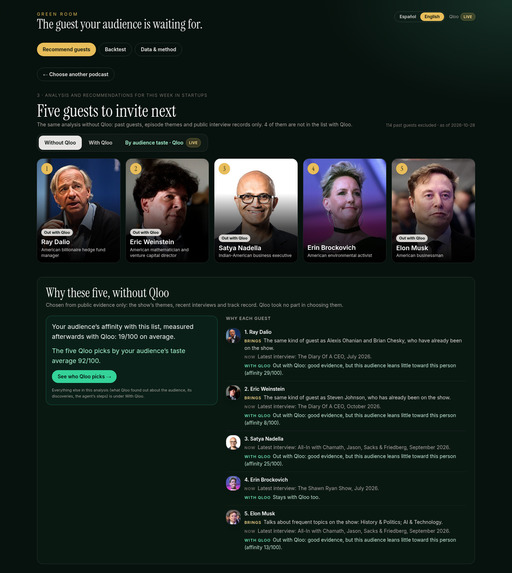
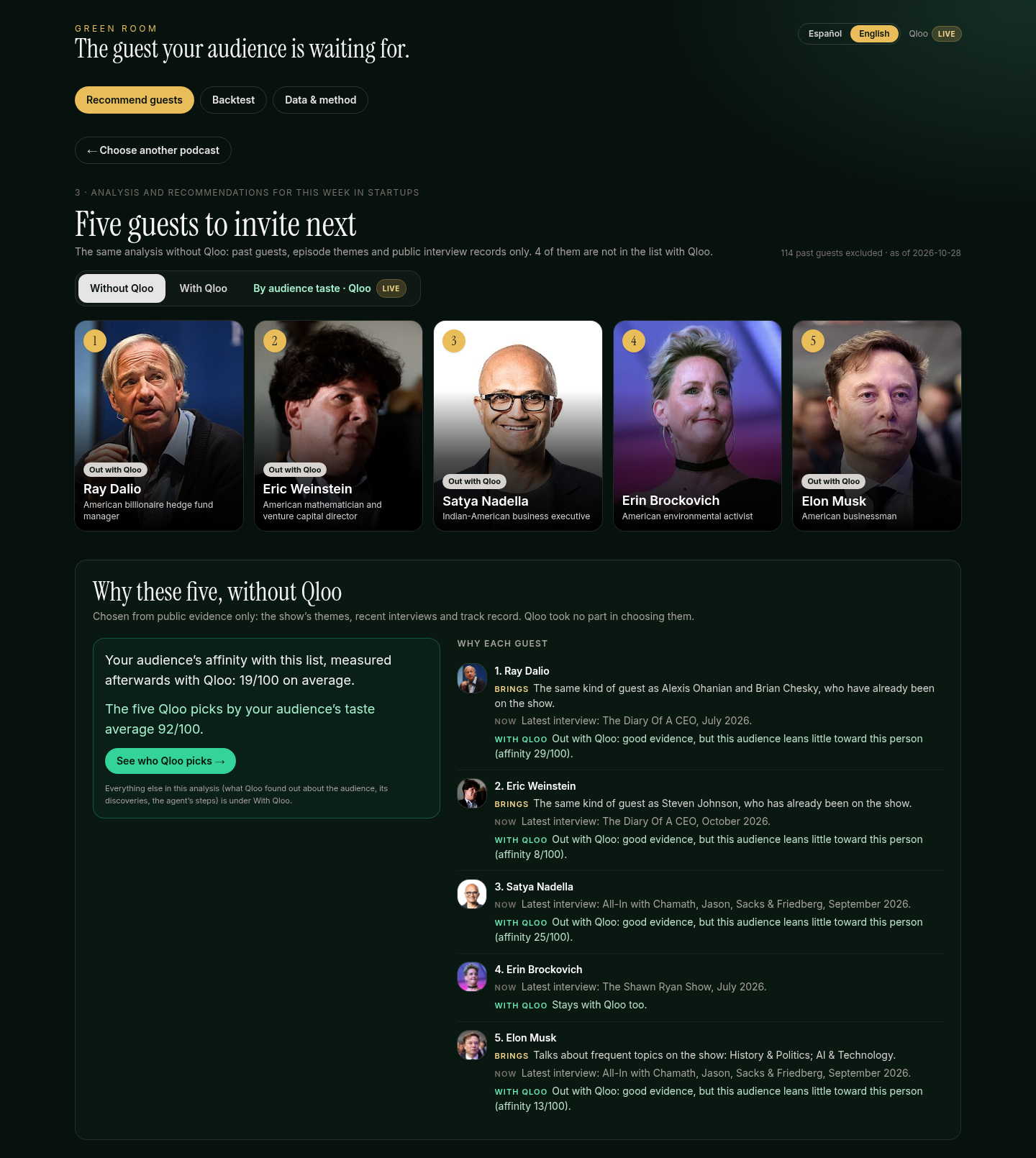
“Without Qloo”: the same analysis with Qloo off, and why each person leaves once Qloo is on.
-
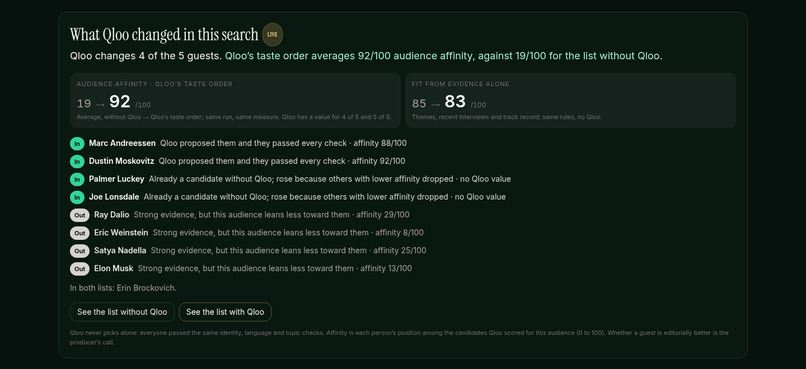
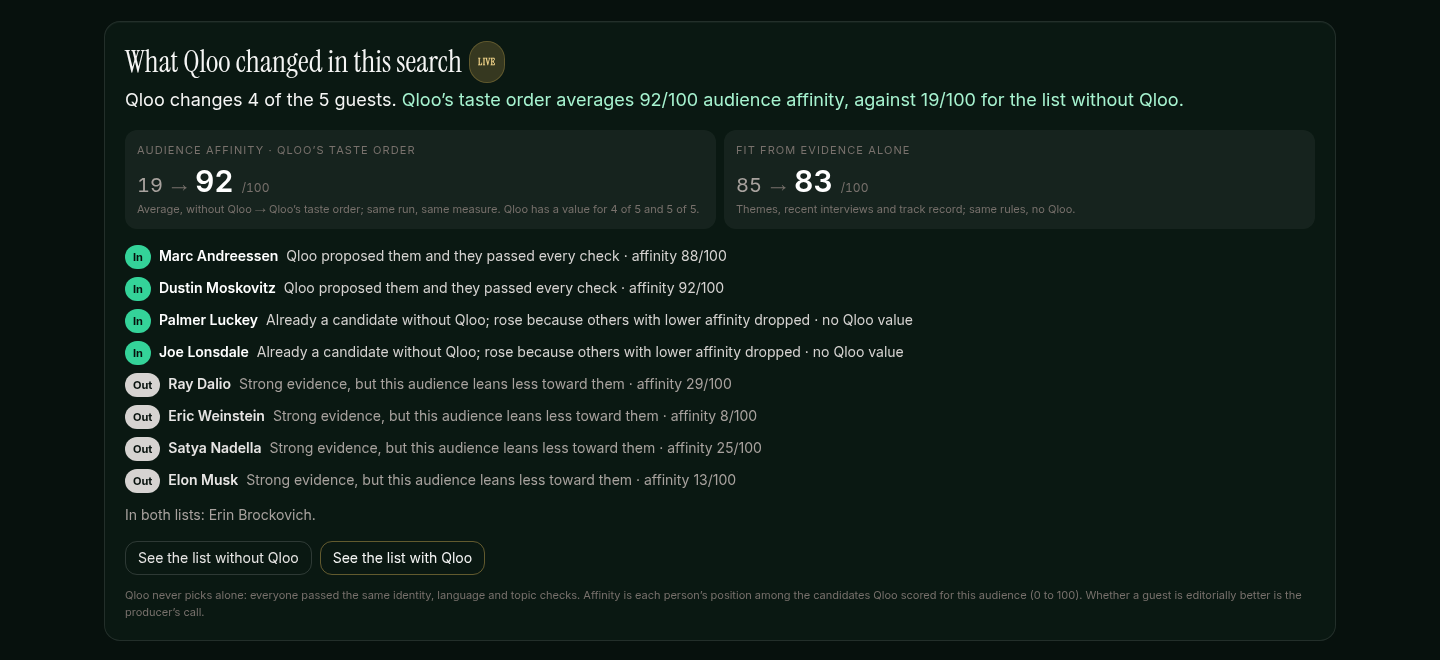
“What Qloo changed in this search”: 19/100 without Qloo against 92/100 in Qloo’s taste order.
-
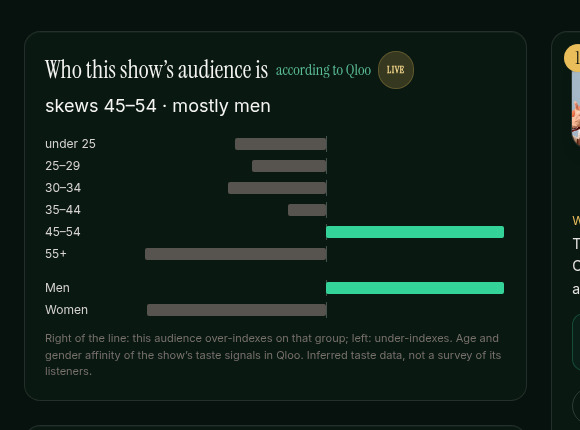
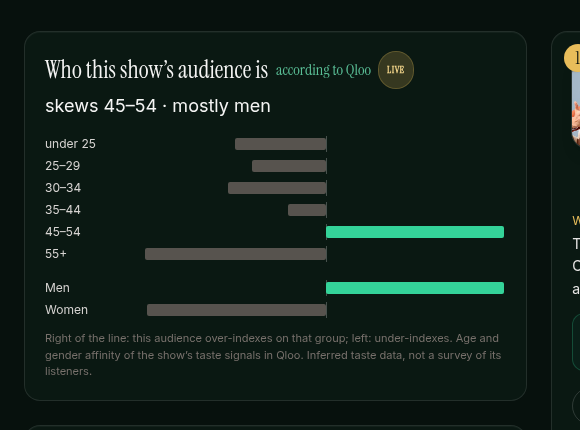
Who the show’s audience is, according to Qloo.
-
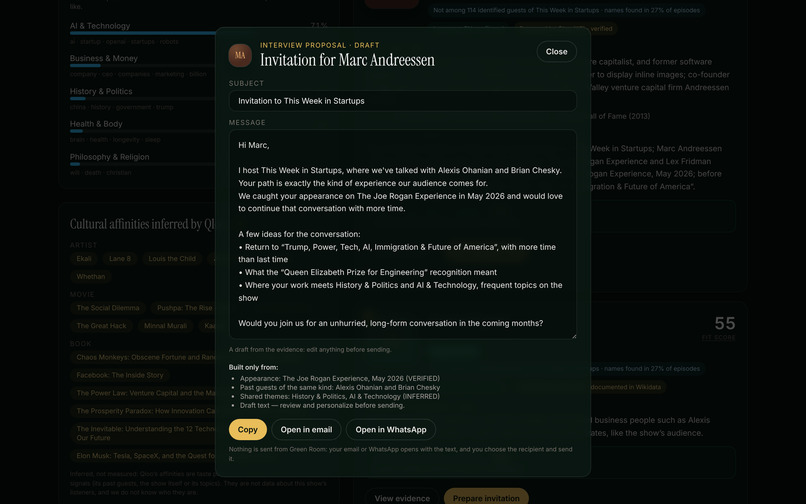
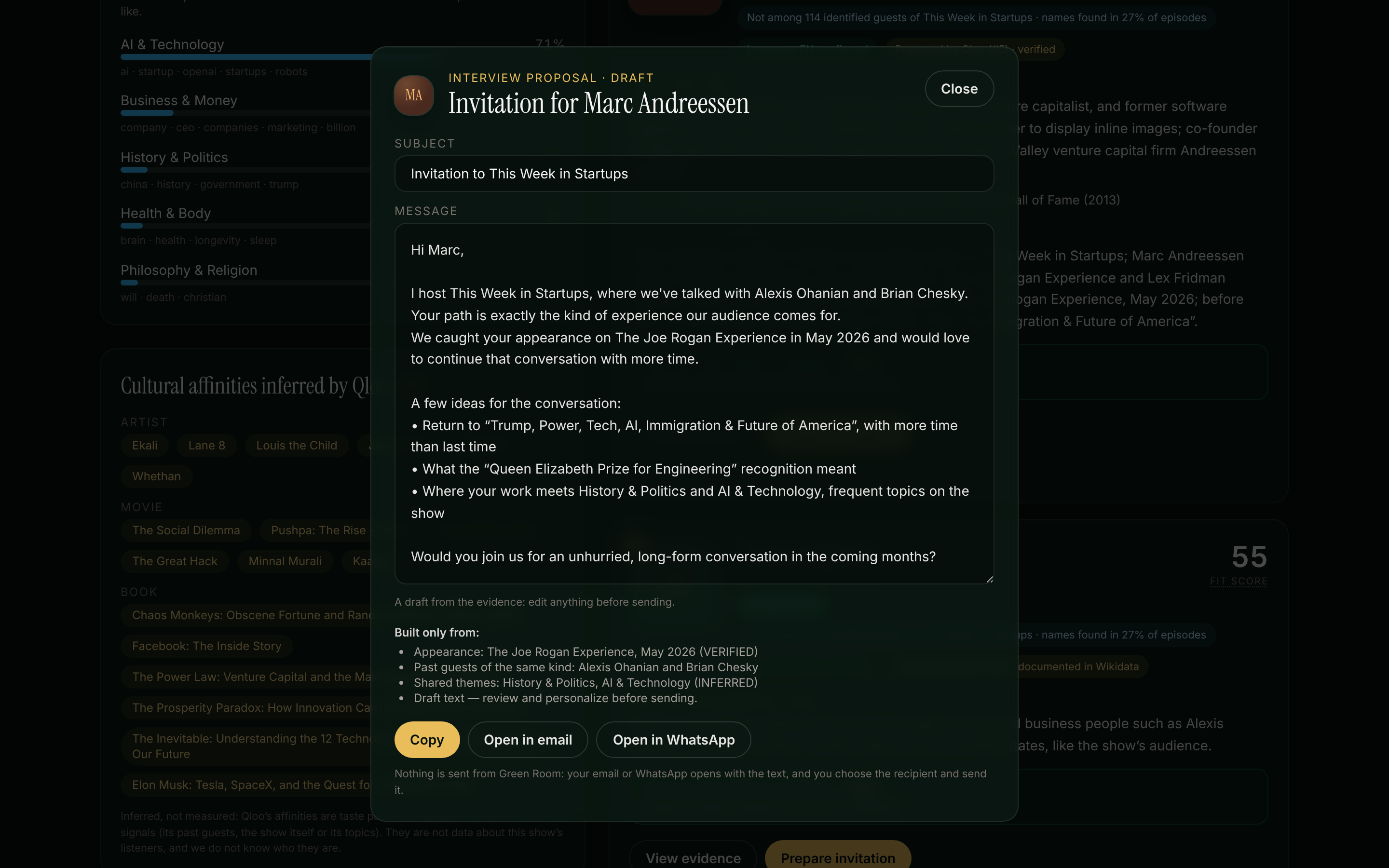
The invitation: built only from evidence, editable, opens in email or WhatsApp.
-
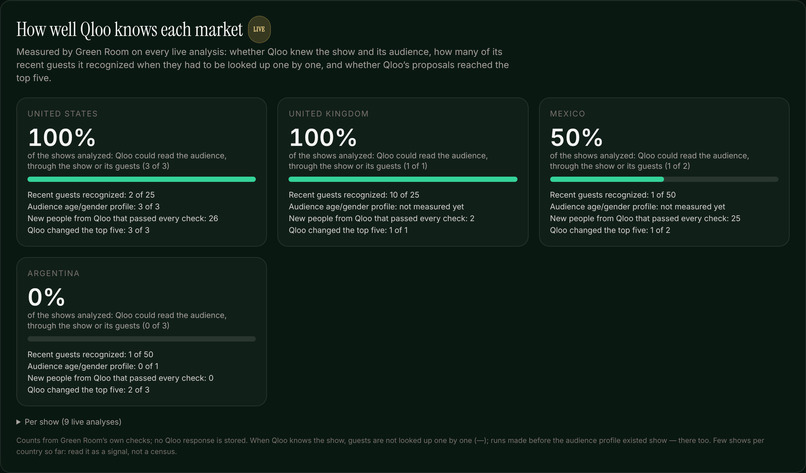
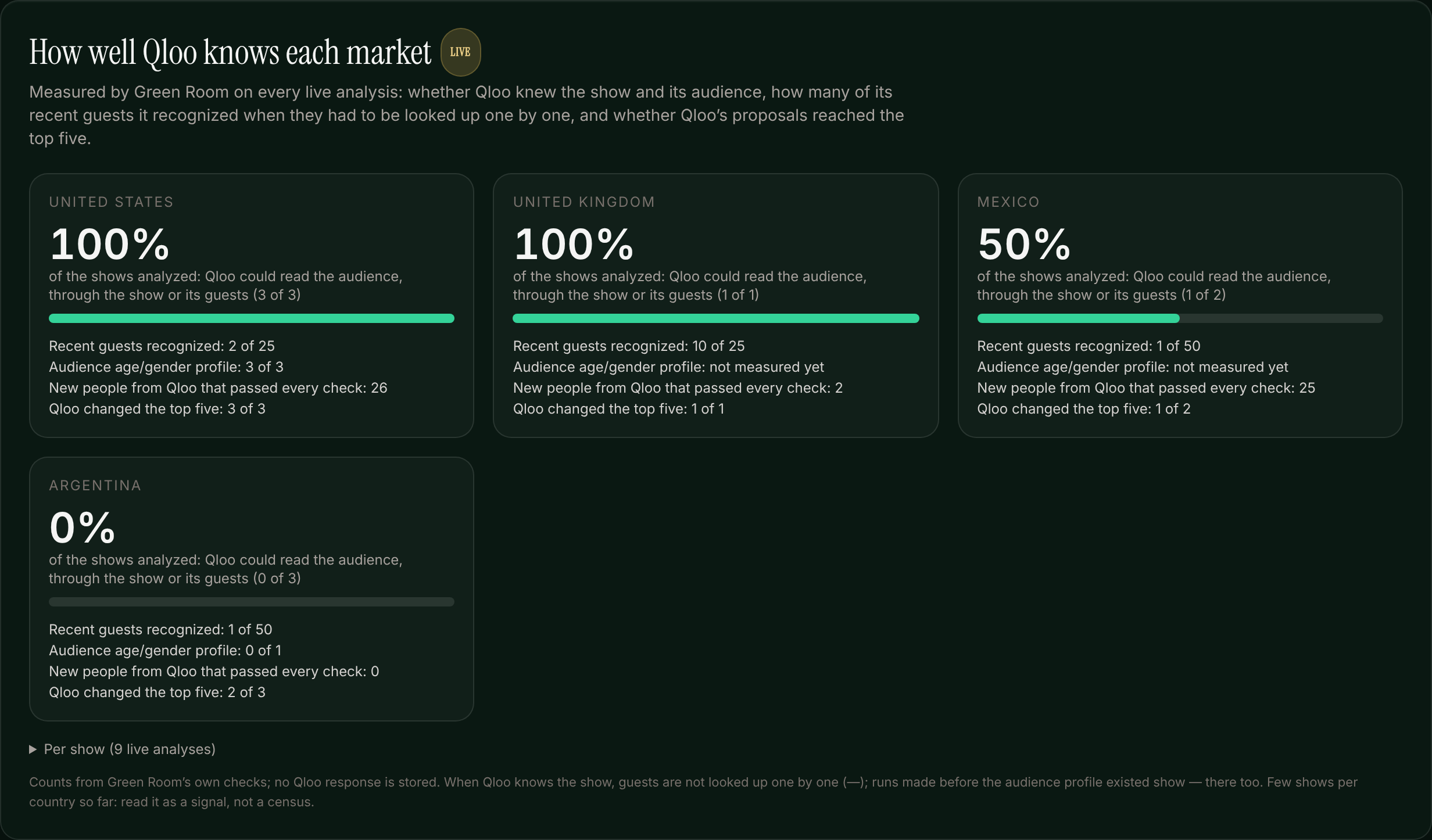
How well Qloo knows each market, measured on Green Room’s own live runs.
The problem. Podcast producers book guests from the same small circle, from memory and gut feeling. A wrong booking costs a whole episode. The usual shortcut, "who is famous?", ignores whether this audience cares. Producers need a shortlist they can defend: people with a real interview track record, who have never been on the show, and whom their audience already follows.
What it does. Pick a podcast: interview shows from Apple's charts in the US, the UK, Mexico, Spain and Argentina, or any show in Apple's directory. Green Room's agent reads the show's real episode history and answers with five guest portraits, then explains them in plain words:
- What Qloo found out about your audience: its age and gender lean, and what else it likes (for This Week in Startups: mostly men aged 45–54, readers of The Power Law and Chaos Monkeys).
- Why each guest: their Qloo affinity with this audience, what they bring (position, the show's topics they talk about, or the past guests they resemble) and how recent their last interview is.
- What the agent did, step by step, with this run's numbers.
Every guest has verified evidence (interview links, identity and language checks) and a draft invitation written only from that evidence. The producer can edit it and open it in email or WhatsApp; nothing is sent by the app.
Why it only works with Qloo. The show's feed says who has been booked. Only Qloo says what its audience likes. The agent turns the show (its Qloo podcast entity, its past guests, its themes as Qloo tags) into a taste signal, then uses Qloo to:
- discover people with affinity to that audience, outside the show's history;
- score every verified candidate's affinity to the audience, with
feature.explainabilitysaying which of the show's signals drove it; - profile the audience by age and gender (
urn:demographics); - find what else that audience likes across books, films and music.
The same analysis with Qloo turned off is one tap away ("Without Qloo"). On This Week in Startups (live run, 2026-10-26; Qloo's answers vary somewhat between runs):
- Qloo changes 4 of the 5 guests.
- Qloo's taste order (Ben Horowitz, Max Levchin, Dustin Moskovitz, Marc Andreessen, Travis Kalanick: none of them on the list without Qloo) averages 92/100 audience affinity. The list without Qloo (Ray Dalio, Eric Weinstein, Satya Nadella, Erin Brockovich, Elon Musk) averages 19/100, both measured the same way in the same run.
- Without Qloo you get famous people. With Qloo you get the people this audience leans toward.
Why a general-purpose LLM can't do this. Asked "who should This Week in Startups book?", a language model guesses from fame. It does not know:
- which 114 people have already been on the show (Green Room reads all 499 episodes and never proposes a past guest or the host);
- whether a name is the right person (Green Room checks identity in Wikidata and Wikipedia, and drops namesakes and people who have died);
- what this audience actually likes. That is measured taste from Qloo's graph, not general knowledge.
How the agent works. A rule-based planner observes, decides, acts, verifies and re-plans, and records why each step ran. Qloo proposes; the agent verifies. On This Week in Startups, Qloo proposed 30 people: 19 passed identity verification and 15 became candidates. Every pick passes the same checks as any other candidate. If the guests can't carry the audience signal, the agent falls back to the show as a Qloo podcast entity, then to its themes as Qloo tags. It also looks further back in time before relaxing any rule, and says so.
Where Qloo is strong, and where it isn't. Green Room measures it on its own runs and shows it in "How well Qloo knows each market":
- US shows: Qloo knows the audiences well, and the demo shows are from there.
- Argentine shows: Qloo knows little, and the app says so on the screen instead of pretending.
For a Latin American launch, that gap is a data opportunity, not a reason to fake results.
Engineering for a real public demo.
- Analyses run as Netlify background jobs; results are kept in Netlify Blobs.
- A rate-aware Qloo client paces requests, honors Retry-After and adapts concurrency.
- A shared daily Qloo budget, a per-visitor cap and a server-side cache protect the hackathon key.
- An emergency pause stops new Qloo calls without a redeploy.
- Qloo data is never committed to the public repository.
- 268 automated tests.
Honest limits.
- Qloo describes aggregate taste, not individual listeners, and the app labels every Qloo value that way.
- Affinity is each person's position among the candidates Qloo scored for this audience (0 to 100), not a forecast of downloads.
- In historical backtests, Qloo affinity did not raise hit rates on our core shows. Green Room uses Qloo to choose and explain, not to claim better predictions of who a host will book.
How to test it (no login needed).
- Open https://greenroom1.netlify.app and press This Week in Startups next to See a live example.
- Above the five portraits, switch between Without Qloo, With Qloo and By audience taste · Qloo: the same analysis with Qloo off, on, and ordered by Qloo alone. Direct link to the contrast: https://greenroom1.netlify.app/?show=this-week-in-startups&view=without
- Read "Why these five" (what Qloo found out about the audience, why each guest, what the agent did) and "What Qloo changed in this search" (19/100 without Qloo against 92/100 in Qloo's taste order).
- Press "Prepare invitation" on any guest: an editable letter built only from that guest's evidence. Nothing is sent from the app.
- Try any other podcast: pick a country, or search any show by name or link. Catalog shows open instantly from a cached Qloo analysis; a new podcast runs live against Qloo in 20–90 seconds.
- Data & method → "How well Qloo knows each market" shows where Qloo knows an audience well (US) and where it doesn't (Argentina).
The app opens in English (add ?lang=es for Spanish). If Qloo is unavailable, the app says so and offers a retry; it never silently shows simulated results.
Built With
- apple-podcasts
- netlify
- netlify-blobs
- netlify-functions
- qloo
- react
- typescript
- vite
- wikidata
- wikipedia

Log in or sign up for Devpost to join the conversation.