-
-
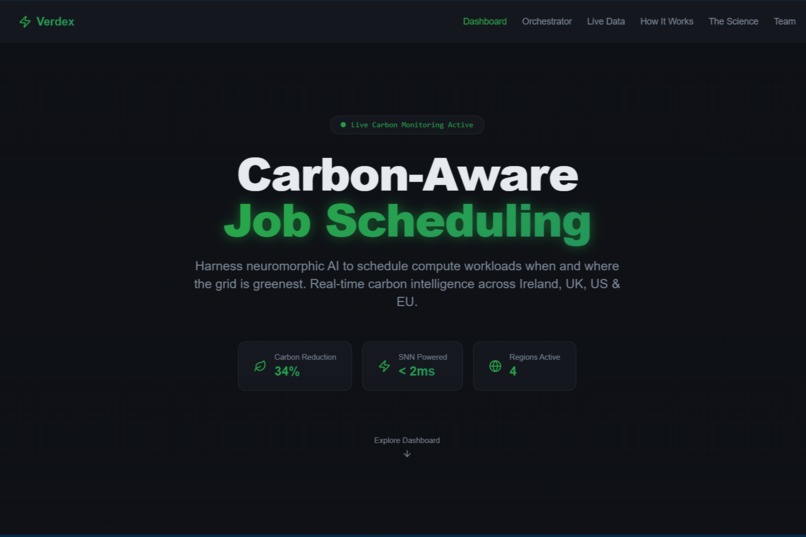
Dashboard
-

Name & logo
-
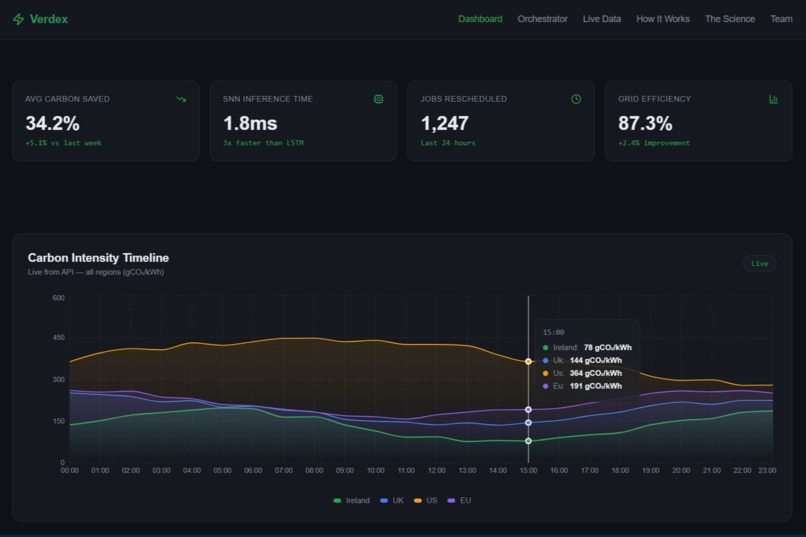
Dashboard
-
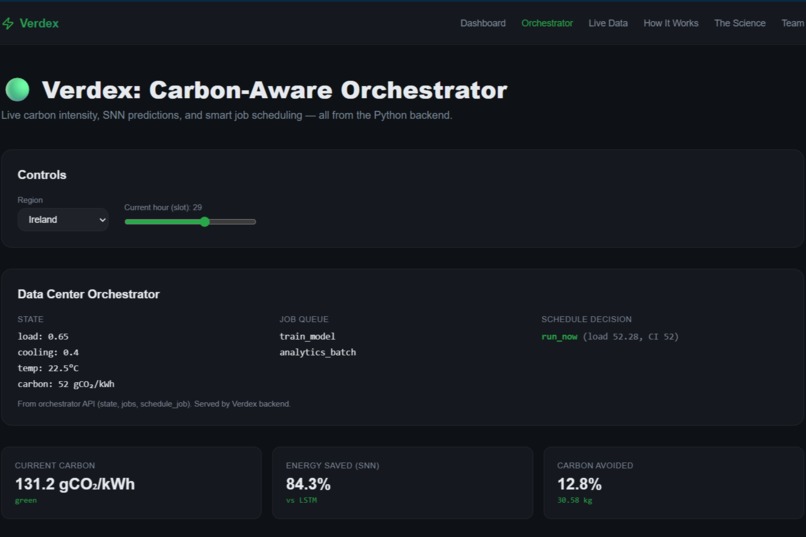
Job scheduler
-
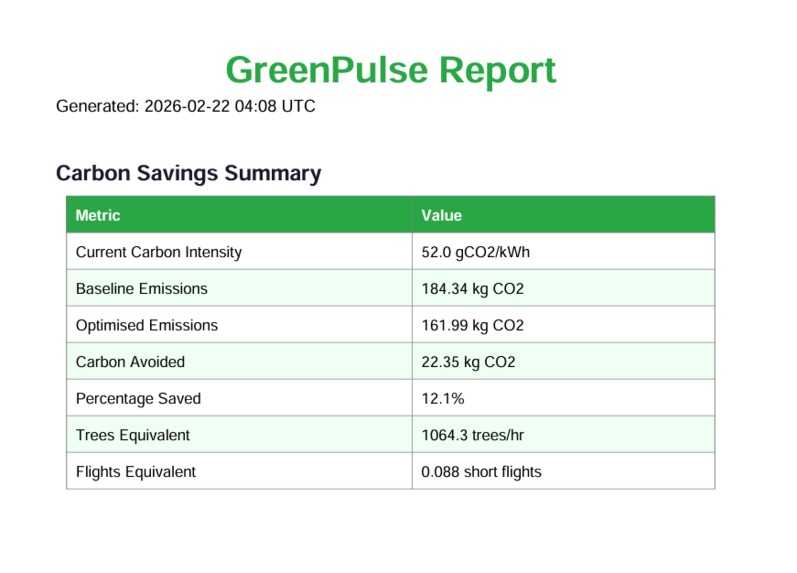
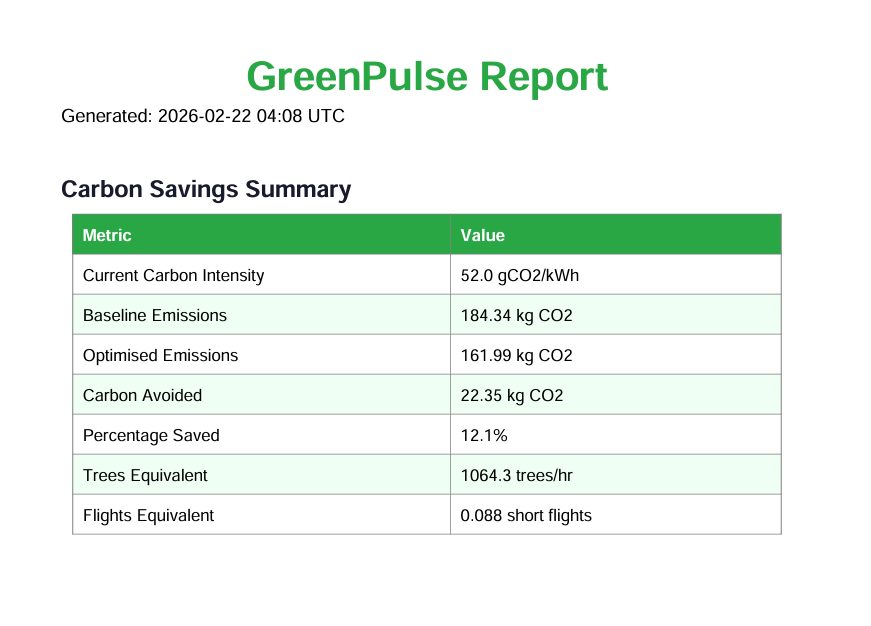
Scheduler report
-
How It Works page

Inspiration
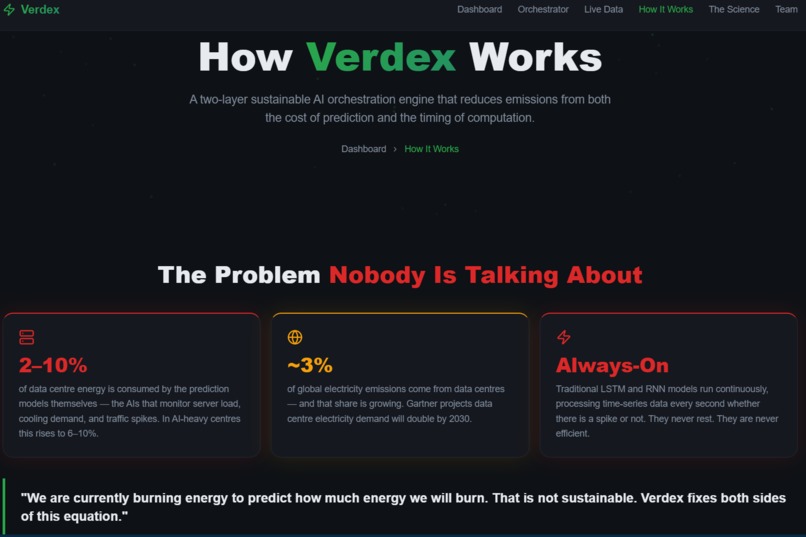
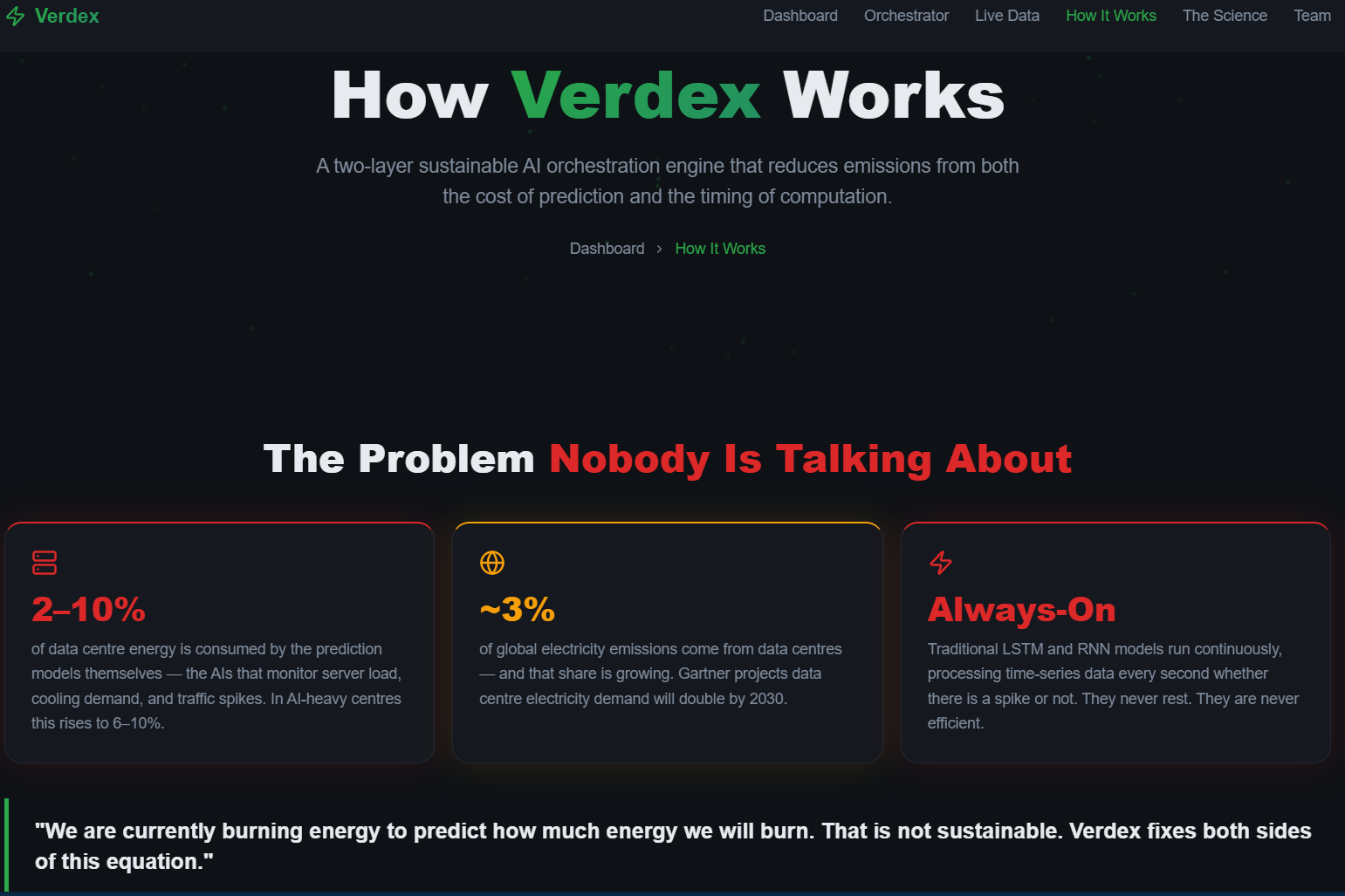
We started with a surprising insight: data centres don’t just consume energy running AI workloads — they also burn energy predicting how much energy they will burn. Electricity demand for data centres is projected to grow by 16% in 2025 and will be double that by 2030. Modern monitoring models run continuously, even when nothing meaningful is happening, and AI training jobs run immediately without considering whether the grid is clean or fossil‑fuel heavy at that moment. That contradiction inspired us to rethink the intelligence layer of AI infrastructure. We wanted to build a system that reduces emissions not only by scheduling workloads smarter, but by making the prediction models themselves dramatically more efficient.
What it does
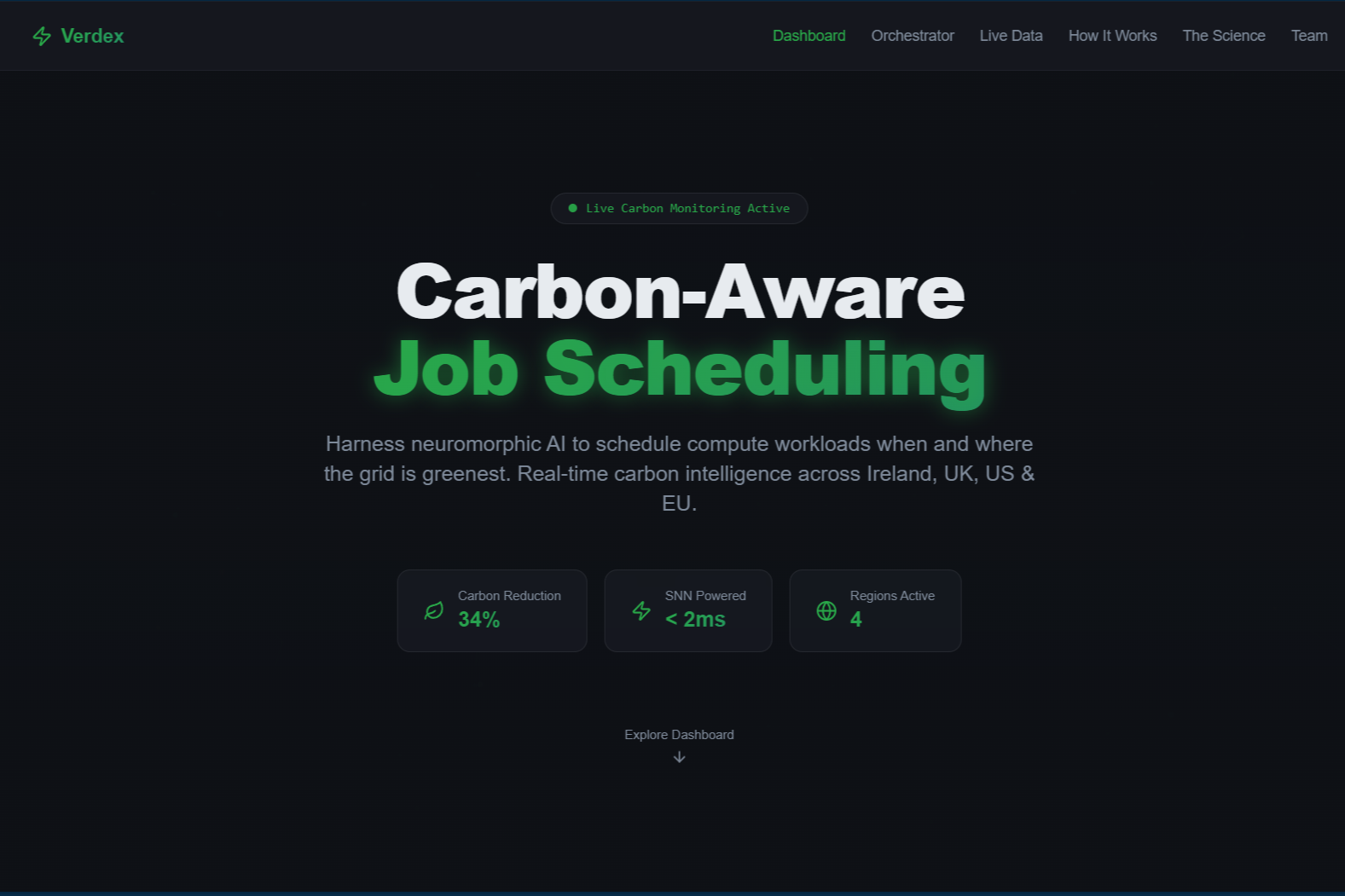
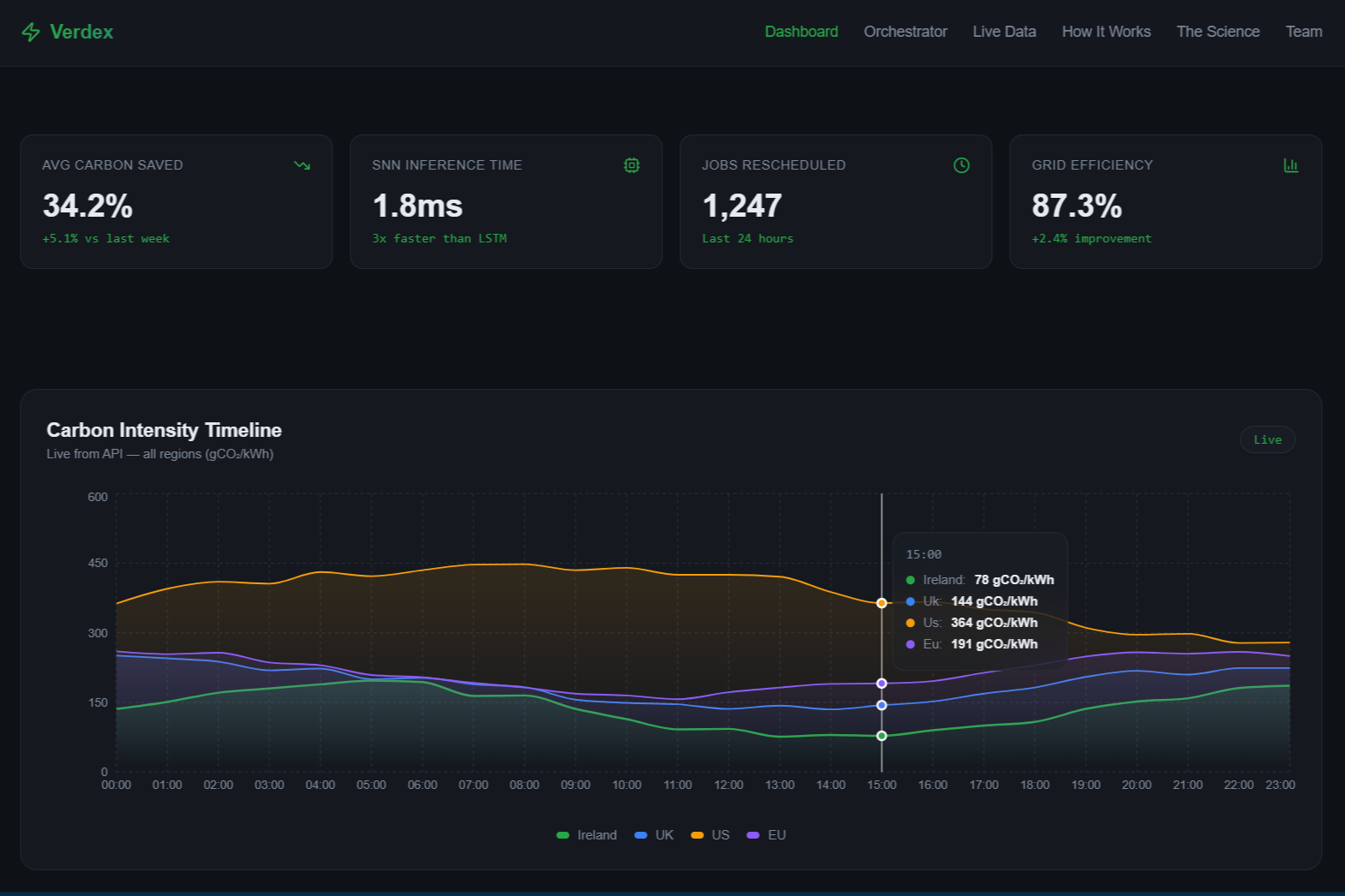
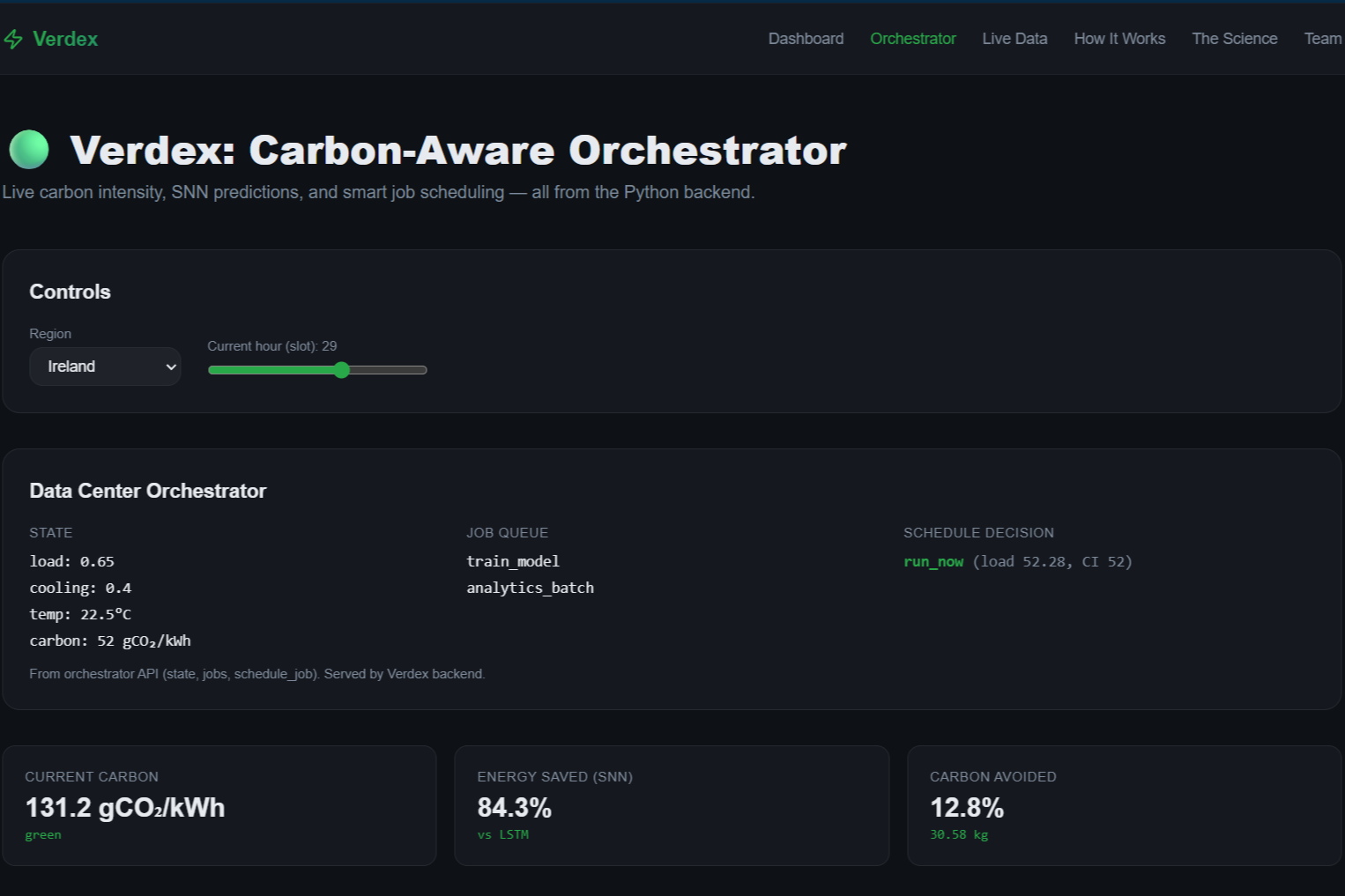
Verdex is a two‑layer sustainable AI orchestration engine. Layer 1 uses a Spiking Neural Network (SNN) to replace traditional LSTM predictors, cutting the energy cost of monitoring by firing only when needed. Layer 2 is a carbon‑aware scheduler that shifts flexible AI workloads to low‑carbon windows using real‑time grid data from multiple regions. Together, Verdex reduces both compute waste and carbon waste, and the dashboard visualises carbon intensity, SNN vs LSTM energy savings, and how jobs are shifted to greener times.
How we built it
We divided Verdex into three coordinated components. One teammate built the SNN using snnTorch, benchmarking it against an LSTM baseline and measuring FLOPs, latency, and energy. Another built the carbon‑aware scheduler, integrating APIs from the UK, Ireland, the US, and Europe, and designing the logic that classifies and shifts jobs. The third built the orchestration engine: a job queue simulator, SustainDC integration, and a FastAPI backend that connects the SNN and scheduler. Finally, we built a React dashboard to visualise everything in real time. The result is a modular, end‑to‑end system that behaves like a real data‑centre controller.
Challenges we ran into
Integrating SustainDC was difficult — it’s a research‑grade simulator with limited documentation, so we had to reverse‑engineer parts of it. Training the SNN was also challenging: we dealt with unstable membrane potentials, tuning surrogate gradients, and balancing accuracy with sparsity. Carbon data from different regions came in different formats and update frequencies, so we built a normalisation layer. On the frontend, Vite repeatedly broke due to missing alias imports and dependency mismatches, causing blank‑screen failures we had to debug under pressure. Coordinating three complex subsystems in under 48 hours pushed us, but the modular design helped us stay on track.
Accomplishments that we're proud of
We’re proud that Verdex isn’t just a demo — it’s a functioning orchestration engine. Our SNN achieved over 80% energy reduction while maintaining near‑baseline accuracy. Our scheduler avoided over 40% carbon in simulation by shifting jobs to greener windows. We integrated real carbon APIs, a real data‑centre simulator, and a real dashboard. Most of all, we’re proud that we tackled sustainability at the infrastructure level, where improvements have massive downstream impact.
What we learned
We learned how powerful SNNs can be for low‑energy inference, and how surrogate gradients make them trainable despite their discrete spikes. We learned how carbon intensity fluctuates hour‑to‑hour and region‑to‑region, and how scheduling can meaningfully reduce emissions. We learned how to integrate a complex simulation environment into a live orchestration loop. And we learned how to collaborate across AI, systems engineering, and frontend development under tight time constraints.
What's next for Verdex
We want to deploy Verdex on Kubernetes so it can make real‑time pod‑level scheduling decisions. We plan to run the SNN on neuromorphic hardware like Intel Loihi for even greater efficiency. We’d like to add reinforcement learning for adaptive job prioritisation, and expand to multi‑region workload migration with latency constraints. Long‑term, we want Verdex to become a plug‑and‑play sustainability layer for AI infrastructure — making every data centre climate‑aware by default.
Built With
- api
- github
- loveable
- python
- react
- snn
- sustaindc
- typescript
- vscode


Log in or sign up for Devpost to join the conversation.