-
-
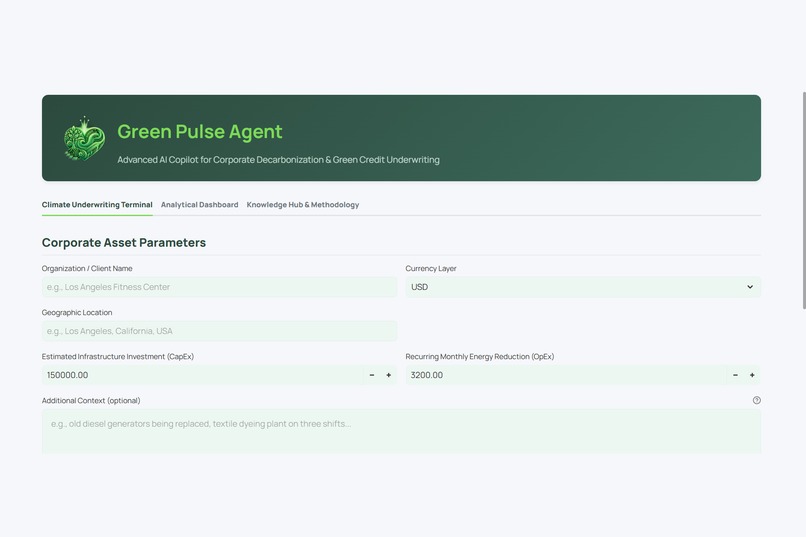
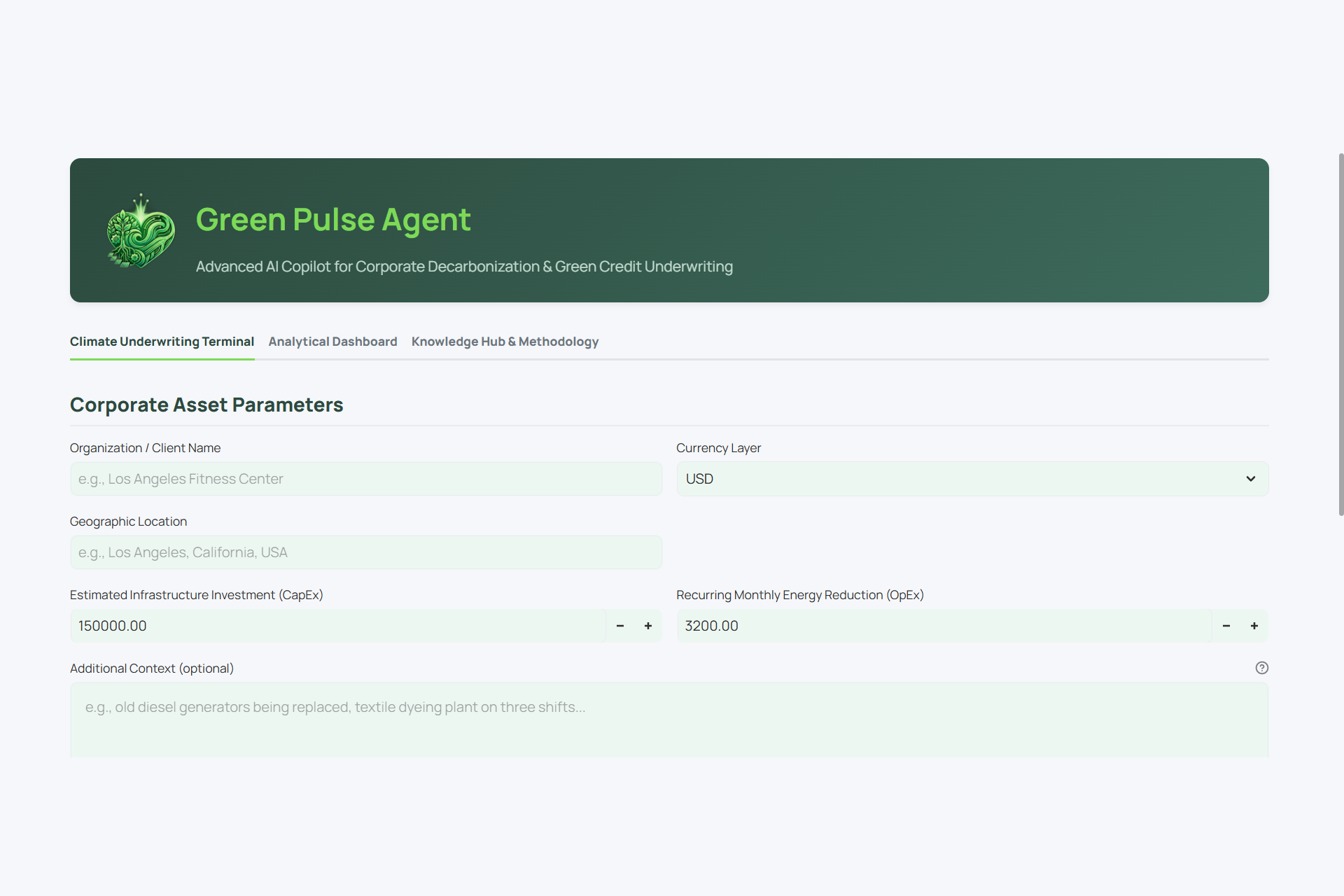
Just 5 inputs — CapEx, OpEx, location, currency, context — and Gemini runs the full underwriting analysis.
-
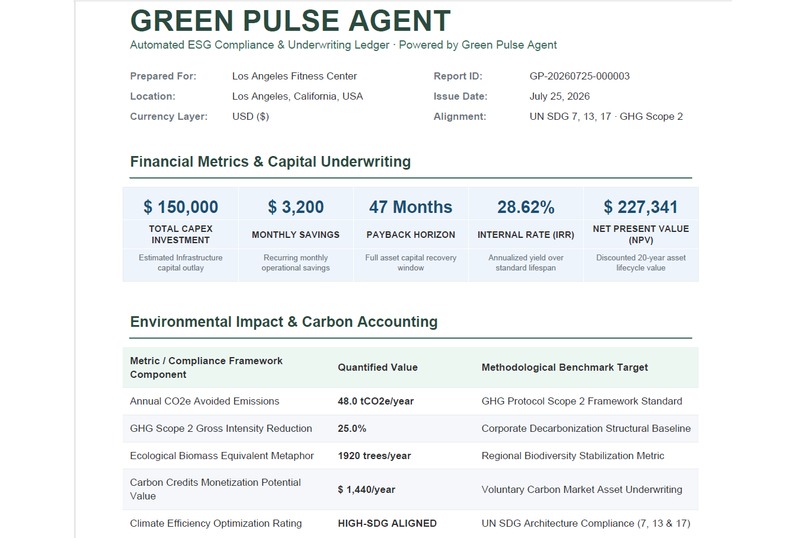
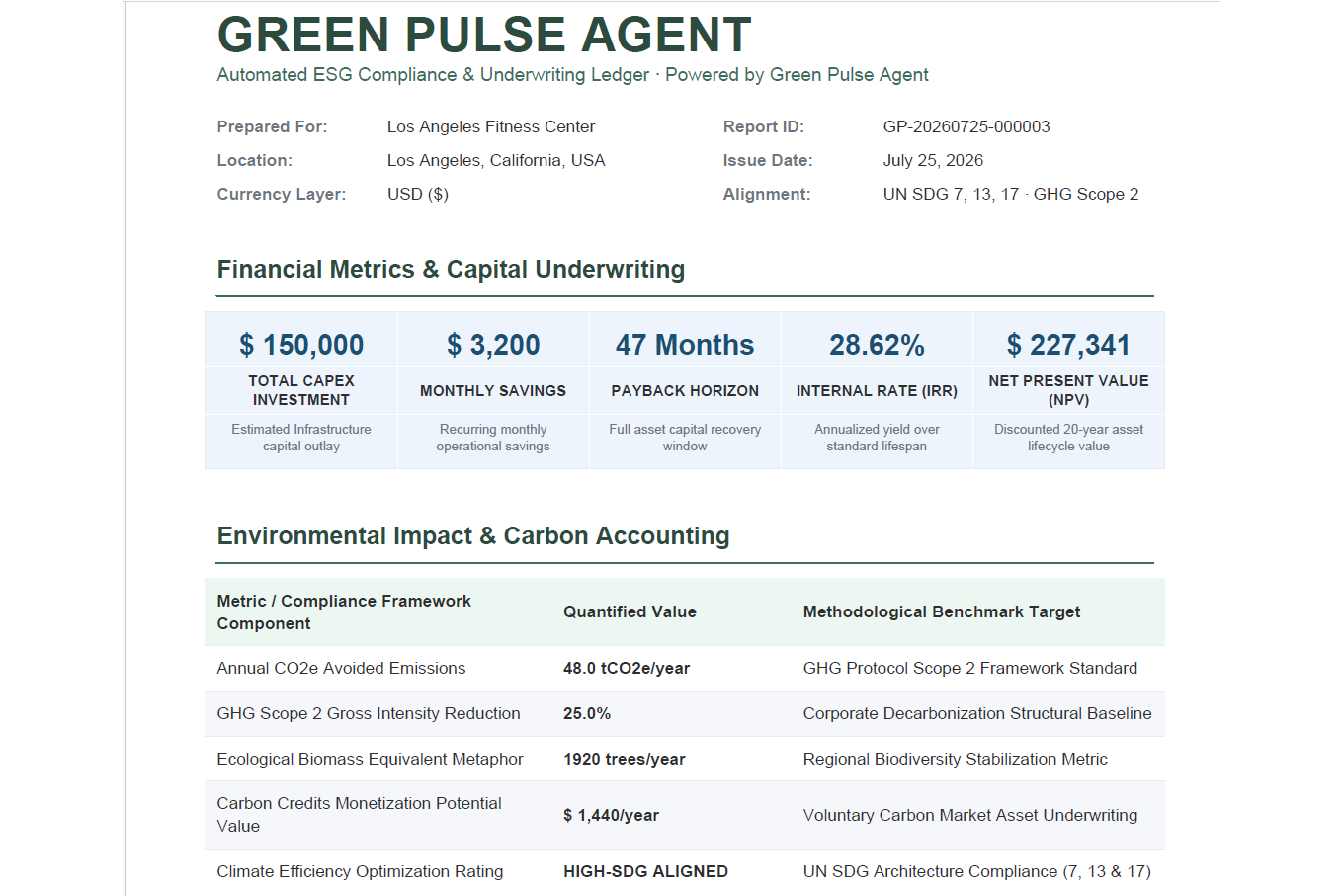
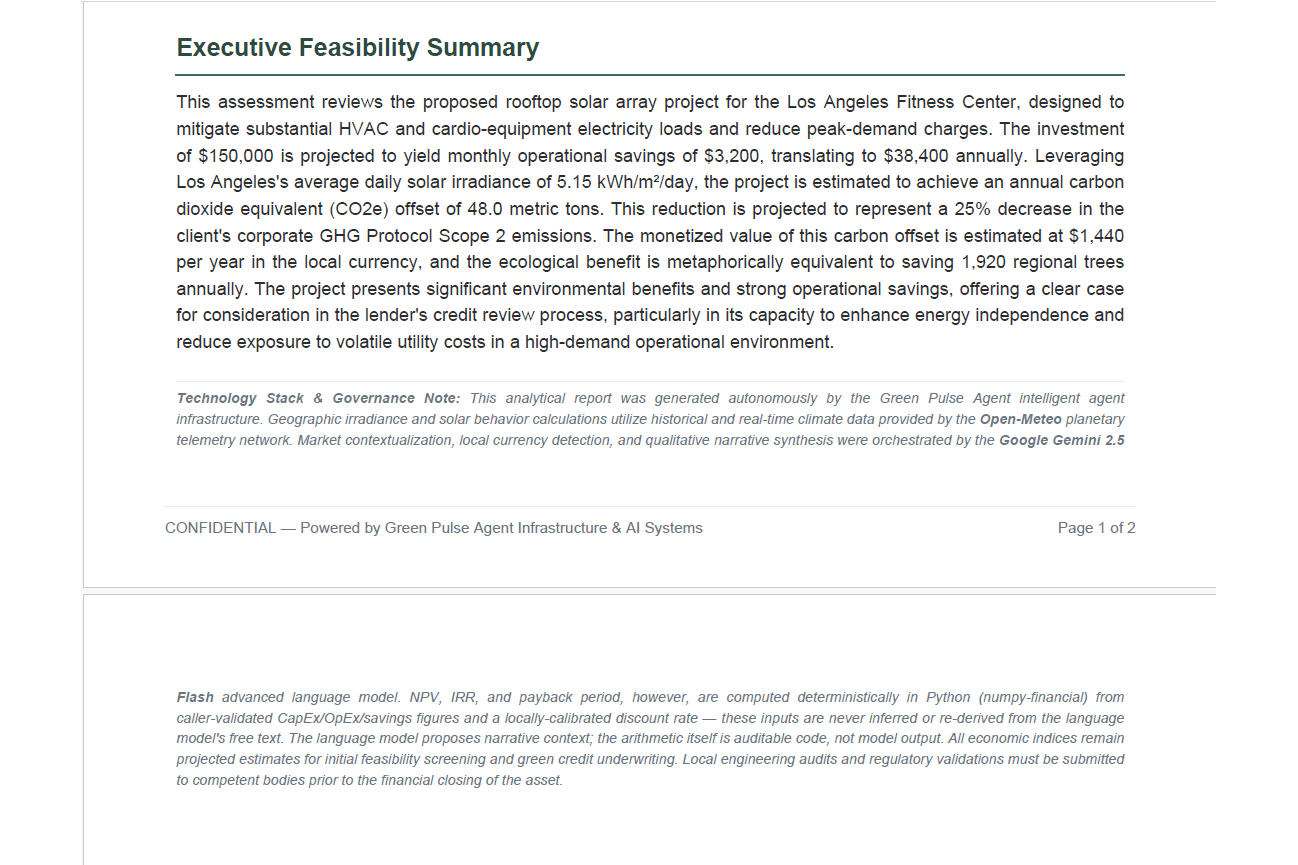
Underwriting-grade output: CapEx, payback, IRR and NPV alongside verified annual CO2e impact.
-
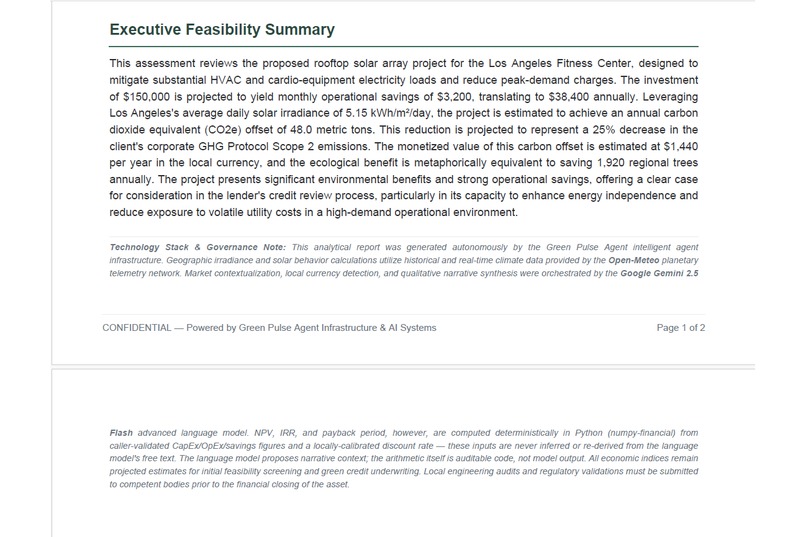
Key safeguard: NPV, IRR and payback are computed deterministically in Python — never by the LLM.
-
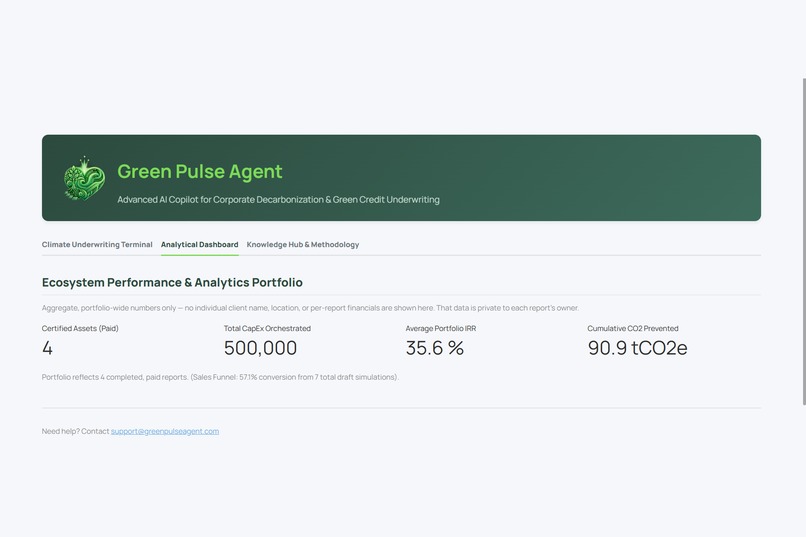
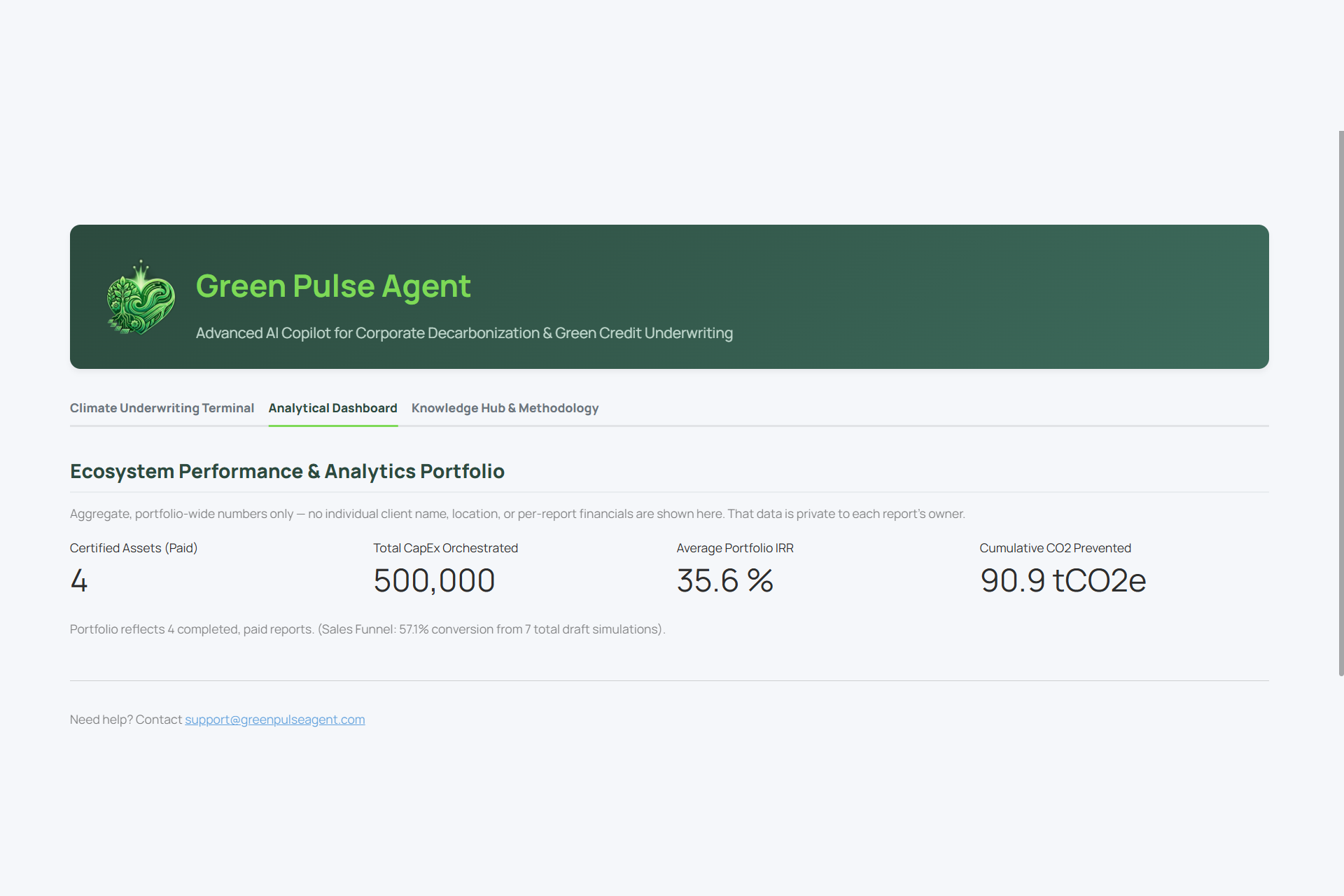
Portfolio dashboard aggregates CapEx, IRR and CO2e across clients — individual report data stays private.
-
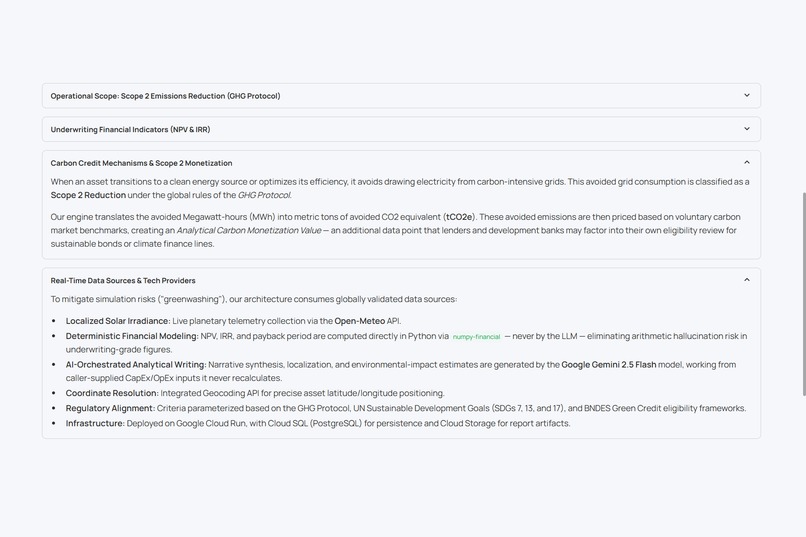
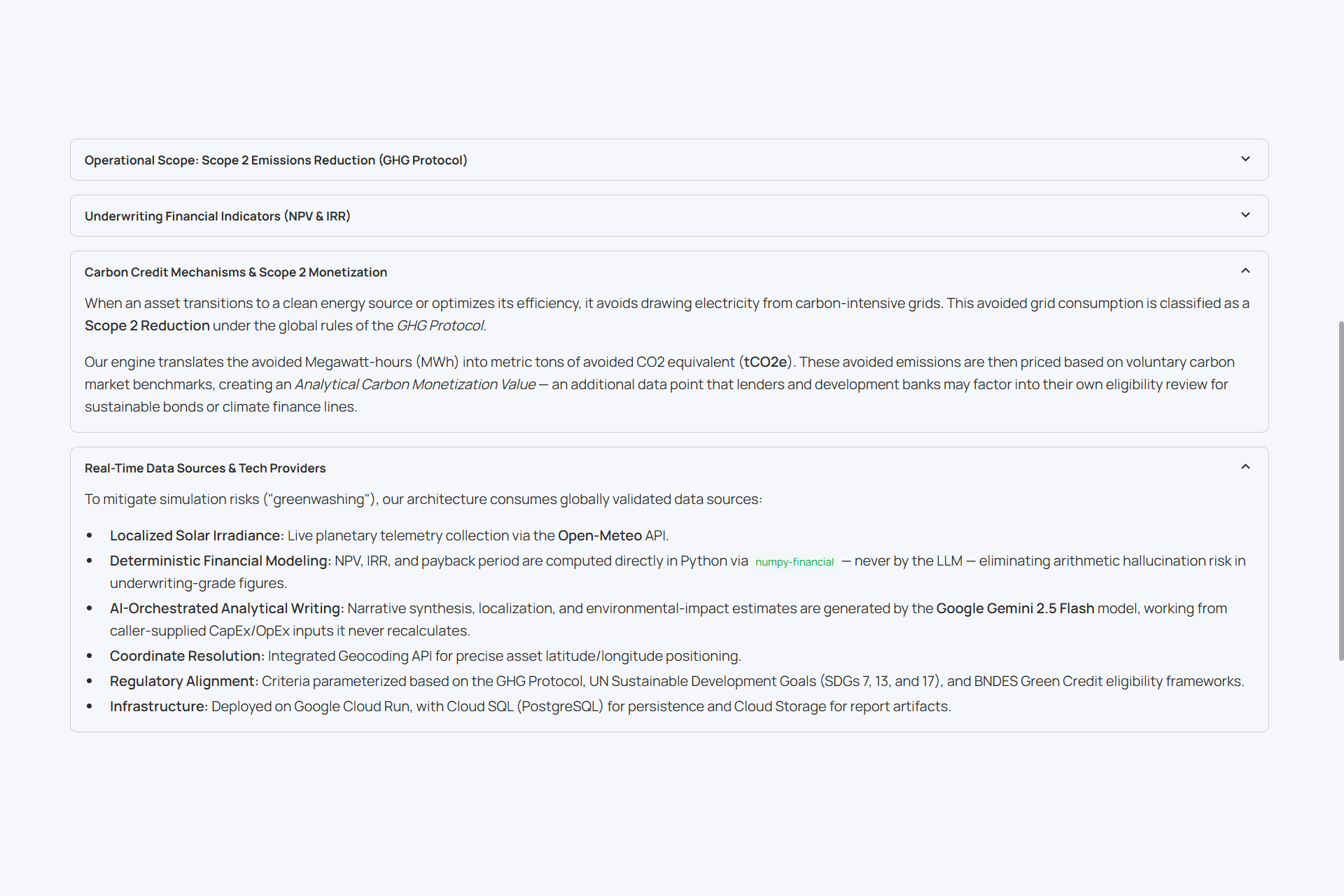
Powered by live Open-Meteo irradiance data, Gemini 2.5 Flash synthesis, and auditable financial code.
Inspiration
Global climate finance hit a record USD 1.9 trillion in 2023, according to the Climate Policy Initiative, yet the same organization estimates the world needs closer to USD 7.4 trillion a year through 2030 to fund the energy transition at the pace required. Part of that gap is not a shortage of viable projects. It is a human bottleneck. Assessing the feasibility of green infrastructure, such as solar PV arrays or industrial retrofitting, is traditionally slow and manual. It requires interpreting complex environmental data, calculating long-term financial returns, and ensuring compliance with frameworks like the GHG Protocol. This friction slows capital deployment and introduces real risks of greenwashing or inaccurate analysis. I wanted to build a solution that removes this friction and accelerates sustainable infrastructure investment.
What it does
Green Pulse Agent is an autonomous, institutional-grade AI pipeline I designed to streamline the preparation of green credit documentation. It ingests unstructured corporate data, cross-references it with live planetary telemetry, and performs deterministic financial modeling. The agent instantly provides a highly accurate, auditable, decision-support ledger for lender review, and dynamically generates an audit-ready PDF report.
How I built it
I built the application with a clear separation of concerns to ensure institutional-grade accuracy: a Streamlit frontend for the interactive terminal and dashboard, a FastAPI backend for routing and business logic, Google Gemini 2.5 Flash (via google-genai) for natural language understanding and narrative generation, and numpy-financial for strictly deterministic IRR, NPV, and payback calculations. Open-Meteo supplies real-time solar irradiance and geocoding, Stripe handles checkout, and everything runs containerized on Google Cloud Run with Cloud SQL, Cloud Storage, and a Global External Load Balancer with a managed SSL certificate on a custom domain.
This is my first AI Engineering project and my first hackathon in the field, built solo, in partnership with two AI models in distinct roles. I deliberately avoided unsupervised autonomous agents. Instead, I ran a Chat-Driven Development workflow with a human in the loop inside Cursor, where Gemini acted as the primary generation engine, valued for speed and a wide context window for API documentation, while Anthropic's Claude Sonnet worked in parallel as a senior code reviewer, auditing logic and validating the security architecture. I tested and validated every feature myself, function by function, through to the system running in production today. That discipline, not the absence of AI, is what shielded the financial pipeline against numeric hallucination and unauditable logic.
Challenges I Ran Into
The overarching challenge was the sheer volume of continuous adaptation required to build a production-grade system solo, constantly shifting hats between AI engineer, backend developer, and product manager.
Technically, the first major hurdle was architectural: LLMs are stochastic engines, not calculators, so relying on one to compute financial metrics risked hallucination. I solved this by strictly limiting the LLM to context and narrative extraction, pushing all financial modeling to a deterministic Python pipeline. Security and production stability brought their own constant hurdles: hardening against IDOR vulnerabilities, engineering a zero-leakage payment flow, and resolving containerized dependency conflicts.
However, even greater than resolving technical bugs was devising a fast-tracked sales strategy under tight deadlines—specifically adapting a product built natively in English for rapid entry into the Brazilian market. Conceptually, I also had to correct a flawed positioning: I was framing the AI as a definitive "credit approver." Recognizing this promised an unrealistic replacement for bank risk analysis, I rewrote the prompt engineering, PDF templates, and app copy end-to-end to reframe the AI as a "Copilot" for human analysts. Navigating these go-to-market, architectural, and positioning pivots made participating in this hackathon an immense learning experience across every level of product creation.
Accomplishments that I'm proud of
I am most proud of a genuinely institutional-grade architecture that completely separates deterministic financial modeling from the AI, eliminating arithmetic hallucination risk by construction. I am also proud of the hardened access-token and zero-leakage payment model, and of the system's resilience: a graceful fallback still generates a mathematically accurate, clearly watermarked PDF even if the AI gateway fails.
What I learned
Building Green Pulse Agent reinforced that LLMs are powerful reasoning engines but terrible calculators, teaching me how to orchestrate AI for what it does best while keeping strict financial logic deterministic. I also learned production operations the hard way: diagnosing a native-dependency crash from Cloud Run logs, handling application state safely across third-party payment round-trips, and treating cloud infrastructure guarantees like session affinity as mitigations, not absolutes. Most importantly, I learned that building software requires as much clarity in product positioning and business constraints as it does in code.
What's next for Green Pulse Agent
The immediate next step is a secure, self-service token recovery flow and evolving the current privacy-by-design architecture into full LGPD/GDPR compliance.
Commercially, the product is primed for active B2B outbound sales. Rather than relying on passive social media growth, the strategy targets small and mid-sized solar integrators directly. By offering highly accessible usage-based pricing, Green Pulse Agent can instantly become the tool that allows smaller firms, who cannot afford dedicated financial analysts, to produce the robust green credit dossiers needed to win larger, bank-financed contracts.
Looking further ahead, the long-term vision is to evolve Green Pulse Agent from a transactional utility into a comprehensive ESG credit infrastructure platform. The roadmap includes API integrations for CRM and ERP systems, consolidated portfolio dashboards for post-installation ESG monitoring, and customizable risk-scoring inputs that lenders can incorporate into their own underwriting criteria. Ultimately, it will transition into a collaborative hub where sustainable integrators, freelance carbon auditors, and financial institutions seamlessly manage the entire lifecycle of green infrastructure financing.
Built With
- claude
- cloud-sql
- docker
- fastapi
- gemini
- google-cloud
- google-cloud-run
- google-gemini-2.5-flash
- google-genai
- google-secret-manager
- numpy-financial
- open-meteo-api
- postgresql
- pydantic
- python
- reportlab
- sqlalchemy
- sqlite
- streamlit
- stripe
- uvicorn

Log in or sign up for Devpost to join the conversation.