-
-
Website
Green Gavel
Inspiration
We built Green Gavel because local government decisions affect daily life, but the information behind those decisions is often buried in meeting agendas, minutes, PDFs, and public records. We wanted to make civic decision-making easier to understand by turning fragmented public data into a fast, conversational, evidence-based experience.
The project was inspired by the idea that residents should be able to ask direct questions about their town’s priorities and receive answers grounded in actual municipal records, not vague summaries or generic AI responses.
What We Learned
This project taught us that building an AI product is not just about the model. The real challenge is designing a system that can retrieve relevant evidence, ground responses in trustworthy sources, and present them clearly to users.
We learned:
- the importance of retrieval quality and evidence-first design
- how to structure a full-stack backend/frontend app around live APIs
- how to handle LLM rate limits, provider instability, and integration failures
- how to build a UX that makes AI answers explainable and trustworthy
- how to work with messy civic datasets and inconsistent public metadata We also learned that a useful civic tool needs to balance accuracy, clarity, and accessibility.
What We Built
We built Green Gavel as a full-stack application with:
- a FastAPI backend for routing, retrieval, and answer generation
- a Snowflake-backed retrieval layer for relevant records
- an OpenRouter-powered model layer for answer synthesis
- a Next.js frontend for the user experience
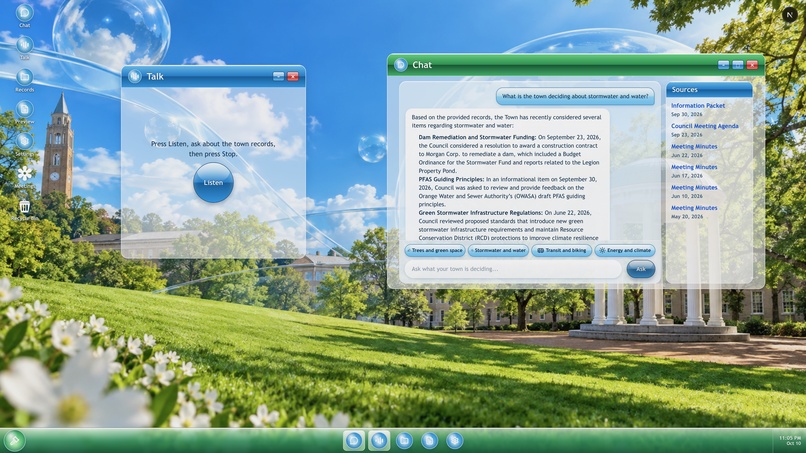
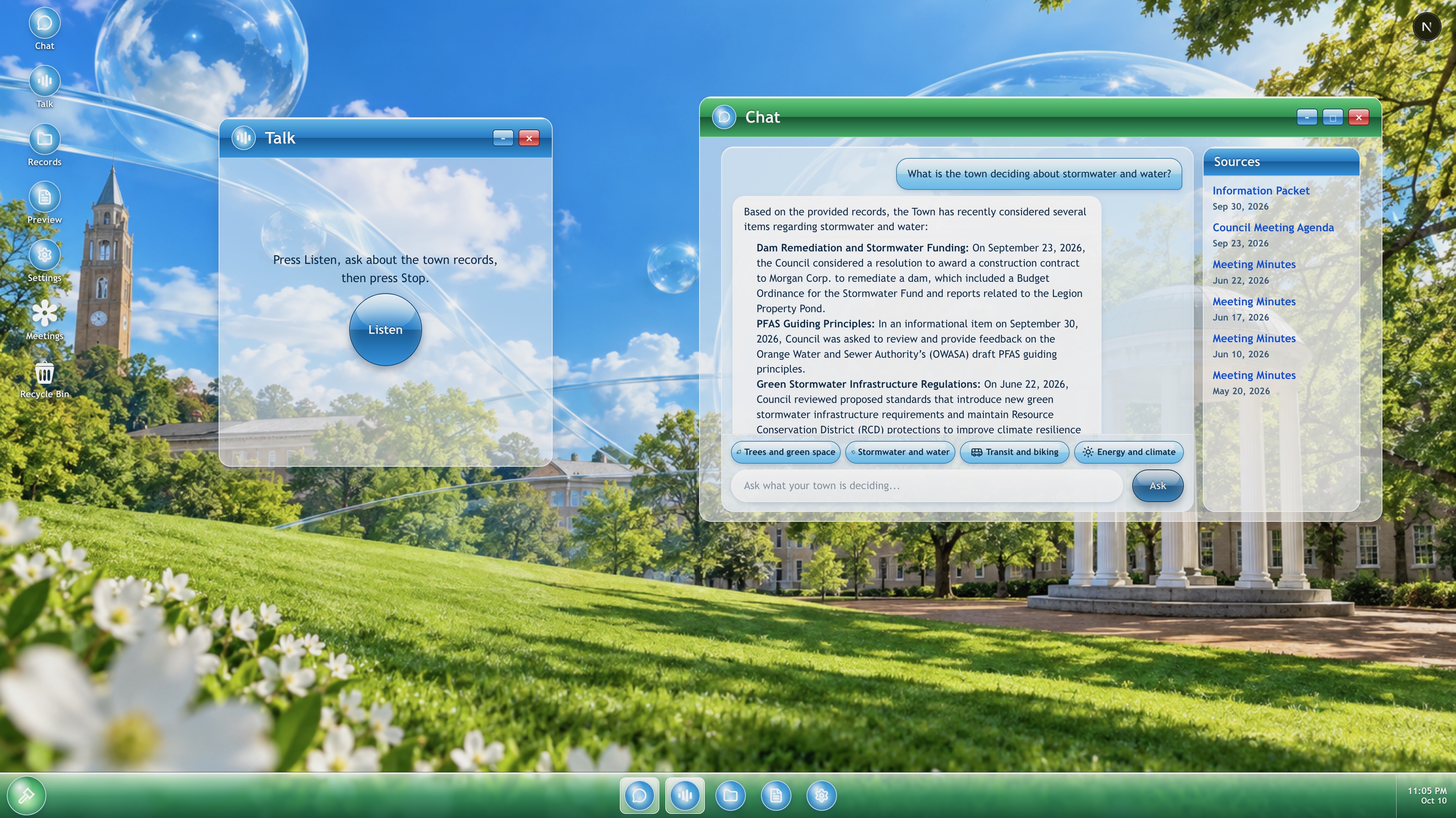
- a meeting feed and source citation flow so responses remain traceable The app lets residents ask questions about topics like trees, water, transit, and energy. The backend retrieves the most relevant record excerpts, passes them through the model, and returns a grounded answer with source references. The frontend surfaces those answers in a clean, readable interface.
The system was designed around a simple principle: if the records do not support the answer, the app should say so rather than inventing confidence.
Accomplishments We’re Proud Of
We are especially proud of several parts of the project:
- building a working end-to-end civic AI pipeline from public records to user-facing answers
- creating a reliable retrieval system grounded in real meeting data instead of generic AI output
- implementing a clean full-stack architecture that connects the backend, frontend, and live data sources
- making the app transparent by citing the underlying records behind each answer
- designing the system to support fast, accessible civic questions with a clean user experience We are also proud that the app is not just technically functional, but useful: it turns complex public records into something that residents can actually understand and use.
Future Plans
We see this as a strong foundation for even more impactful civic tools. In the future, we want to expand Green Gavel by adding:
- phone-based calling to make the service accessible to users who prefer voice interactions
- MCP integration to connect the app more deeply with external tools and structured civic data sources
- broader meeting coverage and more automated ingestion from additional public records
- richer audio summaries and briefing experiences for residents who want a quick update instead of reading a long answer These additions would make the system more accessible, more scalable, and even more useful for real-world civic engagement.
Challenges We Faced
One of the biggest challenges was working with real civic data, which is often inconsistent, fragmented, and spread across multiple sources. It took careful data modeling and retrieval logic to surface the most relevant information reliably.
We also ran into several engineering hurdles:
- environment configuration and secret management
- backend/frontend connectivity problems
- API and CORS issues
- provider rate limits and model call failures
- ensuring outputs were backed by real sources rather than hallucinated content
- handling live data updates and retrieval quality across changing meeting records These challenges forced us to focus on trust, robustness, and system design rather than just model output quality.
Impact
Green Gavel helps make local government more transparent and easier to navigate. It gives residents a way to ask questions in natural language and get answers supported by public records, which makes civic information more accessible and understandable.
This project demonstrates how AI can be used responsibly in public-interest applications: not to replace transparency, but to help people engage with it more effectively.
Built With
- csv
- geminiapi
- javascript
- json
- openrouter
- python
- react
- sql
- tailwindcss
- typescript
- vercel

Log in or sign up for Devpost to join the conversation.