\documentclass{article} \usepackage[utf8]{inputenc} \usepackage{amsmath}
\title{Project Story: GreenDev Coach} \author{Our Team} \date{}
\begin{document}
\maketitle
\section*{Inspiration} When our team thinks of pollution, our minds instantly jump to smog filled cities, oil spills, and exhaust pipes. We rarely look at our glowing screens and coding environments. Yet, the internet and the massive cloud data centers that power our code account for more greenhouse gas emissions than the entire global airline industry. As developers, we love to call ourselves the architects of the future. But we realized a profound, unsettling truth. Every single line of code we write, every server we spin up, and every inefficient data loop we deploy draws real, tangible power from global energy grids.
The mathematical reality of this impact is stark. The carbon footprint of an application can be modeled as: \begin{equation} C = \sum_{i=1}^{n} \left( E_{\text{compute}, i} + E_{\text{network}, i} \right) \times I_{\text{grid}} \end{equation} Where $I_{\text{grid}}$ represents the carbon intensity of the power grid, and $E$ represents the energy consumed. Every inefficient architectural decision exponentially multiplies these variables.
We possess the tools to change the world, but our team completely lacked the visibility to see how our code impacts the planet. We were inspired to build GreenDev Coach to bridge this exact gap. We wanted to build a mentor, a platform that does not just evaluate your code for syntax errors, but evaluates it for environmental stewardship, empowering engineering teams to write code that does not cost the Earth.
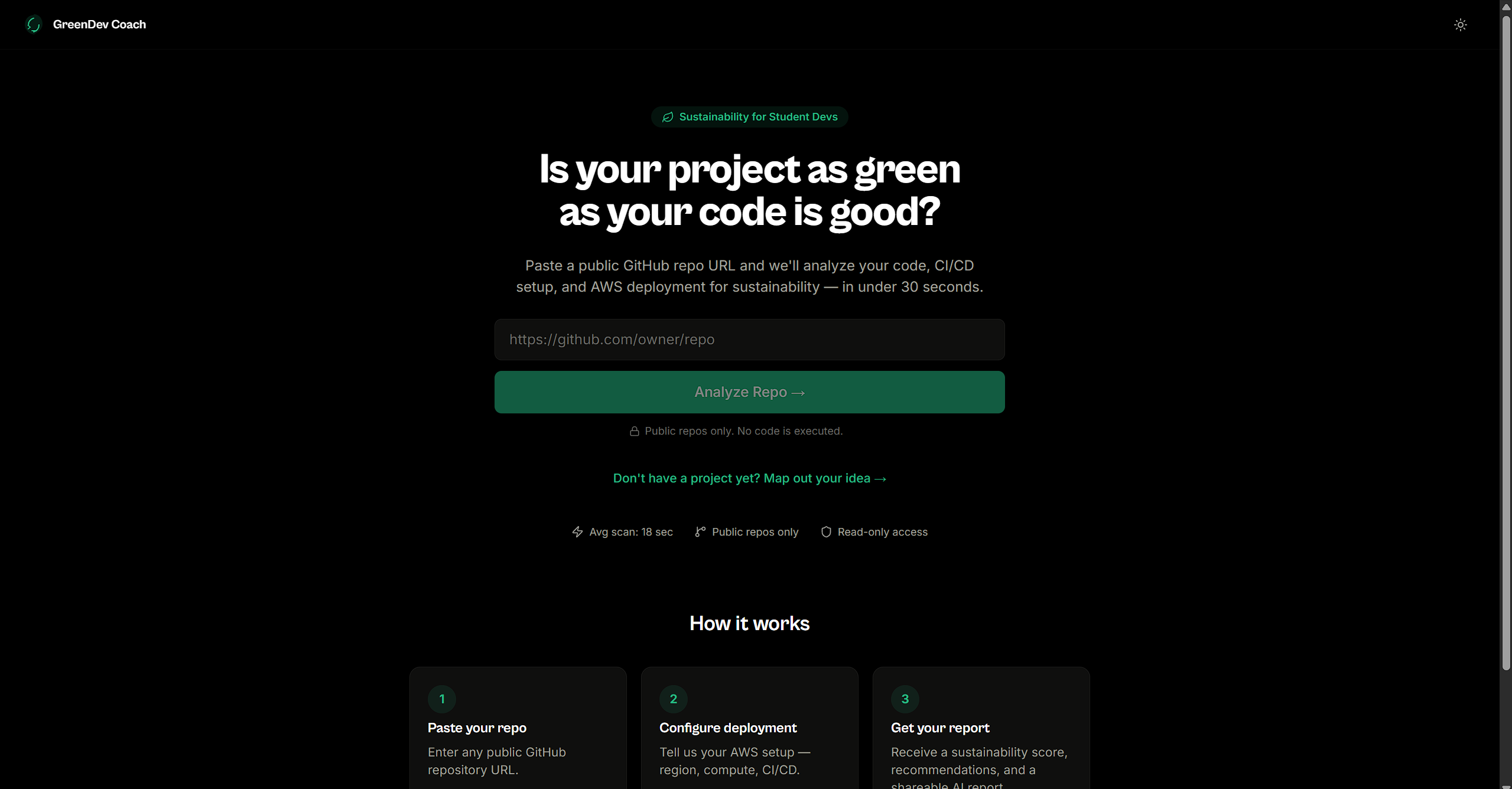
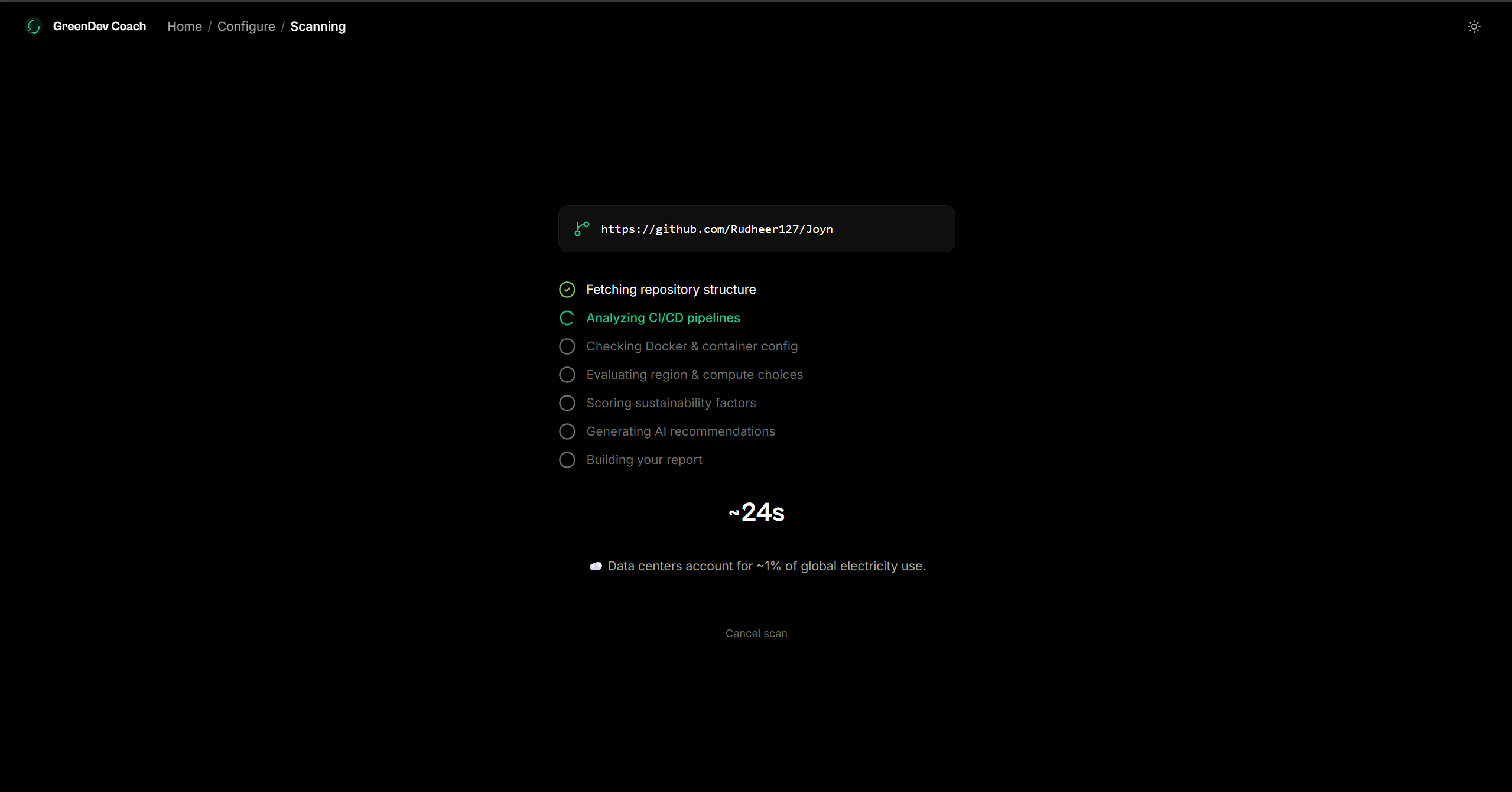
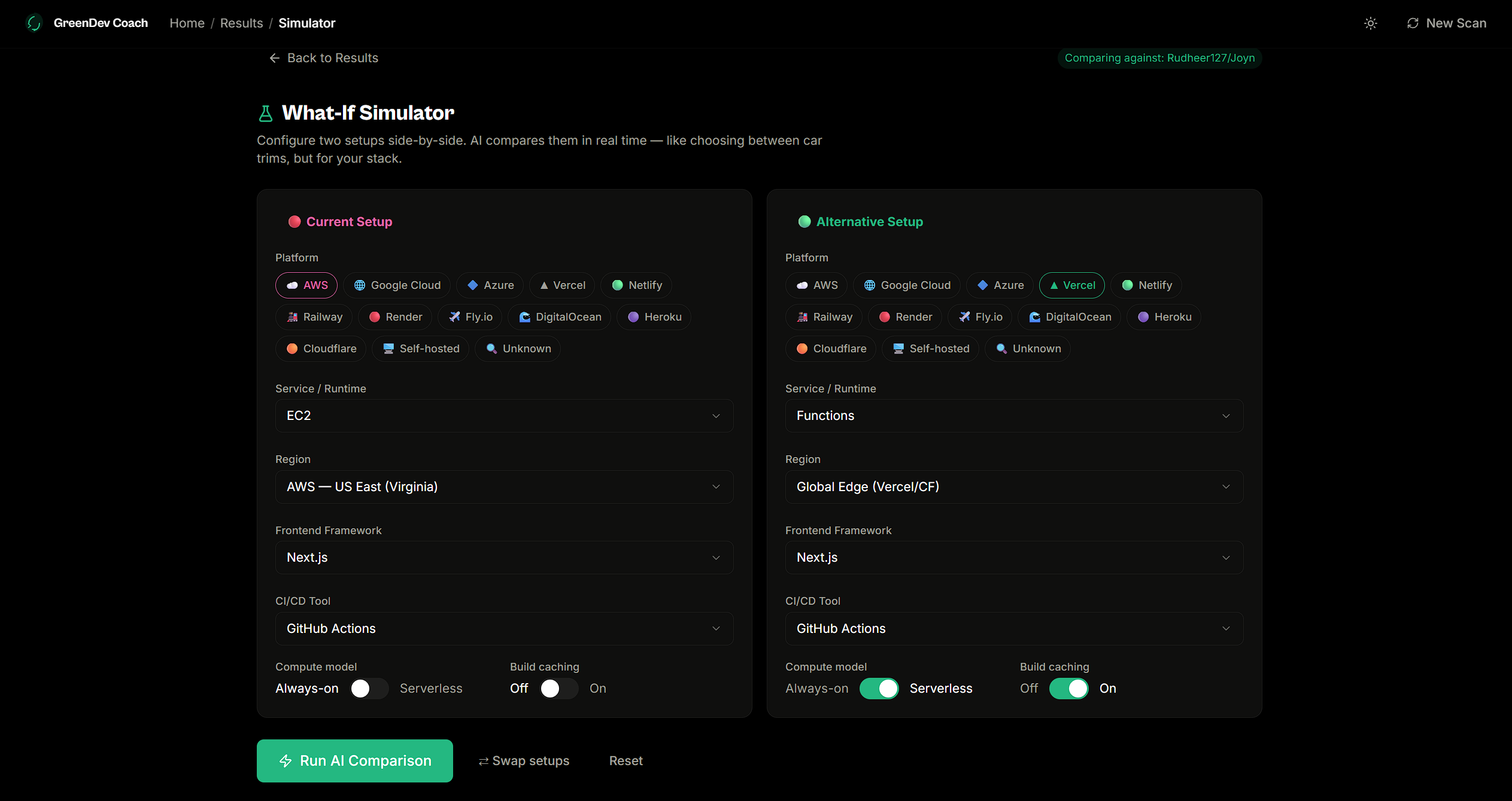
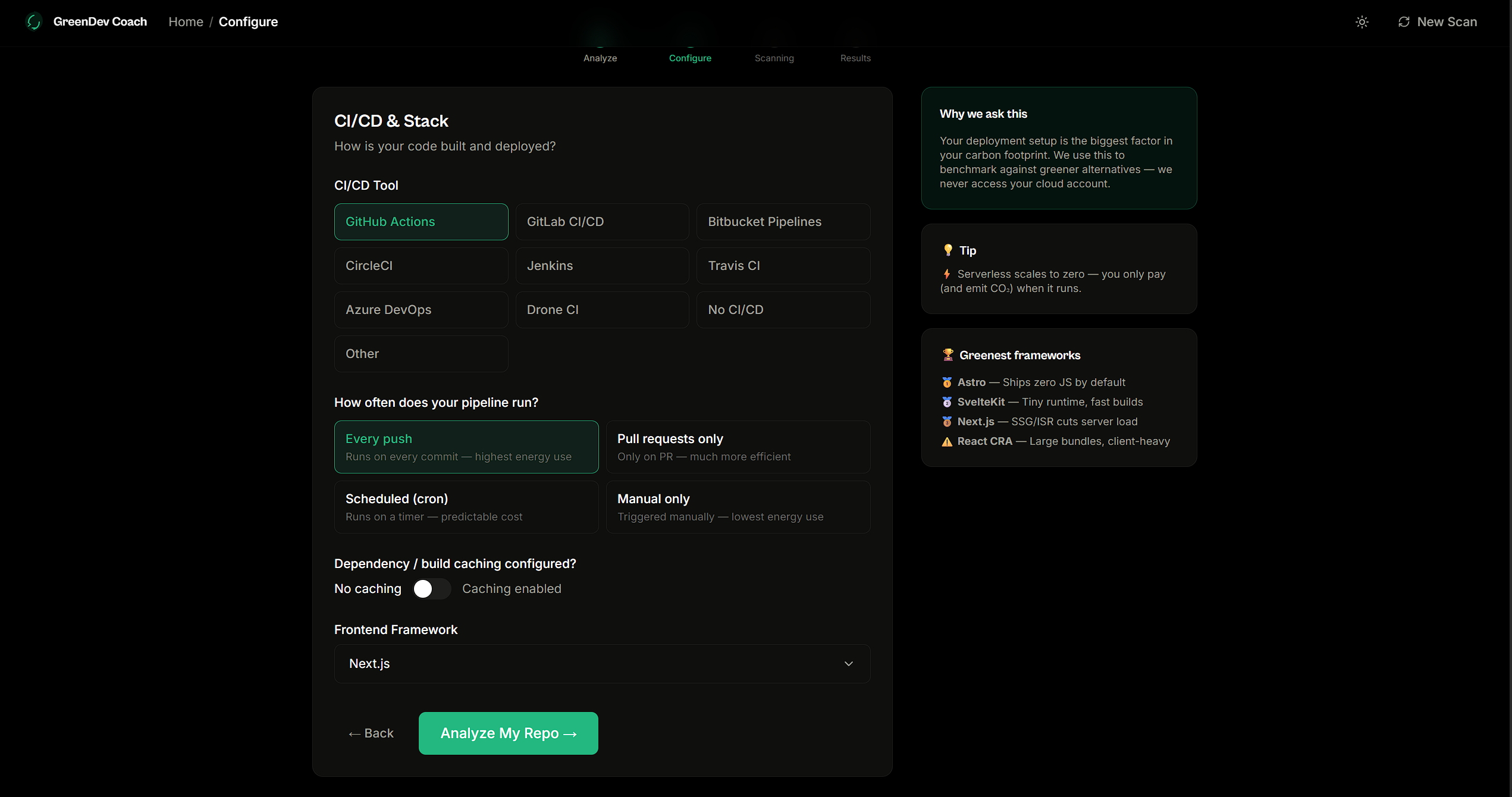
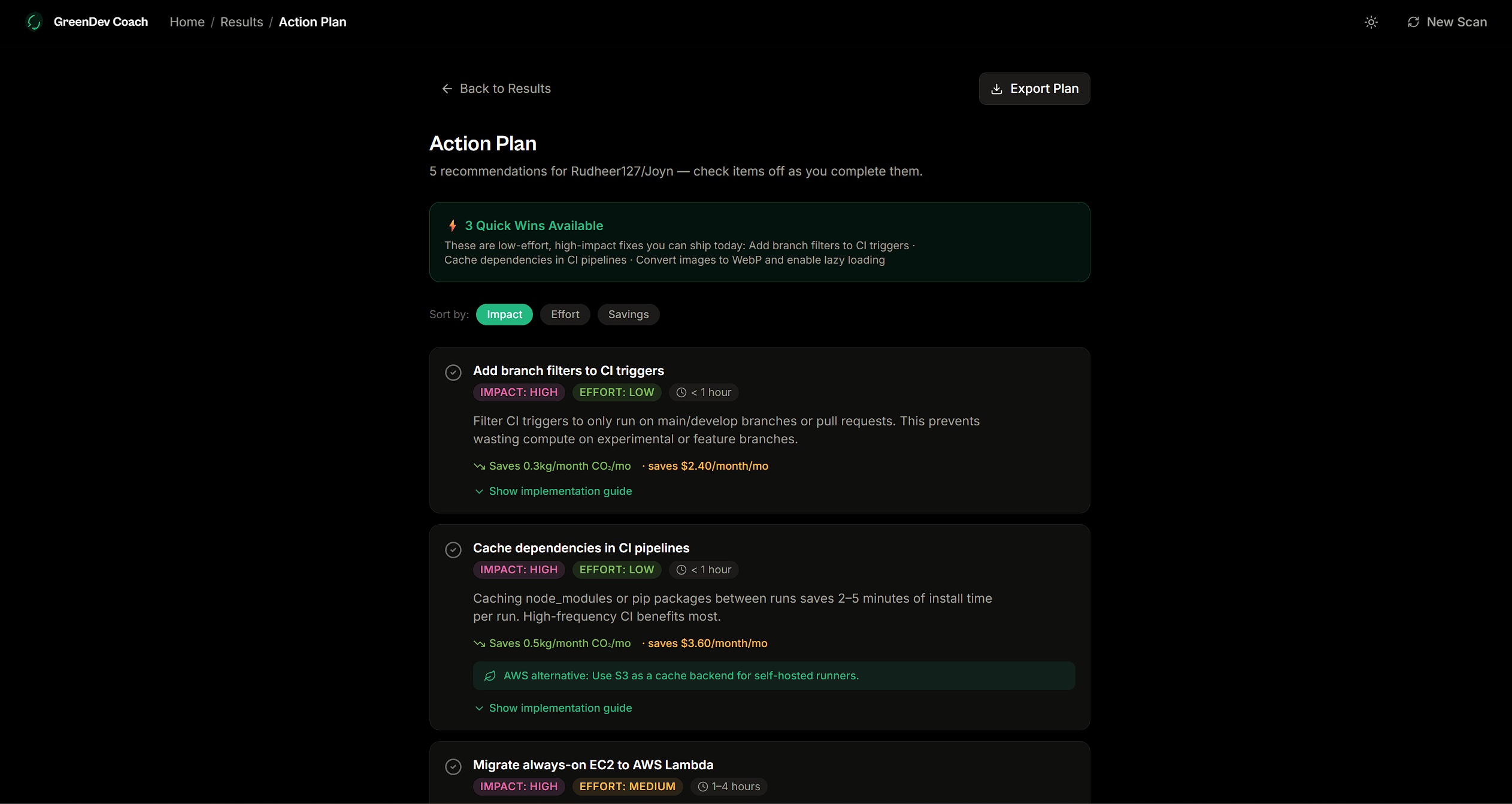
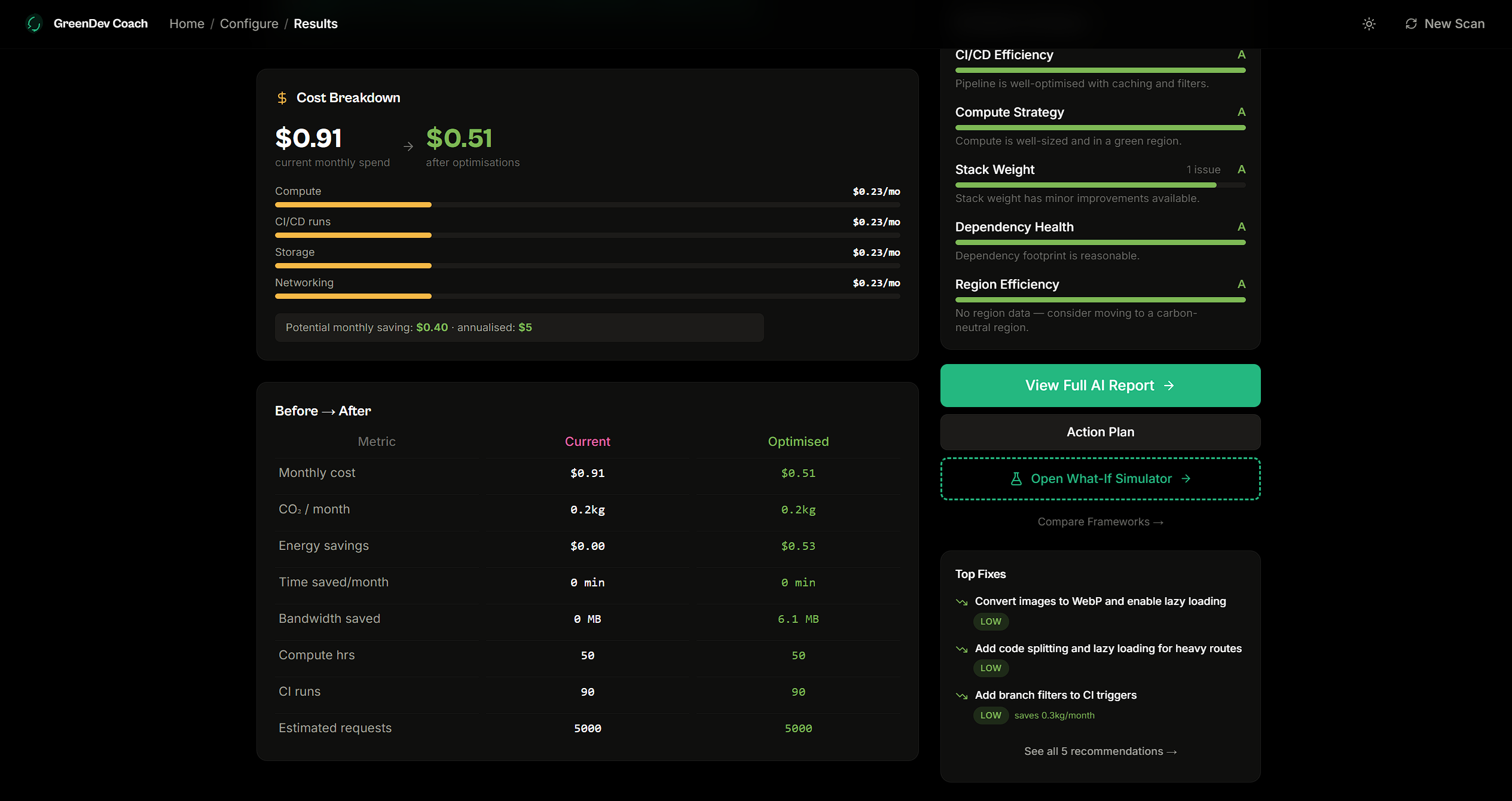
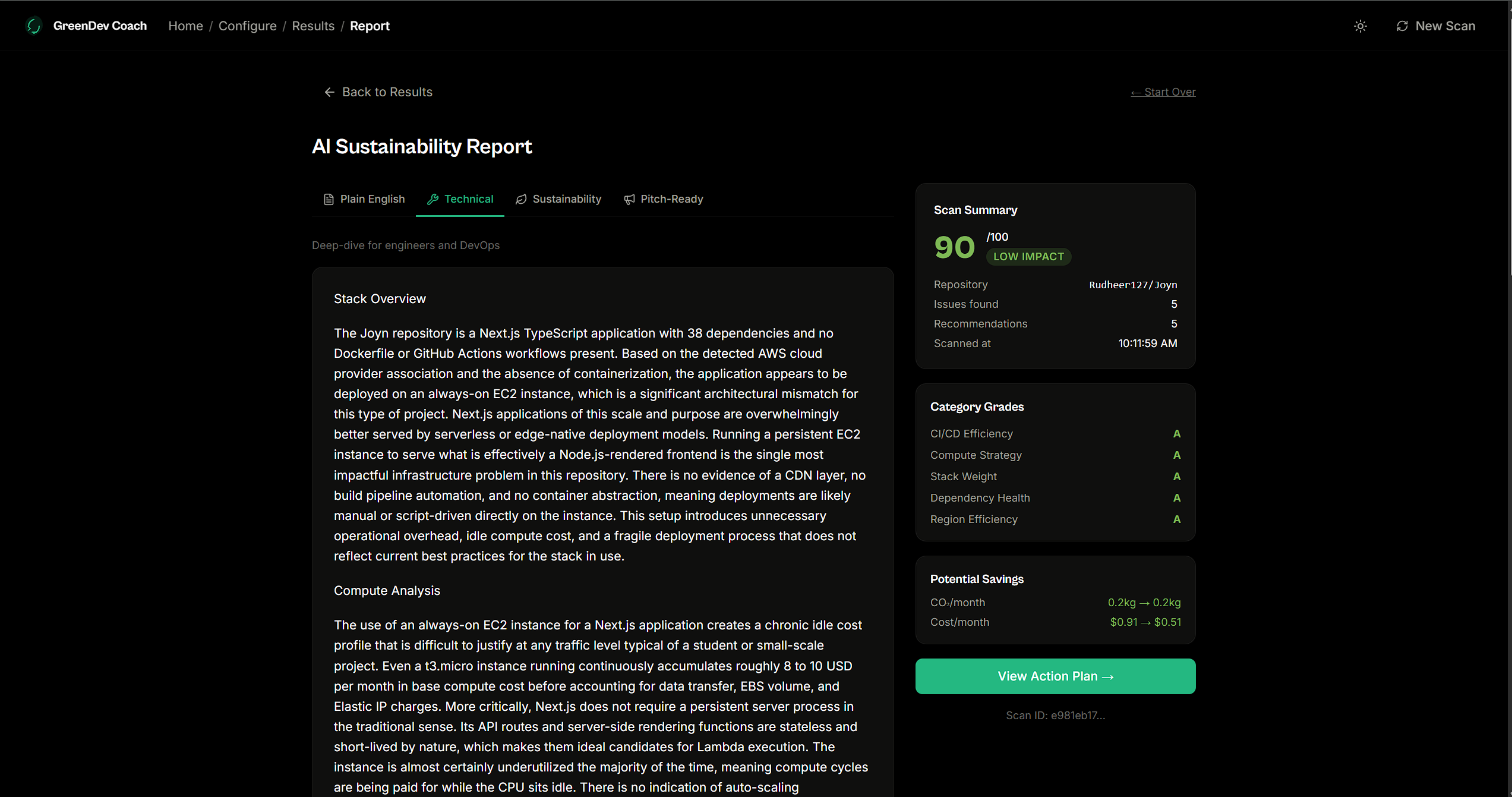
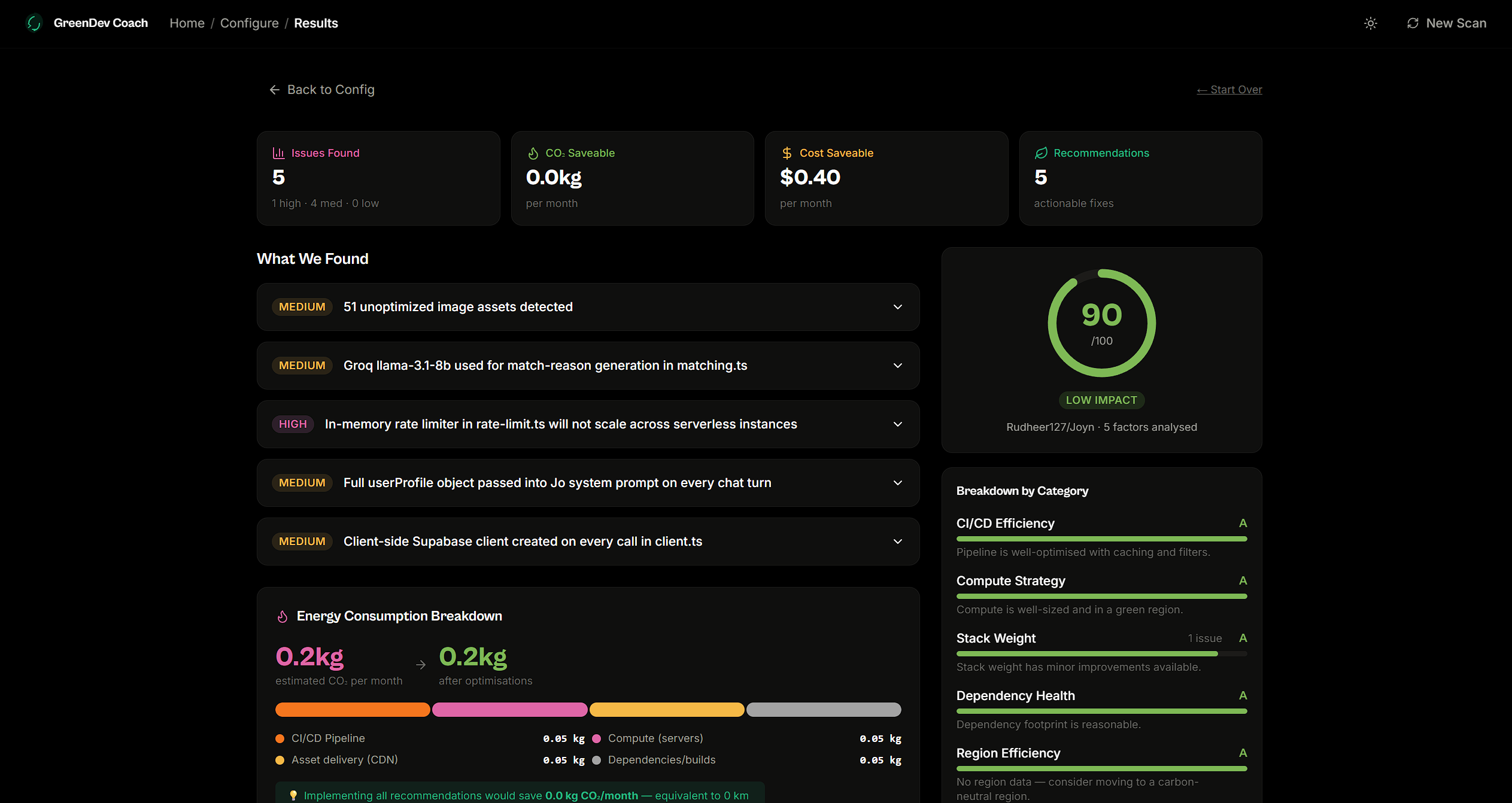
\section*{What it does} GreenDev Coach is an architectural intelligence platform that audits, simulates, and optimizes the sustainability of your tech stack. It operates in two ways. First, for existing software, you simply connect your GitHub repository. Our platform acts as a detective, scanning your deployment configuration, package dependencies, and continuous integration pipelines to generate a comprehensive Green Score alongside actionable advice. This helps you identify exactly where to implement edge caching or when to migrate to a greener cloud region. Second, our team built an Idea Planner for brand new projects. If you just have a concept, you can pitch it to the platform, and it will generate an entire sustainable architecture blueprint tailored specifically to your idea so you start off on the right foot. Finally, it features a What If Simulator sandbox, allowing you to pit your current tech stack against a greener alternative to see real time comparisons on bundle sizes, costs, and estimated carbon reductions.
\section*{How we built it} Our team wanted sustainability to feel premium and engaging, not like a boring enterprise spreadsheet. We built the frontend entirely on Next.js, React, and TypeScript, and relied heavily on Framer Motion to create fluid, glassmorphism inspired user interface transitions. For the brain of the operation, we integrated Amazon Bedrock using the Claude models. By deeply engineering our prompts, we feed the AI either raw GitHub repository metadata or user generated project ideas. The model then acts as a senior architect, calculating trade offs and returning highly structured datasets regarding impact, effort, and strategic alternatives. We bound this all together with a custom React Context engine that handles the complex states seamlessly.
\section*{Challenges we ran into} Our greatest technical hurdle was seamlessly orchestrating unstructured AI reasoning into a strictly typed, predictable interface. Because GreenDev Coach generates a complex dashboard with dynamically calculated metrics, like exactly how many kilograms of carbon dioxide you are saving per month, we had to forcefully constrain the AI to return perfect, parseable intelligence every single time without hallucinating numbers. Additionally, building a parallel pipeline for both Existing Repositories and New Project Ideas required us to heavily refactor our data models late in the process, ensuring our downstream simulators and user interface components could adapt instantly without crashing the application.
\section*{Accomplishments that we are proud of} Our team is incredibly proud of the What If Simulator. Watching the platform successfully contrast a heavy, inefficient application deployment against a highly optimized, edge deployed alternative, and seeing that mathematical carbon difference visualized in real time, is deeply rewarding. We are also extremely proud of the sheer aesthetic quality of the application. We managed to bring a beautiful, consumer grade, and emotional user interface to an environmental problem that is usually ignored or treated as a dry statistic.
\section*{What we learned} We learned how intimately software architecture is tied to planetary health. Simply selecting a data center in a region powered by renewables versus fossil fuels can drastically cut the carbon footprint of an application without requiring you to change a single line of your actual code. From a technical standpoint, we mastered the art of complex state orchestration within React and learned how to build tight guardrails around powerful AI models so they fit into traditional software workflows.
\section*{What is next for GreenDev Coach} Our team vision is to shift GreenDev Coach entirely to the left of the software development lifecycle. We plan to build native GitHub Pull Request integrations. Imagine opening a pull request and having our platform automatically issue a warning detailing how your architectural change will increase the application carbon footprint. We want to make environmental stewardship a native, effortless part of every continuous integration pipeline in the world.
\end{document}
Built With
- amazon-bedrock
- claude
- framer-motion
- github-api
- next.js
- react
- tailwind-css
- typescript
- vercel


Log in or sign up for Devpost to join the conversation.