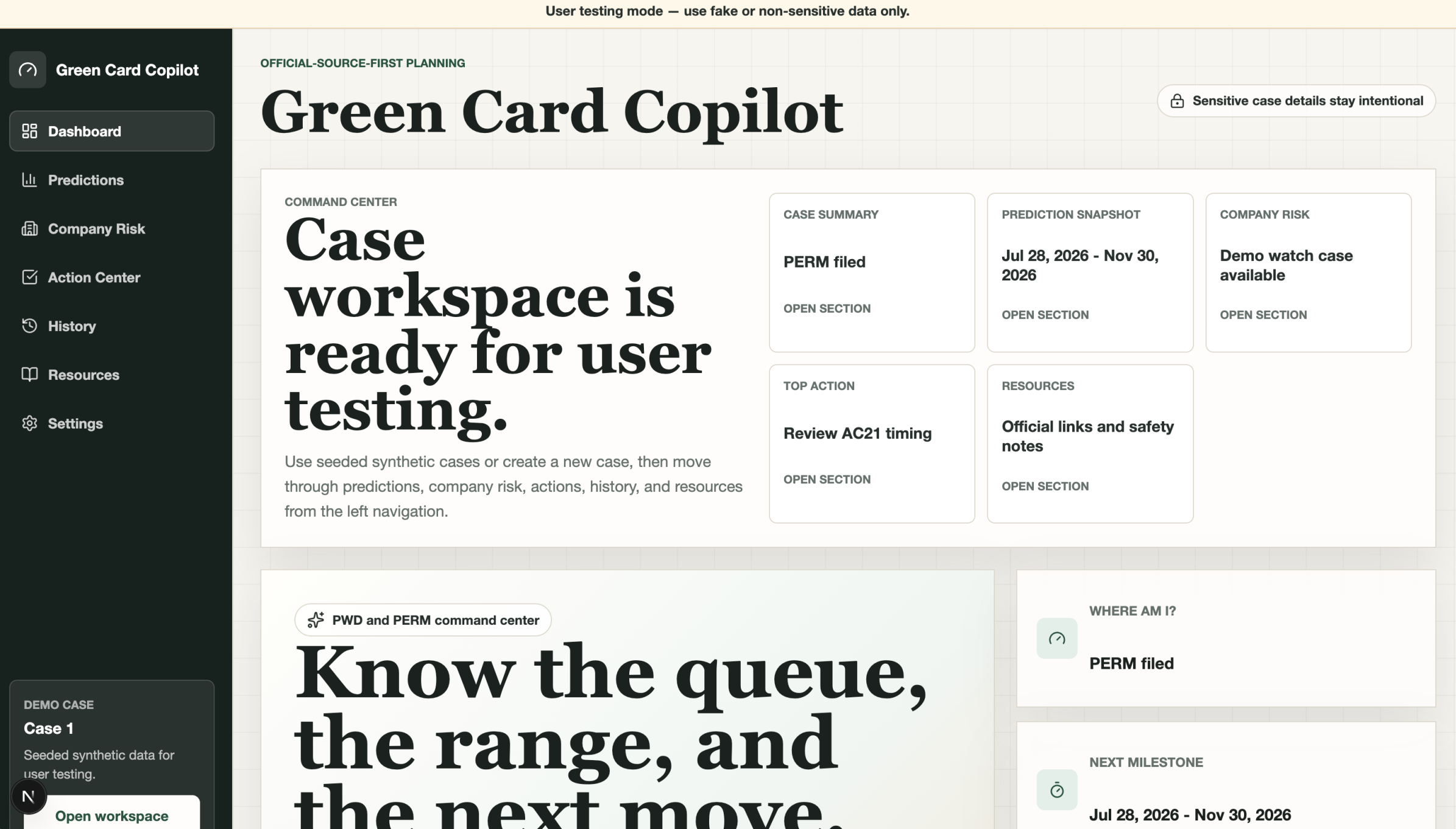
The Green Card process (PERM) is already one of the most uncertain parts of the U.S. employment-based green card journey, but the real instability often has nothing to do with immigration law itself. It comes from the employer.
A layoff, hiring freeze, restructuring, or shift in business priorities can silently pause a PERM case for months, sometimes without any direct communication to the employee.
Green Card Copilot was built to make that invisible layer visible.
It continuously monitors public signals, such as layoffs, company announcements, hiring trends, and news coverage and translates them into a structured view of risk:
“Is my PERM process likely to be delayed or disrupted based on employer stability?” The goal is not to overwhelm users with information, but to give them early warning signals and clarity in uncertainty during a long and opaque process.
Inspiration
This project came from observing a shared anxiety among international professionals navigating long immigration timelines: even when filings are correct and on track, external company decisions can abruptly change outcomes.
What stood out was not just the delay itself, but the lack of visibility into why things might suddenly slow down.
We wanted to turn that uncertainty into something: observable, trackable and actionable
So users are not left guessing in silence.
What we learned
Layoff and hiring data is extremely fragmented across the internet and rarely structured for decision-making Translating unstructured news into meaningful “risk signals” is more about interpretation than extraction Designing for emotional clarity is as important as building functional dashboards In real-time systems, filtering noise is harder and more important than collecting data
How we built it
The system is designed as a three-layer architecture:
- Data collection layer Aggregates public signals from: News articles, Company announcements, Layoff reporting sources, Hiring trend indicators
This layer focuses on breadth of signal capture across inconsistent sources.
- Signal processing layer
Transforms raw text into structured intelligence: Extracts entities (company names, job families, event types) Classifies events into: Layoffs Hiring freezes Expansion signals Neutral updates Assigns a PERM disruption risk score based on relevance and severity
This layer converts “news” into “impact.”
- Experience layer
Presents insights in a way that reduces cognitive overload:
Company-level risk dashboard Timeline view of signals over time Risk status indicators (low / medium / high concern) Monitoring feed for changes affecting employer stability
The focus here is interpretability: what changed, why it matters, and how it affects my timeline.
Challenges faced
Signal noise: Most layoff news is repetitive, vague, or speculative, making false positives a constant risk Entity matching: Companies are referenced inconsistently across sources (subsidiaries, abbreviations, parent groups) Emotional design tension: Balancing informative risk alerts without creating unnecessary panic or overinterpretation Real-time tradeoffs: Managing freshness of data vs accuracy and validation

Log in or sign up for Devpost to join the conversation.