-
-
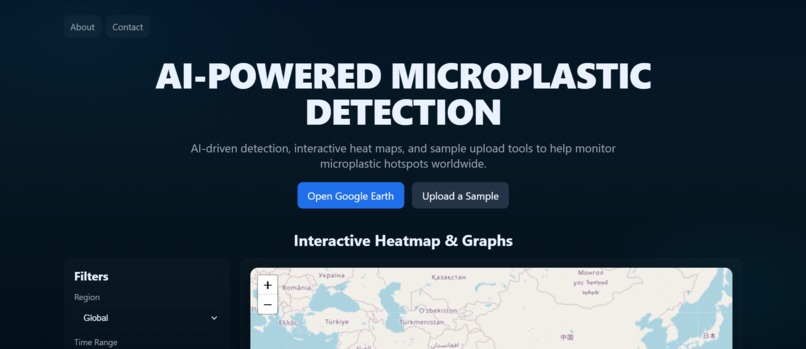
Homepage
-
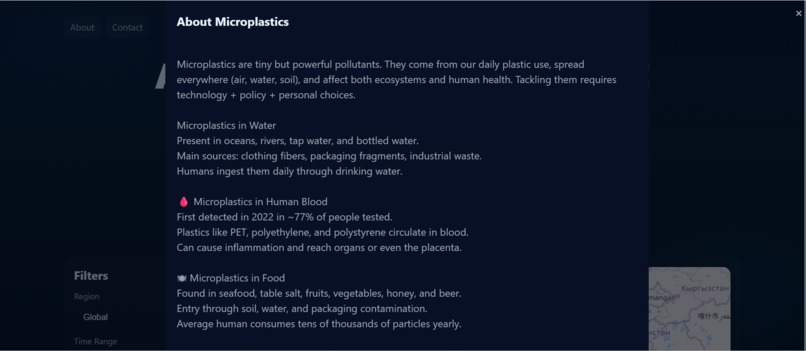
About Section
-

Contact Section
-
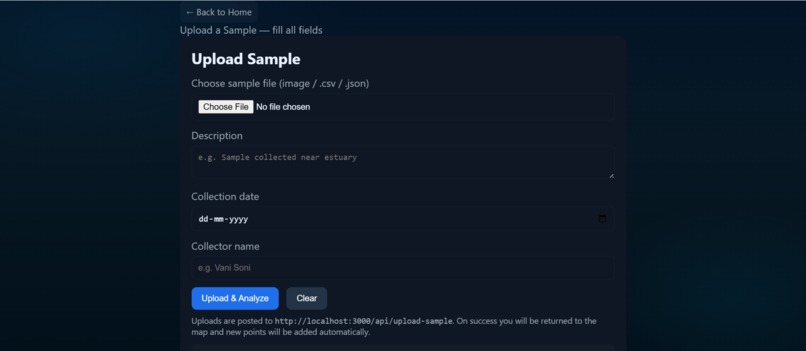
Sample Testing
-
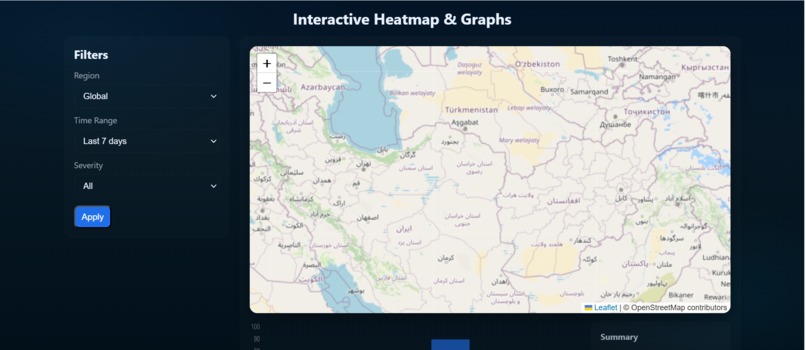
Interactive Heatmap


Inspiration
I have always held a deep respect and affection for our Mother Nature. From a young age, I felt a deep connection to the environment and understood the importance of preserving its beauty and balance. Over time, I realised that nature is not only our home but also the source of our survival and well-being. Witnessing the growing harm caused by human activities has strengthened my determination to make a difference. I see this opportunity as a meaningful way to contribute to protecting our environment and giving back to the nature that has always nurtured us.
What it does
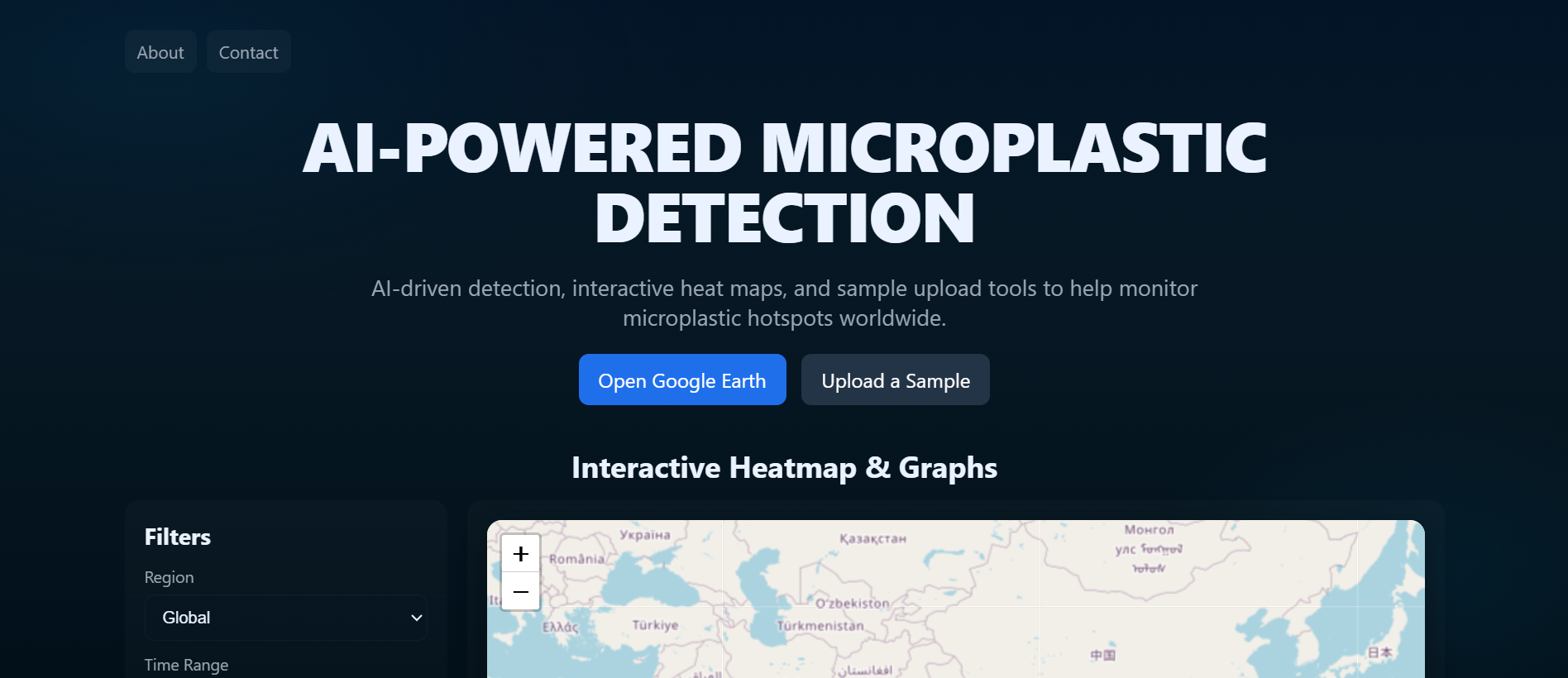
Our model enables users to detect microplastics in a given sample with accuracy and efficiency. Beyond detection, it provides AI-generated insights and solutions to address the identified issues. Additionally, users can interact with the AI to ask questions, seek guidance, or explore more information related to microplastics and environmental well-being.
How we built it
1]. Problem Understanding We started by researching the impact of microplastics in water, soil, and food. We identified the gap: detecting microplastics is complex and expensive, so an AI-based solution could make it more accessible. Dataset Collection & Preparation Collected publicly available datasets of microplastic images in water and soil. Since datasets were limited, we generated synthetic data (augmentations like rotation, scaling, and noise addition). Preprocessed all images into a fixed size (e.g., 128×128 pixels) and normalised them for training.
2]. Model Development Used deep learning with CNNs (Convolutional Neural Networks) to detect microplastics. Leveraged transfer learning with pre-trained models (e.g., ResNet, EfficientNet) to improve accuracy. Trained and validated the model on a GPU for faster performance.
3]. Backend (AI Inference) Created an inference pipeline in Python (PyTorch + TorchVision). Built an API using Flask/FastAPI to handle image uploads and return predictions. Stored the trained model (.pt file) and optimised it for deployment.
4]. Frontend (User Interface) Designed a clean, interactive dashboard using React.js + Tailwind CSS. Features: Upload a sample (image) Get detection results (whether microplastics are present) Preview option
5]. Access AI-generated solutions & insights Chat with the AI for guidance AI Assistant Integration Integrated a large language model (LLM) that allows users to ask questions about microplastics, the environment, or solutions. This ensures users not only detect but also understand the problem and possible actions.
6]. Deployment Backend deployed on a server (Flask API). Frontend connected with the API for real-time predictions. Ensured scalability so more samples can be tested in the future.
7]. Testing & Validation Tested with real and synthetic images. Cross-checked predictions with available research papers and datasets. Improved accuracy with feedback loops.
In short, we combined an AI-based microplastic detection
Challenges we ran into
One of the major challenges was integrating AI seamlessly into the system, ensuring smooth interaction between the detection model, backend, and frontend. Another difficulty was testing on real samples, as the availability and accuracy of real-world microplastic data posed limitations compared to synthetic datasets. These challenges required careful optimisation, troubleshooting, and creative workarounds to move the project forward.
Accomplishments that we're proud of
We completed the project and built a working solution despite the challenges we faced. We are proud of overcoming technical hurdles such as AI integration and real-world testing, and delivering a functional system that detects microplastics, provides AI-driven insights, and allows user interaction. This achievement reflects our teamwork, persistence, and commitment to contributing toward environmental sustainability.
What we learned
Throughout this project, we gained knowledge and experience across a wide spectrum of skills, ranging from the basics of application development to advanced concepts in artificial intelligence. At the start, we explored how to build and structure an API, which served as the backbone for connecting the detection model with the user interface. This helped us understand the importance of backend systems, data flow, and efficient communication between different components of a project.
As we progressed, we delved deeper into AI model development and integration. We learned how to prepare and preprocess datasets, apply augmentation techniques to handle limited data, and experiment with deep learning architectures for accurate predictions. Integrating the trained model into a real-world system was an invaluable learning experience, as it required us to optimise for performance, scalability, and usability.
What's next for AI-Powered Microplastic Detection & Monitoring System
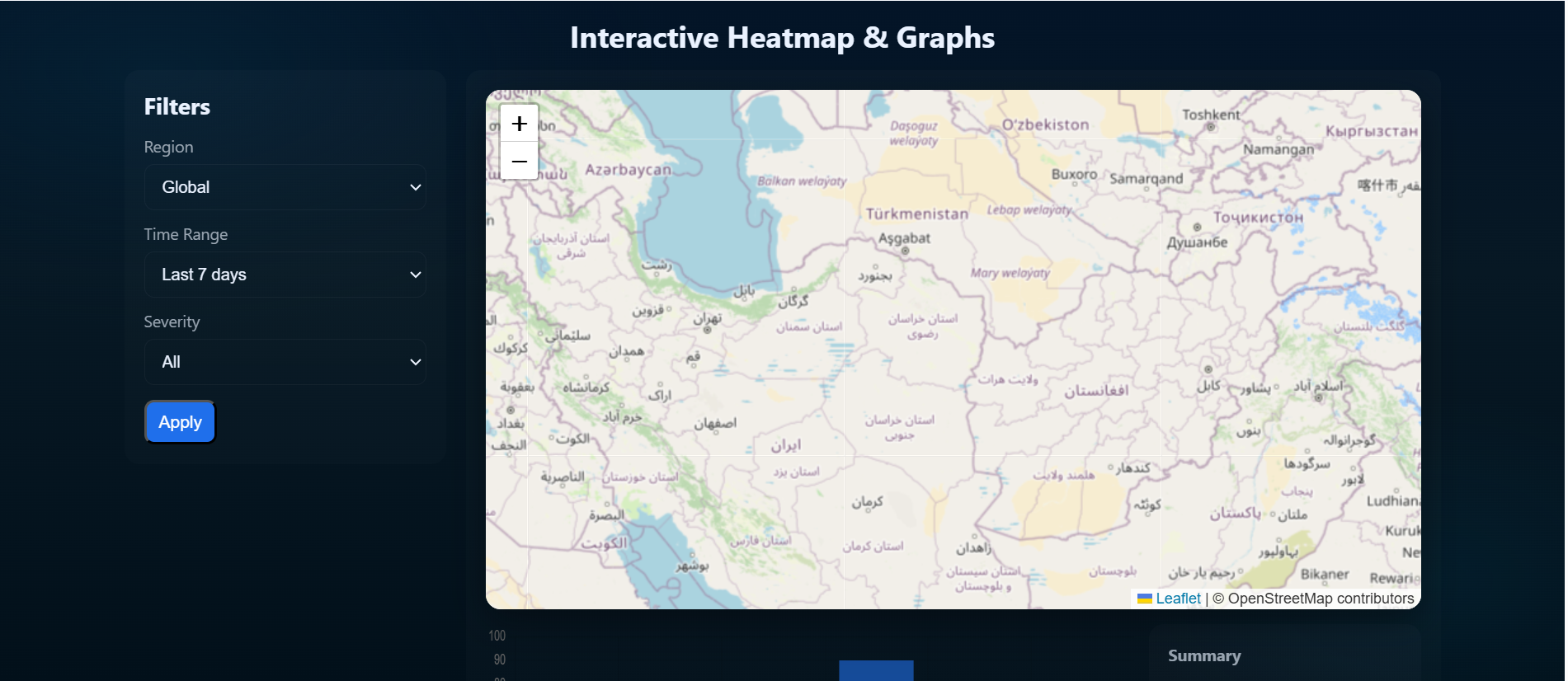
Our journey doesn’t stop here. While we have built a working prototype that detects microplastics and provides AI-driven insights, we envision several exciting future enhancements: Integration with Real-Time Sensors: Expanding beyond image-based detection by connecting IoT sensors for continuous monitoring in water bodies, soil, and air. Scalability to Larger Datasets: Training on more diverse and real-world datasets to improve accuracy, robustness, and adaptability across environments. Cloud Deployment & Mobile App: Making the system accessible on the cloud and through a mobile application, enabling users and researchers to detect microplastics anytime, anywhere. Advanced Analytics & Dashboards: Offering detailed visualisations, trends, and reports for policymakers, industries, and environmental organisations. Community & Citizen Science Participation: Allowing individuals to upload local data, strengthening global awareness and data collection. Integration with Recycling & Remediation Efforts: Extending beyond detection by suggesting actionable solutions, including recycling strategies and pollution control methods. Our ultimate goal is to transform this project into a scalable, user-friendly, and impactful platform that not only detects but also monitors and helps reduce microplastic pollution globally.
Built With
- ai
- colab
- css
- flask
- flask-cors
- gpt-oss:20b
- html
- javascript
- machine-learning
- ollama
- openai
- pil
- python
- spyder

Log in or sign up for Devpost to join the conversation.