Inspiration
We were inspired by a problem that almost nobody talks about: the carbon cost of our digital lives.
People are becoming more conscious of the climate impact of flights, food, fast fashion, and transportation, but digital behavior still feels invisible. Yet millions of people spend hours every day on TikTok, YouTube, Netflix, Instagram, Zoom, and other online platforms powered by devices, cellular networks, and massive energy-hungry data centers. The average person has no intuitive way to understand that impact, no product that shows it to them, and no habit loop that encourages change.
That gap felt huge to us.
We wanted to build something that did more than calculate carbon. We wanted to build something that made digital carbon personal, emotional, visible, and memorable. We asked ourselves: what if reducing your digital footprint felt less like reading a sustainability report and more like taking care of something alive?
That idea led to Greelo.
Greelo transforms screen time into a live digital carbon footprint experience. Instead of giving users a number they will forget, it creates an immediate feedback loop: your digital behavior affects a living companion, your social standing, and a shareable weekly “carbon receipt.” We were especially inspired by the behavioral power of products like Duolingo, Tamagotchi, and social habit trackers, and wanted to apply that same engagement loop to climate action in a way that feels modern, relevant, and surprisingly urgent.
At its core, Greelo came from one simple belief: if people could finally see the hidden cost of their digital habits, they would start to change them.
What it does
Greelo is a digital carbon awareness platform that turns screen time into a live, interactive climate signal.
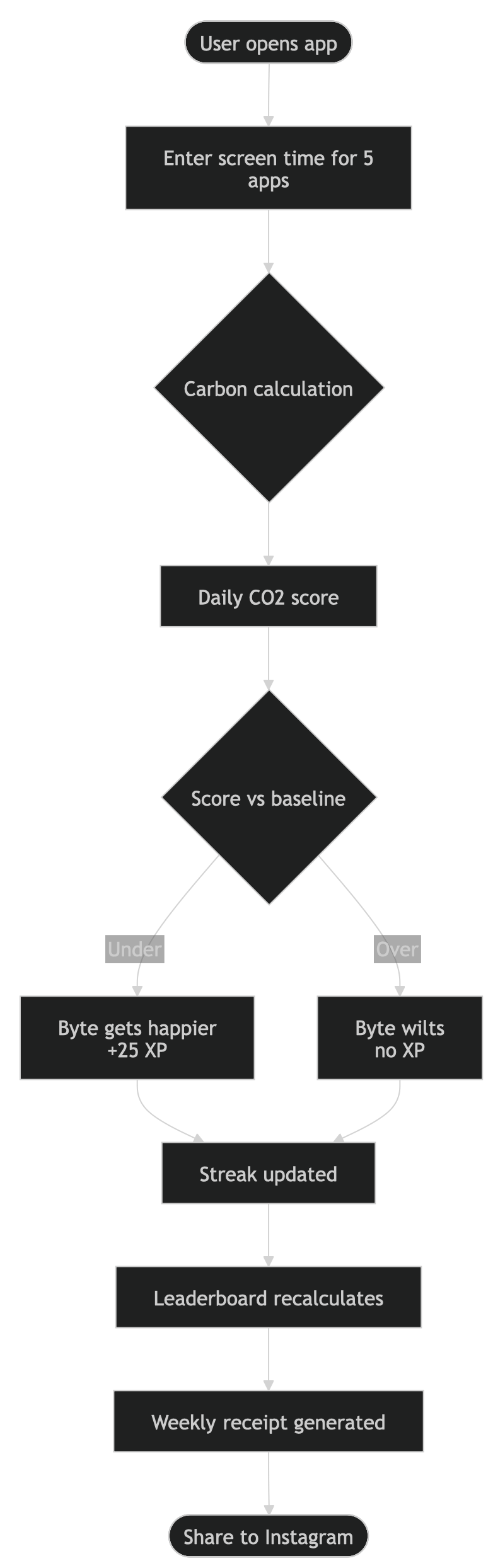
The app lets users input time spent across major apps such as TikTok, Netflix, YouTube, Instagram, and Zoom. It then estimates the carbon impact of that usage based on the type of platform being used, the device involved, network conditions, and regional energy context. Instead of burying that information in a technical dashboard, Greelo turns it into a clear and emotionally resonant experience.
Our MVP includes several connected layers:
1. A live digital carbon score Users can log or input app usage and immediately see an estimated carbon number representing the environmental impact of their digital behavior. This makes an invisible system visible in real time.
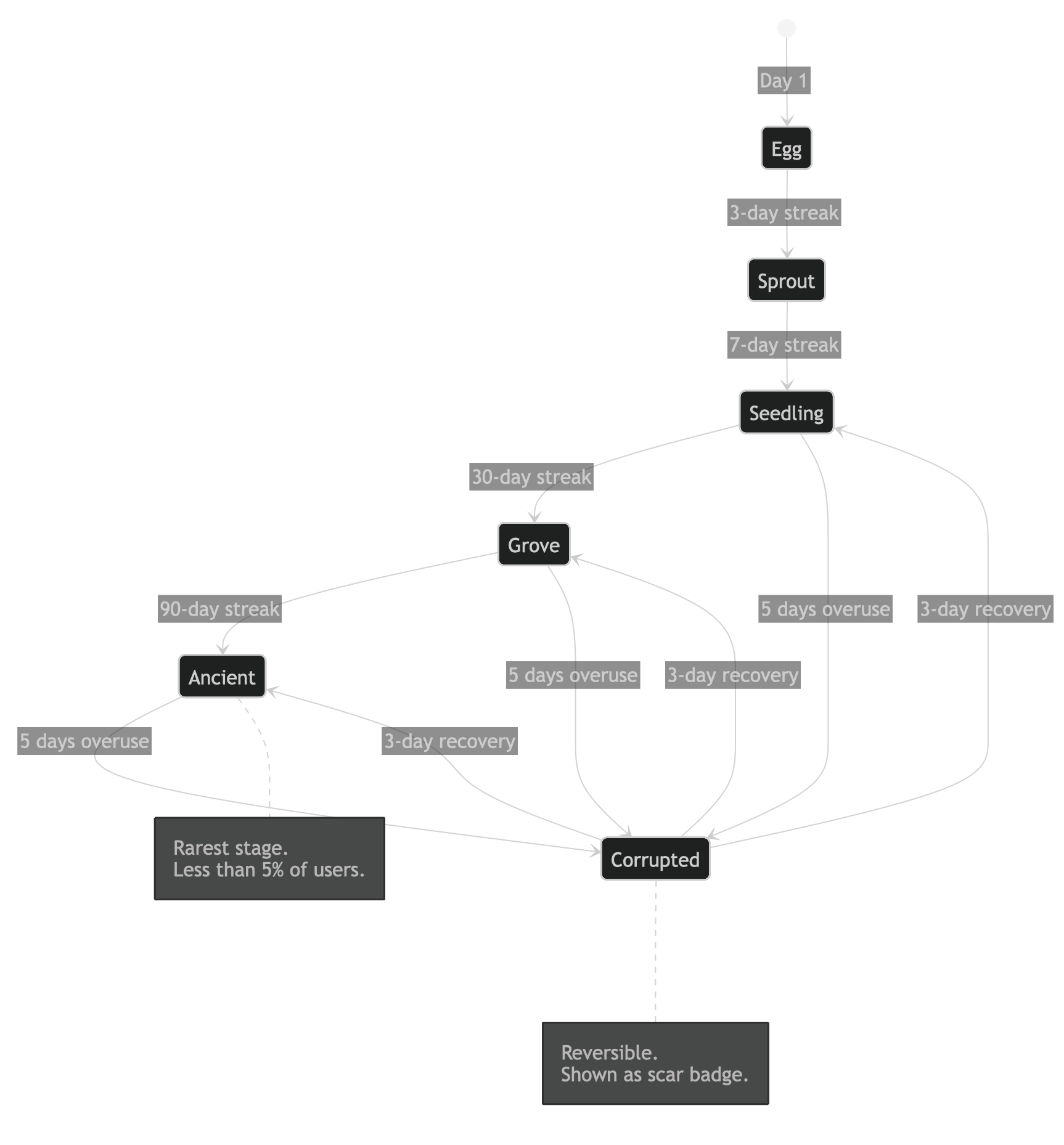
2. A reactive digital companion Greelo includes a living digital creature whose health and emotional state reflect the user’s digital carbon behavior. When usage is low and behavior is more climate-conscious, the companion appears healthy, bright, and energetic. As usage increases, it becomes tired, wilted, and eventually corrupted. This transforms carbon feedback from abstract data into emotional feedback.
3. A weekly carbon receipt We designed a shareable weekly summary card that works like a “Wrapped”-style receipt for digital emissions. It highlights total carbon output, top contributing apps, baseline comparison, and user progress. This feature makes the experience social, visual, and inherently shareable.
4. A social and competitive layer Greelo is not just a solo tracker. It includes a leaderboard concept where users can compare weekly carbon performance with friends. Instead of glorifying more usage, it flips the usual social logic: lower digital carbon means better performance. This gives users a reason to come back and creates accountability in a fun way.
5. A campus dashboard concept We also extended the idea beyond the individual. Our university dashboard concept shows how Greelo could scale institutionally by visualizing aggregate student digital carbon patterns, surfacing trends, and creating campus-wide challenges. This adds a serious systems-level dimension to the product and makes it relevant not only for users, but also for schools and sustainability offices.
What makes Greelo compelling is that it does not stop at awareness. It combines awareness, emotion, gamification, identity, and social comparison into one unified experience. It turns digital carbon from something people never think about into something they can understand, react to, and want to improve.
How we built it
We built Greelo as a focused hackathon MVP designed to prove one core idea: digital carbon can become visible, interactive, and behavior-changing if it is presented the right way.
We started by identifying the most important pieces of the user experience rather than trying to build every possible feature. That led us to center the MVP around five essential elements:
- manual app usage entry
- live carbon calculation
- an animated digital companion
- a shareable weekly receipt
- a social/campus dashboard layer
From a product design perspective, this was crucial. We knew that if the first interaction did not feel immediate and memorable, the concept would lose its impact. So instead of overinvesting in infrastructure, we focused on building a polished, demo-ready interaction loop where users can enter usage, instantly see a carbon result, and watch the companion react.
We developed the app as a web-first MVP so that we could maximize speed, polish, and reliability during the hackathon. This let us concentrate on user experience, visual design, and feedback loops rather than spend valuable time wrestling with fragile native integrations. That decision made the entire product stronger because it kept the emphasis on clarity and demo quality.
We then designed the digital companion system to act as the emotional core of the product. Its different visual states correspond to different ranges of digital carbon behavior, allowing users to immediately understand the consequence of their actions without reading any explanation. This feature became the heart of the product because it translates sustainability into a living visual language.
We also built a receipt experience that transforms a week of digital behavior into a polished, social, story-like summary. This was important because it takes something hidden and technical and makes it public, visual, and culturally legible. People may not post a spreadsheet of emissions, but they might post a beautiful summary card that feels like part of their identity.
Finally, we expanded the project with a campus-level dashboard concept because we wanted to show that Greelo is not just a consumer app — it can also become an institutional sustainability tool. This made the project more ambitious, more scalable, and more interesting from a systems perspective.
In short, we built Greelo by combining:
- climate awareness
- behavioral psychology
- gamification
- emotional design
- social accountability
- scalable systems thinking
That combination is what gives the project its distinctiveness and its potential.
Challenges we ran into
One of our biggest challenges was the core challenge of the problem itself: digital carbon is invisible.
When people think about environmental impact, they usually imagine something physical — a car, a plane, a factory, a plastic bottle. Streaming and doom-scrolling do not feel physical, even though they are supported by real infrastructure with real energy costs. That meant our first design challenge was not just technical, but conceptual: how do you make something abstract feel real enough that people care?
Our answer was to make the feedback emotional rather than purely numerical. That led to the digital companion concept, but getting that right was harder than it sounds. If it was too cute, the project would feel trivial. If it was too serious, it would feel heavy and uninviting. We had to find the exact middle ground where the product felt engaging, emotionally resonant, and still meaningful.
Another challenge was scope. There are many directions this idea could go in: native screen-time integrations, real widgets, larger social systems, advanced personalization, institutional tooling, recommendation engines, and more. In a hackathon, trying to do everything is the fastest way to build nothing well. We had to be disciplined about scope and repeatedly ask ourselves: what is the smallest version of this idea that still feels powerful?
That forced us to prioritize a polished MVP over feature sprawl. We intentionally cut things like full native integrations and more advanced systems so that we could make the key interaction loop feel complete. That was difficult, but it made the final result stronger.
We also ran into the classic product challenge of balancing information and motivation. Most sustainability tools are good at showing numbers, but weak at changing behavior. Most social apps are good at changing behavior, but often in the wrong direction. We were trying to combine the strengths of both without inheriting their weaknesses. We had to think deeply about what kind of social loop would encourage lower digital carbon without accidentally encouraging more screen time.
Finally, we had to make the project feel both consumer-friendly and institutionally credible. The individual experience needed to feel playful and engaging, while the campus layer needed to feel serious, scalable, and useful. Bridging those two worlds in one project was a real design challenge, but it also became one of Greelo’s biggest strengths.
Accomplishments that we're proud of
We are proud that Greelo feels like a genuinely new kind of climate product.
There are plenty of sustainability tools, screen-time tools, and gamified habit trackers, but very few products combine those worlds into a single experience this cohesively. Greelo does not feel like a repackaged carbon calculator. It feels like the beginning of a new category: digital carbon awareness made emotional, social, and actionable.
We are especially proud of the digital companion system. That feature gave the product a soul. It transformed a technical metric into a relationship. Instead of asking users to care about a graph, we created something they instinctively do not want to harm. That shift from data to emotion is one of the most powerful parts of the project.
We are also proud of the weekly receipt. It takes a concept that could have felt dry and turns it into something visual, social, and highly memorable. In a world where people love sharing identity-driven summaries and status snapshots, this feature gives climate behavior a format that feels native to how people already interact online.
Another accomplishment we are proud of is the scope of the vision. We did not stop at the individual user. By building a campus dashboard concept, we showed how Greelo can scale from a personal behavior-change tool into a platform with real institutional relevance. That gives the project a much larger future and makes it more compelling as a serious solution rather than just a clever app demo.
Most of all, we are proud of the overall product experience. The flow is clear, the concept is sticky, and the demo tells a compelling story: enter your digital behavior, see the carbon impact, watch your companion react, compare yourself socially, and imagine a world where this becomes part of everyday climate awareness. That clarity and cohesion are hard to achieve in a short hackathon, and we believe it is one of the reasons Greelo stands out.
What we learned
We learned that awareness alone is not enough.
One of the most important lessons from building Greelo is that people rarely change behavior just because a number exists. Information matters, but emotion, visibility, and feedback loops matter more. If we wanted users to care about digital carbon, we could not just show them a metric. We had to make the metric feel immediate, personal, and impossible to ignore.
We also learned how powerful framing is. Existing screen-time tools usually frame reduced usage as a wellness or productivity decision. Existing climate tools usually frame reduced emissions as a long-term moral decision. Greelo showed us that when you combine those two frames, you create something much more compelling: a climate action that feels personal, daily, and socially legible.
Another major lesson was that emotional design is not a cosmetic layer — it can be the core mechanism of behavior change. The digital companion was not just a fun addition to the product; it became the product’s central communication system. That taught us a lot about how deeply interface design can shape whether a sustainability product actually works.
We also learned the value of disciplined product scope. Early on, it was tempting to imagine a much bigger system with more data integrations, more automation, and more features. But what made Greelo strong was choosing the minimum set of features needed to make the idea click instantly. That let us invest in polish, clarity, and product storytelling rather than just technical breadth.
Finally, we learned that the idea has much bigger potential than we initially expected. What started as a consumer-facing screen-time concept quickly opened up into a campus tool, a sustainability education tool, and a new way of thinking about invisible infrastructure through design.
What's next for Greelo
The next step for Greelo is turning this strong MVP into a complete ecosystem for digital carbon awareness and behavior change.
Our immediate next goal would be to replace manual input with real integrations into device-level screen-time systems so the experience becomes frictionless and automatic. That would make the feedback loop much stronger and allow users to build a true daily habit around the product.
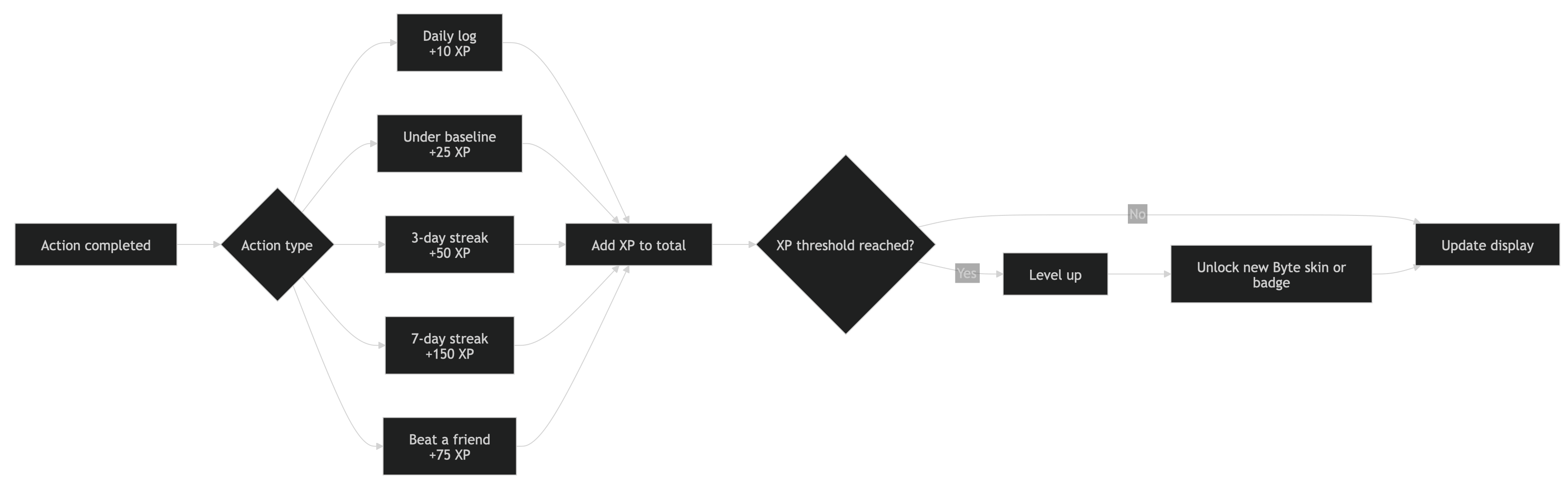
We also want to expand the companion system significantly. That includes richer progression, more visual states, unlockable cosmetics, more advanced recovery and corruption dynamics, and social interactions where friends can support each other’s companions. We believe this system has the potential to become one of the most memorable parts of the product and a major driver of retention.
On the product side, we want to deepen the social layer with group challenges, stronger weekly competition, long-term progress tracking, and more meaningful team-based sustainability goals. This would allow Greelo to work not only as a personal habit tool, but also as a shared experience among friends, dorms, clubs, and student communities.
At the institutional level, we see major potential in partnerships with universities. A campus dashboard could help schools better understand the hidden impact of digital infrastructure and student behavior while giving students a way to participate in sustainability efforts that feels relevant to how they actually live. This is especially exciting because most campus climate initiatives focus on transportation, waste, or food; Greelo opens up an entirely overlooked dimension of sustainability.
Long term, we want Greelo to define a new category. Not just “another sustainability app,” but the first platform that makes the carbon footprint of digital life visible, engaging, and culturally sticky. If carbon literacy is going to become part of everyday life, digital behavior has to be part of that conversation — and Greelo is our vision for how that future begins.
Built With
- css
- javascript
- mermaid
- typescript

Log in or sign up for Devpost to join the conversation.