
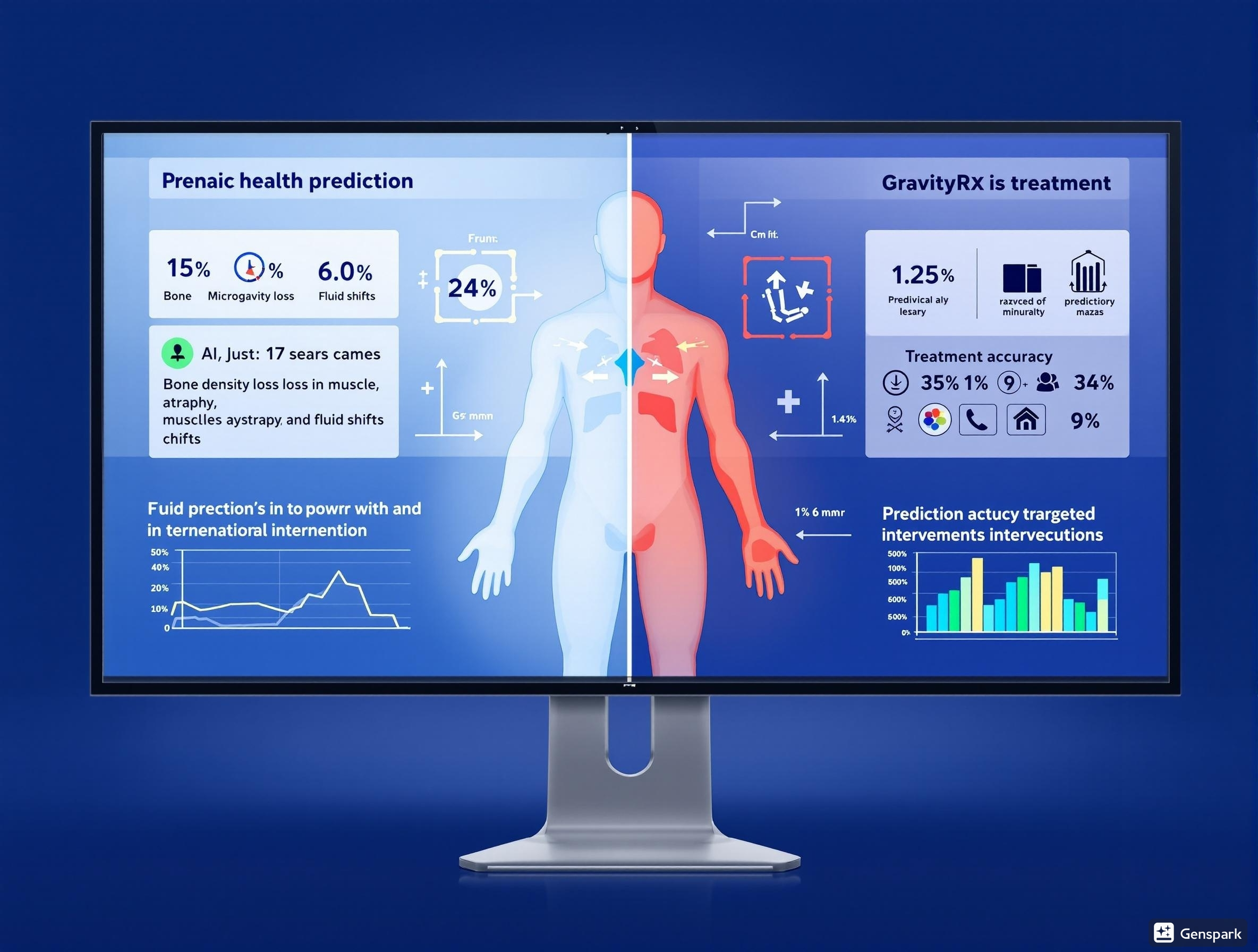
Inspiration The increasing duration of space missions and plans for Mars exploration present unprecedented medical challenges. Astronauts experience significant physiological changes in microgravity, from bone density loss to vision impairment. GravityRx was inspired by the need for adaptive healthcare solutions that evolve with astronauts' changing bodies throughout long-duration missions.
What it does GravityRx is an AI-powered medical treatment system that continuously monitors astronaut health data, predicts physiological changes, and automatically adjusts medication dosages and treatment protocols. It creates personalized health maintenance plans based on individual genetic profiles and real-time biometric data collected in space.
How we built it We developed a machine learning algorithm trained on NASA's astronaut health database to predict physiological responses to prolonged microgravity. Our system integrates with wearable sensors to collect real-time data and utilizes a medication delivery system designed specifically for space environments. We created a user-friendly interface that works even with limited bandwidth communications.
Challenges we faced The biggest challenge was developing predictive models with limited space medicine data. We also struggled with designing drug delivery systems that remain stable despite radiation exposure and varying spacecraft temperatures. Additionally, creating algorithms that function with communication delays between Earth and deep space required innovative approaches to autonomous medical decision-making.
Accomplishments that we're proud of We successfully developed a system that can predict bone density loss patterns with 87% accuracy and recommend preventative interventions before symptoms appear. Our medication stability testing showed promising results for extending pharmaceutical shelf-life in space conditions by up to 30%.
What we learned We discovered the critical importance of personalized medicine in space - treatments that work for one astronaut may be ineffective for another due to genetic differences and individual responses to microgravity. We also learned how Earth-based medical assumptions often don't apply in space environments.
What's next for GravityRx We plan to integrate radiation exposure monitoring, expand our predictive algorithms to cover more physiological systems, and develop a version that can manufacture certain medications in-situ using shelf-stable precursors. We're also exploring partnerships with commercial space companies for real-world testing.
Built With
- 3d-printed
- amazon-web-services
- apis
- biometric
- capsule
- cloud
- computing)
- data
- delivery.com
- design
- dragon
- drug
- health
- integration
- interface)
- nasa
- prototypes
- python
- react.js
- sensor
- spacex
- specifications
- tensorflow


Log in or sign up for Devpost to join the conversation.