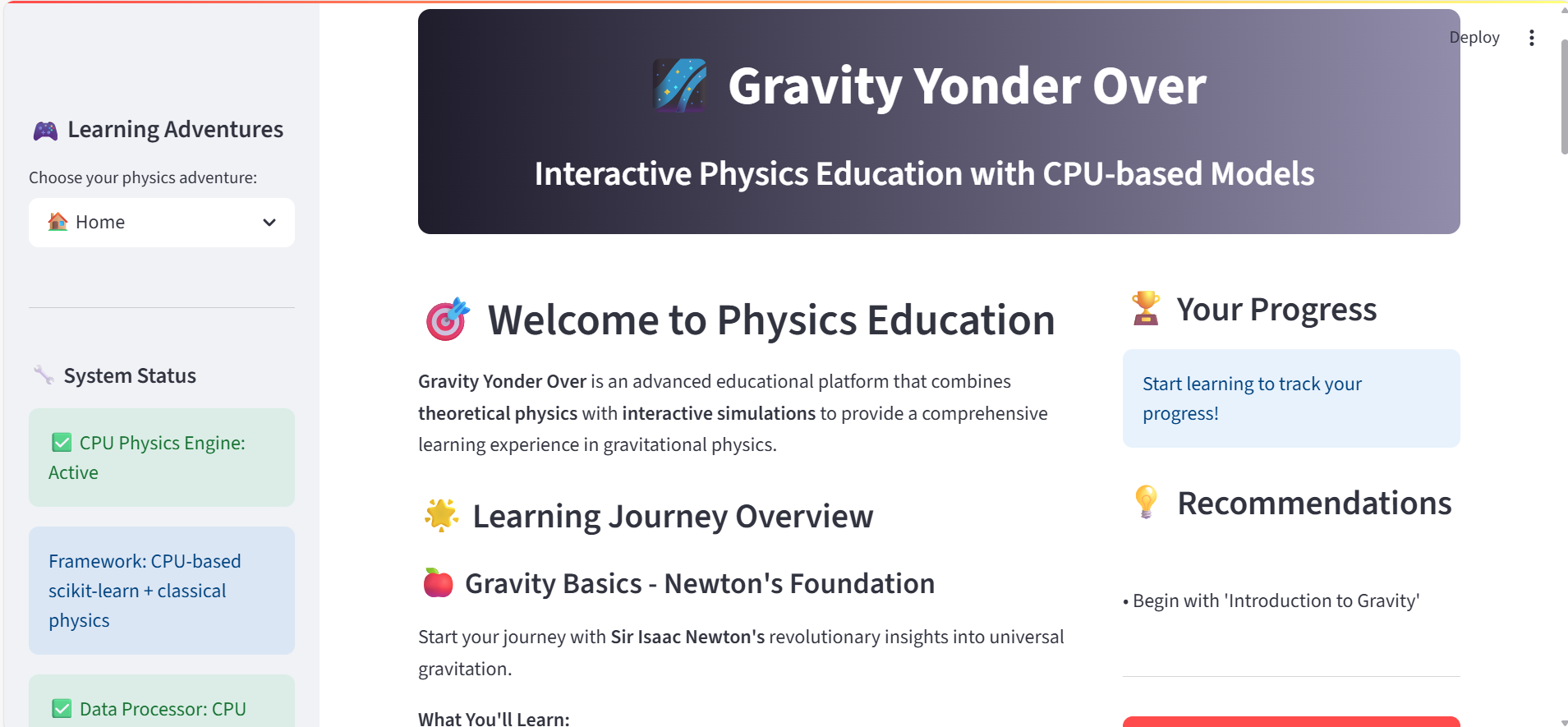
🌌 Gravity Yonder Over - Educational Physics Platform



Gravity Yonder Over is an advanced educational web application that combines theoretical physics with interactive simulations and games to provide a comprehensive learning experience in gravitational physics. Built with Streamlit, PyGame, and CPU-based physics models, it offers an engaging way to learn about gravity, orbital mechanics, black holes, and gravitational waves.
🎯 Features
📚 Educational Content
- Comprehensive Theory: Detailed explanations of physics concepts
- Historical Context: Stories of scientific discoveries and pioneers
- Mathematical Foundations: Equations and derivations with explanations
- Real-World Applications: How physics concepts apply to everyday life
🎮 Interactive Games
- 🍎 Gravity Drop Challenge: Master projectile motion and gravity effects
- 🛰️ Orbital Designer: Design stable orbits and learn Kepler's laws
- 🕳️ Black Hole Escape: Navigate extreme gravity and relativistic effects
- 🌊 Gravitational Wave Detective: Detect waves from merging black holes
🔬 Physics Simulations
- CPU-Based Physics Engine: No GPU required, runs on any computer
- Interactive Visualizations: Real-time parameter adjustment
- 3D Field Visualizations: See gravity fields and spacetime curvature
- Animation Support: Video simulations and trajectory analysis
📊 Learning Tools
- Adaptive Quizzes: Questions tailored to your progress
- Progress Tracking: Monitor your learning journey
- Interactive Calculators: Solve physics problems step-by-step
- Trajectory Predictors: Visualize projectile and orbital paths
📖 Learning Topics
🍎 Gravity Basics
- Newton's Law of Universal Gravitation
- Gravitational fields and potential energy
- Escape velocity and orbital mechanics fundamentals
- Tidal forces and their effects
Interactive Game: Launch projectiles with different gravity settings to hit targets and understand trajectory physics.
🚀 Orbital Mechanics
- Kepler's Three Laws of Planetary Motion
- Circular and elliptical orbits
- Orbital velocity and energy relationships
- Spacecraft trajectory design
Interactive Game: Design satellites with proper velocities to achieve stable orbits around a central body.
⚫ Black Hole Physics
- Einstein's General Relativity
- Event horizons and Schwarzschild radius
- Hawking radiation and black hole thermodynamics
- Relativistic effects and time dilation
Interactive Game: Navigate a spacecraft around a black hole, avoiding the event horizon while collecting fuel.
🌊 Gravitational Waves
- Einstein's prediction and LIGO detection
- Binary merger signatures and chirp signals
- Coincidence detection methods
- Future of gravitational wave astronomy
Interactive Game: Operate multiple detectors to find gravitational wave signals from cosmic events.
🛠️ Technical Architecture
Core Components
streamlit_app_new.py: Main application interfacesrc/cpu_physics_engine.py: CPU-based physics calculationssrc/educational_games.py: PyGame-based educational gamessrc/plotly_visualizer.py: Interactive visualizationssrc/interactive_simulation_engine.py: Advanced simulation tools
Physics Models
- Classical Mechanics: Newtonian gravity and orbital dynamics
- Relativistic Effects: Simplified General Relativity concepts
- Wave Physics: Gravitational wave propagation
- Numerical Integration: Runge-Kutta and symplectic methods
Game Engine
- PyGame Integration: Real-time physics games
- Streamlit Compatibility: Seamless web integration
- Educational Focus: Learning-oriented game design
- Progressive Difficulty: Adaptive challenge levels
🎮 Game Details
Gravity Drop Challenge
Objective: Hit targets by adjusting launch parameters and gravity strength.
Learning Goals:
- Understand projectile motion equations
- See gravity's effect on trajectory shape
- Develop intuition for launch angles
- Practice physics problem-solving
Controls:
- Launch angle (0-90 degrees)
- Launch speed (10-200 m/s)
- Gravity strength (1-20 m/s²)
Orbital Designer
Objective: Create stable circular orbits at target radii.
Learning Goals:
- Master the v = √(GM/r) relationship
- Understand orbital velocity requirements
- See consequences of incorrect velocities
- Learn about escape trajectories
Controls:
- Target orbital radius
- Velocity factor adjustment
- Real-time orbital prediction
Black Hole Escape
Objective: Navigate around a black hole while collecting items.
Learning Goals:
- Experience extreme gravitational effects
- Understand event horizons
- Feel tidal force effects
- Learn about relativistic physics
Controls:
- Thrust direction and power
- Fuel management
- Distance monitoring
Gravitational Wave Detective
Objective: Detect gravitational waves using multiple detectors.
Learning Goals:
- Understand wave detection principles
- Learn about coincidence requirements
- Analyze chirp signal patterns
- Experience scientific methodology
Controls:
- Detector activation/deactivation
- Signal analysis tools
- Detection threshold settings
📊 Educational Features
Progress Tracking
- Completion status for each topic
- Mastery levels and skill assessment
- Time spent learning
- Quiz performance analytics
Adaptive Learning
- Personalized learning paths
- Difficulty adjustment based on performance
- Recommended next topics
- Remedial content suggestions
Assessment Tools
- Interactive quizzes with immediate feedback
- Conceptual questions and calculations
- Problem-solving exercises
- Real-world application scenarios
Adding New Games
- Create game class in
src/educational_games.py - Implement physics simulation and rendering
- Add game runner in
src/streamlit_game_runner.py - Integrate into main app topic pages
- Add educational content and learning objectives
🎓 Educational Philosophy
This platform is designed around several key principles:
Learning by Doing: Interactive simulations and games make abstract concepts tangible.
Progressive Complexity: Start with fundamentals and build to advanced topics.
Multiple Perspectives: Combine mathematical, visual, and intuitive approaches.
Real-World Connection: Link physics concepts to everyday experiences and current research.
Active Engagement: Games and interactivity keep learners engaged and motivated.
Built With
- python
- streamlit

Log in or sign up for Devpost to join the conversation.