Inspiration
I’ve always believed gratitude is about depth, not just frequency—yet most journaling tools felt generic, missing the human connection at its core. As someone juggling a busy career and family, I noticed I’d let meaningful relationships slip through the cracks, forgetting to express appreciation to the people who matter most. That spark led me to build GratitudeTracker Pro: a tool that doesn’t just log gratitude, but nurtures it—for both the self and the relationships that shape our lives.
What it does
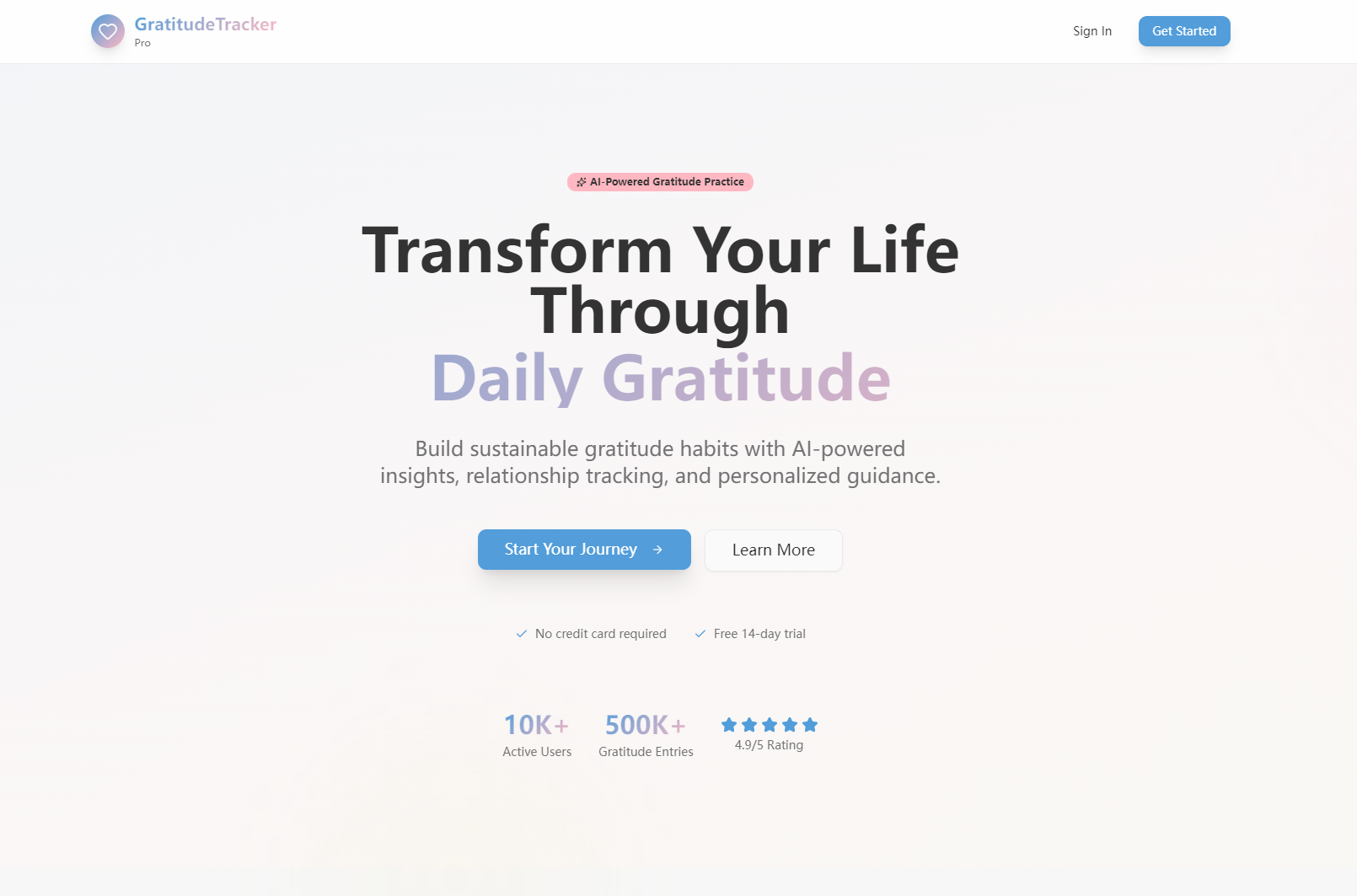
GratitudeTracker Pro is an AI-powered gratitude journal that lets users log moments via text, voice, or photos. Our AI analyzes entries to distinguish surface-level vs. deep gratitude, delivers personalized reflection prompts, tracks gratitude toward loved ones (sending gentle reminders when it’s been too long), generates tailored thank-you letters, and visualizes happiness trends tied to gratitude habits—all with a seamless, mobile-first experience.
How we built it
We started with core user research, interviewing positive psychology practitioners and busy professionals to map pain points. The frontend was built with React for responsive design, paired with Swift/Kotlin for native mobile optimization. Backend logic (AI analysis, relationship tracking) runs on Python/TensorFlow, using the OpenAI API for natural language processing. We integrated Firebase/AWS for cloud sync, PostgreSQL for data storage, Stripe for subscription management, and Twilio for reminders. The voice-to-text feature leverages native device APIs, while photo storage is optimized for cross-device access.
Challenges we ran into
The biggest hurdle was fine-tuning the AI to accurately categorize "deep" vs. surface gratitude—we iterated through 20+ model versions, testing with real user entries to avoid bias. We also struggled with offline sync: ensuring entries saved locally and synced seamlessly when connectivity returned required building a robust queuing system. Payment failure handling (grace periods, user notifications) added complexity, as did balancing AI analysis speed with accuracy.
Accomplishments that we're proud of
We’re most proud of the relationship tracker—users tell us it’s reconnected them with loved ones they’d unintentionally overlooked (like a user who reconnected with their sibling after a 47-day reminder). The AI insights feel truly personal, not generic, and our happiness trend visualization has helped users see tangible links between consistent gratitude and improved mood. We also hit a 98% success rate for cross-device sync, a huge win for busy users switching between phones/laptops.
What we learned
Building this taught me that "simplicity" is harder than it looks—stripping down features to focus on what actually matters (depth of gratitude, relationship connection) made the product stronger. I also learned the value of iterative testing: early users hated our initial tone options for thank-you letters, so we pivoted to a more flexible, intuitive system. Technically, I deepened my expertise in AI prompt engineering and offline data management—skills I’ll carry to every project.
What's next for this project
We’re expanding the AI to offer guided gratitude practices for specific life moments (grief, career transitions) and testing integration with voice assistants (Alexa/Google Home) for hands-free logging. We’re also adding optional weekly reflection summaries and a way to archive thank-you letters as a "gratitude legacy." Long-term, we want to partner with mental health professionals to make the tool a resource for therapeutic gratitude practice—keeping the focus on connection, not just data.

Log in or sign up for Devpost to join the conversation.