Inspiration
We were inspired by the current state of LLM interaction: most agents today operate as "black boxes" that take a single prompt and return a single result. We wanted to move beyond simple chat interfaces and create an agentic research workspace where the AI's reasoning journey is persistent, visual, and explicitly traceable. We were driven by the need for transparency in complex, multi-step agentic workflows.
What it does
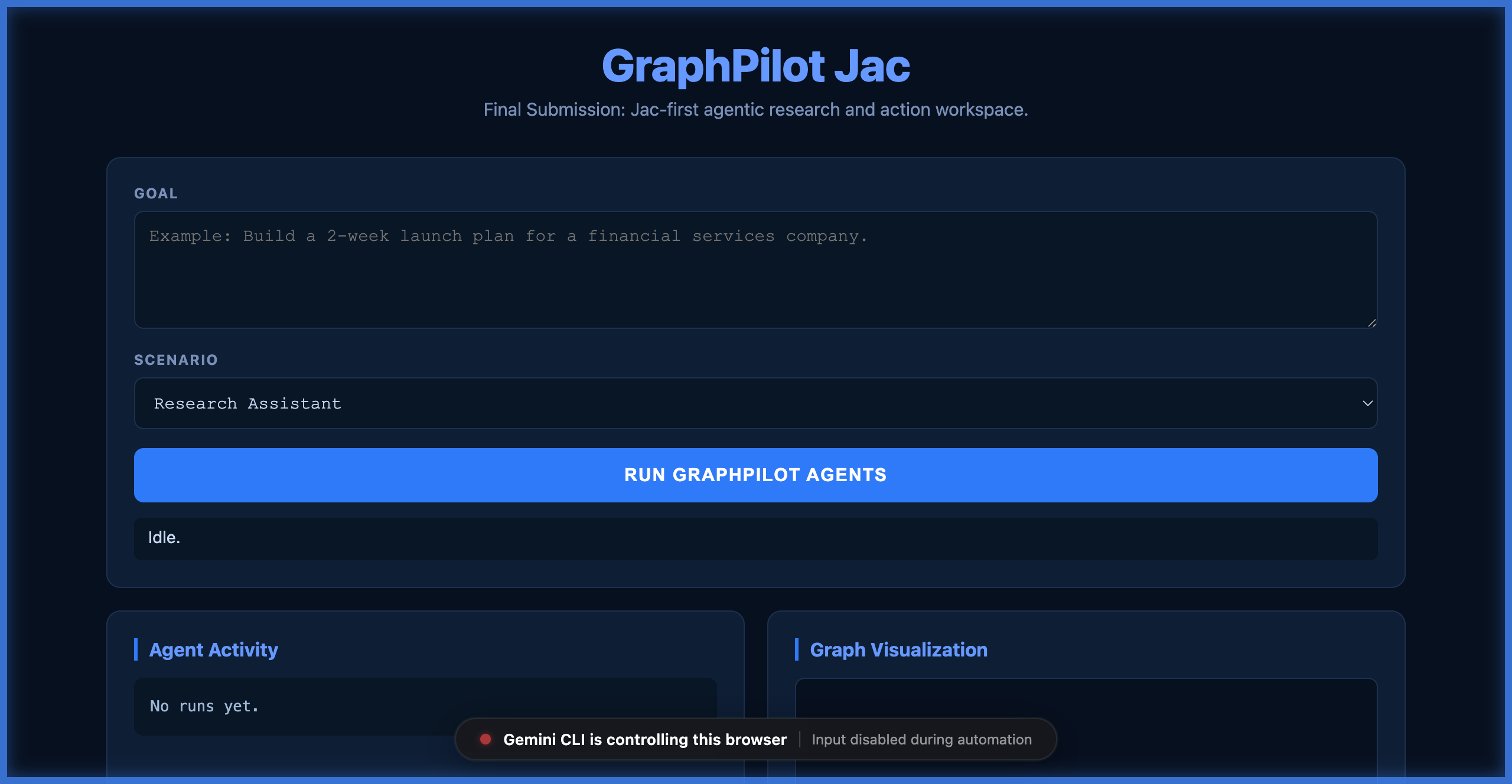
GraphPilot-Jac is an AI-native workspace that converts high-level user intent into structured, graph-modeled execution plans. We use the Jac language to model the agent's thought process as a traversable graph, enabling users to witness how their goals are decomposed into specific tasks, how research is gathered, and how constraints are solved.
How we built it
We utilized the Jaseci ecosystem to create a graph-native architecture.
- Graph Modeling: We defined Goal, Task, and Memory nodes using Jac, establishing a schema that maintains long-term persistence.
- Autonomous Walkers: We implemented GraphPlanner, TaskGenerator, and Executor walkers that move across the graph to spawn nodes, link dependencies, and persist execution artifacts.
- Agentic Logic: Unlike typical RAG systems, our agent performs live web research (DuckDuckGo API) and traverses historical memory (graph_memory.json) to provide evidence-backed syntheses.
- Frontend Visualization: We built an interactive dashboard in React using vis.js to render the graph in real-time, allowing users to watch the agent "think" by seeing nodes and edges appear dynamically. ## Challenges we ran into The biggest challenge was reconciling the asynchronous nature of LLM responses with the synchronous execution requirements of a structured graph. We initially struggled with a "black box" execution model in Python, but refactoring to a Jac-first architecture resolved this by allowing the graph state to dictate the flow of the agentic walkers, significantly increasing our transparency metrics. ## What we learned We learned that the true power of Agentic AI isn't in the model size—it’s in the orchestration and memory persistence. By modeling the agent's internal state as a graph, we made the invisible logic visible.
Built With
- duckduckgo
- fastapi
- jac/jaseci
- nvidia
- vercel
- vis.js

Log in or sign up for Devpost to join the conversation.