-
-
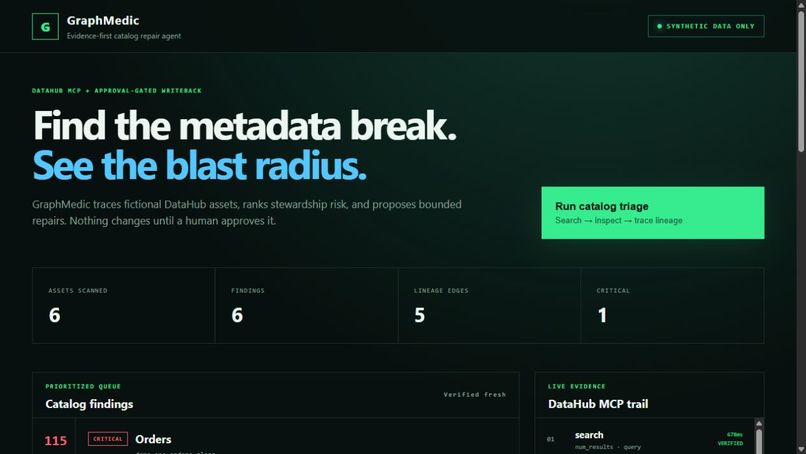
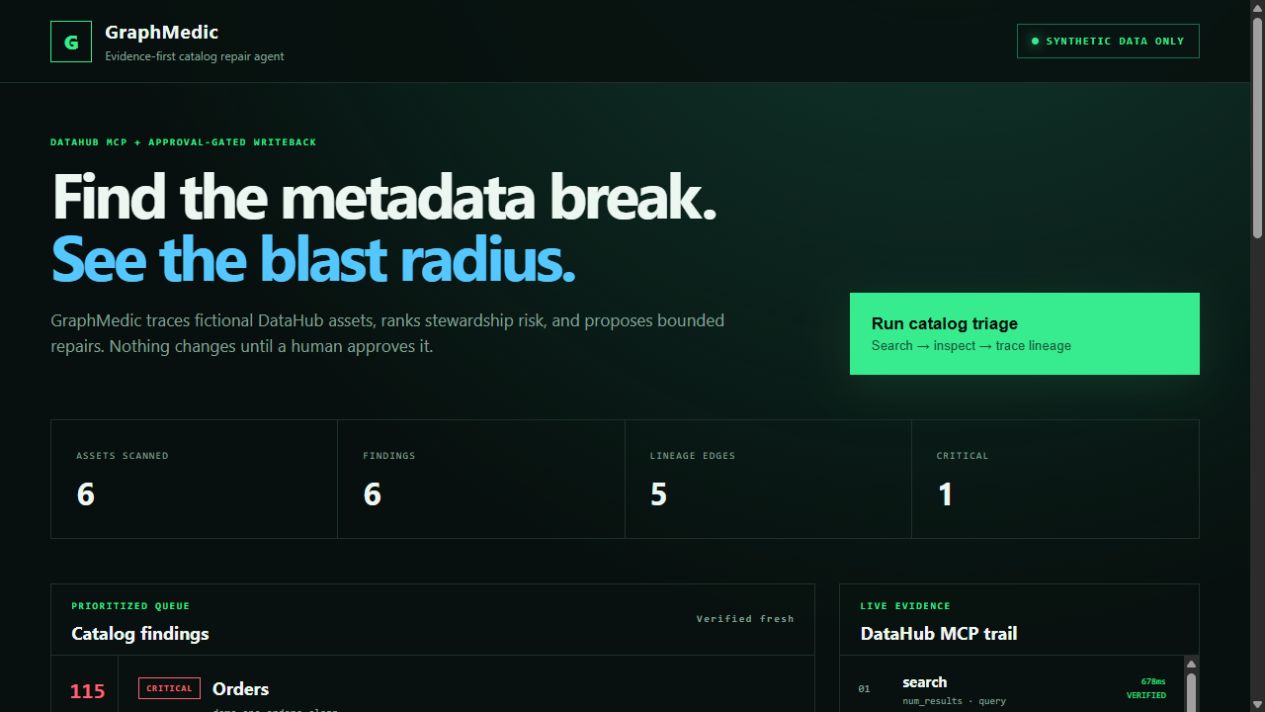
GraphMedic ranks synthetic DataHub catalog risks with lineage-backed evidence.
-
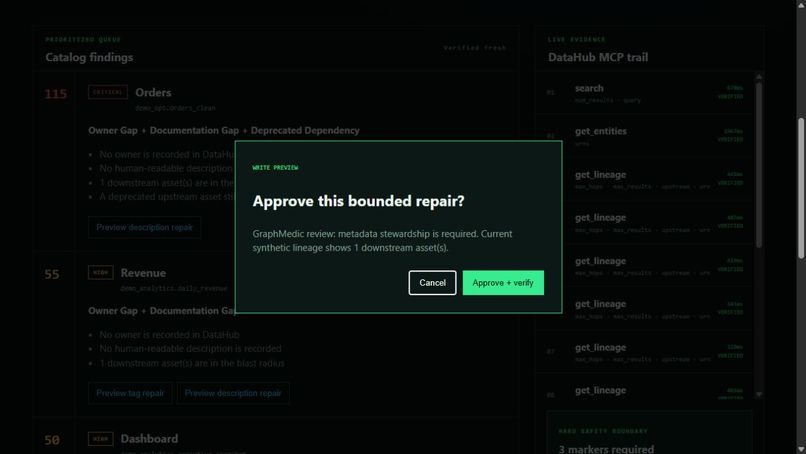
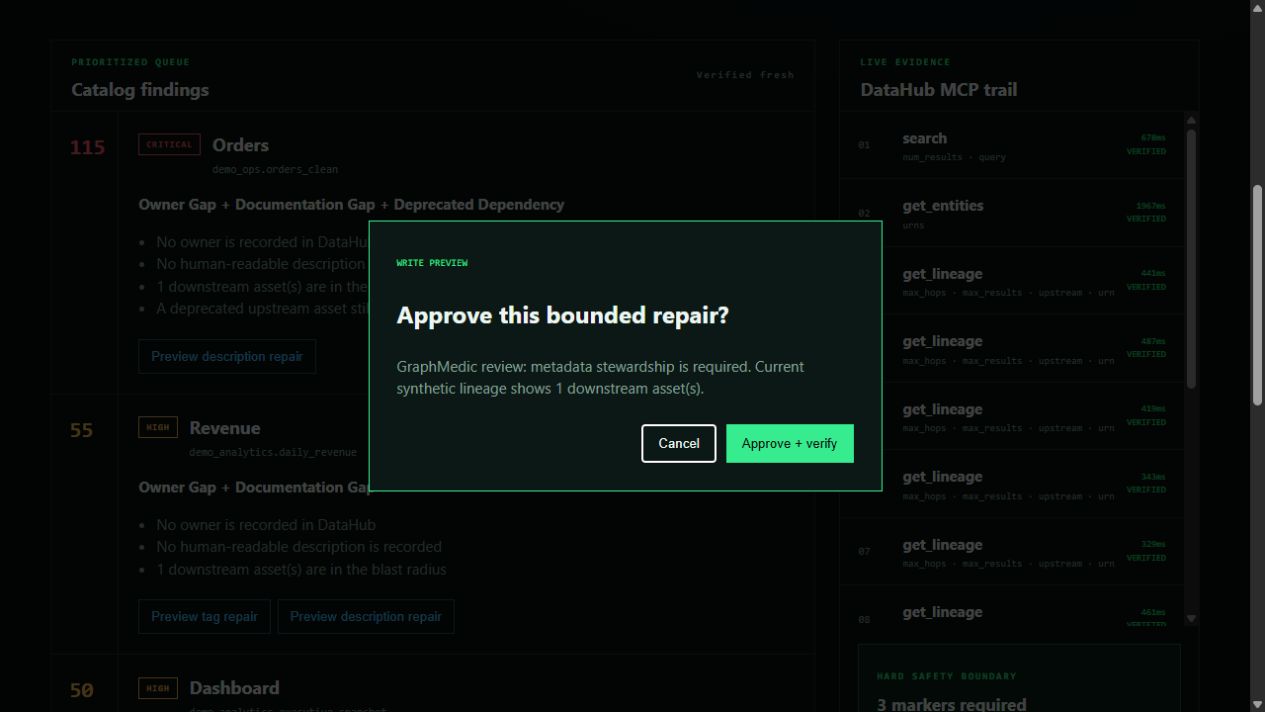
A bounded repair is previewed, explicitly approved, written through MCP, and verified by rereading DataHub.
Inspiration
Catalog cleanup is often treated as a list of empty fields. In practice, the important question is graph-shaped: which incomplete or retired asset still feeds downstream decisions, and what is the smallest truthful repair a steward can make? GraphMedic turns that question into an explainable queue.
What it does
GraphMedic searches an explicitly opted-in synthetic DataHub namespace, verifies entity metadata, traces lineage in both directions, and ranks stewardship risk using missing ownership, missing descriptions, downstream blast radius, and deprecated dependencies. It proposes bounded metadata repairs, shows the exact write to a human, performs only the approved mutation, and reads the entity back to verify success.
How we built it
The backend is Python and FastAPI. A typed adapter launches the official DataHub MCP server over stdio and calls search, get_entities, get_lineage, add_tags, and update_description. DataHub OSS stores six fictional datasets and five fictional lineage edges seeded through the DataHub Python SDK. The UI is framework-free HTML, CSS, and JavaScript so the evidence trail stays fast and legible.
The browser never supplies a URN or write value. It submits only a finding ID, an action kind, and explicit approval. The server looks up the reviewed proposal, verifies the three-marker synthetic boundary, runs the mutation, and verifies it with a fresh read.
Challenges we ran into
The hardest part was making writeback useful without making it dangerous. Search alone is not a sufficient safety boundary, so GraphMedic independently requires a demo namespace, the GraphMedicDemo tag, and a SYNTHETIC classification. It refuses to invent owners or business meaning. A separate scanner checks public artifacts for private paths, addresses, credentials, emails, and network identifiers.
Accomplishments that we're proud of
- Real bidirectional lineage analysis through the official DataHub MCP server
- Approval-gated tag and description writeback with post-write verification
- An explainable 115-point critical finding combining missing ownership, missing documentation, downstream blast radius, and a deprecated upstream dependency
- Ten automated tests plus generic and user-specific privacy scans
- A polished responsive UI, interactive sanitized reviewer preview, 120-second narrated demo, Apache-2.0 source, and reusable Agent Skill
What we learned
Metadata agents are most trustworthy when their authority is narrower than their insight. GraphMedic can search and reason broadly inside a clearly marked demo boundary, but its write vocabulary remains tiny, deterministic, reviewable, and verified.
What's next for GraphMedic
The same design can support organization-defined opt-in domains, richer stewardship queues, issue creation, policy-as-code scoring, and reversible patch sets. The deny-by-default adapter and Agent Skill are reusable building blocks.
Privacy and data
Every dataset shown is fictional and explicitly labeled synthetic. The project contains no employer, customer, coworker, household, private-network, credential, or other private data.
Built With
- css3
- datahub
- datahub-mcp-server
- datahub-oss
- docker
- fastapi
- html5
- javascript
- pydantic
- pytest
- python
- remotion

Log in or sign up for Devpost to join the conversation.