-
-
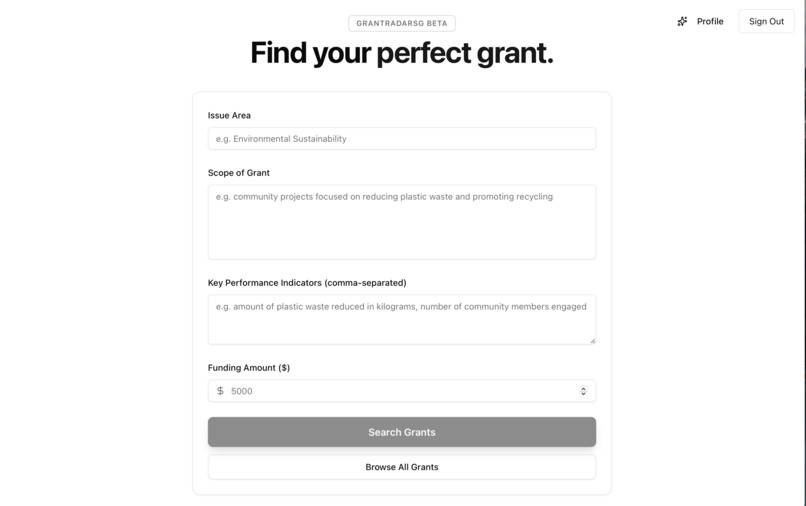
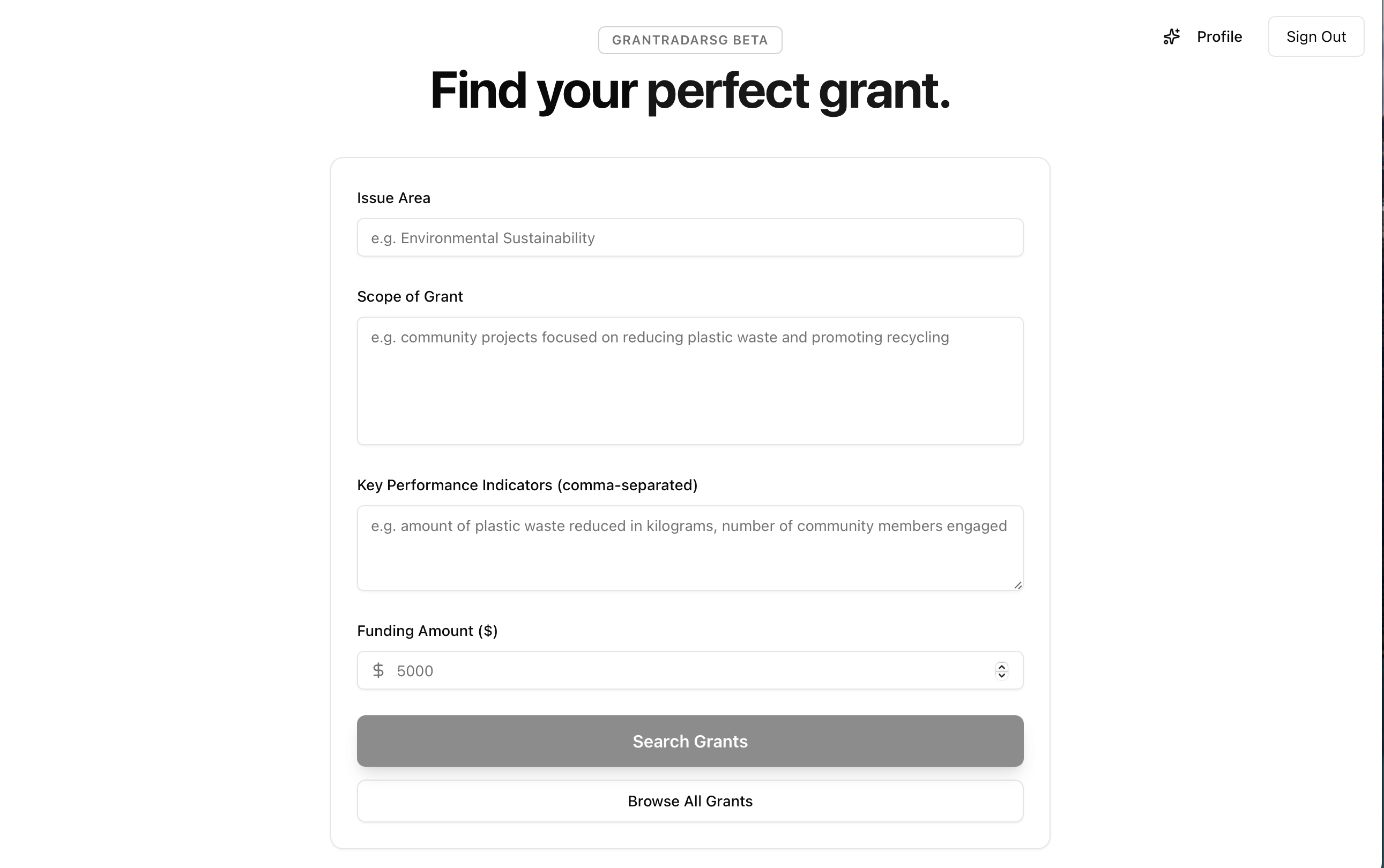
Query using key criteria in natural language
-
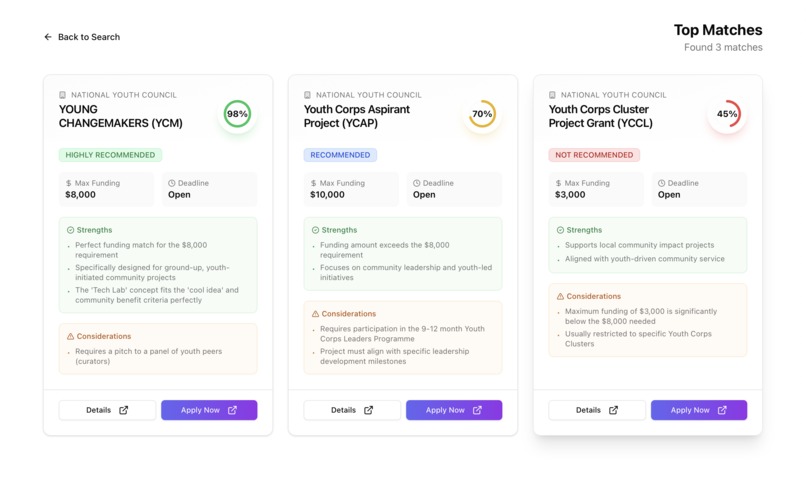
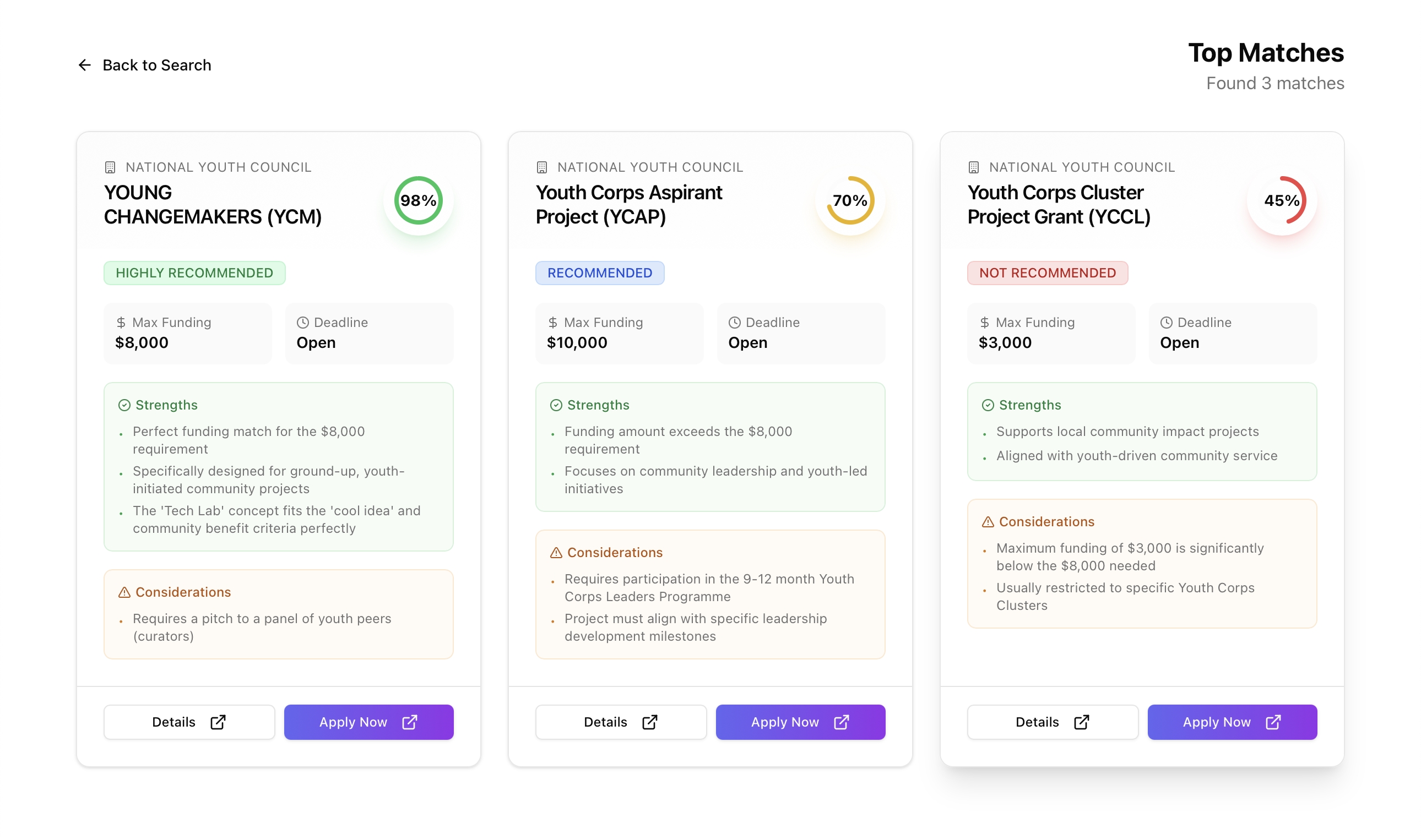
Detailed query results with analysis by AI agent
-
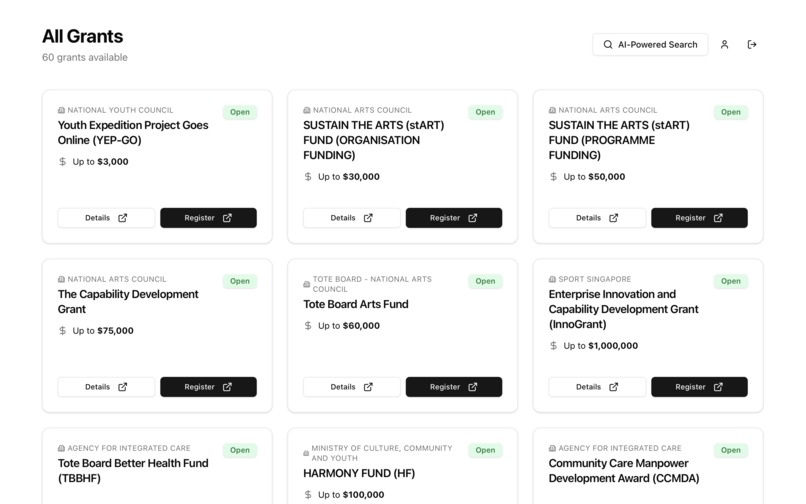
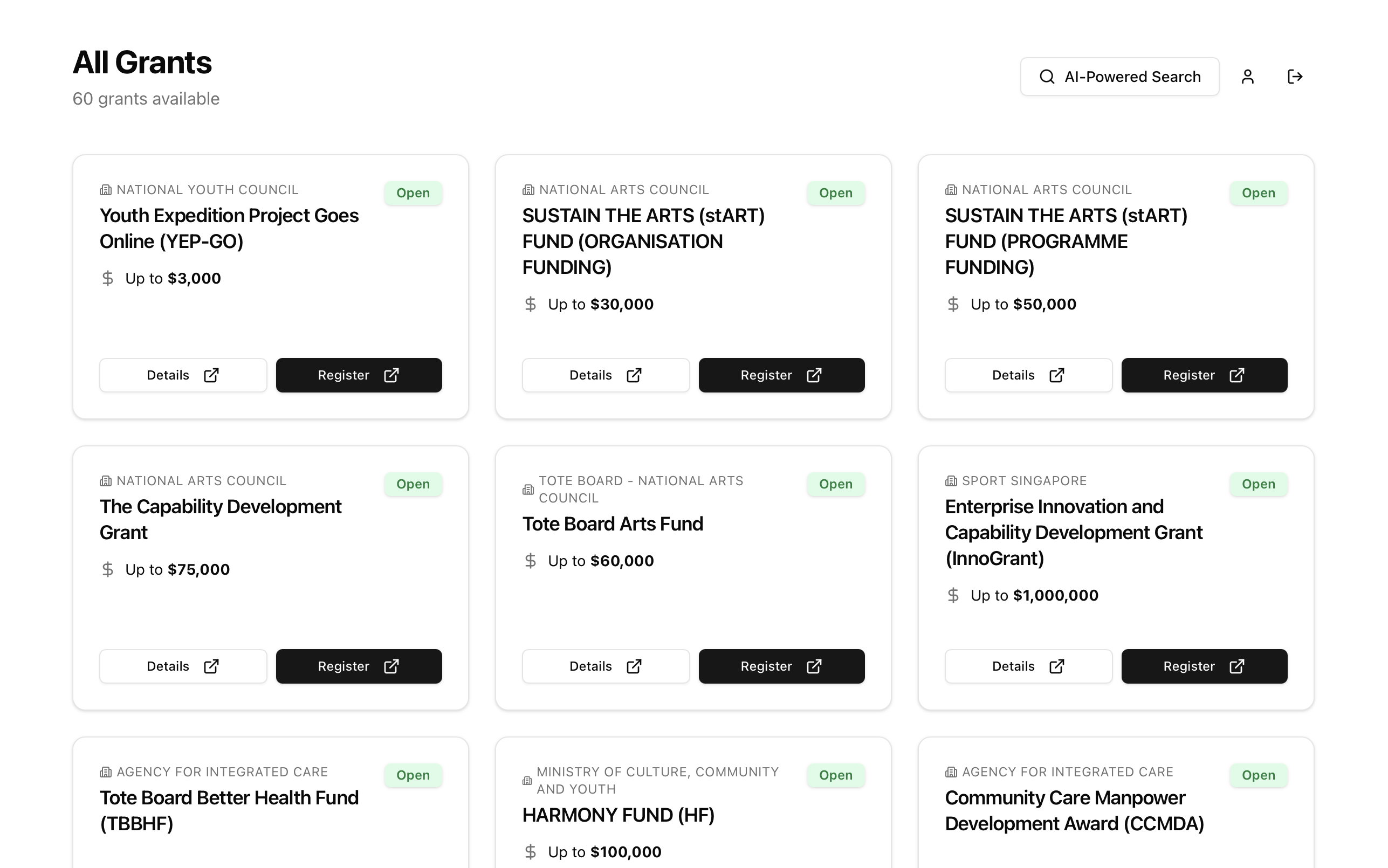
Up to date database of all available grants
-
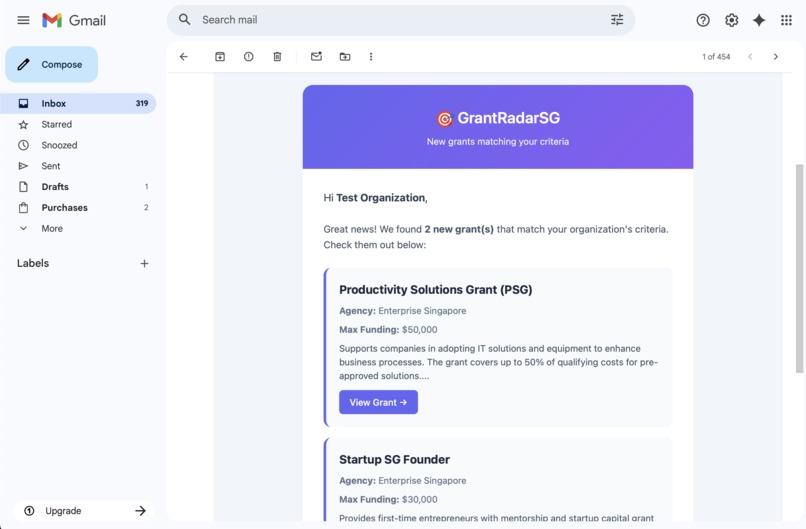
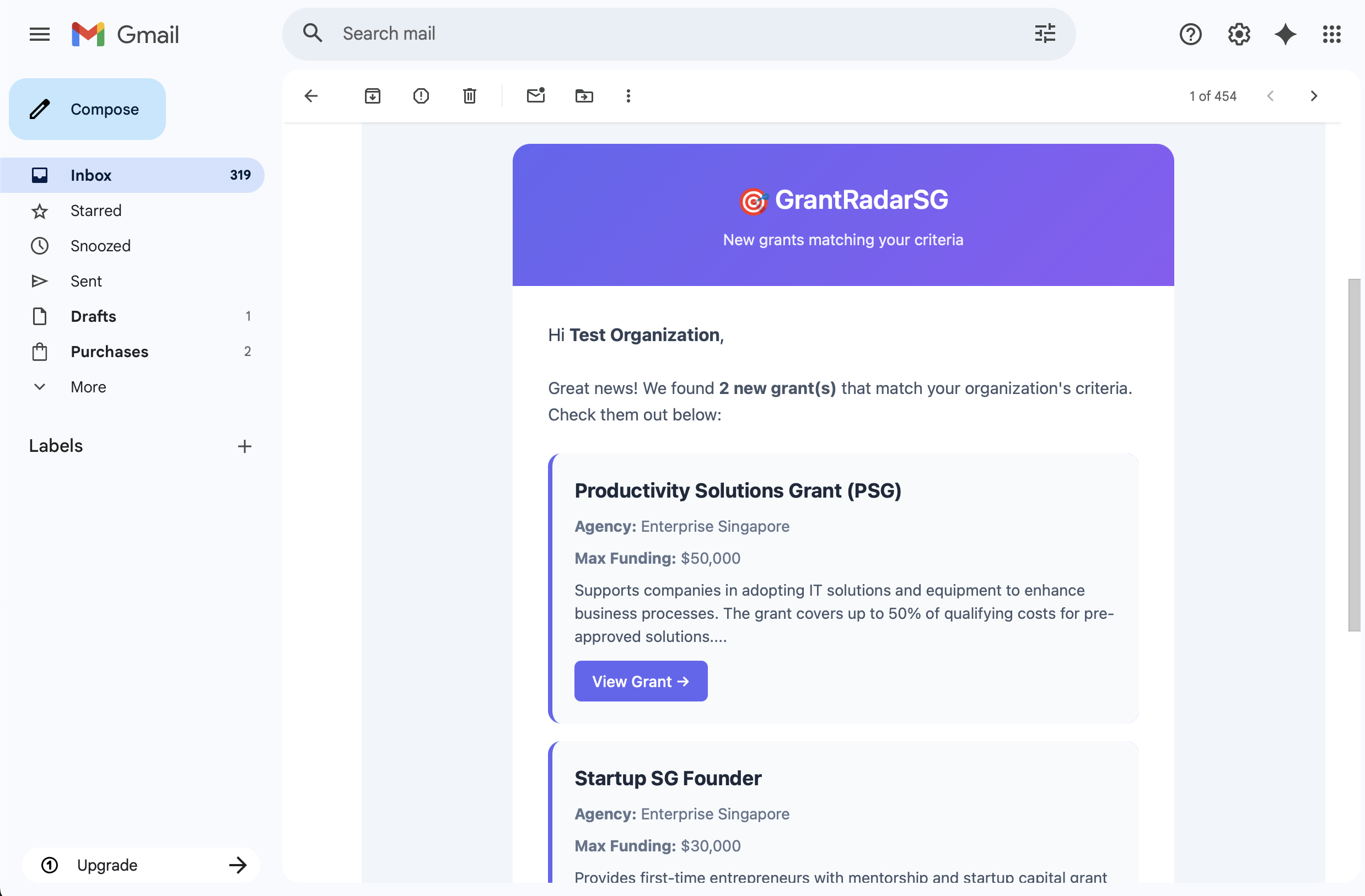
Automated Email notification for latest suitable grants
GrantRadarSG
Problem statement
How might non-profit organisations “pull” information about grants from OurSG grants portal that are relevant to them according to key criteria including issue area, scope of grant, KPIs, funding quantum, application due date, etcs. so that they can strengthen their financial sustainability?
Project description
GrantRadarSG is an AI-powered platform designed to help Singaporean Non-Profit Organizations (NPOs) and SMEs automatically discover, match, and apply for relevant government grants.
Instead of manually searching through hundreds of schemes, users create an organization profile, and our AI agents continuously scan and alert them to opportunities that match their specific mission, KPIs, and funding needs.
Inspiration
Grant Radar SG was inspired by the operational challenges faced by the 460 Non-Profit Organizations (NPOs), charities, and NGOs in Singapore. These organizations often operate with limited manpower and overworked staff who juggle multiple roles. Despite their critical need for government grants to implement projects and ensure financial stability , the process of finding suitable funding is burdensome. The current manual search process on the OurSG Grants Portal is often inefficient because the portal can be cluttered with closed grants, and its rigid filter categories do not serve organizations with niche focus areas.
What it does
Grant Radar SG is an AI-powered platform designed to automate the discovery and matching of government grants for Singaporean NPOs and SMEs. Key functions include:
AI Semantic Search: Users can find grants using natural language queries (e.g., "funding for elderly digitalization") instead of being restricted to pre-defined keywords.
Smart Matching: The system automatically evaluates an organization's specific sector, mission, and KPIs against grant eligibility criteria.
Real-time Results: Search results are streamed instantly as AI agents score each grant's suitability.
Passive Grant Hunting: Organizations can create persistent profiles that allow AI agents to continuously scan for new opportunities.
Automated Notifications: Users receive email alerts the moment a new grant matching their criteria is identified, removing the need for periodic manual searches.
The platform is built on a modern, event-driven architecture designed for scalability and real-time performance:
Frontend: Developed using Next.js 15 (App Router) and TypeScript, with styling provided by Tailwind CSS and shadcn/ui. Authentication is fully managed via Firebase Auth.
Streaming Backend: The core application logic is hosted on Google Cloud Run running a FastAPI (Python) service. This allows us to utilize Server-Sent Events (SSE) to stream AI analysis and grant scores to the user in real-time, preventing request timeouts during complex RAG operations.
Serverless Ingestion: Our automated ingestion engine is built on Firebase Functions (Gen 2) triggered by a Cloud Scheduler cron job. This serverless worker wakes up periodically to scrape grant portals using BeautifulSoup4, process PDF guidelines, and update our vector indices without requiring a constantly running server.
Data Layer: We use PostgreSQL with pgvector (via Google AlloyDB) as our vector database to store and retrieve high-dimensional embeddings generated by Google's text-embedding-004 model.
AI Integration: We utilised Google Gemini via LangChain for natural language processing, orchestrating the Retrieval-Augmented Generation (RAG) pipeline that matches NPO profiles to grant criteria.
Challenges we ran into
One of the primary technical hurdles was the unstructured nature of grant information, which required using LLMs to process diverse PDF and HTML guidelines into a searchable format. Additionally, the system was optimised to overcome high computational costs by using a tiered search approach that reduced costs by over 90% compared to searching the entire database with a full LLM for every query.
The Latency vs. Complexity Trade-off: Another critical challenge we ran into was the extremely long response time from the AI agents. We initially designed a multi-agent workflow where specialized agents would independently evaluate different aspects of a grant. While comprehensive, this "committee" approach resulted in unacceptable response times—often exceeding 60 seconds, caused by cumulative network overhead, complex reasoning tasks, and high token counts. To bridge the gap between quality and speed, we refactored the architecture from a multi-agent swarm into a singular, high-performance evaluation agent. By optimizing the system prompt to handle multi-faceted evaluation in a single pass and streamlining the retrieval context, we reduced the latency to 10–20 seconds—a 70-80% improvement—without sacrificing the depth or accuracy of the assessment.
However, comprehensive AI analysis of grant documents still takes time (10–20 seconds), which leaves users staring at a loading spinner. Standard HTTP requests would often time out or feel unresponsive. We moved our backend to Cloud Run to leverage its native support for HTTP Streaming. By implementing an SSE (Server-Sent Events) endpoint in FastAPI, we could "stream" the AI's thought process (scoring criteria, finding strengths) to the client instantly as they were generated, vastly improving the perceived performance and user experience.
Accomplishments that we're proud of
Dynamic Deep-Crawl & Multimodal Extraction: Developed a recursive scraper that traverses OurSG to identify and crawl individual grant URLs to provide richer content to our database. We also utilised multi-modal AI agents to transform inconsistent web structures and visual infographics into standardized JSON for high-fidelity data storage and retrieval.
Cost Efficiency: Our RAG-powered query system achieved a >90% reduction in token counts and context window by running semantic search to extract the most relevant bit of information for LLM processing as compared to searching and evaluating the entire grants database using raw LLM.
Scoring Accuracy: The AI agents successfully provide suitability scores and comprehensive summarized "Strengths" and "Considerations" for each match, helping users understand at a glance why a grant is recommended.
Automation: We successfully built a fully automated pipeline—from scraping official sources to sending tailored email notifications—that directly reduces the administrative workload for NPO staff.
What we learned
We gained deep insights into the specific pain points of the Singaporean social sector, particularly how administrative overhead can hinder community impact. Technically, we learned how to effectively implement AI agents to perform evaluative tasks, such as scoring grant suitability, and the importance of using vector databases like pgvector to make large datasets of unstructured text searchable and actionable.
What's next for GrantRadarSG
The next steps involve expanding the Automated Ingestion Engine to cover more official grant sources beyond the primary portals. We also plan to enhance the AI agents' capabilities to include preliminary grant writing assistance, helping organizations not only find matches but also start their application process based on their persistent organization profiles.

Log in or sign up for Devpost to join the conversation.