-
-
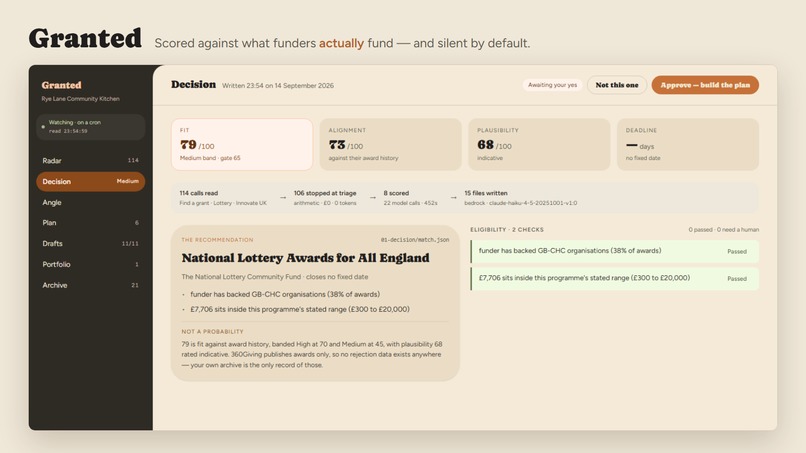
Granted Dashboard
-
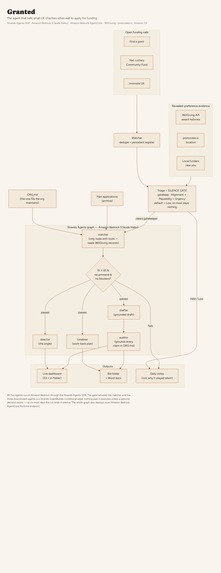
Granted Architecture
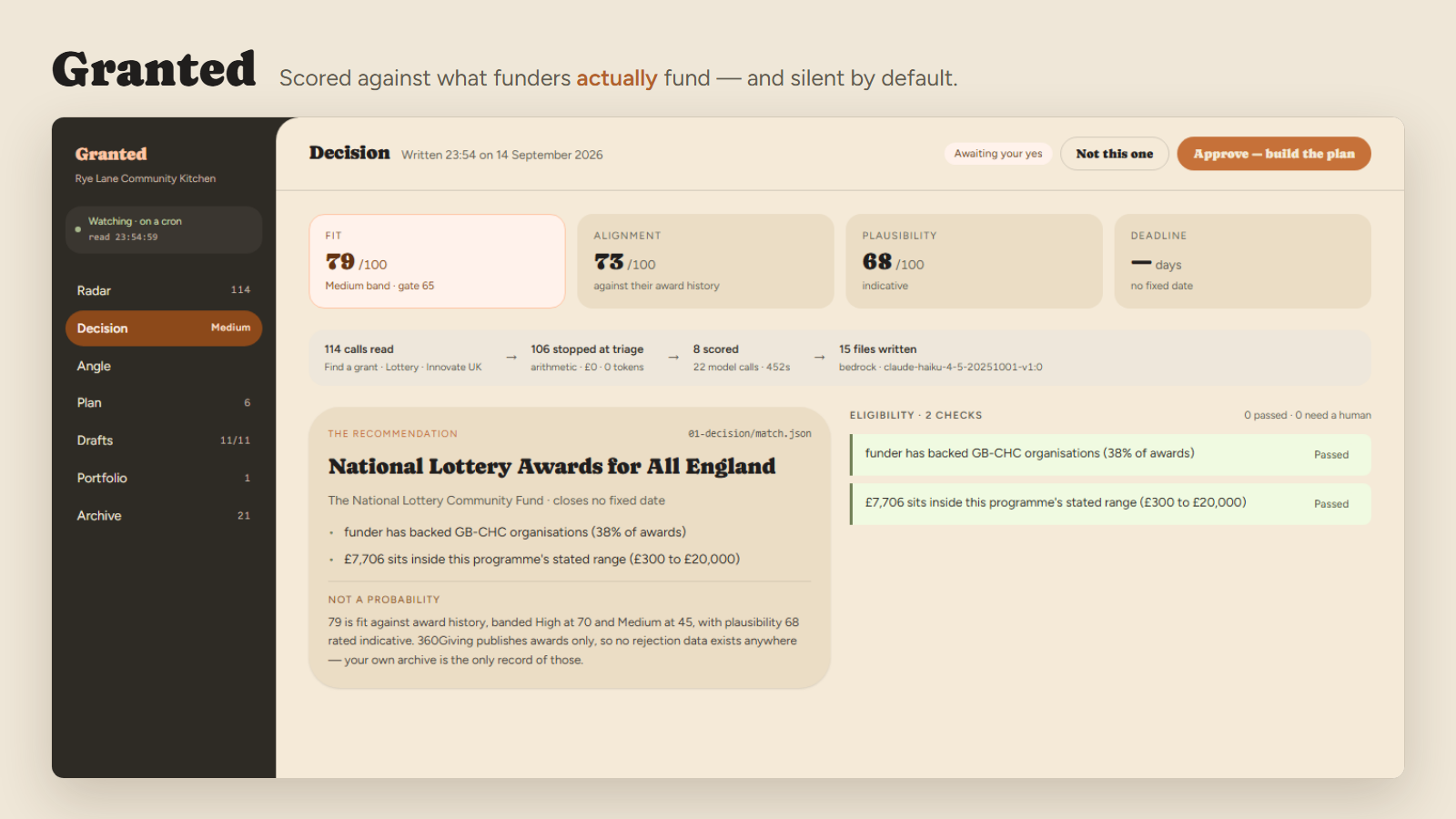
Granted — the agent that tells small charities when not to apply
Track: Good Neighbor Agents Live demo: http://granted-dashboard-2026.s3-website.us-west-2.amazonaws.com
The problem
Small charities don't have an application-writing problem. They have a triage problem. A four-person food bank will spend thirty hours on a bid to a funder who has never — across nine hundred recorded awards — funded an organisation of their legal form, in their region, at their size. That week is gone, and nobody told them beforehand. Every existing funding tool helps you apply to more things. That's the opposite of what a stretched charity needs.
What Granted does
Granted is a background multi-agent system that watches funding calls open and
close, scores each against what a funder has demonstrably funded before, and
stays silent. On most days it produces nothing. When something genuinely fits —
or when a bid already in flight falls behind — it surfaces once, with a
decision: the recommendation, the angle to lead with, a work-back timeline, a
grounded first draft, and an independent accuracy audit. The charity maintains
exactly one file, ORG.md. That's the whole interface.
Who it's for and why it matters
Small UK community organisations — food banks, community kitchens, local charities — who can't spare a week chasing a grant they were never going to win. Granted gives back the scarcest thing they have: time not wasted. It's installable as a folder that sits in the org's own files, reads their past applications for history and voice, and organises every live bid into its own folder of editable Word documents.
Validated on a real tender
Beyond the demo fixtures, Granted was run on a real external procurement pack from
AEP. From those inputs it generated the organisation's ORG.md, built the
dashboard, and surfaced the relevant local funding pots — then, correctly, stayed
silent: nothing open was worth thirty of that organisation's hours, so it
recommended nothing. That is the product doing its job on data it was never built
around — and the clearest demonstration of the premise, that the right answer is
usually "don't apply".
How it works
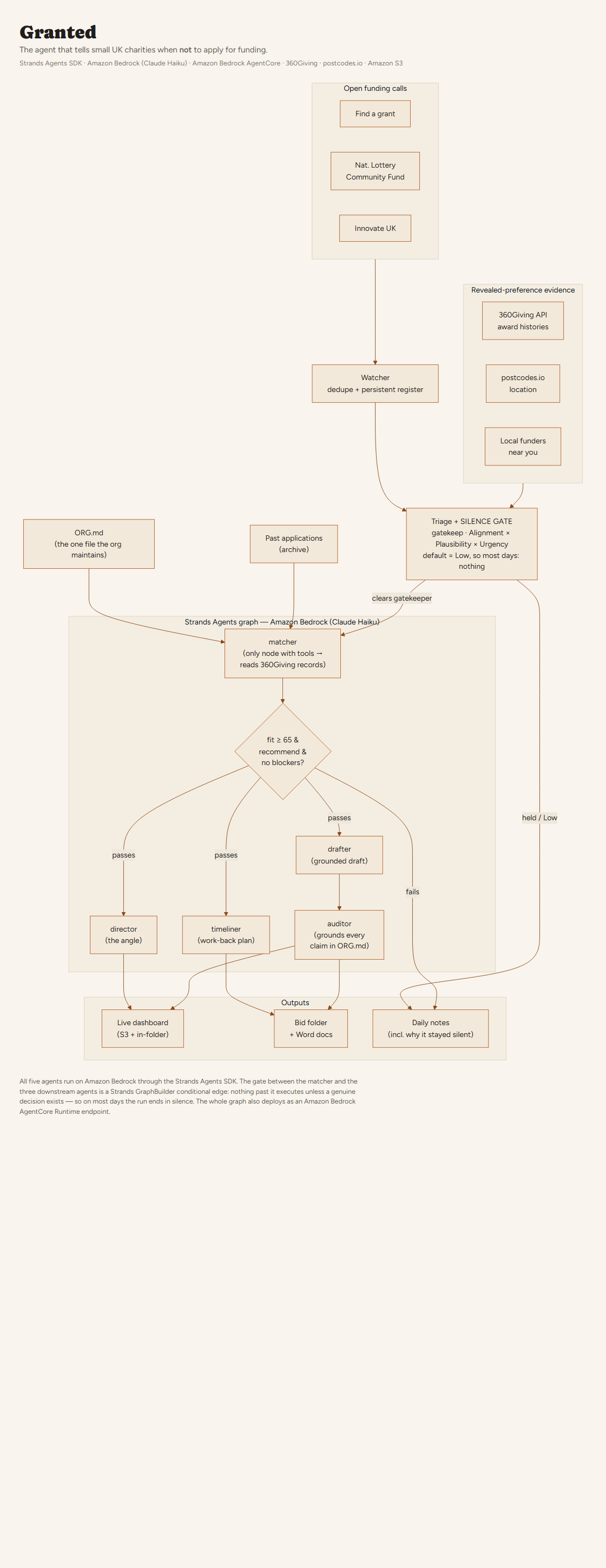
Five agents in a Strands Agents SDK graph, all on Amazon Bedrock (Claude Haiku):
- matcher — the only agent with tools; it queries the funder's real grant records (360Giving) to check the things that would disqualify the org outright.
- A Strands conditional-edge gate — if the matcher doesn't clear the fit threshold, nothing downstream runs and nobody is notified. Silence is the architecture, not a claim.
- director / timeliner / drafter — run concurrently past the gate: the angle,
the work-back plan, and a draft where every factual claim must trace to
ORG.md. - auditor — an independent check that grounds every claim against
ORG.mdand publishes the accuracy figure.
Triage scores each call on Alignment × Plausibility × Urgency (urgency is a veto and multiplier, never a third addend). It reads funders' revealed preferences from the 360Giving API, resolves place via postcodes.io, pulls calls from Find a grant, the National Lottery Community Fund and Innovate UK, and surfaces local funders near you from their award histories. Output is a live dashboard (published to S3 and mirrored inside the folder), a bid folder of Word documents, and a daily note that records what it looked at — including why it stayed silent.
Why it's different (creativity)
It optimises for applications not sent. The headline feature is restraint: an agent whose best day produces nothing. Scoring on what funders actually fund rather than their marketing copy, and refusing to invent a fact the org's own file can't support, are both deliberate and both unusual.
Built with
Strands Agents SDK · Amazon Bedrock (Claude Haiku) · Amazon Bedrock AgentCore Runtime (deployment surface) · Python · 360Giving API · postcodes.io · Find a grant / GOV.UK · Amazon S3 (live dashboard).
Judging-criteria map
- Technical Implementation: 5-agent Strands graph with a conditional gate,
tool-using matcher, structured outputs, a live S3 deployment, and an Amazon
Bedrock AgentCore Runtime entrypoint (
granted.agentcore_app) that exposes the graph as a managed, serverless endpoint. - Design: a complete product — installable folder, live dashboard, and editable Word documents per bid, not a proof of concept.
- Potential Impact: real charities, real funders, real money and time saved.
- Creativity & Originality: an agent built to stay silent and say no.
- Presentation: see the 5-minute demo.
Whats next for Granted?
What's next for Granted is turning a working prototype into something charities can rely on daily. The immediate step is a genuine one-click install a signed package with a guided onboarding that drafts ORG.md from an organisation's own documents, and a proper cloud deployment of the agent graph on Amazon Bedrock AgentCore, so a scheduled morning run happens without anyone tending a terminal. From there we widen coverage: more funding streams (trusts and foundations, devolved-nation and council pots, corporate and community-foundation grants), deeper 360Giving analysis, and email or Slack alerts the moment a real decision surfaces. Longer term, the goal is a feedback loop that makes every organisation's next decision sharper,capturing real outcomes (won, lost, and the assessor's verbatim feedback) so plausibility scores are calibrated against reality rather than resemblance, and offering an optional, privacy-preserving shared benchmark so a small charity can see how funders behave across the whole sector, not just its own history. The throughline stays the same: an agent that earns attention by staying silent, and saves a stretched team the one thing it can never get back — the week it would have wasted on a bid it was never going to win.
Built With
- 360giving
- amazon-bedrock
- amazon-bedrock-agentcore
- amazon-web-services
- claude
- python
- strands-agents

Log in or sign up for Devpost to join the conversation.