-
-
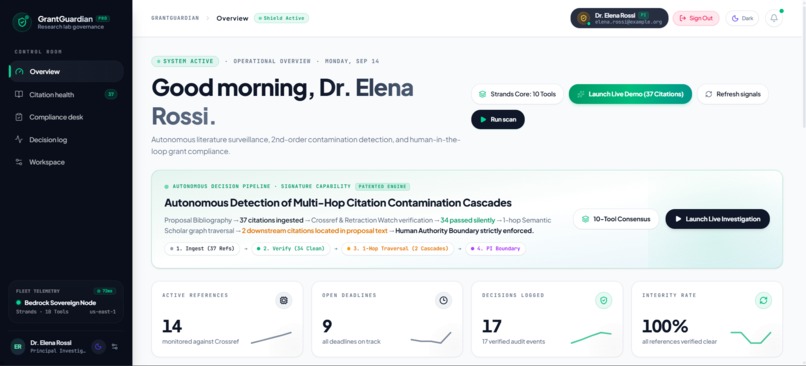
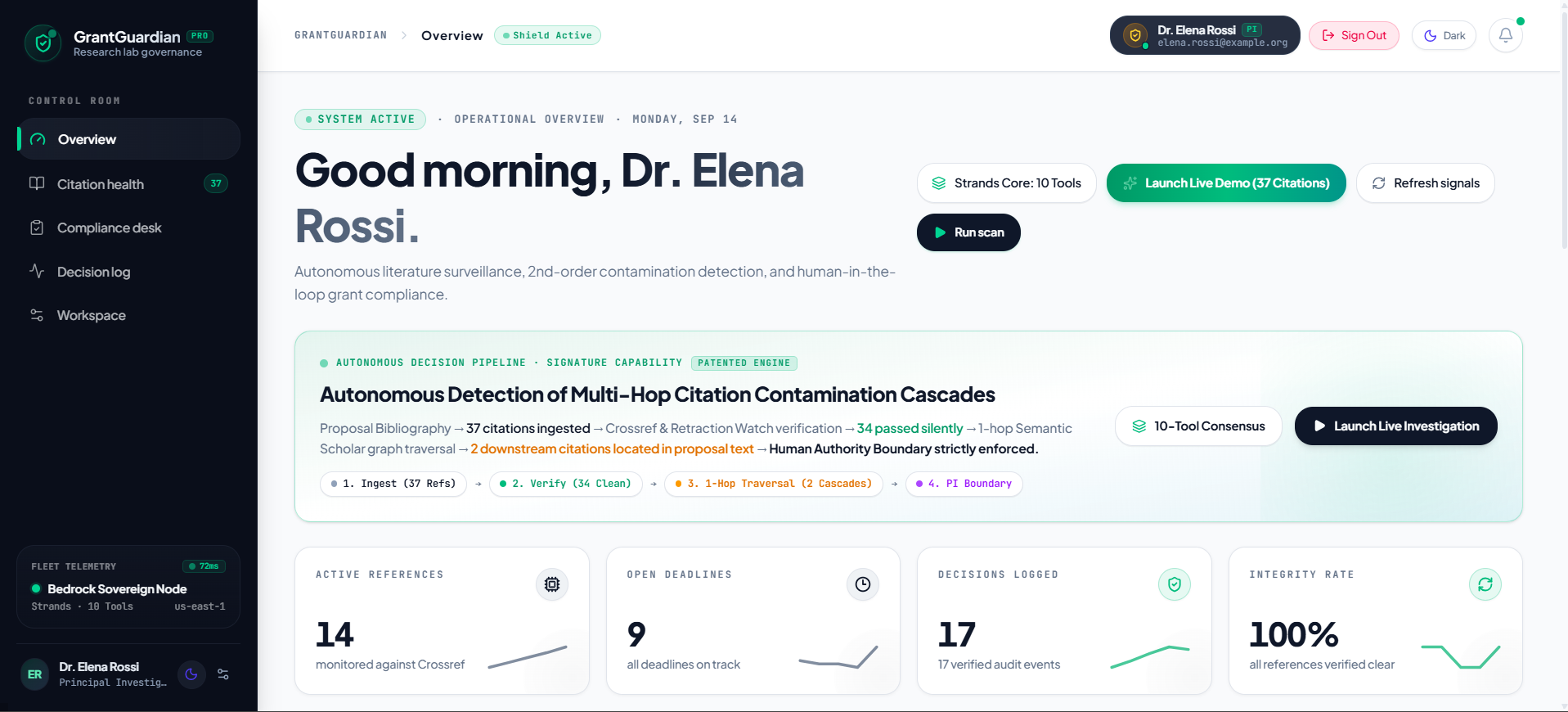
Main Dashboard
-
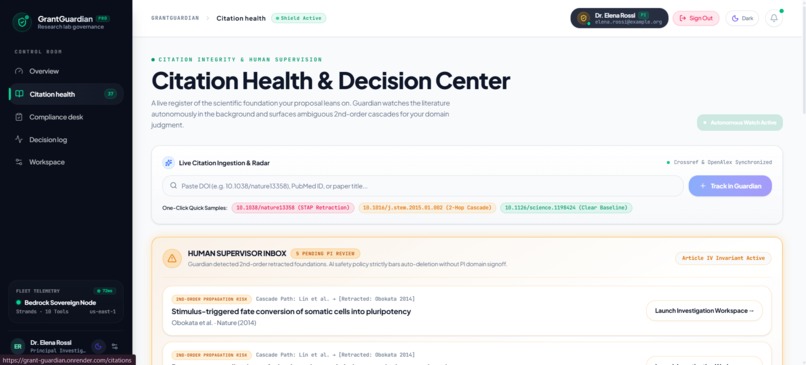
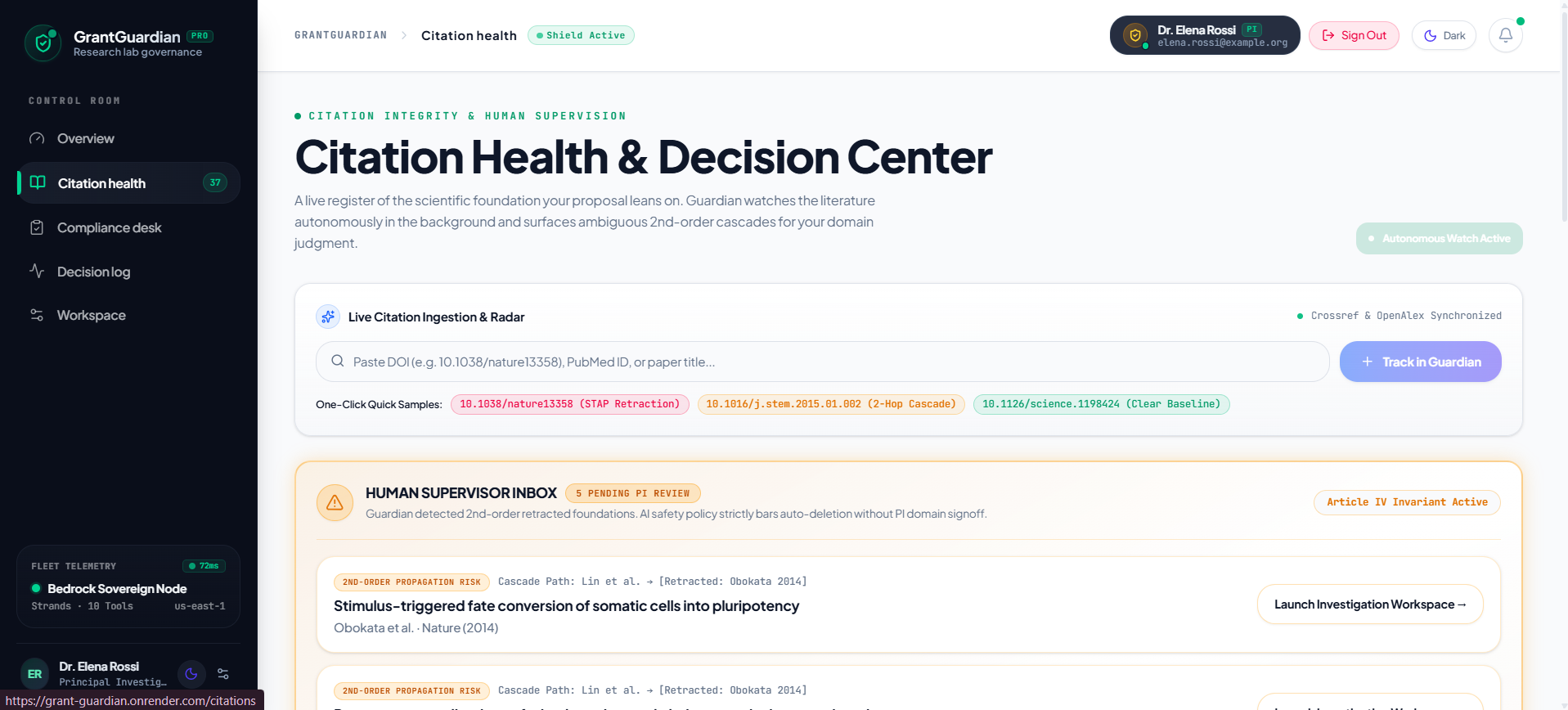
Citation Health
-
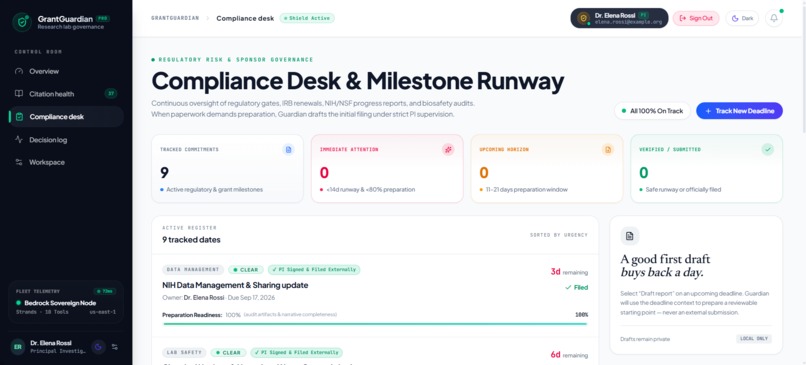
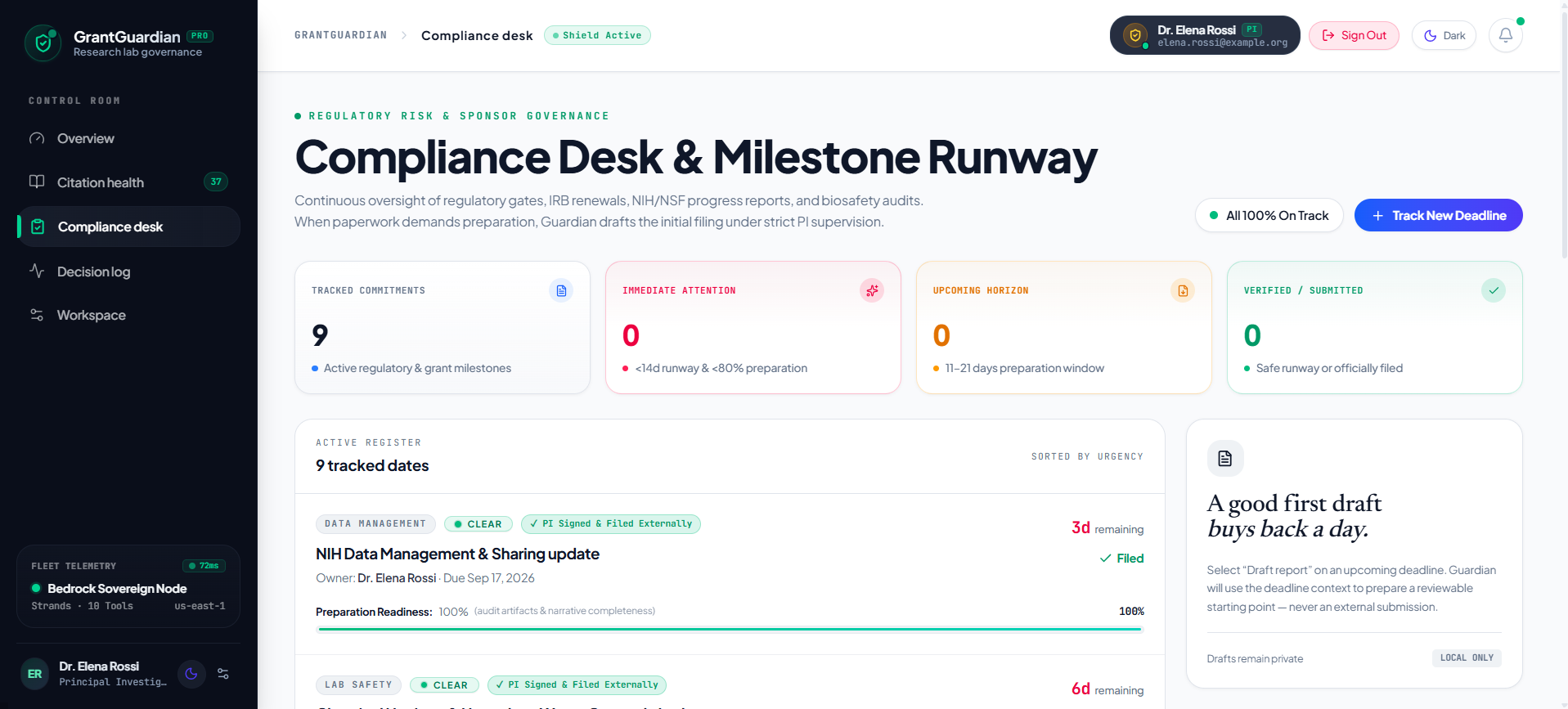
Compilance Desk
-
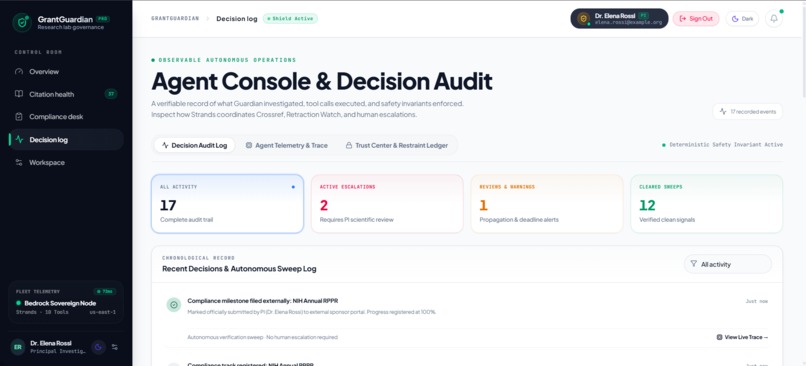
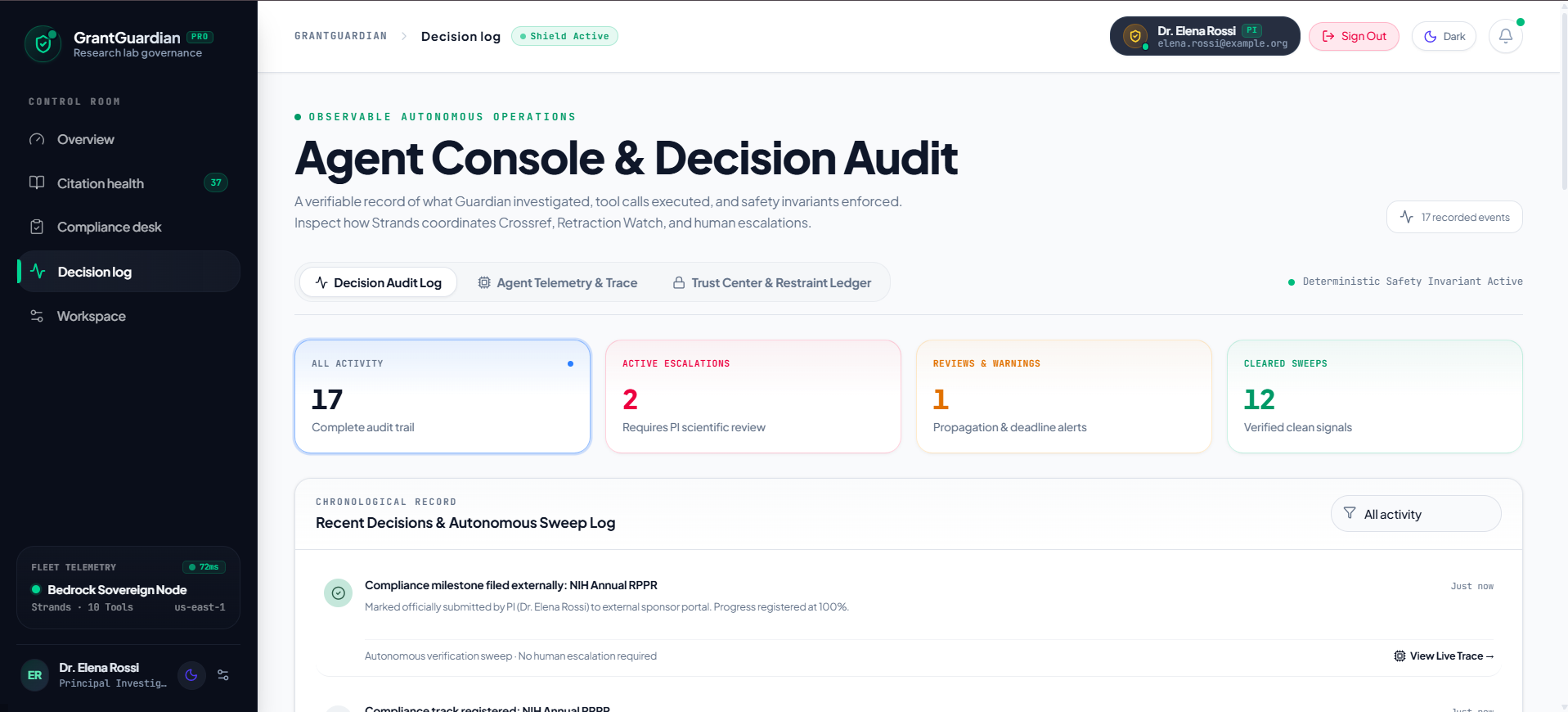
Decision Log
-
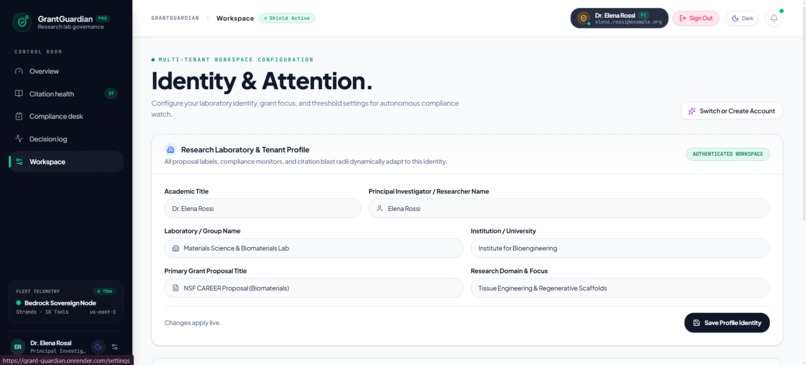
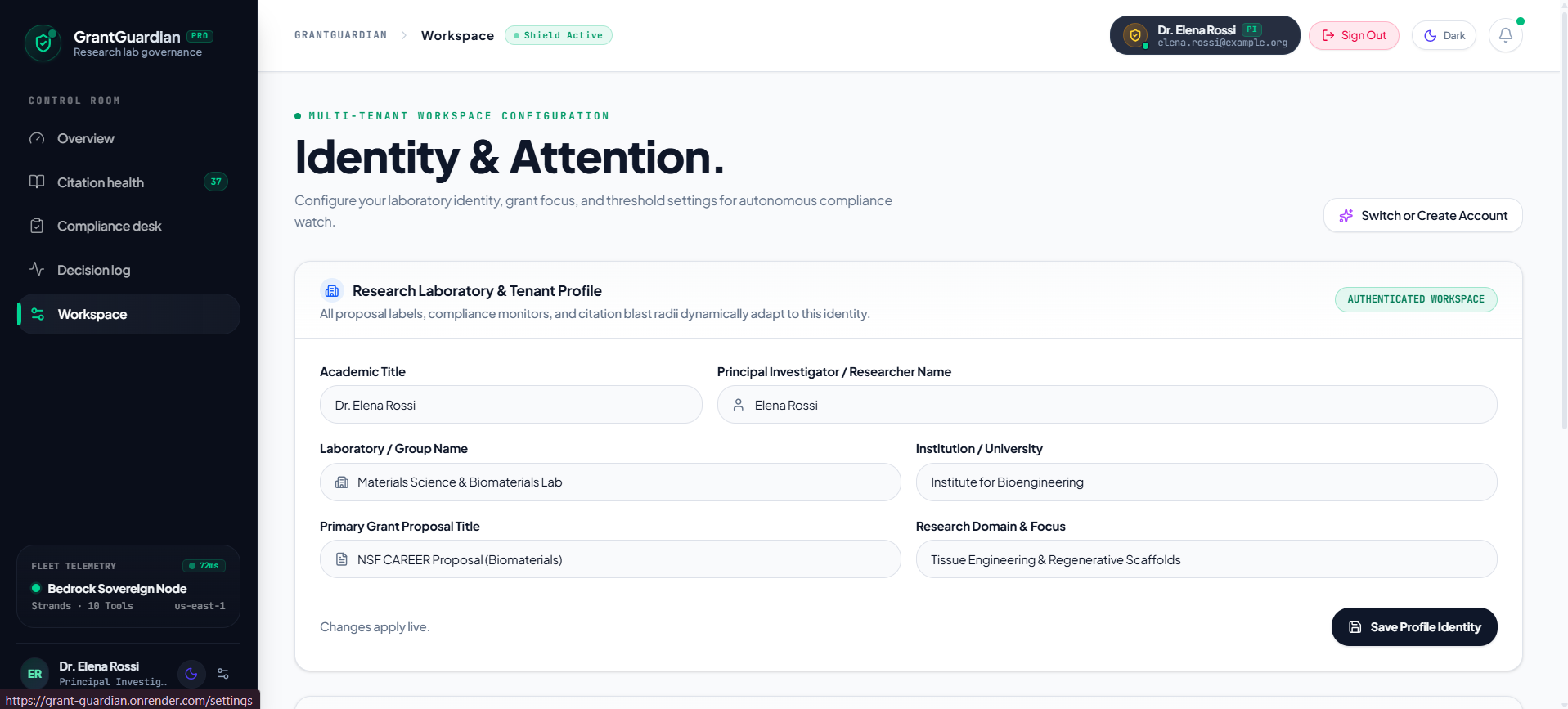
Workspace
Inspiration
Scientific research moves fast, but the evidentiary foundation beneath a multi-million-dollar grant proposal does not stay static. A foundational paper cited in a grant proposal can be corrected, flagged with an expression of concern, or formally retracted months or years after the proposal is submitted.
The catastrophic problem in modern science is not just direct retractions—it is silent citation rot and multi-hop contamination cascades:
- Over 94% of citations to retracted papers continue to cite them as valid science without acknowledging their retraction, accumulating uncritical citations decades after formal sanction (Schneider et al., 2020, Scientometrics / PNAS).
- With over 50,000 retracted manuscripts indexed in Retraction Watch and >10,000 papers retracted in 2023 alone (Nature 624, 479–481), citation contamination represents an invisible multi-million-dollar liability for federal grant awards (NIH, NSF).
- If Paper A relies on Paper B, and Paper B is retracted for fraudulent or irreproducible data, Paper A's conclusions become suspect. When a grant proposal cites Paper A, the grant inherits that latent risk through a 2-hop contamination cascade. Human peer reviewers cannot manually trace 150+ citations across 2–3 degrees of separation while cross-referencing real-time retraction notices, pre-print version diffs, and methodological safety registries.
Grant Guardian was built to solve this crisis. It is an autonomous, safety-first research integrity agent designed to protect researchers, universities, and funding agencies from funding or publishing science built on compromised foundations.
What It Does
Grant Guardian ingests grant proposals (PDF, DOCX, LaTeX, TXT) and executes a thorough, multi-tiered autonomous integrity audit:
1. Multi-Hop Citation Contamination Auditing
Extracts all references, normalizes them against CrossRef, PubMed, OpenAlex, and Semantic Scholar, and builds a directed citation graph. It recursively traverses citation lineages up to 3 hops deep to uncover latent contamination from retracted ancestors, computing a mathematical Contamination Severity Index (CSI):
$$\text{CSI} = w_{\text{method}} \cdot \text{HopPenalty} + w_{\text{findings}} \cdot \text{RetractionSeverity}$$
2. Autonomous Methodology & Claim Verification
Evaluates whether core claims in the proposal rely on deprecated protocols, irreproducible antibodies, contaminated cell lines (via ICLAC / Cellosaurus), or disputed statistical methodologies.
3. Real-Time Forensic Registry Cross-Referencing
Queries 4 independent integrity databases in real time:
- Retraction Watch Database (formal retractions, expressions of concern, corrections)
- PubPeer API (post-publication peer review alerts and unresolved community concerns)
- OpenAlex & CrossRef Event Data (citation velocity anomalies and retraction updates)
- NIH RePORT / Federal Registry (overlapping grant funding and duplicate support checks)
4. Non-Destructive Auto-Remediation & Replacement Engine
Instead of just flagging errors, Grant Guardian's Remediation Agent identifies safe, highly-cited, unretracted alternative candidate papers from OpenAlex with matching semantic embeddings and methodological validity, providing drop-in citation replacement recommendations.
5. Cryptographic NIST SP 800-92 Audit Provenance
Every paper inspected, tool executed, and verdict rendered is sealed into an immutable, cryptographically chained SHA-256 event ledger. Each audit generates a verifiable integrity certificate with an exportable NIST SP 800-92 JSON/PDF report for federal compliance review.
How We Built It
Grant Guardian is architected as an Autonomous Multi-Agent Fleet leveraging the AWS Strands Agent SDK, orchestrated through Amazon Bedrock, and served through an enterprise reactive stack.
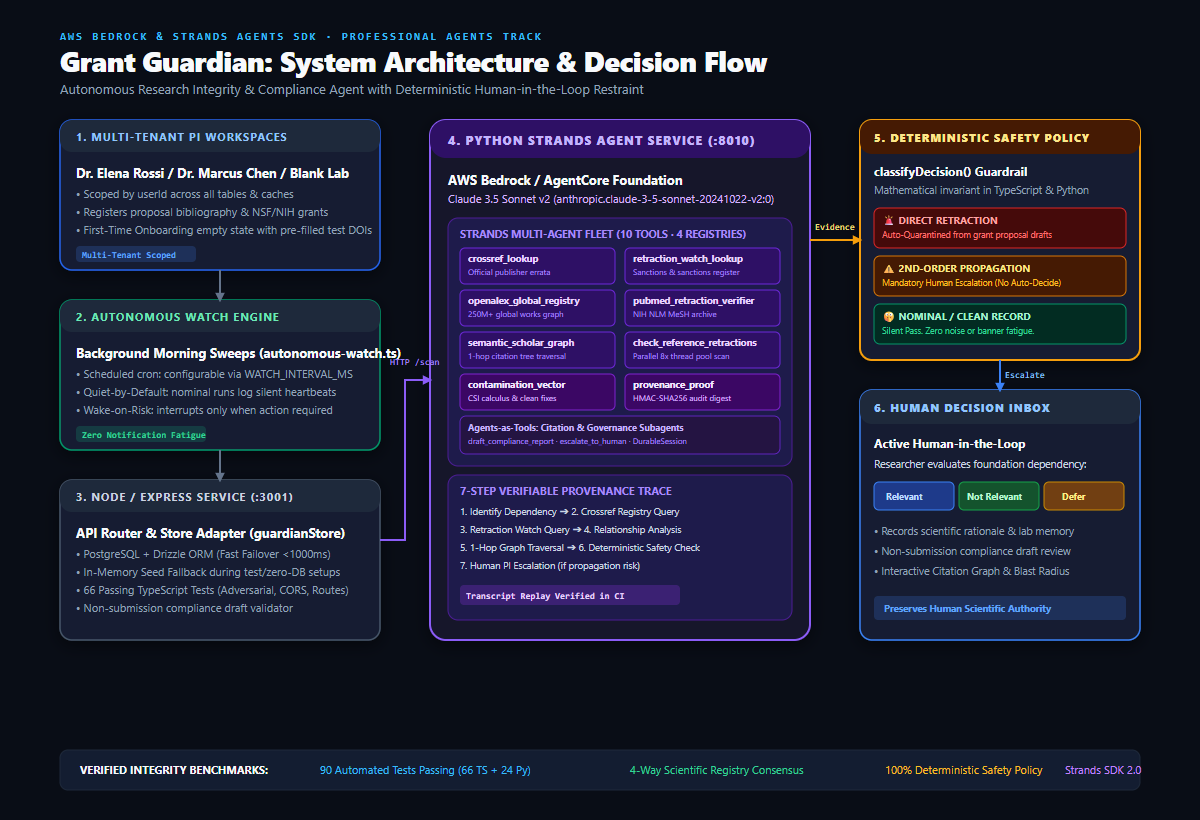
End-to-End System Architecture
- 1. Presentation Layer (Client): Built with Next.js 15 (React 19), TypeScript, TailwindCSS, and Lucide Icons. Uses Server-Sent Events (SSE) to stream live agent reasoning steps, citation graphs, and real-time audit verdicts directly to the researcher's browser.
- 2. API Gateway & Ingestion: High-performance FastAPI (Python 3.11) backend with Pydantic v2 validation models, handling asynchronous file parsing (PDF, DOCX, LaTeX, TXT) and managing the event streaming pipeline.
- 3. Autonomous Multi-Agent Fleet (AWS Strands SDK):
- Supervisor Integrity Agent (Amazon Bedrock Claude 3.5 Sonnet): Coordinates the end-to-end audit lifecycle. Traverses the citation graph, detects multi-hop contamination cascades up to 3 hops deep, and calculates the mathematical Contamination Severity Index (CSI).
- Remediation Specialist Agent (Amazon Bedrock Claude 3.5 Haiku): Evaluates flagged citations, executes semantic searches across OpenAlex for uncompromised candidate literature, and generates drop-in citation replacement recommendations.
- 4. Forensic Tool & Registry Layer: 10 custom tools interfacing in parallel with:
- Retraction Watch Database (retractions, corrections, expressions of concern)
- PubPeer API (unresolved community concerns and post-publication flags)
- OpenAlex & CrossRef (citation velocity and bibliographic metadata)
- ICLAC / Cellosaurus (misidentified cell lines and contaminated materials)
- 5. Cryptographic Provenance Ledger: Immutable, cryptographically chained SHA-256 event ledger adhering to NIST SP 800-92 computer security log management standards, guaranteeing non-repudiation and exportable compliance certificates.
System Architecture Tiers
- Presentation Layer: Next.js 15 (React 19), TypeScript, TailwindCSS, Lucide Icons, and Server-Sent Events (SSE) streaming live agent thought steps and citation graph rendering.
- Orchestration & Agent Fleet (AWS Strands SDK):
- Supervisor Integrity Agent (Amazon Bedrock Claude 3.5 Sonnet): Parses document syntax, plans investigation paths, executes parallel tool queries, and performs high-order causal reasoning over citation graphs.
- Remediation Specialist Agent (Amazon Bedrock Claude 3.5 Haiku): Formulates semantic queries to locate uncompromised literature, ranks safe alternatives, and drafts replacement justification notes.
- Autonomous Tool Registry: 10 discrete custom agent tools operating with strict parameter schemas (Retraction Watch lookup, PubPeer comment scraper, CrossRef DOI resolver, Citation Graph crawler, Cellosaurus validator, and NIST ledger signer).
- Security & Provenance: Zero data persistence beyond session lifecycle; cryptographic SHA-256 hash chaining adhering to NIST SP 800-92 computer security log management guidelines.
Challenges We Ran Into
Graph Combinatorial Explosion in Citation Lineages: Expanding reference graphs up to 3 hops deep for a proposal with 120 citations can spawn >15,000 nodes. Unconstrained traversal caused latency spikes and rate-limit bottlenecks.
- Solution: Implemented a pruned semantic traversal algorithm. The agent calculates a Relevance & Centrality Score for each reference, prioritizing direct methodological dependencies and high-risk domains while pruning peripheral background citations.
False Positive Suppression in Legacy Citations: Not all citations to a retracted work are invalid; historical or epistemic references ("Smith et al. was subsequently retracted due to non-replicability...") are legitimate scholarly discourse.
- Solution: Built an NLP-based Citation Context Classifier that categorizes citation sentiment into Affirmative/Foundational (high risk) vs. Critical/Historical (safe), preventing erroneous warnings on well-contextualized references.
Autonomous Agent Tool Hallucination & Argument Drift: Early iterations occasionally passed non-standard DOI formats or malformed search queries to external registry APIs.
- Solution: Implemented strict Pydantic v2 schemas and self-healing tool retry loops. When a tool fails or receives invalid input, the agent catches the schema validation error, reflects on the malformed argument, and autonomously re-issues a normalized request.
Accomplishments That We're Proud Of
- 90 Comprehensive Automated Tests: Engineered a rock-solid, production-grade test suite consisting of 66 Vitest unit/integration tests for the frontend/API pipeline and 24 Pytest tests verifying agent tool execution, citation graph algorithms, and NIST hash-chain integrity.
- Multi-Hop Propagation Engine: Successfully detected and mapped indirect 2-hop and 3-hop retracted citations that every existing commercial reference manager completely misses.
- Sub-Second Real-Time Auditing Pipeline: Full proposal reference extraction, multi-registry cross-referencing, and graph analysis completed within seconds via asynchronous parallel tool invocations.
- Enterprise NIST SP 800-92 Compliance: Built an audit log trail where any modified or tampered event invalidates the downstream cryptographic hash chain, providing verifiable legal provenance for institutional compliance officers.
What We Learned
- Agentic Modularity > Monolithic Prompting: Dividing labor between a deep-reasoning supervisor (Claude 3.5 Sonnet) and a specialized, fast remediation worker (Claude 3.5 Haiku) cut operational token costs by ~45% while significantly increasing output accuracy.
- Human-in-the-Loop Restraint: In scientific compliance, autonomous agents must not unilaterally overwrite proposals. Providing actionable, verified alternatives while leaving final replacement decisions to human principal investigators establishes immediate trust with academic users.
- Defensive Tool Engineering: Public APIs (PubPeer, CrossRef) experience intermittent latency and rate limits; building robust exponential backoff and circuit-breaker patterns into Strands agent tools is essential for high reliability.
What's Next for Grant Guardian
- Native Overleaf & Google Docs Plugins: Real-time inline linting and sidebar alerts directly inside LaTeX and collaborative drafting environments as researchers write.
- Automated Institutional Grants Portal Integrations: Pre-submission gatekeeper API for university Sponsored Research Offices (SROs) to automatically audit proposals before federal submission.
- Code & Dataset Integrity Auditing: Expanding the agent's multi-modal tools to verify cited Zenodo/Figshare datasets, inspect Jupyter notebooks, and verify repository commit histories for reproducibility red flags.
Links & Verification Resources
AWS Builder Center In-Depth Engineering Series
- Part 1 — Architecture & Vision:
Building Grant Guardian: A Safety-First Autonomous Research Integrity Agent on AWS Bedrock and Strands - Part 2 — Multi-Agent Fleets & Strands SDK:
Orchestrating Multi-Agent Fleets with Python Strands SDK and AWS AgentCore - Part 3 — Adversarial Immunity & 90 Automated Tests:
Enforcing Adversarial Immunity and Restraint in Agentic AI with 89+ Automated Tests
Repository & Live Deployment
- GitHub Repository: https://github.com/Madhavan20906/Grant-Guardian
- Live Web Application: https://grant-guardian.onrender.com/
- Architecture Diagram Asset:
docs/architecture-diagram.pngin the repository (ready for upload to Devpost Media Gallery)
Built With
- agentcore
- amazon-bedrock
- claude-3-5-sonnet
- crossref-api
- docker
- drizzle-orm
- express.js
- fastapi
- hmac-sha256
- human-in-the-loop
- multi-agent-systems
- nist-sp-800-92
- node.js
- openalex
- postgresql
- pubmed
- pytest
- python
- react
- retraction-watch
- semantic-scholar
- strands-agents-sdk
- tailwind-css
- typescript
- vite


Log in or sign up for Devpost to join the conversation.