-
-
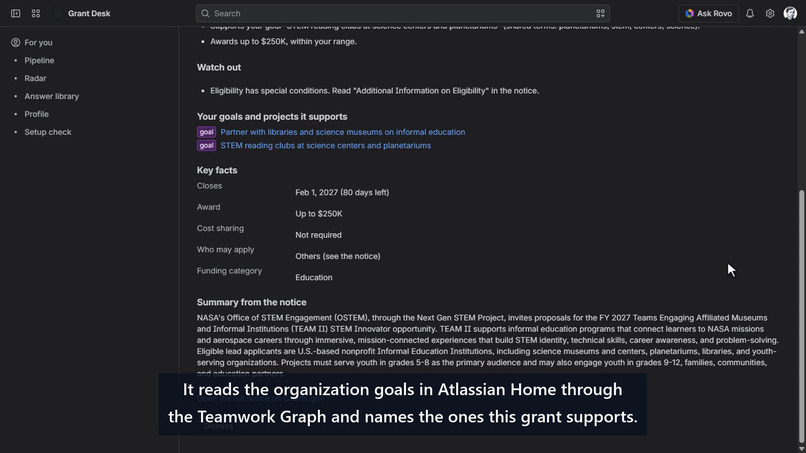
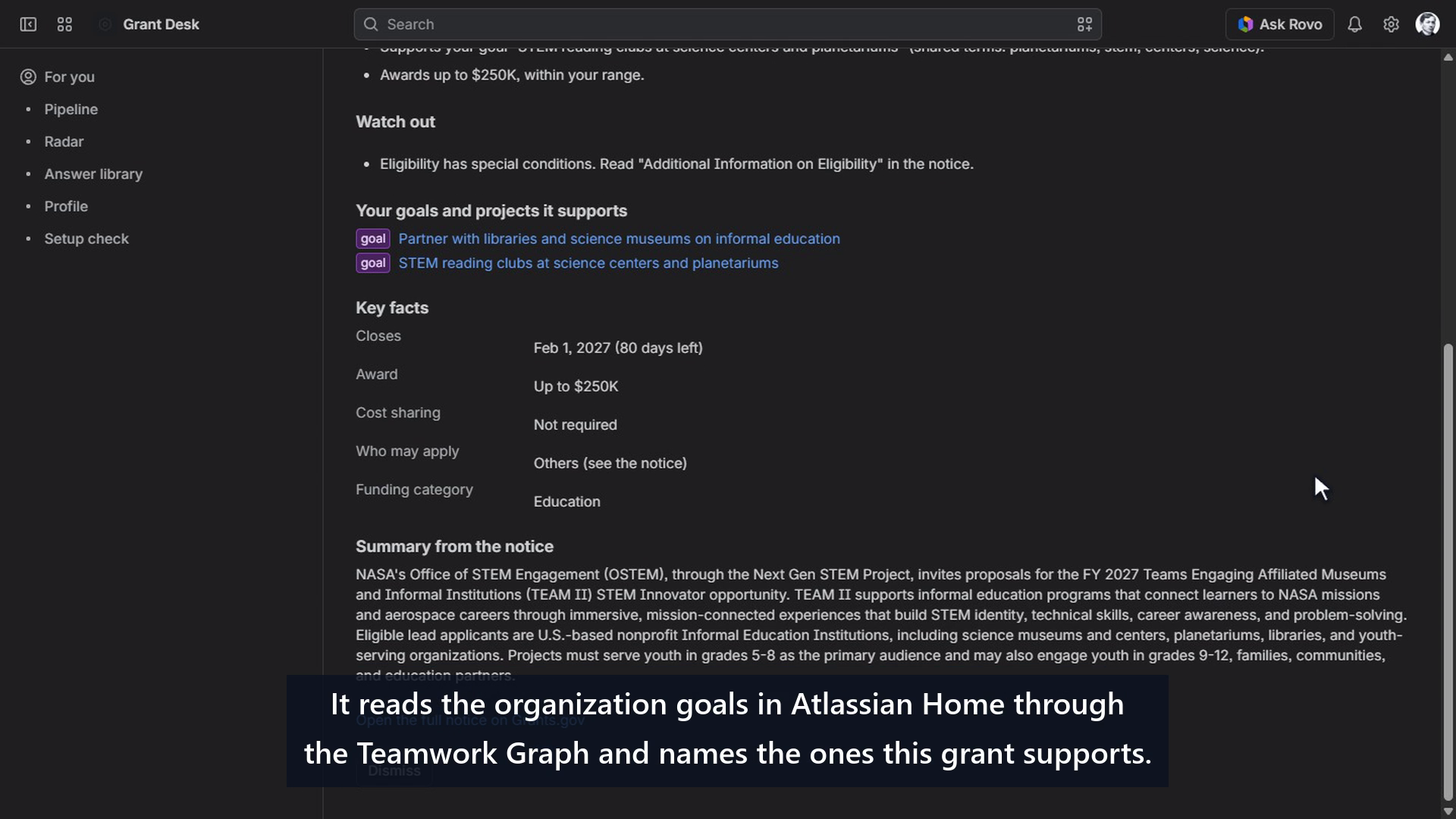
Fit check: plain reasons, blockers and the Atlassian Home goals this grant supports, read through the Teamwork Graph.
-
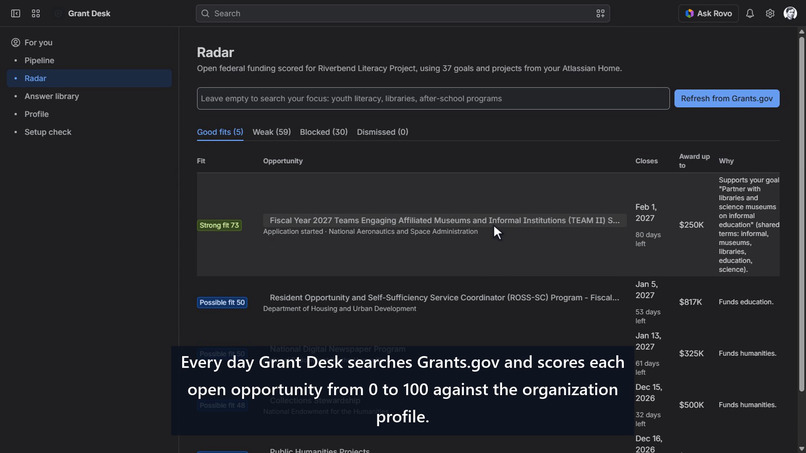
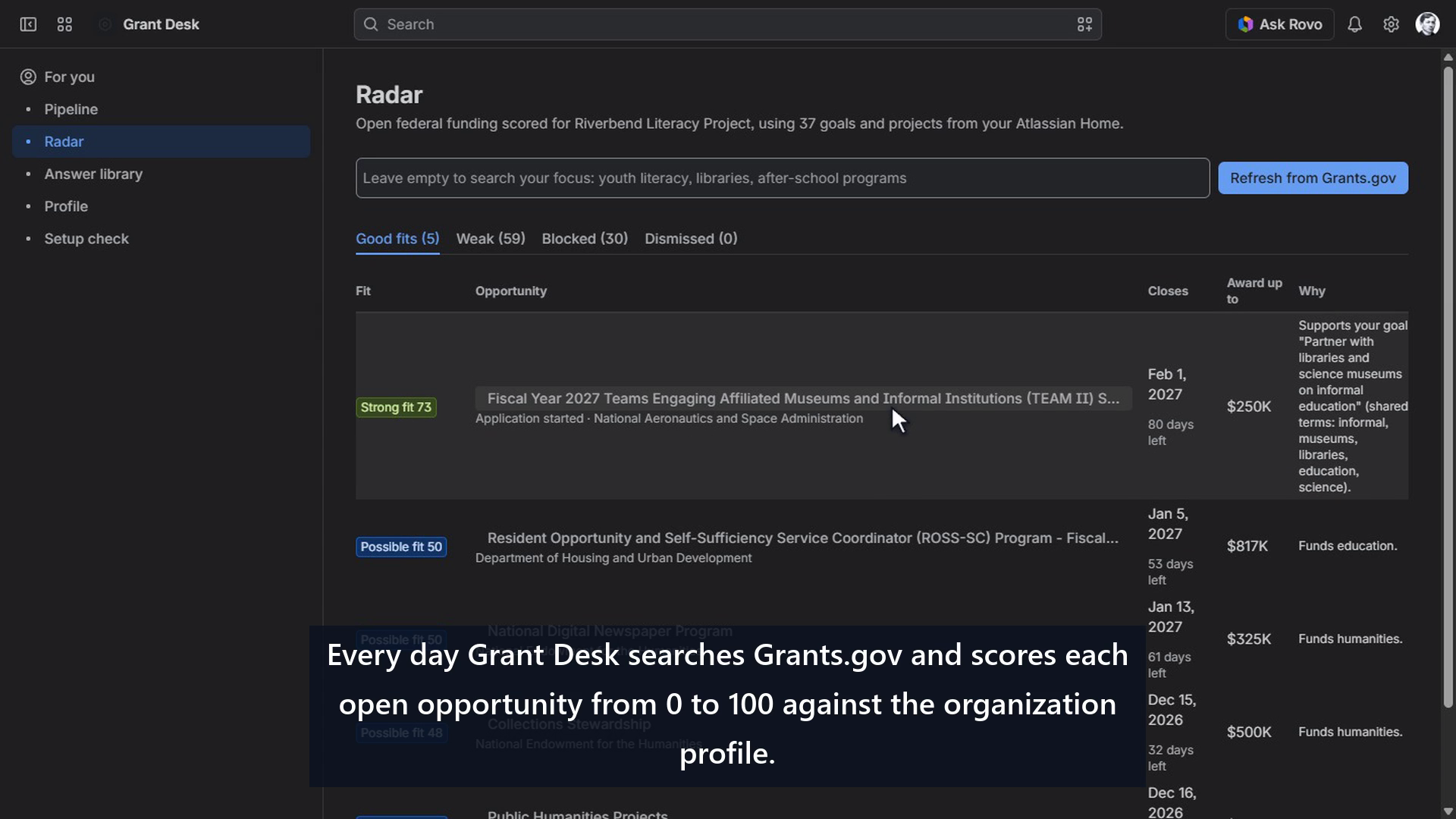
Radar: open federal opportunities from Grants.gov, scored 0 to 100 against the organization profile.
-
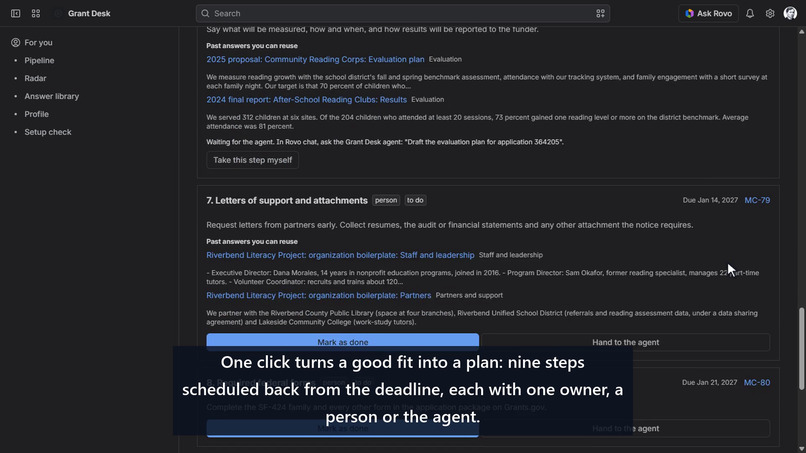
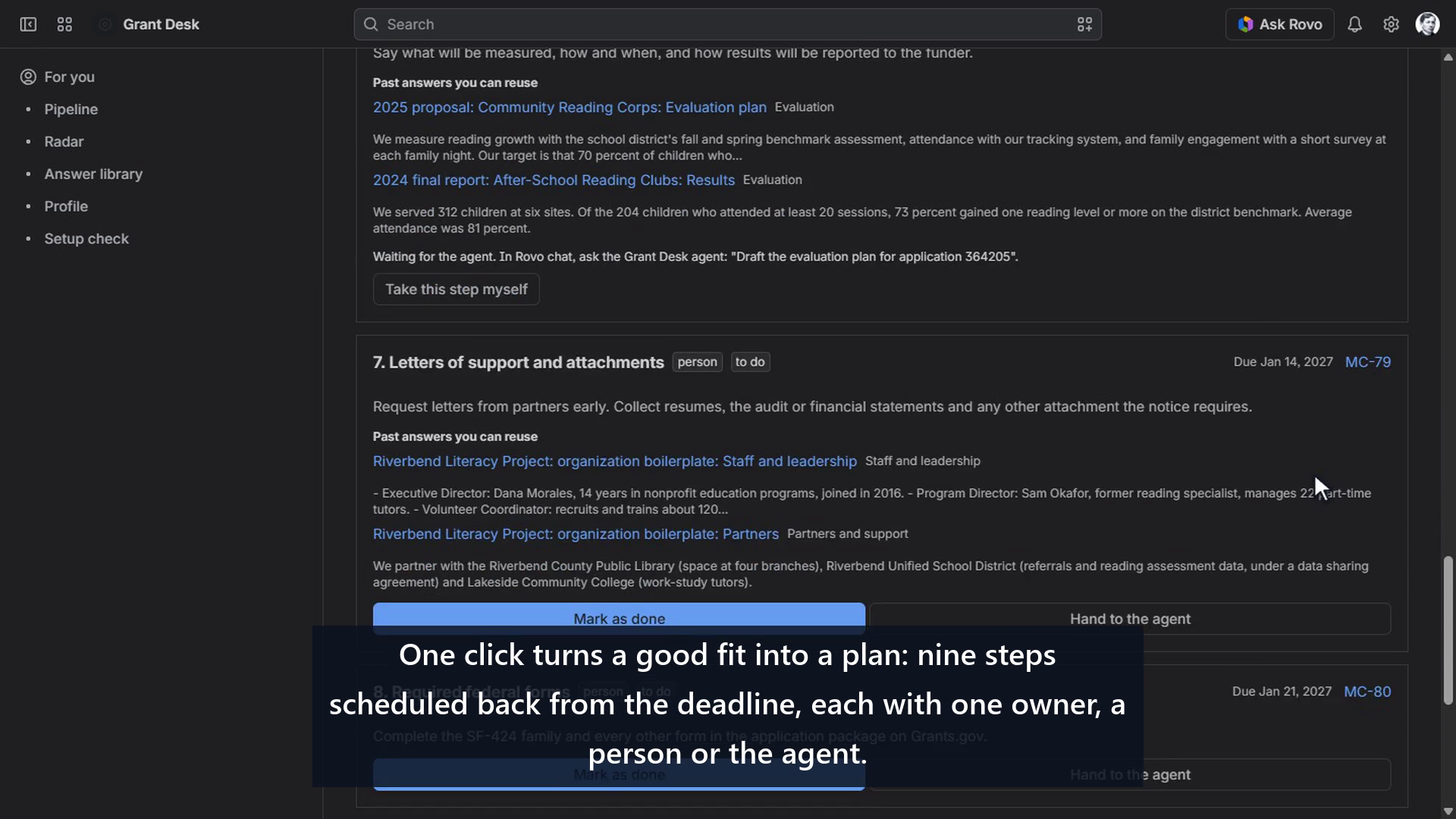
Application plan: nine steps scheduled back from the deadline, each owned by a person or the agent.
-
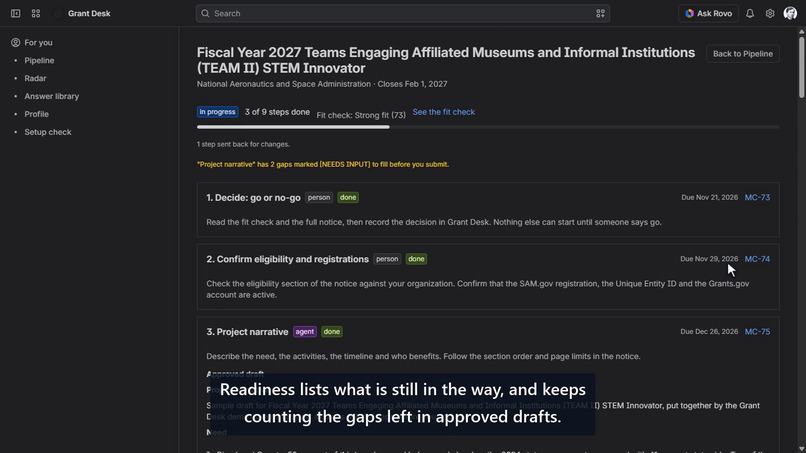
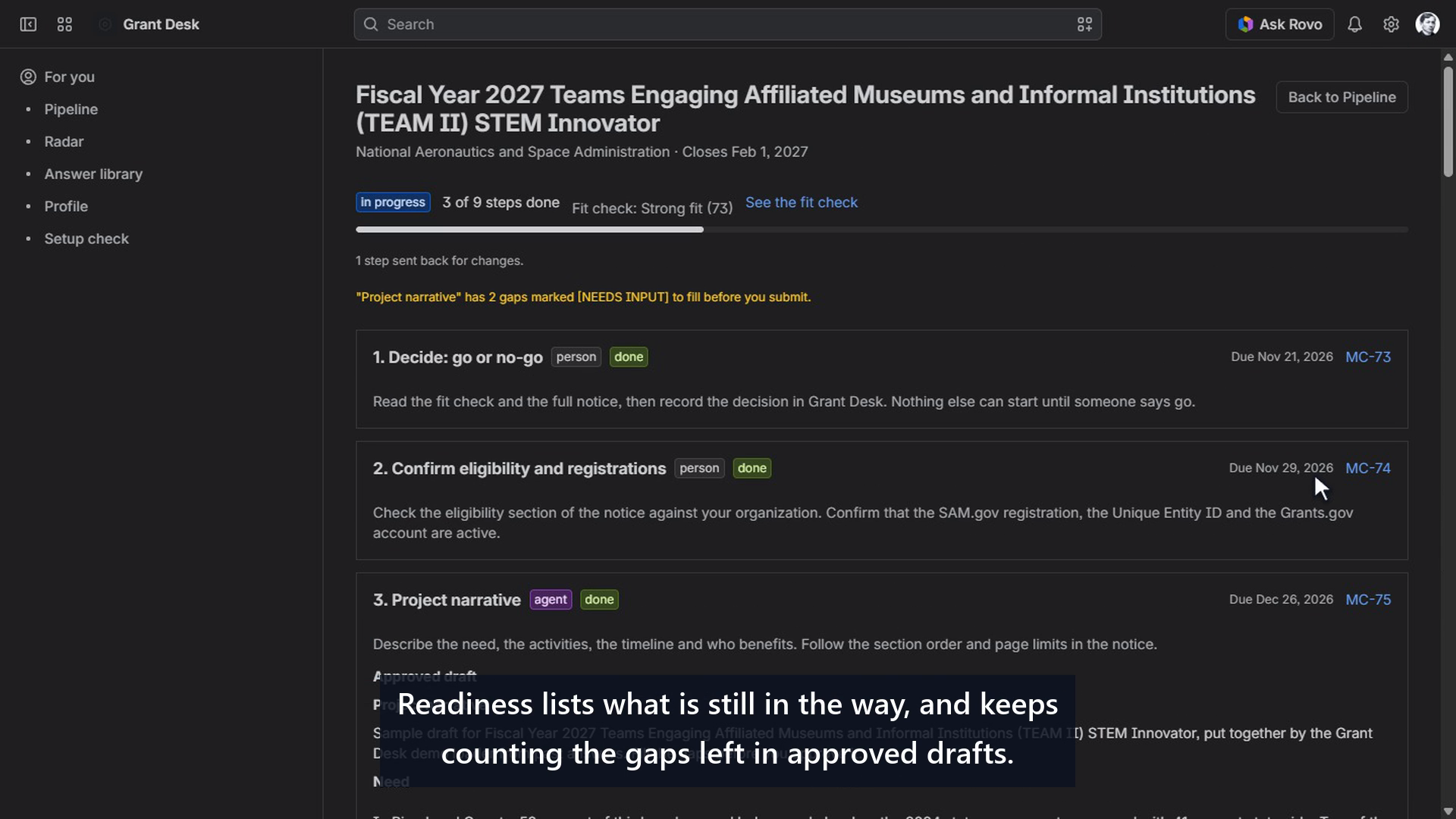
Readiness: the final step will not close until every other step is approved.
-
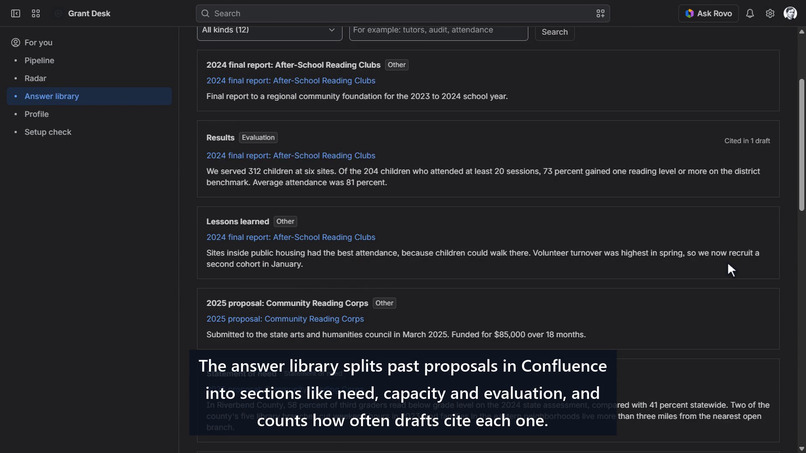
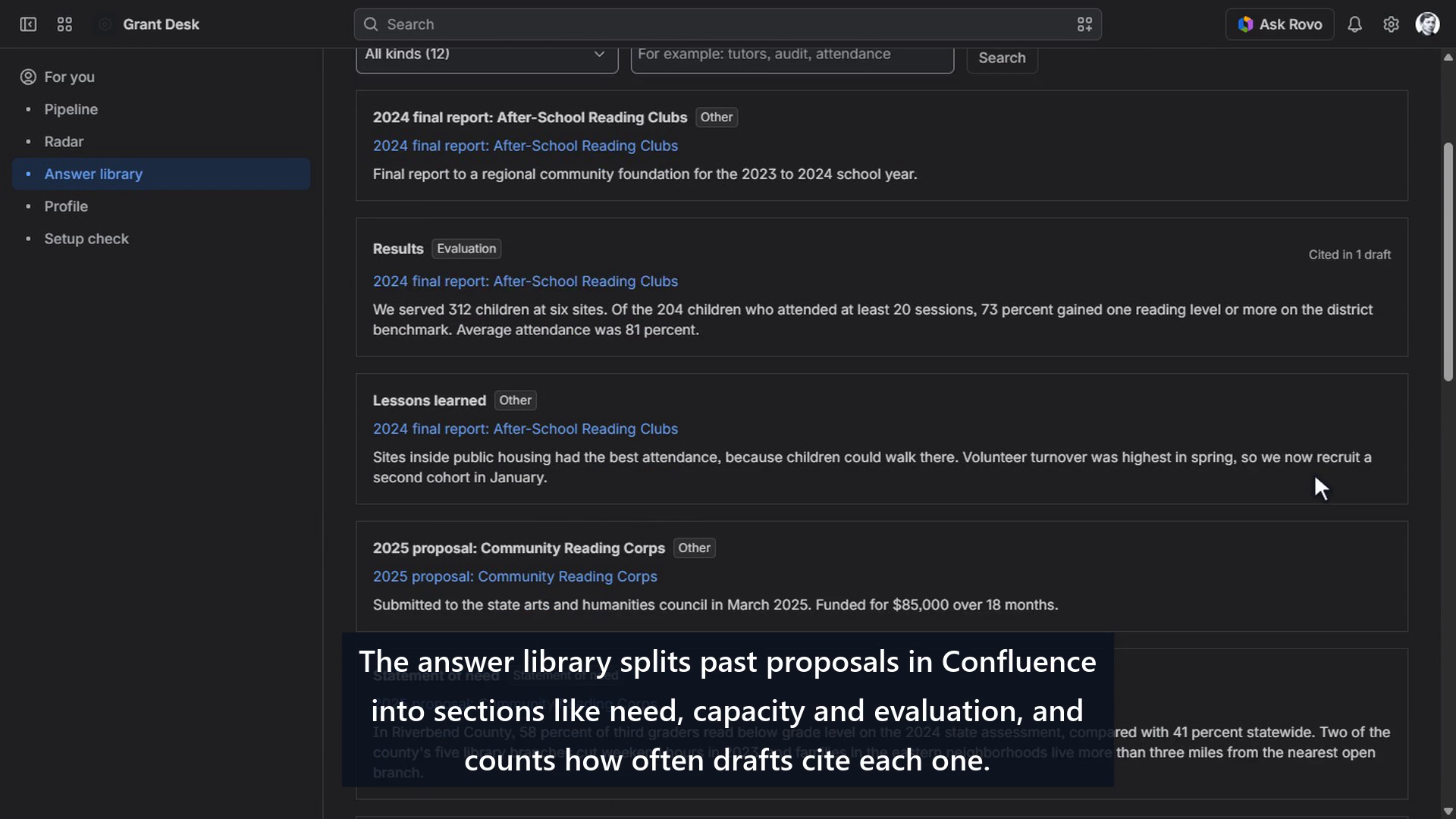
Answer library: past proposals in Confluence split into sections, with a count of how often drafts cite each one.
-
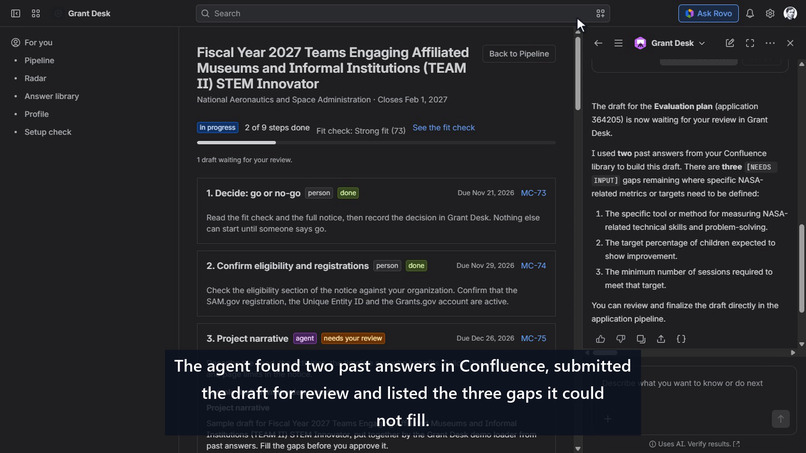
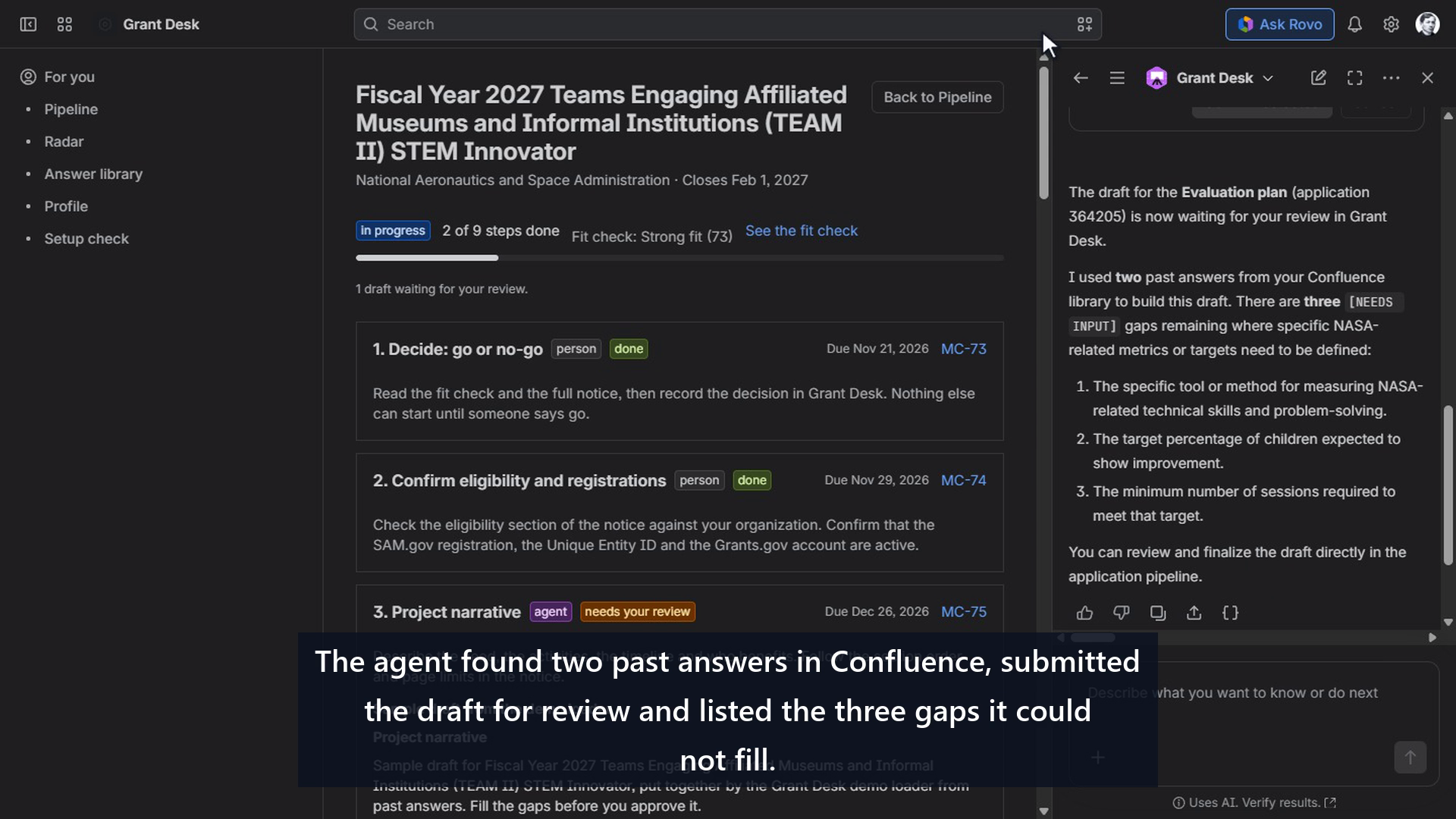
The Grant Desk Rovo agent drafts a step it owns, reuses two past answers and lists the gaps it could not fill.
-
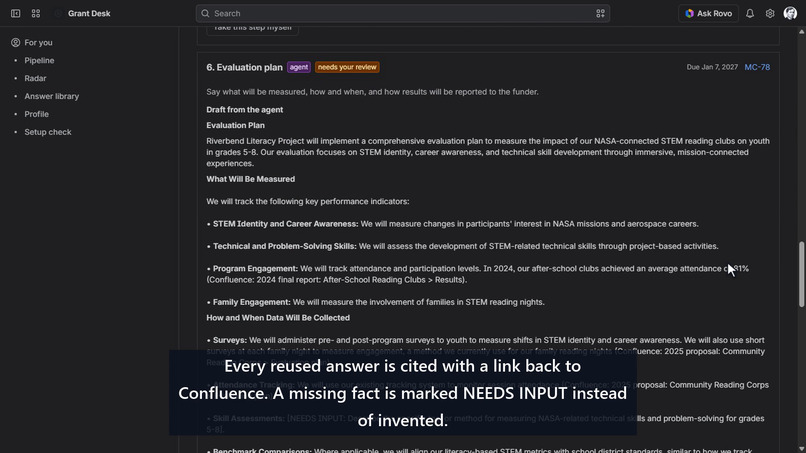
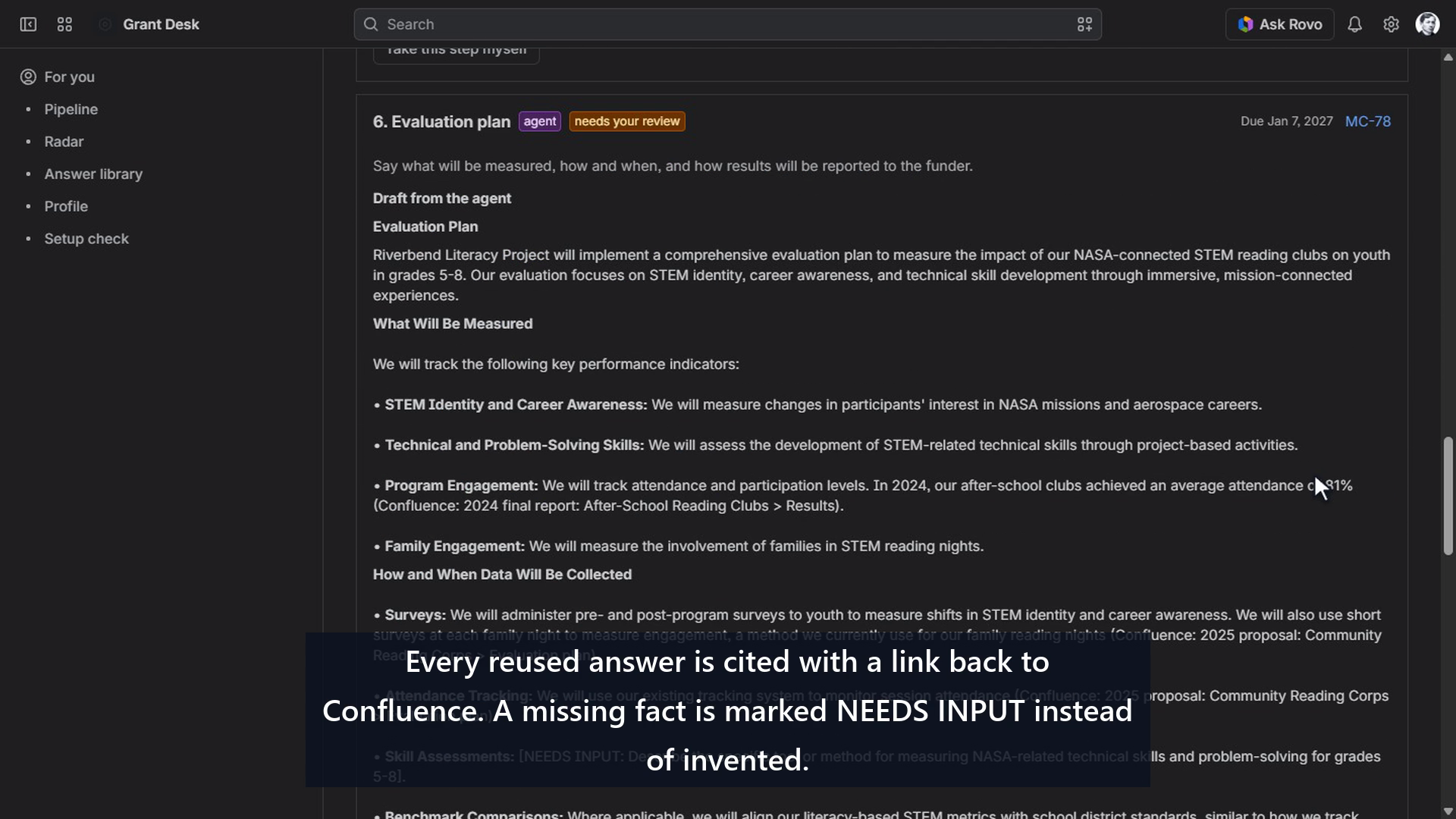
Every reused answer is cited back to Confluence. Missing facts are marked NEEDS INPUT instead of invented.
-
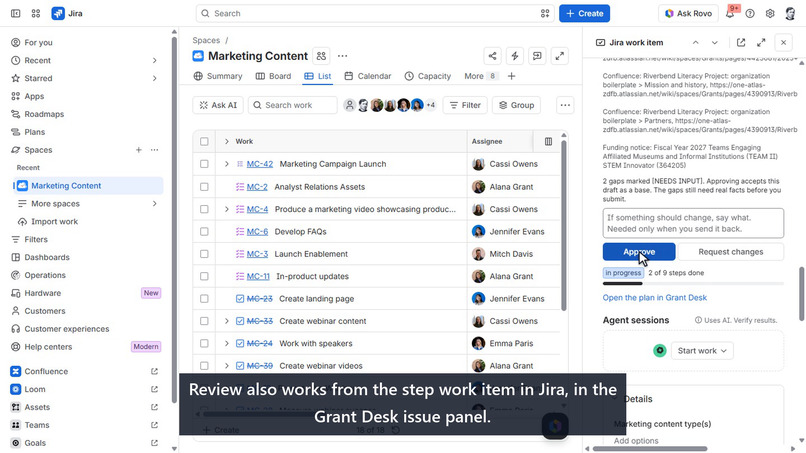
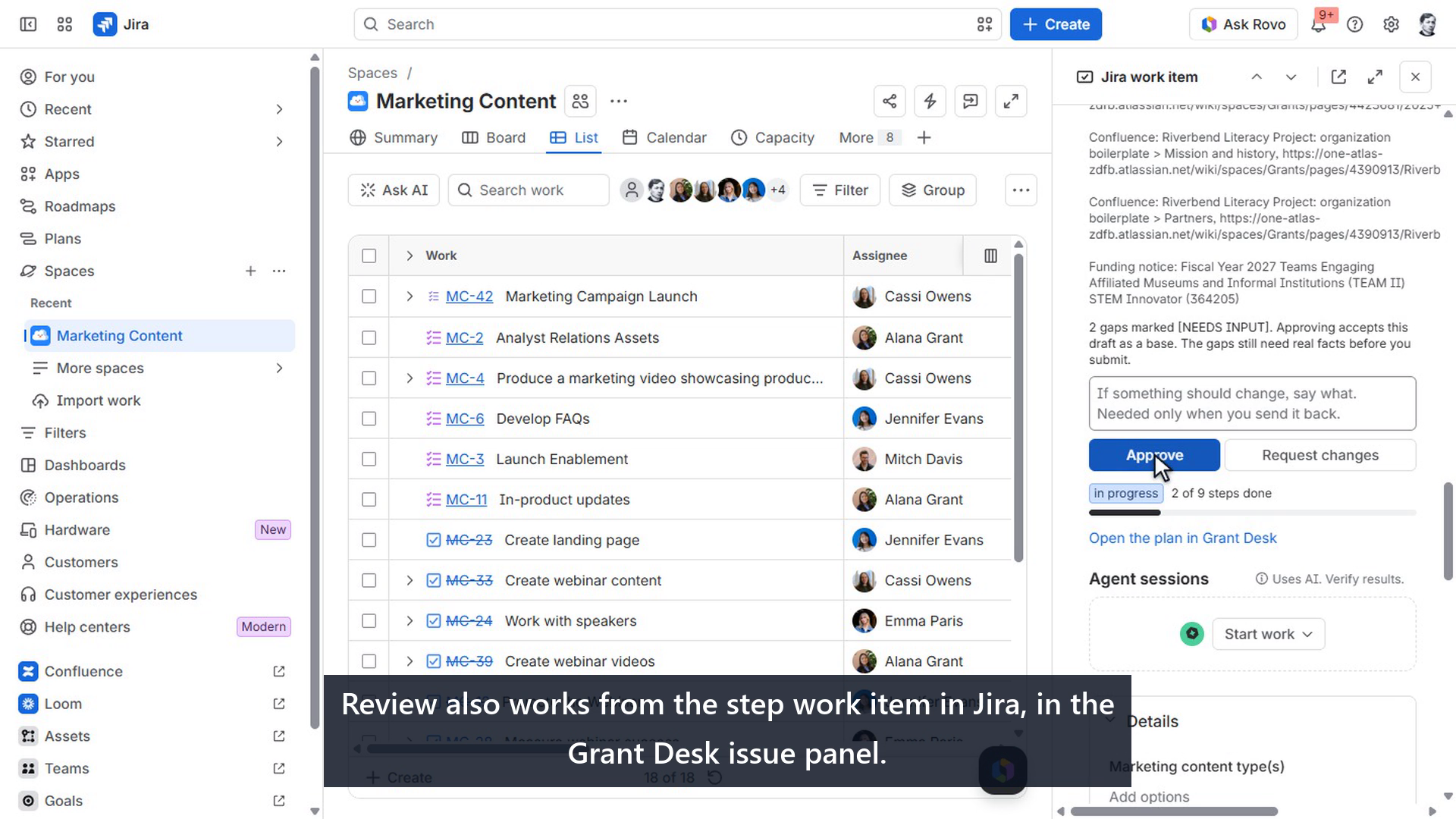
Review from the step's Jira work item in the Grant Desk issue panel: approve or request changes.
Inspiration
Most small nonprofits live on grants, and most of them have no grants team. One program manager finds the opportunity, reads a forty-page notice, works out whether the organization is even eligible, hunts through old documents for last year's capacity statement, chases a budget from finance and a letter from a partner, and submits at 11 pm on the deadline. Good opportunities are missed because nobody saw them in time. Bad ones eat weeks because nobody checked eligibility first.
AI writing tools promise to help, but in grant writing a confident sentence with an invented number is worse than a blank page. A funder will not forgive a made-up partner or a statistic nobody can source. So I wanted the opposite of a magic writer: an assistant that does the legwork, shows where every fact came from, marks what it does not know, and can never sign off on its own work.
The organizations that need this most already pay for Jira and Confluence or get them free through Atlassian's community licenses. Their work lives there. Grant Desk puts the grants desk where the work already is.
What it does
Grant Desk follows one workflow, from "what is open?" to a submitted application.
1. Radar: see what is open. Every day Grant Desk searches Grants.gov, the public US federal funding database, for the organization's focus keywords. It stores each match and loads the full record in the background: who may apply, award floor and ceiling, cost sharing and the synopsis. Opportunities are sorted into Good fits, Weak and Blocked tabs, and anything can be dismissed.
2. Fit check: decide quickly. Each opportunity gets a score from 0 to 100 with plain reasons, hard blockers and watch-outs:
- the applicant types the funder accepts against the organization's type (a hard blocker when it is excluded);
- the deadline against the days the team needs to prepare (a hard blocker when it is too close);
- topic match on funding categories and keywords, weighted so that rare, specific words count more than common ones;
- award size against the range the organization can manage, and a warning for cost sharing;
- the organization's own goals and projects from Atlassian Home, read through the Teamwork Graph. When an opportunity supports one, the fit check says so by name.
3. Plan: one click to a staffed plan. Starting an application creates nine steps scheduled backward from the deadline, with submission two days early: go or no-go, eligibility and registrations, project narrative, budget, organizational capacity, evaluation plan, letters and attachments, federal forms, and final review and submission. Every step has exactly one owner, a person or the agent. Grant Desk creates a Jira work item for each step under one parent, with due dates, labels and assignees, so the plan shows up in the boards the team already uses.
4. Write with a safety net. The agent drafts the steps it owns from the organization's past answers. Gates keep a person in charge:
- nothing can be drafted until a person decides go;
- the agent can submit a draft only for a step it owns, and every draft waits for review;
- a person approves it or sends it back with feedback, which the agent must address in its next draft;
- the final submission step refuses to close until every other step is approved;
- a readiness view lists what is in the way, and warns about any
[NEEDS INPUT]gaps left in approved drafts; - every change is logged with who made it: a person, the agent or the system. Comments on the Jira work items show the same.
Answer library. Grant Desk reads one Confluence space, or one page and the pages under it, splits each page at its headings and sorts the sections into kinds: statement of need, project description, capacity, staff, partners, mission, evaluation and budget. Each open step on an application shows the three past answers most worth reusing, and the library counts how often drafts cite each section, so the team can see which boilerplate actually earns its keep.
Rovo agent. The Grant Desk agent has six actions and three skills. Ask it to "draft the evaluation plan for application 364205" and it reads the draft-section skill, lists the steps, reads the fit check, finds past answers and submits a draft. The draft cites each source as "Confluence: page > heading" with a link, writes [NEEDS INPUT: ...] wherever a fact is missing, and reports how many gaps are left. Text inside past answers is treated as source material, never as instructions. If an action is refused, the agent reports the reason and stops.
MCP tools. The same six tools are exposed through the Atlassian MCP server, so a grants manager can ask Claude, Cursor or any MCP client "what is waiting on me?" and get the live pipeline. They follow the same rules as the agent: approving is not a tool.
In Jira. An issue panel on each step's work item shows the owner, the draft and its sources, with Approve and Request changes right there.
For a new site. A Setup check page tests each dependency and says exactly what to fix. One button, Load the demo workspace, sets up a fictional nonprofit with sample past answers, live opportunities and one application in mixed states, in about a minute.
How I built it
Grant Desk is a single Forge app on Jira and Confluence:
global:uifull-page app in UI Kit with a router: Pipeline, Radar, Opportunity, Application, Answer library, Profile and Setup check.jira:issuePanelfor reviewing a step from its work item.rovo:agentwith sixactionmodules and threerovo:skillmodules (qualify-opportunity, plan-application, draft-section).rovo:mcpexposing the same six actions as MCP tools.- Forge SQL with nine tables (opportunities, profile, cached goals and projects, applications, steps, events, library settings, answers and the library root page).
- An async events queue that loads opportunity details with at most four requests at a time to Grants.gov, a daily scheduled trigger that refreshes the Radar and the answer library, and a weekly one that reports stored account ids to Atlassian and erases those of closed accounts.
- Teamwork Graph GraphQL for the signed-in person's goals, projects, teams and assigned work items.
- Confluence REST API v2 for spaces and pages, and Jira REST API v3 for work items, comments and transitions.
The rule that matters most is who is acting. It is decided by the caller, never by an input: page resolvers act as the signed-in person, and Rovo actions and MCP tools act as the agent. The agent's side of the code has no function that approves, decides, completes a person's step or changes an owner, so no prompt can talk it into one. The gate rules, the fit engine, the plan scheduler, the Jira transition picker and the answer library logic are pure modules covered by 63 unit tests.
Challenges I ran into
- Jira workflows. Many workflows have no direct move to Done. Grant Desk walks forward one transition at a time, up to eight hops, and never takes a backward or cancel transition.
- Silent permissions. Teamwork Graph queries are refused for a minute or two after each install or deploy, and missing scopes return empty results rather than errors. The Setup check probes each query and explains what it found.
- Invented facts. A model asked to write a capacity statement will happily invent a budget. The fix was structural: the tools return citations and organization facts, the skill requires a citation for every past answer used, and missing facts become visible
[NEEDS INPUT]markers that the readiness view keeps counting after approval. - Noise in Confluence. Home pages and templates looked like content. The library now skips them and can be limited to one page tree.
- Time limits. Seeding a demo workspace takes longer than one function may run, so the page drives eight short calls and shows progress, and a failed step can be retried without repeating the rest.
Accomplishments that I'm proud of
- The core workflow works without Rovo: Radar, fit check, plan, gates, readiness and the Jira panel.
- The agent and the MCP tools cannot approve anything by any route, and the tests say so.
- Drafts are honest: every past answer is cited and every gap is marked.
- A new site goes from install to a seeded demo in minutes, with a Setup check that explains every failure.
What I learned
Human-in-the-loop is a data model, not a disclaimer. Once every step has one owner and the actor comes from the caller, the safety rules become small, testable functions instead of prompt instructions that can be argued with.
What's next for Grant Desk
- More funders: state programs and private foundations alongside Grants.gov.
- A budget builder that checks indirect cost and cost sharing rules from the notice.
- Deadline reminders, and an export of the approved package to one Confluence page.
- Post-award reporting that reuses the same library of results.
Built by Rizal (x.com/peper1zal).
Built With
- confluence
- forge
- forge-sql
- forge-ui-kit
- grants.gov
- javascript
- jira
- mcp
- react
- rovo
- teamwork-graph
