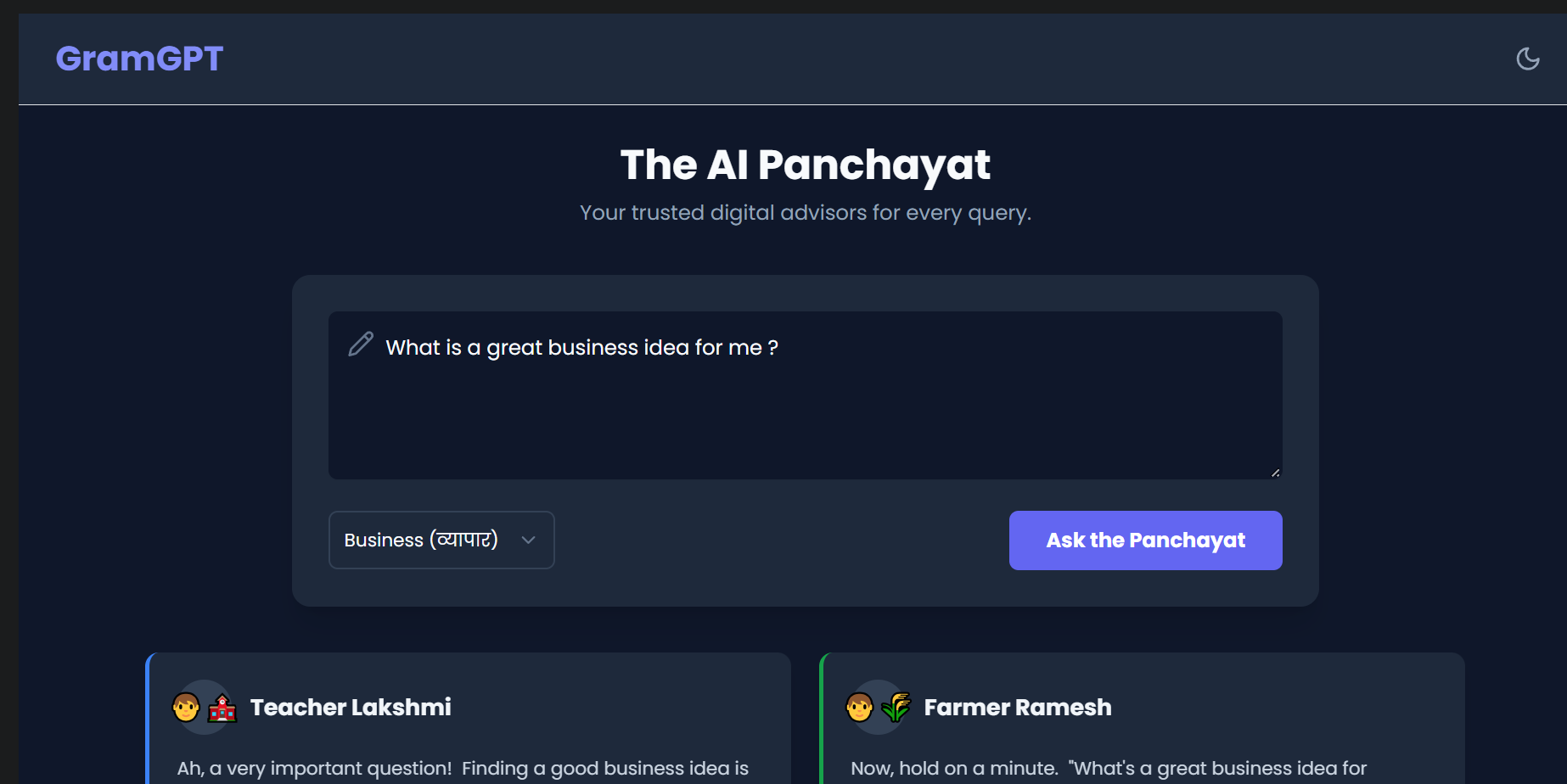
🌾 GramGPT: The AI Panchayat
✨ Inspiration
India’s rural population (65%+) faces daily challenges — limited access to quality education, modern farming knowledge, healthcare awareness, and small-business guidance.
While AI is advancing rapidly, these tools are often designed for urban, English-speaking users with reliable internet. We asked ourselves:
“What if every village had its own AI Panchayat, an offline, multilingual knowledge hub that empowers people with reasoning, not just answers?”
This sparked the creation of GramGPT: a lightweight, fine-tuned local AI agent built on gpt-oss open models, designed for Tier-2/3 towns and rural India.
🏗 What We Built
Four AI Adapters (LoRA fine-tunes)
- 📚 ShikshaGPT – Localized learning assistant for students.
- 🌱 KisanGPT – Agricultural copilot for farmers.
- 🏥 SwasthyaGPT – Healthcare & wellness guide.
- 🛍 VyapaarGPT – Business mentor for small entrepreneurs.
Core Features
- Offline Agentic System: Runs fully on-device with
vLLM/Ollama, no internet dependency. - Multilingual Support: Fine-tuned on Hindi + regional datasets, with Whisper + Indic-TTS for voice I/O.
- Knowledge Augmentation: Integrated with local vector DB (Supabase / SQLite) containing government schemes, weather updates (if online), crop prices, and educational material.
- One-stop UI: A clean Next.js app with 4 tabs (Education, Farming, Health, Business), voice-first interface, and chatbot mode.
⚙️ How We Built It
- Base Models:
gpt-oss-20bfor deployment,gpt-oss-120bfor few-shot evaluation. - Fine-tuning: Used LoRA adapters with domain datasets (NCERT + AgriStack + Health articles + MSME docs).
- Datasets: Mined from open-source (Govt portals, Wikipedia, Indic NLP datasets, WHO health FAQs).
🔄 Pipeline
- Data curation & translation to Hindi/regional languages.
- Fine-tuning with LoRA for each domain.
- Local inference with vLLM/Ollama.
- Voice I/O integrated with Whisper (speech-to-text) + Indic-TTS (text-to-speech).
- UI in Next.js + Tailwind + Supabase.
📚 What We Learned
- Reasoning → Information: Fine-tuned models that explain “why” are far more trusted in rural settings.
- Multilingual UX matters: Even simple Hinglish + voice output drastically improves adoption.
- Local agents shine offline: A 20B model running on a laptop (no internet) is a game-changer for remote areas.
- Fine-tuning tradeoffs: Balancing dataset size vs inference speed was key to keeping it lightweight.
🚧 Challenges We Faced
- Data Scarcity: Finding clean, domain-specific Hindi datasets was tough; we had to translate and normalize raw sources.
- Compute Limits: Training adapters on a laptop wasn’t feasible, we optimized with LoRA + 8-bit quantization.
- Voice I/O Latency: Whisper models were slow on CPU; we optimized with faster-whisper + caching.
- UX for Rural Users: Designing a UI simple enough for non-tech users (icons, voice, minimal text) required iteration.
🔥 In short:
GramGPT bridges the AI divide by giving villages their own reasoning agent — offline, multilingual, and domain-aware.

Log in or sign up for Devpost to join the conversation.