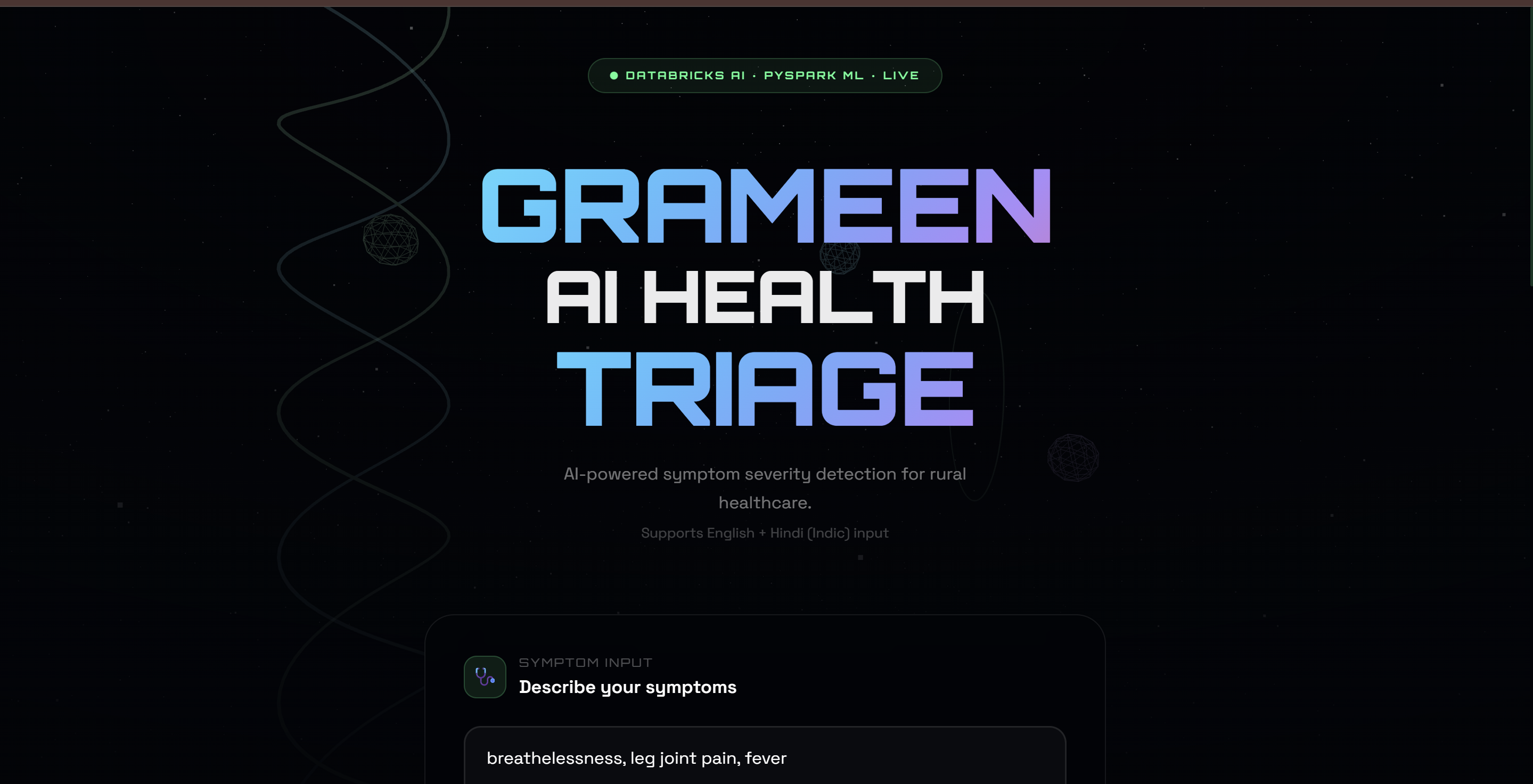
🏥 Grameen AI Health Triage + Medicine Demand Predictor
🌟 Inspiration
In many rural parts of India, access to healthcare is still a major challenge. Patients often delay treatment due to lack of nearby doctors, and primary health centers frequently face medicine shortages.
We wanted to build a solution that could assist patients in early decision-making while also helping healthcare systems prepare in advance.
This project was inspired by the idea that AI can bridge both gaps — diagnosis and availability — simultaneously.
💡 What It Does
Our system provides a dual-layer AI solution:
🧑⚕️ 1. Health Triage System
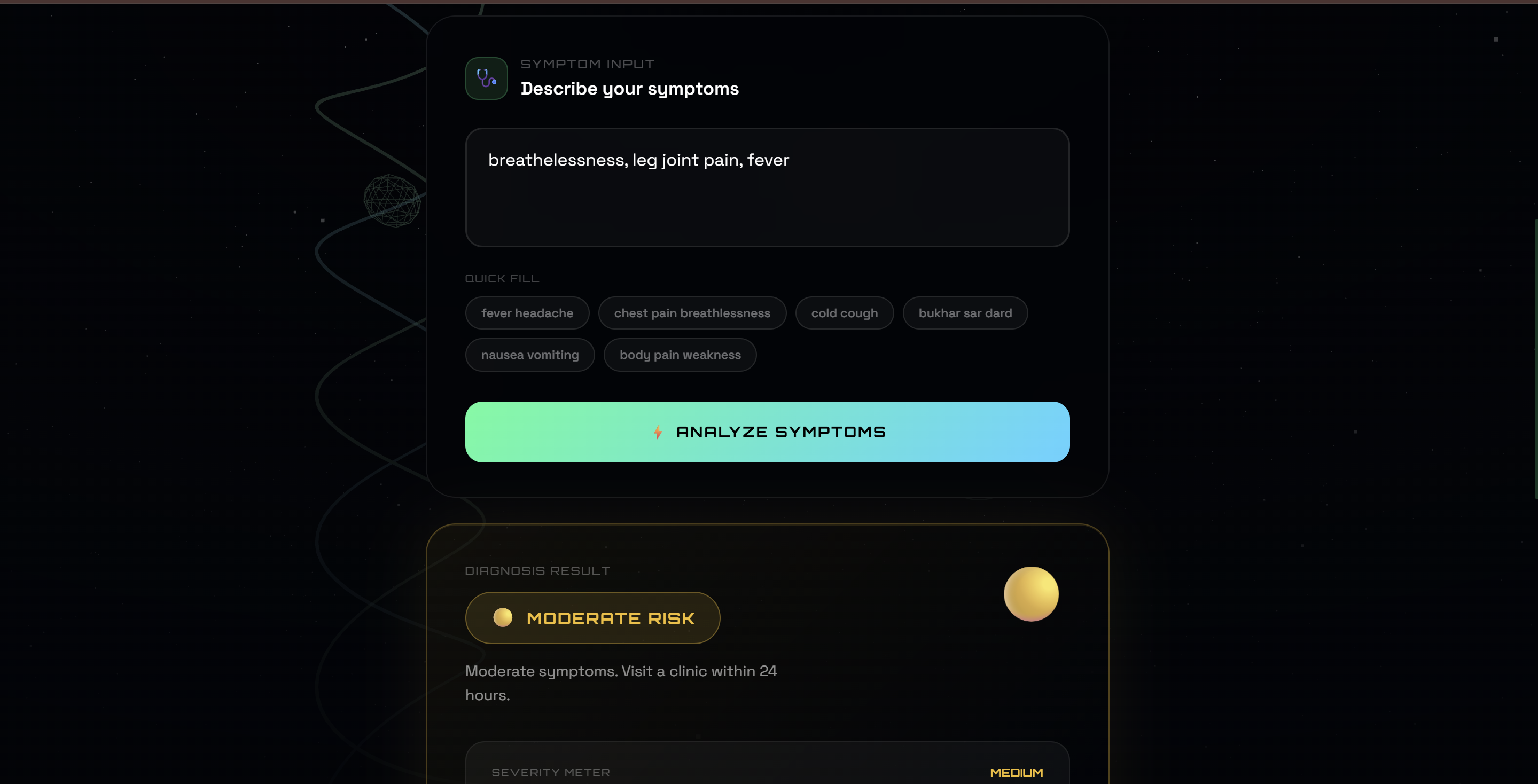
- Users input their symptoms (e.g., fever, headache, vomiting)
The AI model classifies severity into:
- Low
- Medium
- High
Supports Indic inputs like "bukhar sar dard"
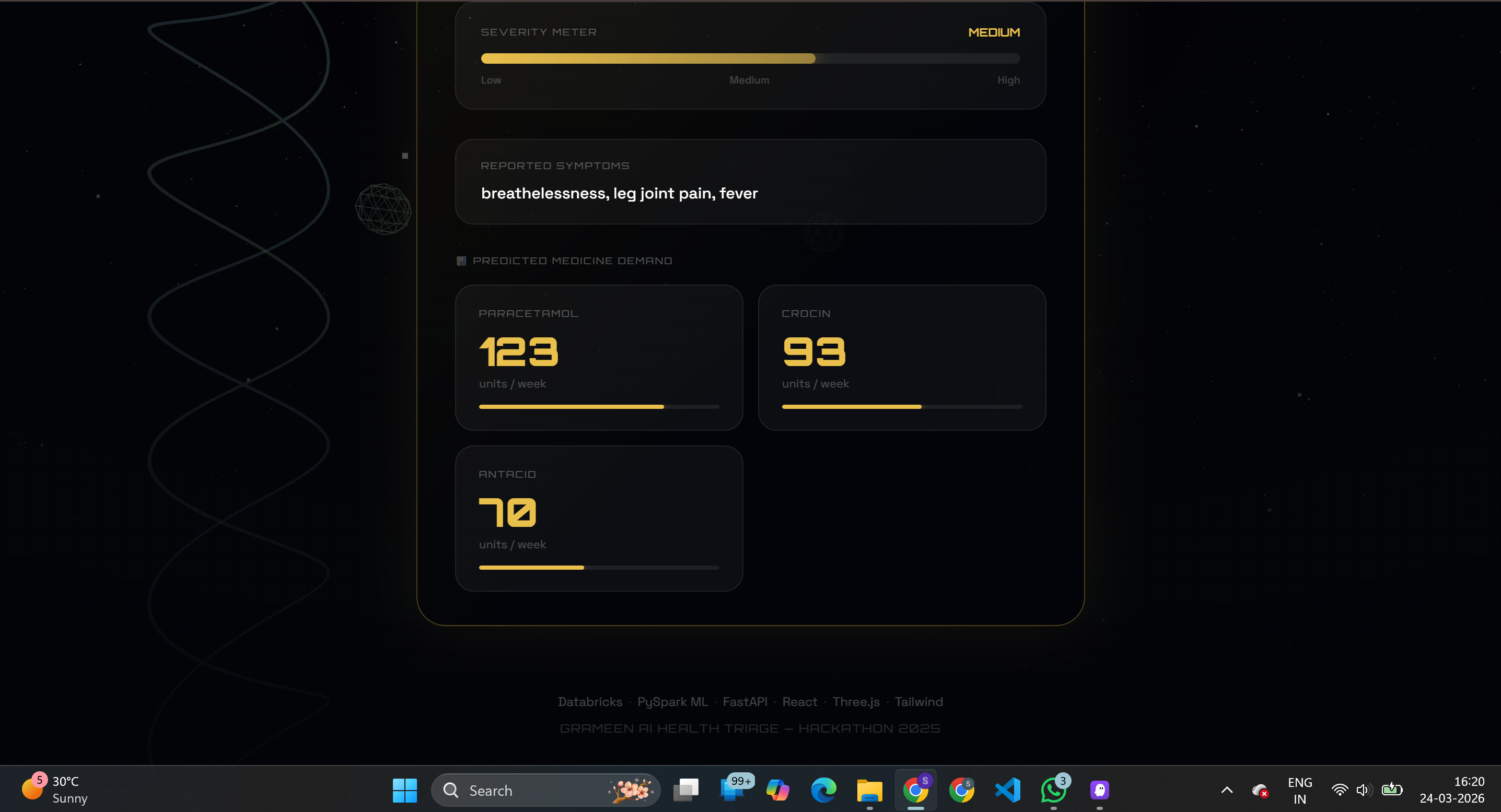
💊 2. Medicine Demand Predictor
- Uses historical demand data
- Predicts future medicine requirements
- Helps prevent stockouts in rural health centers
🛠️ How We Built It
🔹 Data & Processing (Databricks)
- Used Apache Spark (PySpark) for distributed data processing
- Stored structured data using Delta Tables (Lakehouse architecture)
- Managed data pipelines directly inside Databricks
🔹 AI / ML Pipeline
We built an NLP-based classification model:
- Tokenization: $$ text \rightarrow words $$
- Feature extraction using HashingTF
- Label encoding using StringIndexer
- Classification using Logistic Regression
Final pipeline:
Symptoms → Tokenizer → HashingTF → Logistic Regression → Severity Prediction
🔹 Medicine Prediction Logic
- Aggregated historical demand data
- Used statistical averaging to estimate future needs: $$ Predicted\ Demand = \frac{\sum Demand}{n} $$
🔹 Frontend & API
- Built a simple UI for user interaction
- Backend API handles prediction requests
- Modular architecture:
Frontend → API → Databricks Model → Response
🚧 Challenges We Faced
Limited dataset → We simulated realistic data to demonstrate scalability
Label mismatch issue → Fixed by dynamically mapping labels using
StringIndexerDatabricks serverless restrictions → Switched from DBFS paths to managed Delta tables
Balancing speed vs accuracy → Focused on a working prototype rather than perfect model accuracy
📚 What We Learned
- How to build end-to-end AI pipelines using Databricks
- Importance of data preprocessing and feature engineering
- Real-world architecture: separating data layer, API layer, and UI
- Handling practical issues like label encoding and deployment constraints
🌍 Impact
This system can:
- Reduce unnecessary hospital visits
- Enable early risk detection
- Ensure better medicine availability in rural areas
🚀 Future Scope
- Integration with real healthcare datasets
- Voice-based input for accessibility
- Deployment in government health systems
- Real-time model serving using APIs
🏁 Conclusion
Grameen AI Health Triage is a step toward accessible, scalable, and intelligent healthcare for rural India, combining AI-driven diagnosis with proactive resource planning.
Built With
- apache
- css3
- databricks
- datapipelines
- deltalake
- fastapi
- git
- github
- html5
- javascript
- natural-language-processing
- particle
- python
- tailwindcss

Log in or sign up for Devpost to join the conversation.