Inspiration
Campus life comes with everyday questions: “Is the library open right now?” “What’s being served in the dining hall?” “Is the shuttle running?” Answers can be scattered across websites, group chats, and word of mouth. We built GramAsk to bring campus knowledge and student observations together in one place for the Grambling State University community.
What it does
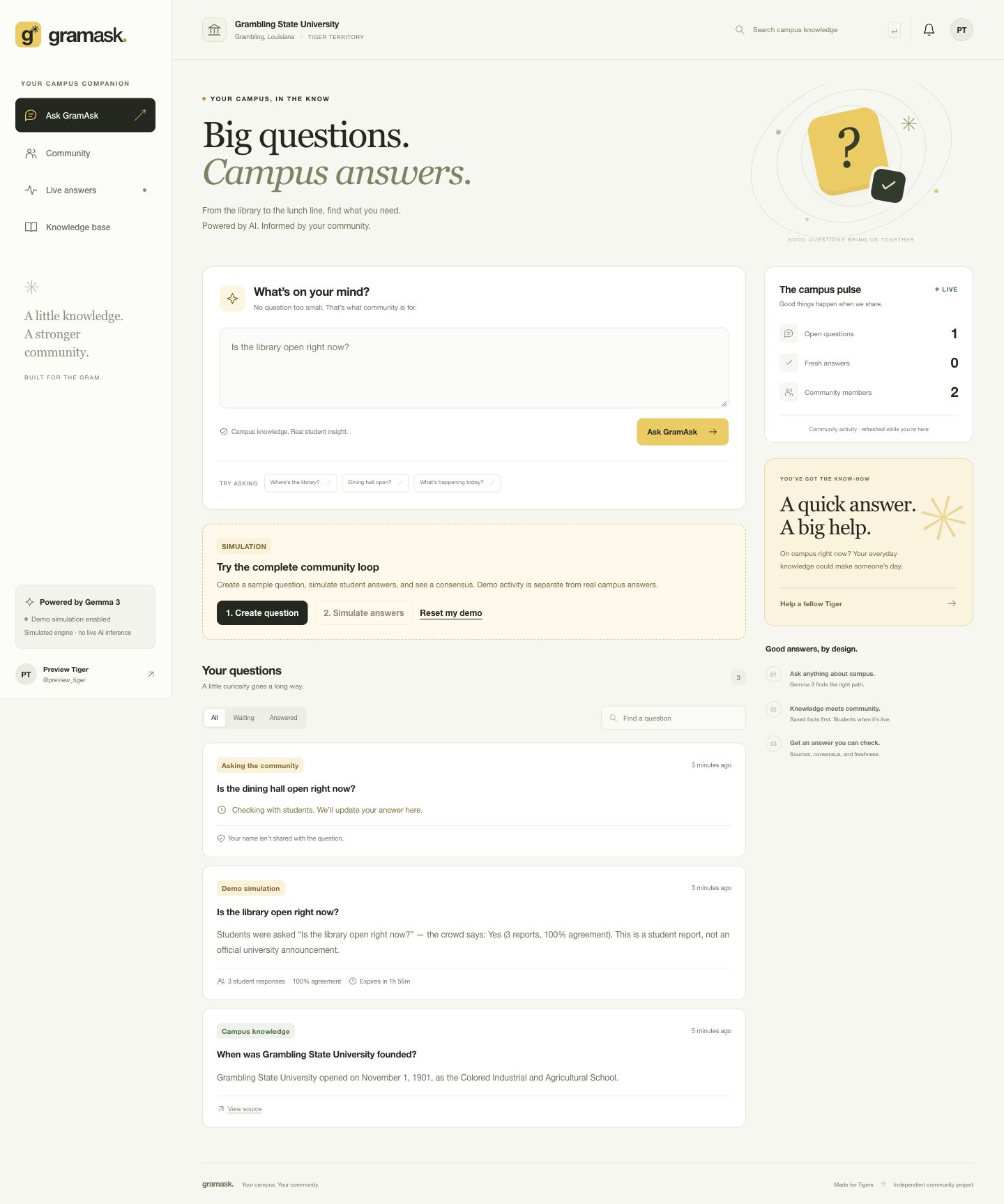
GramAsk is a campus Q&A platform that combines AI with community contributions. Students ask questions in natural language, and Gemma 3 helps route them to source-linked campus facts or other students who can report current conditions. For live questions, the app collects reports and publishes an answer only when enough eligible contributions agree. Answers show report counts, agreement levels, and expiration times. Students can also view their question history, contribute through a community inbox, and receive in-app notifications when answers are ready.
How we built it
We built the backend with Python and FastAPI, used SQLite for persistent storage, and created a responsive frontend with HTML, CSS, and JavaScript.
Gemma 3 powers question routing, fact selection, and grouping of free-text student reports through an Ollama or compatible hosted endpoint. Curated campus facts include source links, while the backend independently enforces voting eligibility, agreement thresholds, and answer expiration. We also added password-protected accounts, session security, Docker packaging, and an isolated demonstration mode.
Challenges we ran into
A central challenge was deciding when an answer had enough evidence to be useful. Students may disagree, express uncertainty, or describe the same situation differently. We addressed this with minimum report requirements, agreement checks, and exclusions for uncertain responses.
Freshness and question meaning also mattered. An answer about library availability can quickly become outdated, and “Is it open?” cannot reuse the same yes/no answer as “Is it closed?” We designed expiration and question matching around these distinctions.
Accomplishments that we're proud of
We’re proud of building a complete workflow from asking a question to collecting reports, reaching agreement, and notifying students. GramAsk makes its evidence visible and clearly distinguishes student reports from official campus information.
The project also includes account protections, a mobile-friendly interface, and 39 documented passing automated tests covering API behavior, security, and model integration boundaries using controlled model responses.
What we learned
We learned that useful AI systems need clear limits and dependable application logic. AI can help interpret questions and organize responses, while the application must decide what evidence is sufficient to publish.
We also learned that freshness, transparency, and thoughtful handling of uncertainty are essential for campus information.
What's next for GramAsk
Next, we want to validate live Gemma performance and run a student pilot at Grambling State. Future improvements include campus email verification or university SSO, moderation tools, a larger source-linked knowledge base, and push notifications that work when the app is closed. Student feedback will guide broader campus coverage and infrastructure improvements as usage grows.
