Inspiration
When I was a kid, my favorite book was Mike Mulligan and His Steam Shovel. It is a 1939 children's book, but to me it has always been a story about dignity and respect in a world where obsolescence happens faster and faster.
Mike's steam shovel, Mary Anne, is being displaced by newer electric and gasoline-powered machines. She looks obsolete, but Mike believes she still has something useful to contribute.
Nearly forty years after I first read it, the book feels oddly prescient. With the rise of AI, questions about how human beings will continue to feel useful, purposeful, and valued have been top of mind for me. Those questions were a large part of what led me to start working on Grainwork.
Grainwork is a homeowner utility app today, but that is only the first expression of a much larger idea. The long-term goal is an ecosystem where homeowners develop a deeper sense of stewardship over the places we live, and where skilled trades are valued on par with information work. I believe that is a transition we will need to make as a society.
The future cannot consist only of producing more information, more quickly. The physical world will still need to be understood, maintained, repaired, and cared for. People will still need ways to contribute that give them dignity, agency, and a visible relationship to the communities around them.
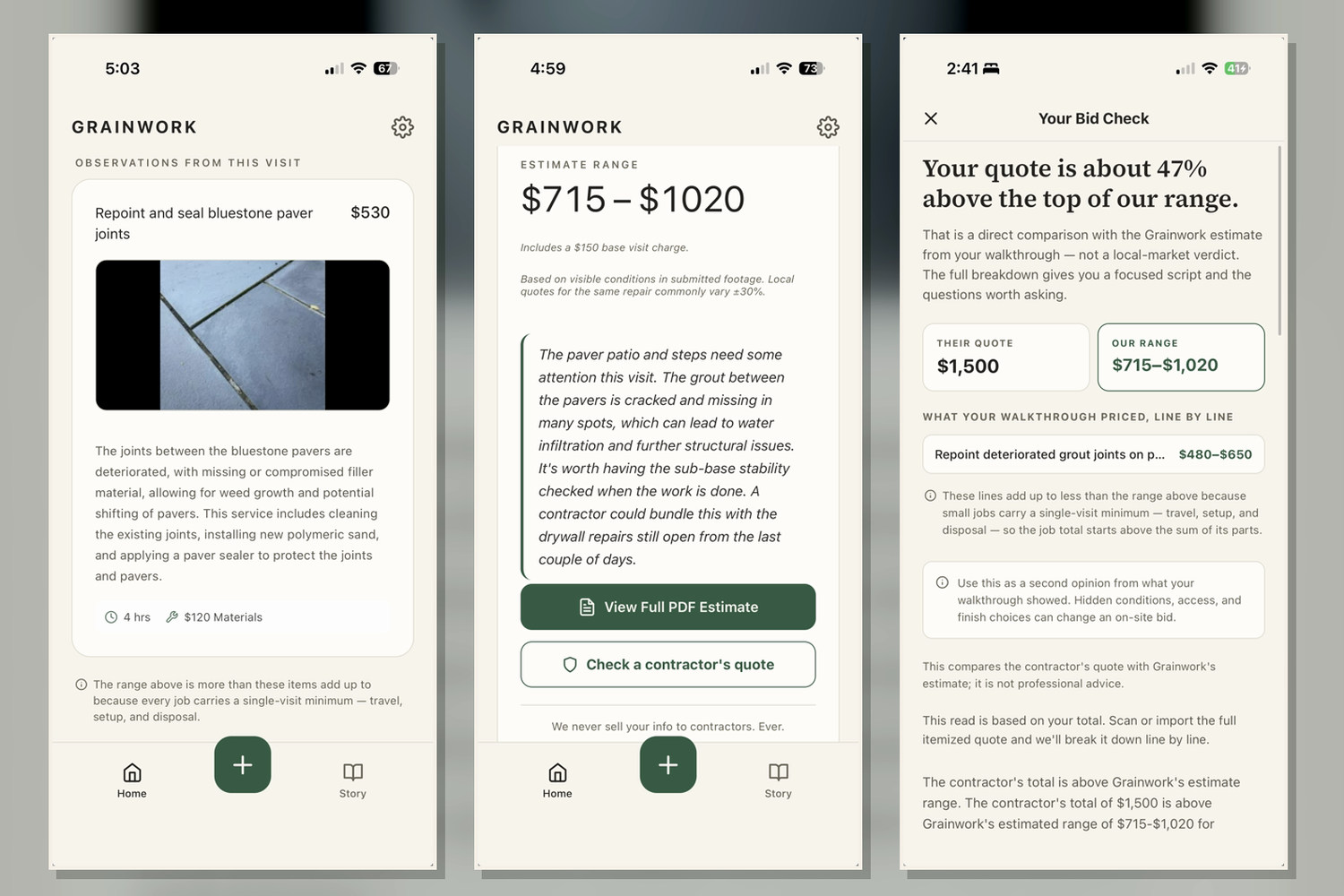
Today, Grainwork starts with a concrete information imbalance. A homeowner can film damage, receive an independent repair estimate, compare it with a contractor's quote, and keep what they learned in a plain-English record of the home. Grainwork takes no money from contractors and sells no leads, so its incentives remain with the homeowner.
Each visit helps with an immediate repair, but it also teaches a homeowner to notice, understand, and care for the place over time. That is what stewardship means in the product today.
The longer horizon is the other side of that relationship: tools that help small tradespeople stay independent, and eventually an educational layer that helps people learn to see, scope, and price physical work. I want skilled trades to be treated as knowledge work that happens in the physical world, and as a dignified path more people can enter. That is the direction Grainwork is building toward; the working product today begins with homeowners.
Building Grainwork also became an experiment in what human work looks like alongside AI. I made the earliest prototypes with ChatGPT nearly a year ago, moved to Gemini in November, and worked primarily with Claude beginning in April. About ten days ago, I returned to OpenAI's tools and began working intensively with Codex and GPT-5.6.
Those ten days have been extraordinarily productive. But Grainwork is not the product of one model. The continuity was me: the person carrying its intent, memory, taste, and responsibility forward.
The limiting question was no longer simply, “Can the AI do this?” It became: What is actually true right now? Which source is authoritative? Who owns the next decision? What has been approved? Does that approval still authorize this exact action?
That is where the Mike Mulligan story took on a second meaning. Mike and Mary Anne work so quickly that they finish the cellar before anyone has planned how Mary Anne will get back out. Extraordinary execution creates its own operational trap. AI can do the same thing: produce work faster than a person can understand, supervise, or safely authorize it.
That is why I built Grainwork Cockpit.
What it does
Grainwork's working homeowner loop is simple: film what needs fixing, get an independent repair read, compare a quote, and preserve what was learned in the home's record. It is designed as someone in the homeowner's corner, not another lead marketplace.
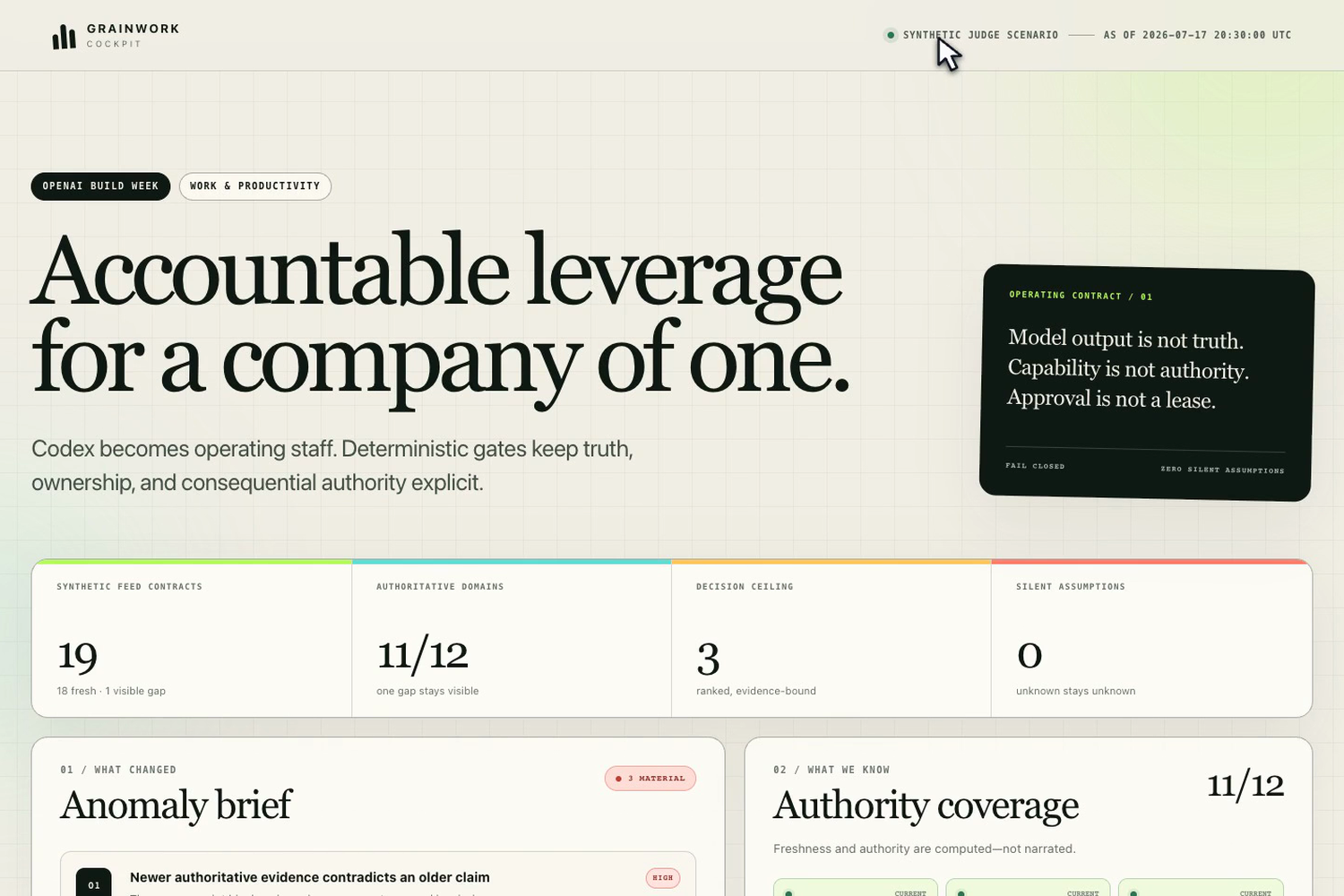
Grainwork is the mission and working product context. Grainwork Cockpit is the Build Week project: a safety-gated operating system that lets one founder work with AI at company scale without confusing model output with truth or capability with permission. It turns fragmented operating state into a brief a human can inspect and act on while keeping truth, ownership, and consequential authority explicit.
Its design rests on three separations:
- Model output is not truth. A confident answer cannot override an authoritative receipt or current system record.
- Capability is not authority. Being able to publish, spend, contact someone, or release software does not mean an agent is permitted to do it.
- Approval is not a lease. Approval and single-writer execution are separate gates; both must match the exact action and scope.
The private owner Cockpit is used in the real operation of Grainwork and recorded a bounded supervisor pass across all 19 configured collectors. That means every collector was checked or refreshed with zero supervisor failures; it does not mean every underlying source or domain was authoritative, and the owner system continues to surface real coverage gaps. This submission includes a sanitized evaluator that models the same operating problem with 19 synthetic feed contracts across 12 domains. It contains no customer data and has no production connection.
The scenario deliberately includes an older plan saying a release is ready, a newer authoritative receipt saying it is blocked, and one stale Growth source. Cockpit reports 11 of 12 domains current and authoritative instead of inventing a green state. Every action belongs to either NEEDS RYAN or SYSTEM OWNS. A lease lab then shows Task A acquiring one exact branch, action, commit, and approval scope while Task B is blocked. The successful lease still grants no approval.
What I built during Build Week
Grainwork's customer app, backend, earlier owner wall, and underlying operating practices existed before Build Week. They establish the real product, audience, and operating problem, but I am not presenting that earlier work as work completed during the event.
The eligible Build Week work is Cockpit: the governed control plane, explicit coverage contracts and authority checks, anomaly-only briefs, typed human/system action lanes, structural receipts, exact approval scope, a single-writer lease, a bounded GPT-5.6 staff view, and this sanitized runnable evaluator. A separate dated owner-system receipt records 193 passing Cockpit tests.
I also built this sanitized evaluator so judges can inspect those mechanics without exposing the owner system, credentials, customer information, or private operating data.
How I used Codex and GPT-5.6
Codex and GPT-5.6 did much of the eligible implementation and review with me. I set the product intent, chose the three separations, decided which sources count as authoritative, kept consequential actions human-owned, defined the privacy boundary, and accepted or rejected the work. Codex helped implement, test, investigate, document, and adversarially review it.
GPT-5.6 is also a meaningful runtime component. Deterministic Python compiles freshness, authority, contradictions, action lanes, and stable evidence IDs before generation. The only application data supplied to the live request is the checked-in synthetic packet; normal Codex system instructions and bundled system skills still apply.
The model returns explanation, selected action IDs, and citations through a strict schema. Host code rejects unknown or out-of-scope evidence, derives the operating risk, and supplies each action's title, owner, authority, and permitted next step from deterministic state. Model prose is never treated as authorization.
The optional live path runs in an ephemeral session with an isolated temporary profile, empty working directory, read-only sandbox, and shell, web, apps, plugins, and subagents disabled. Any capability event makes the result unusable. The default evaluator remains fully demonstrable through a clearly labeled deterministic preview.
How I built it
The evaluator uses Python's standard library, JSON, JSON Schema, HTML, CSS, and JavaScript, with no third-party runtime dependency. Its web boundary binds only to loopback, requires same-origin POSTs, exposes no upload or free-form prompt, and keeps application state in memory.
The package audit enforces an exact file allowlist, rejects symlinks, internal identifiers, private paths, and secret-shaped content, pins the reviewed image by SHA-256, and builds evaluator archives only from approved files. The independent test suite covers authority hydration, action scope, risk derivation, future timestamps, contradiction precedence, profile isolation, unexpected capability events, same-origin enforcement, safe errors, lease collisions, and redaction controls.
Challenges
The hardest design decision was deciding what not to let the model decide. A fluent answer can cite stale evidence, subtly change an action's owner, or turn “prepare” into “publish.” Prompting alone is not an authority boundary, so critical truth, risk, ownership, approval, and lease paths remain deterministic.
The second challenge was honest scope. Cockpit is compelling because it emerged from operating Grainwork, but the submission needed a precise boundary between the pre-existing product and the control-plane work completed during Build Week.
The third was privacy. A fabricated mockup would prove little, while publishing the private owner system would expose information that does not belong in a hackathon entry. The evaluator preserves the real architecture and failure modes using synthetic state.
What I learned
One person working with capable models can create astonishing leverage. That does not make human judgment less important. It makes judgment more important, because one mistaken assumption can propagate farther and faster.
AI-native organizations will need more than agents and prompts. They will need provenance, explicit ownership, scoped approvals, execution leases, and durable ways to distinguish knowledge from inference.
Sometimes the human becoming the bottleneck is not a failure of the system. Sometimes the bottleneck is exactly where responsibility belongs.
What's next
Near term, Grainwork will keep deepening the homeowner side: more useful repair reads, better quote comparison, evidence over time, and a home record that helps people notice problems before they become crises.
Longer term, I want to build the missing supply side: tools that make small tradespeople more capable and independent, and an apprentice's window that helps people entering skilled work learn how to see, scope, and price what the physical world needs. Those are future directions, not features claimed in this submission.
Cockpit remains the operating layer beneath that work. It gives one founder the leverage of an organization while keeping truth, ownership, and consequential authority attached to a person. The same trust layer could eventually help any small team, nonprofit, research group, or institution delegating meaningful work to AI without losing human accountability.
Grainwork is the future I want to help build: one where technology strengthens our relationship with the physical world, elevates the people who care for it, and gives more human beings a meaningful way to contribute. Cockpit is what I had to build to pursue that future responsibly.
Mary Anne did not need to defeat the future to remain useful. She needed a role worthy of what she could still contribute.
I believe people deserve the same.

Log in or sign up for Devpost to join the conversation.