-
-
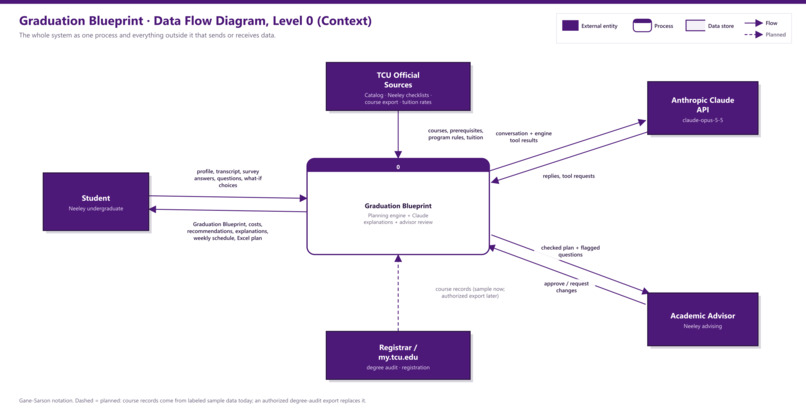
Level0 DFD
-
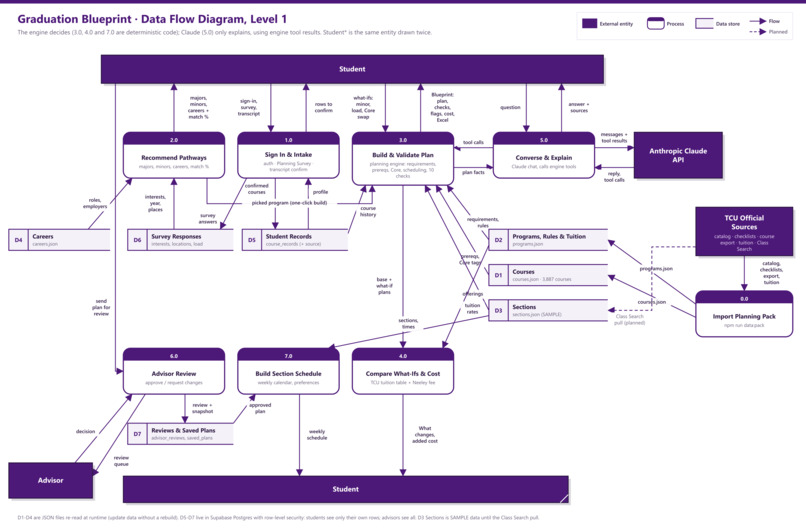
Level1 DFD
Inspiration
It's 11:47 on a Sunday night and Jordan, a junior, can't sleep. He just wants to know if he's graduating on time. So he emails his advisor, gets a reply Monday, and finally sits down with her Wednesday for five minutes. Fifty-eight hours of stress for an answer that should have taken thirty seconds.
Maya has it worse. She's an incoming freshman who doesn't know what she wants to major in, and she's staring at a catalog of 3,887 courses.
We as current students have all faced these challenges. And one wrong class at the wrong time can cost a full extra semester, which at TCU is $42,650 in tuition and housing.
What it does
Graduation Blueprint gives every Neeley student a clear, checked path to graduation in seconds, and it shows them what every choice costs before they make it. Here are our two Demo Cases. Feel free to access them on our website and test them out!
Maya takes a two-minute survey, sees the majors and careers that actually fit her, and clicks one. Her entire four-year plan appears. She mentioned golf, so her free elective already suggests Beginning Golf.
Jordan asks "Am I on track?" and gets his answer right away: Spring 2028, every requirement covered. Then he plays "what if." Adding an Accounting minor keeps him on time for $810 more.
Then he tries a lighter semester, and that's where our tool earns its keep. We call it our Sharpest Bottleneck: a lighter semester can quietly cost a year. Students assume dropping to 15 hours is safe. But when a required course only runs once a year and sits at the end of a prerequisite chain, one light semester can push it past graduation, and nothing in the catalog warns you. In our demo, Jordan's lighter load pushes him to Spring 2029 and costs $34,290. He finds that out before he registers, not after.
When something can't be confirmed, like his community college math credit, the plan says so and sends it to his advisor. When he's ready, he submits the plan, and his advisor reviews and approves it in minutes instead of building it from scratch.
Try it yourself: [https://agentic-advisor-flax.vercel.app/login]. Click "Continue as Maya" or "Continue as Jordan." No sign-up needed.
How we built it
This isn't another chatbot, and that's on purpose. Our AI isn't allowed to make decisions! A rules engine does. It knows TCU's real catalog, prerequisites, both Neeley rulebooks and the 2026–27 tuition rates, and it checks every plan ten different ways, from prerequisite order to credit hours to whether a class is actually offered that semester. Claude is our friendly voice on top. It answers student questions and explains the plan, but it can only use facts the engine hands it.
Every cost comes from TCU's published rates: a flat \$33,260 for 12–18 hours, plus \$270 per credit hour for Neeley courses. So a Core class that fits your schedule adds \$0, and a 3-hour business class adds \$810.
The app runs on Next.js and Vercel, with Supabase keeping each student's records visible only to them and their advisor.
Challenges we ran into
TCU's own sources don't always agree. We found 21 conflicts, including whether you need 120 or 124 hours to graduate. Instead of quietly picking one, our tool flags them for an advisor.
Prerequisites are written in English that reads like a logic puzzle ("A, or B, or C and D"), so we checked 151 business courses by hand.
And the AI got things wrong. In testing, Claude told a student he needed dean approval for something that has no such rule. That moment is exactly why we built it this way: the engine makes the decisions, the AI only explains them, and an advisor always signs off.
We also couldn't get live class times, so section schedules in the demo are clearly labeled sample data. The plan never passes an assumption off as fact.
Accomplishments that we're proud of
None of us had ever built with a database before this hackathon. Now Graduation Blueprint runs on a real one, with real sign-ins and security rules that make sure a student can only ever see their own records, while advisors can see everyone they advise. We tested it by logging in as each user and trying to break it.
It was also our first time building an AI product. Instead of just putting a chat window on top of Claude, we built our own planning engine that holds TCU's real catalog, prerequisites, both Neeley rulebooks and tuition rates, and then connected Claude to it as the explainer. Getting those two to work together, where the engine decides and the AI only talks about what the engine found, was the hardest and most rewarding part.
And it's live, not a mockup. Students can sign in, get a checked four-year plan, see what a minor or a lighter semester would cost, send it to an advisor, and download it in Neeley's own Excel format. Every plan passes ten checks, plus a separate checker we wrote that verifies it straight from the raw data.
Most of all, we're proud that it shows students the cost of a decision before they make it, which is the moment that actually changes outcomes.
Built With
- anthropicapi
- claude
- exceljs
- github
- inkscape
- next.js
- node.js
- postgresql
- python
- react
- runway
- supabase
- tcucoursecatalog
- typescript
- vercel
- vscode
- zod


Log in or sign up for Devpost to join the conversation.