-
-
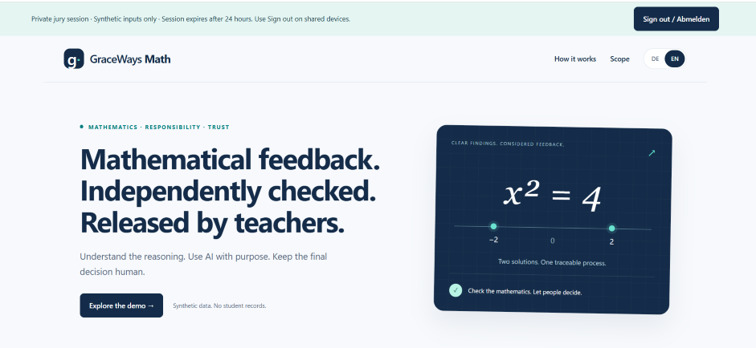
Independent mathematical checks, AI feedback drafts, and teacher-controlled release.
-
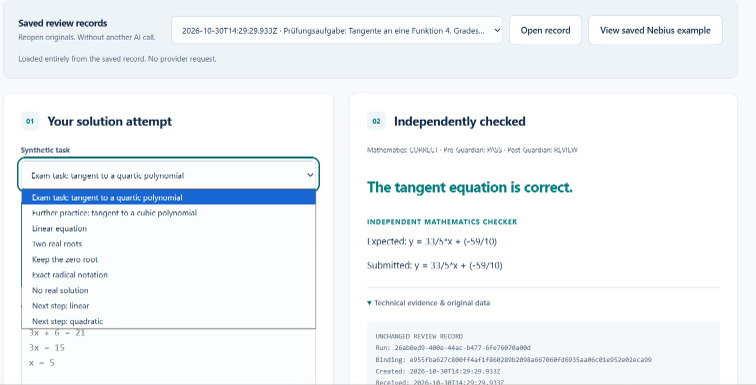
Exact arithmetic verifies a polynomial tangent equation independently of the AI model.
-
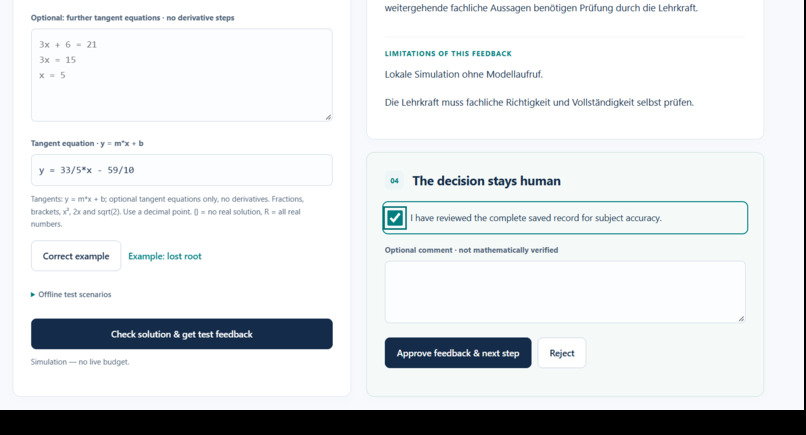
A teacher reviews the feedback draft before releasing it and the next learning step.
Inspiration
As a mathematics teacher, I need feedback that I can inspect and take responsibility for. A fluent explanation can still be mathematically wrong. GraceWays Math explores a practical alternative: independently check the supported mathematics, bind those findings to the model request, and require human approval before releasing feedback and a next learning step.
What it does
The application connects a task, a synthetic solution attempt, deterministic findings, a feedback draft, and an explicit human decision.
The independent checker supports:
- Linear and quadratic equations with rational coefficients, complete real solution sets, exact supported radicals, and equivalence of entered equation steps.
- Tangent equations for polynomials up to degree four at rational evaluation points, checking the exact slope and intercept.
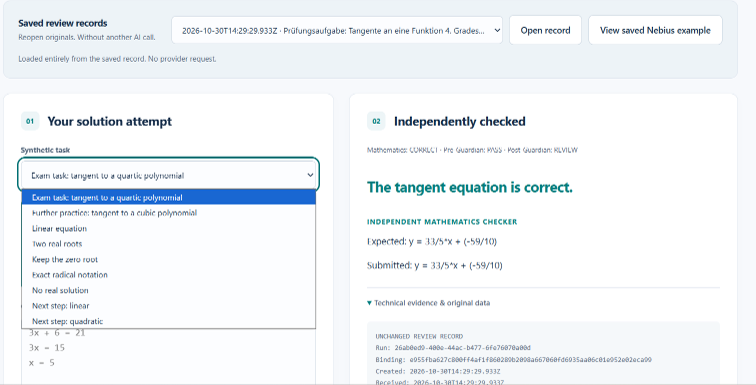
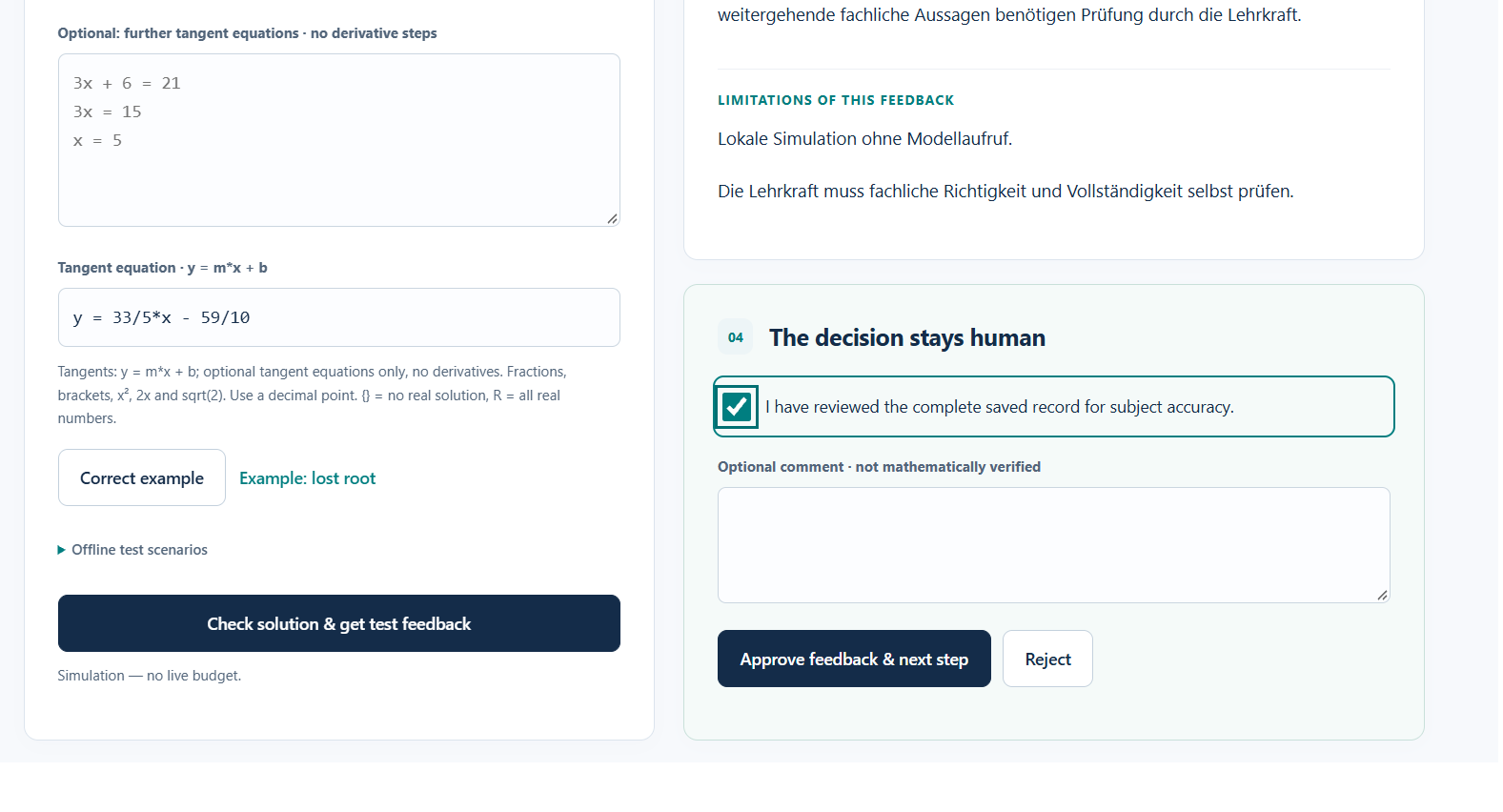
For example, a tangent exercise based on a vocational upper-secondary examination uses f(x) = -4/5*x^4 + 29/5*x^2 - 5 at x = 3/2. The checker independently obtains f(3/2) = 4 and slope 33/5, giving y = 33/5*x - 59/10. Changing the intercept's sign produces an incorrect result.
Unsupported input returns UNKNOWN and stops before the provider. AI explanations do not acquire a mathematical verification label. There is no automated grading, diagnosis, or judgement of a learner's ability.
Nebius and NVIDIA integration
The standalone Node application includes a real server-side adapter for Nebius Token Factory using NVIDIA's nvidia/nemotron-3-super-120b-a12b model through /v1/chat/completions. Requests bind the task, submitted answer and deterministic report. Structured responses are checked for request and report binding before entering human review. Credentials stay on the server.
A successful real Nebius response and its original human approval are preserved in the hosted jury application as read-only evidence, including the provider response ID. This is a saved historical run, not a new inference on each visit.
The hosted Cloudflare application deliberately separates that real evidence from the interactive, explicitly labelled simulation. New tangent demonstrations use the simulation; they have not been live-validated with Nemotron. The optional Node live mode requires explicit startup flags and a server-side key, with a persistent one-shot budget. There is no silent simulation fallback after a provider error.
How I built it
The core uses JavaScript, Node.js, exact rational arithmetic, bounded parsing, JSON contracts and SHA-256 bindings. The hosted trial uses Cloudflare Workers and a SQLite-backed Durable Object for separated visitor sessions, saved records and decisions. The interface supports German and English.
Feedback remains a draft until a person reviews the complete saved record. An approval can release feedback and a deterministically selected follow-up task. Edited inputs invalidate the displayed review context; reloading or reopening a saved record does not generate another model response.
The public repository contains only the standalone demonstration core under the MIT license. The broader private GraceWays Education platform and student records are not included.
Challenges
The difficult part was separating mathematical evidence from model-generated prose, preserving complete responses for later review, and preventing stale inputs or later provider errors from changing earlier successful records. Another lesson came from testing real browser form behaviour: login origin checks needed a same-origin referrer policy while continuing to reject null and foreign origins.
Accomplishments and validation
The current Cloudflare extension passed 129 offline tests, covering supported mathematics, incorrect and unsupported answers, contradictory provider responses, binding, persistent replay, isolated sessions and synthetic review actions. Offline tests are distinct from the saved real inference. The deployed tangent workflow and preserved historical record were also checked in the browser.
Feedback on Nebius and NVIDIA
For this bounded experiment, Nebius Token Factory successfully served the selected Nemotron model and returned a response that passed our application's structure and binding checks. Using a hosted endpoint allowed the prototype to integrate the model without managing a GPU server.
The integration still needed application-side validation, explicit error handling, durable response capture and human review. I would welcome clearer end-to-end examples combining constrained JSON output, response IDs, output limits and model-specific inference options. This project used Token Factory; it did not evaluate Nebius AI Cloud or self-host the model weights. I would use the combination again for a controlled pilot, with broader evaluations before classroom deployment.
What I learned and what's next
A model's successful response is one part of an educational workflow. Independent checks, transparent limits and human control matter just as much.
Next steps are independently verified task types for more examination topics, broader adversarial evaluation, authenticated teacher roles and classroom usability studies. This prototype does not yet demonstrate improved learning outcomes.
Development during the hackathon
The broader GraceWays Education concept predates this standalone submission. During the submission period, the work produced the isolated math-feedback demonstration, independent mathematical checker, Nebius/Nemotron adapter and real-run evidence, durable replay and approval workflow, bilingual jury website, and polynomial tangent extension. The submission concerns this public core, not the entire Education platform.
Built With
- javascript
- nebius-token-factory
- nvidia-nemotron

