-
-
Homepage
-
-
Inspiration
As a healthcare compliance consultant, I have seen how difficult it can be for organizations to distinguish mandatory requirements from operational recommendations. Healthcare organizations must interpret overlapping federal requirements, state rules, accreditation standards, and professional guidance. Traditional compliance templates often combine these authorities without clearly showing which statements are mandatory and which are recommendations.
GracePoint Compliance AI™ was created to make healthcare compliance documentation transparent, traceable, and evidence-classified.
What it does
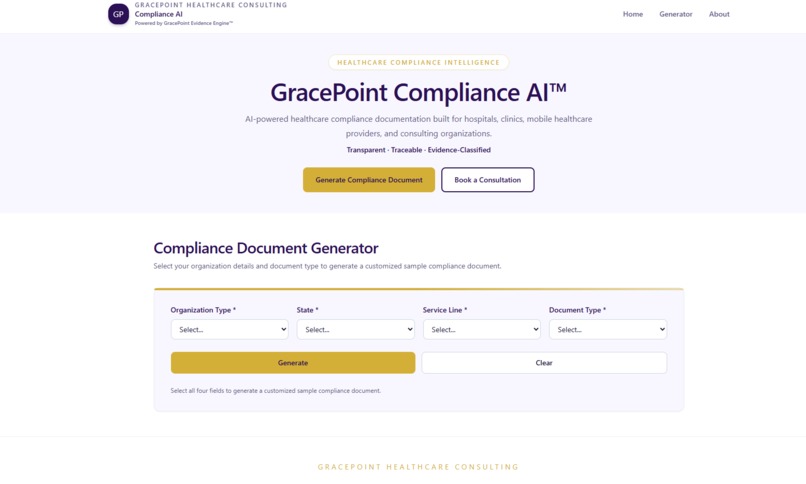
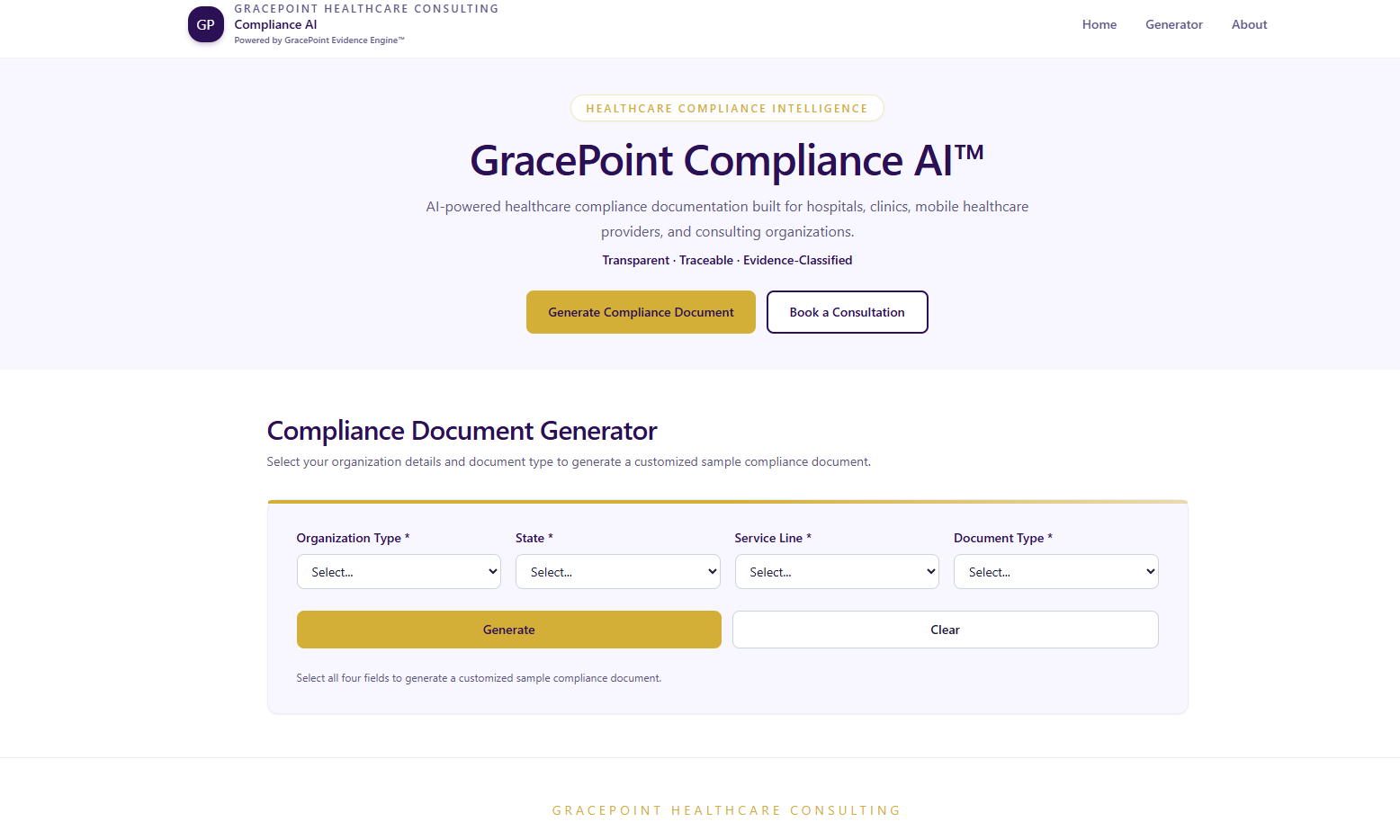
GracePoint Compliance AI™ generates organization-specific sample compliance documents based on four selections:
- Organization type
- State
- Service line
- Document type
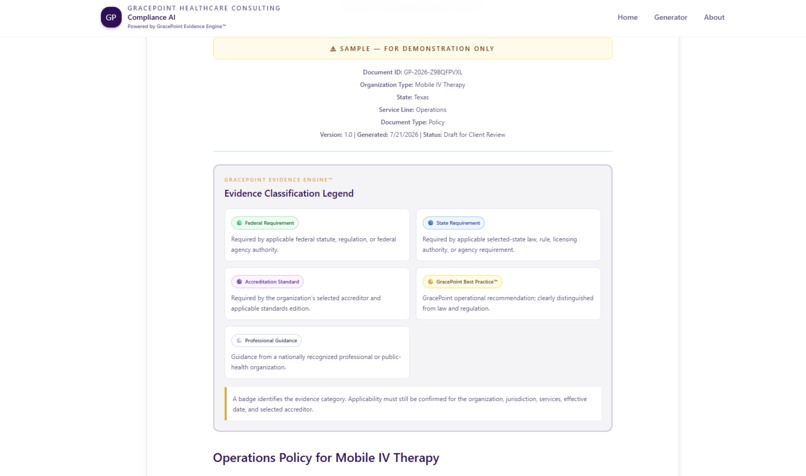
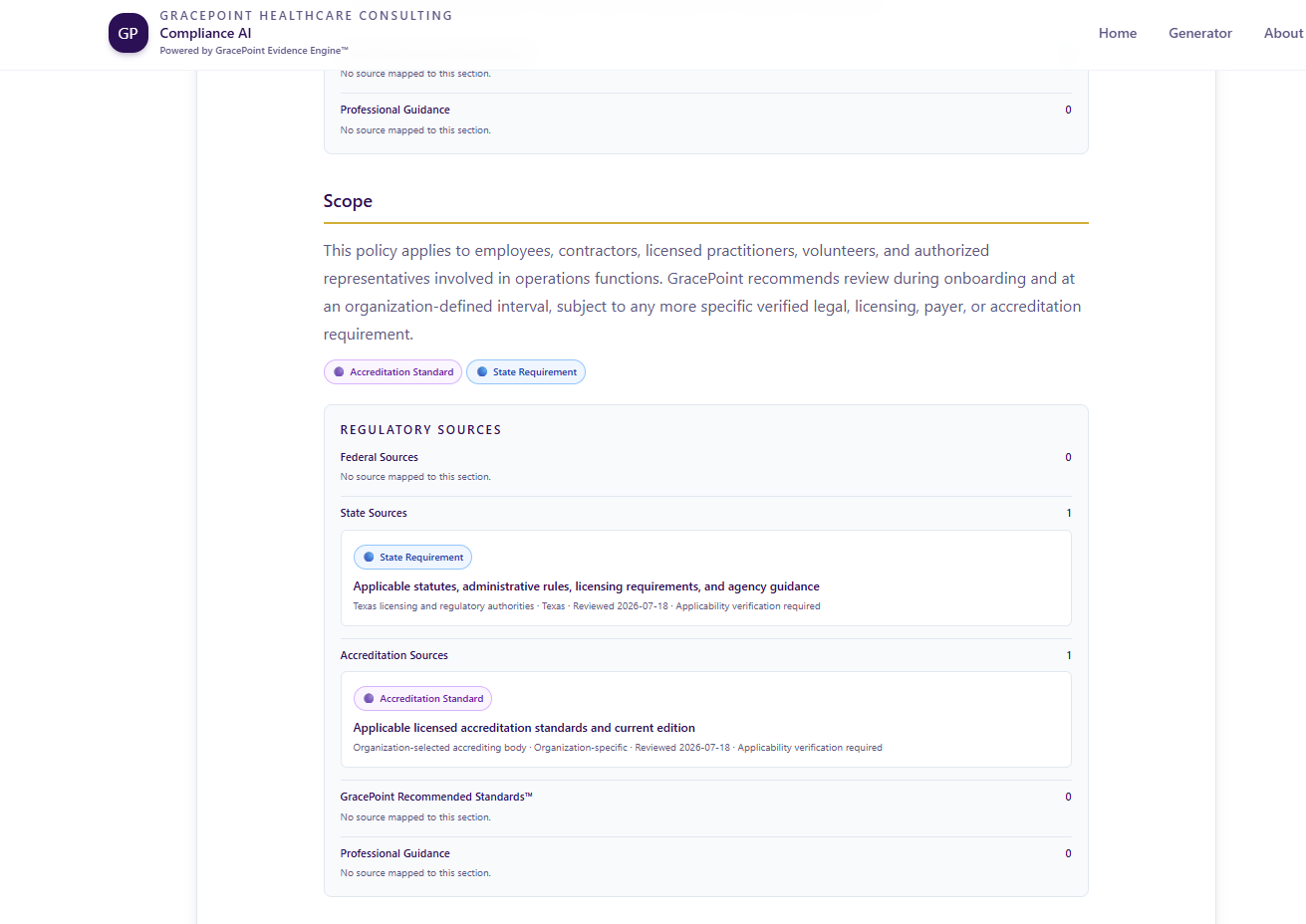
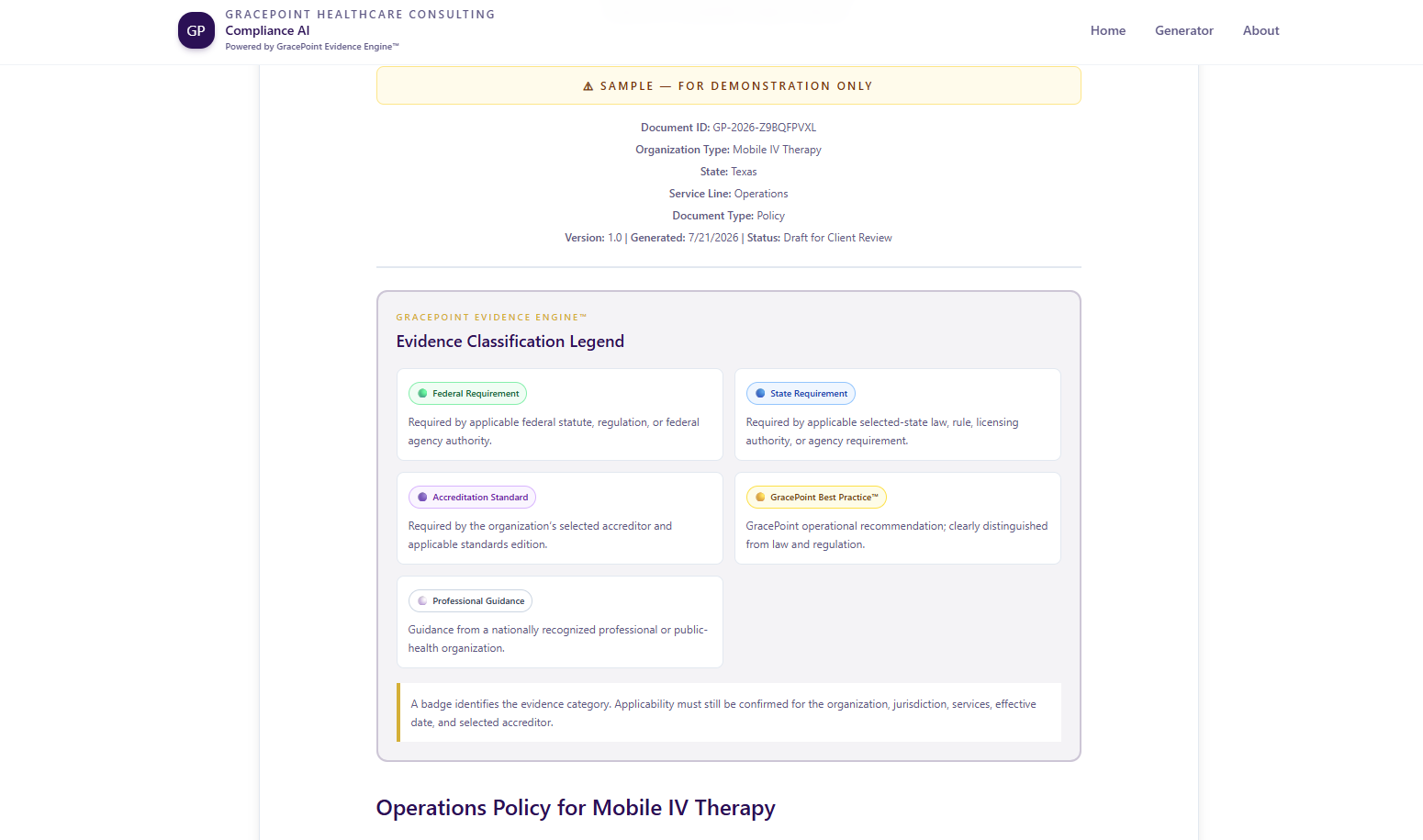
Every generated recommendation is classified by the GracePoint Evidence Engine™ as one of five evidence categories:
- Federal Requirement
- State Requirement
- Accreditation Standard
- GracePoint Best Practice™
- Professional Guidance
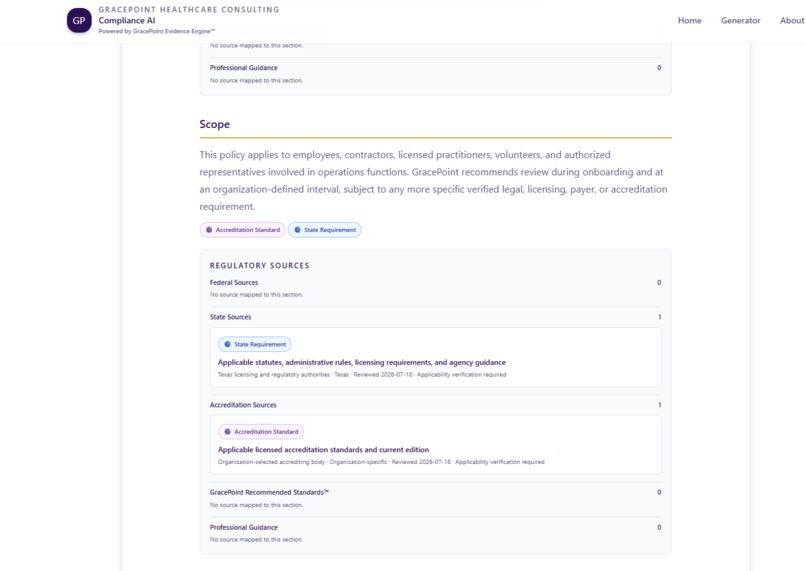
The generated document begins with an Evidence Classification Legend, displays evidence badges throughout, provides regulatory-source panels for each section, and concludes with an Evidence Summary Dashboard. Users can also print, copy, clear, or restart the document-generation workflow.
The application clearly identifies its output as sample material for demonstration and does not represent legal advice or regulatory certification.
How we built it
The application was developed with GPT-5.6 through Codex during OpenAI Build Week. Codex supported architecture, implementation, debugging, evidence-model design, interface refinement, documentation, quality assurance, GitHub preparation, and deployment.
The product uses Next.js, React, TypeScript, and Tailwind CSS. Its modular evidence architecture separates evidence classifications, source records, recommendation mappings, document-generation rules, and presentation components. The current prototype uses deterministic rules so classifications remain predictable and auditable.
The application is deployed through Vercel and the source code is maintained in GitHub.
Challenges we faced
The primary challenge was preventing legal requirements, accreditation standards, professional guidance, and internal best practices from appearing equivalent. We addressed this by creating an explicit five-category classification system and applying evidence badges directly to recommendations.
Another challenge was building a useful demonstration without overstating regulatory authority. The system therefore includes source-verification labels, applicability notices, sample-document warnings, and a clear disclaimer.
We also had to preserve responsive design, document formatting, printing, copying, validation, and the existing rules-based generator while adding the Evidence Engine.
Accomplishments that we're proud of
- Built and deployed a working healthcare compliance application
- Created a modular GracePoint Evidence Engine™
- Classified generated recommendations using five evidence categories
- Added evidence legends, badges, source panels, and summary dashboards
- Preserved printing, copying, validation, Start Over, and responsive behavior
- Established a GitHub development history and professional documentation
- Produced and published a complete public demonstration in under three minutes
What we learned
We learned that explainability is essential in healthcare compliance technology. A recommendation is more useful when users can understand its authority, jurisdiction, verification status, and limitations.
Codex helped translate a healthcare consulting concept into a structured, working application while supporting rapid iteration across architecture, implementation, testing, documentation, and deployment.
What's next for GracePoint Compliance AI™
Future releases are designed to support:
- Verified state-specific regulation libraries
- Federal regulation databases
- Accreditation-standard databases
- AI-assisted citations with human verification
- Source version tracking
- Regulatory-update monitoring
- Review and approval workflows
- Expanded organization types, jurisdictions, and document libraries
Our vision is transparent, traceable, evidence-classified healthcare compliance intelligence.
Built With
- codex
- css
- github
- gpt-5.6
- next.js
- react
- tailwind
- typescript
- vercel

Log in or sign up for Devpost to join the conversation.