Inspiration
When pandemic-era Medicaid protections ended in 2023, more than 25 million Americans lost coverage. About 69% of them lost it to paperwork rather than eligibility — roughly 17 million people who still qualified, cut off because a letter went unanswered or one document never arrived.
The detail that turned this into a project: federal law already gives those families 90 days to fix it. 42 CFR 435.916(a)(3)(iii) requires the agency to reconsider a household terminated for failing to return a renewal form, if it arrives within 90 days — without requiring a new application. Almost nobody knows the window exists, and it closes quietly.
The failure has no error message. A renewal simply does not happen, and a family finds out at a pharmacy counter when a prescription is refused. That is a class of harm nobody intended and nobody is watching, which is exactly the shape of problem an agent can hold.
What it does
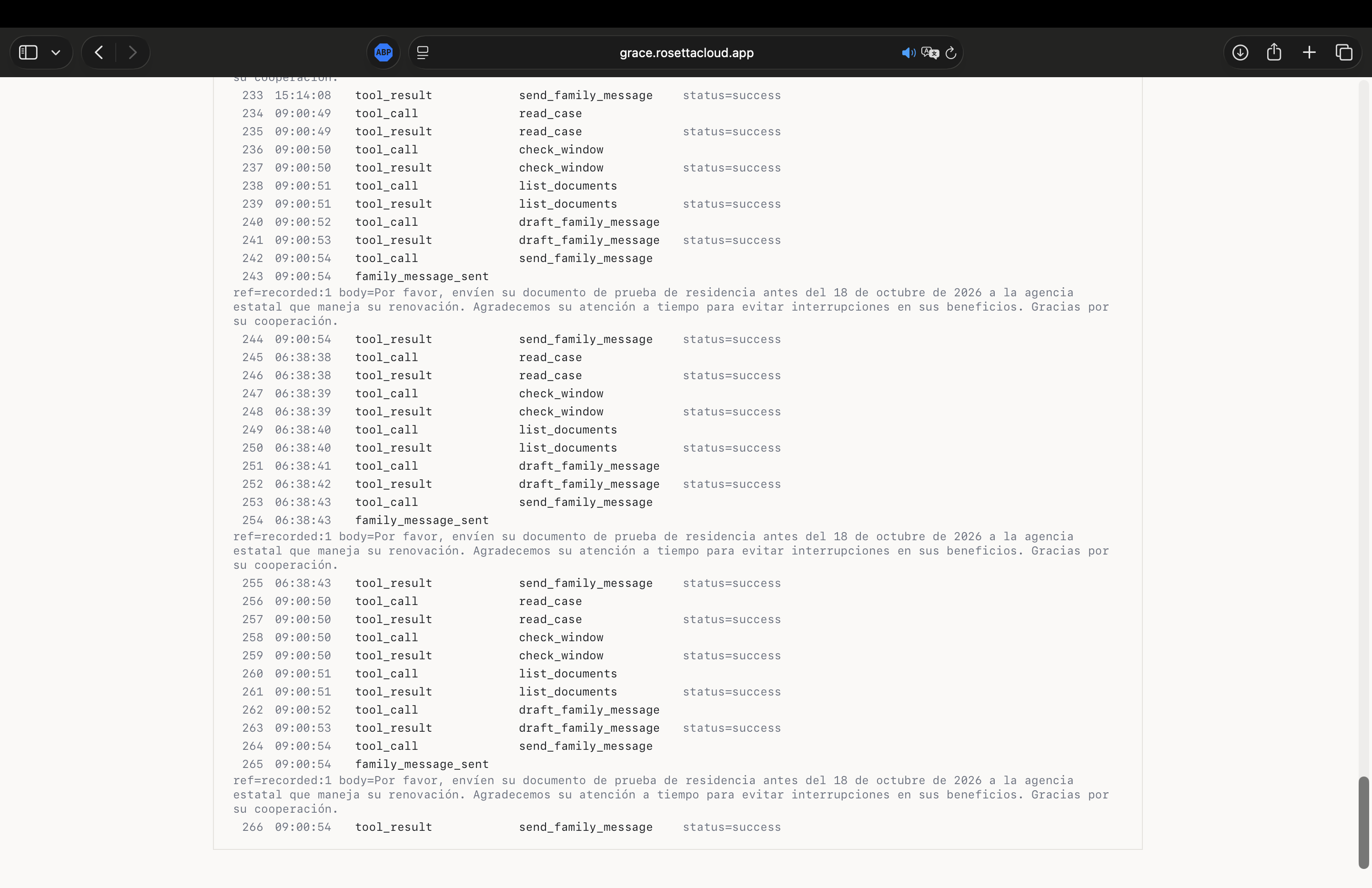
Grace watches every household's benefit-renewal clock against the encoded rules for its program, files the renewals that are unambiguous, texts the family in their own language for the one missing document, and wakes a human caseworker only when eligibility is genuinely in doubt.
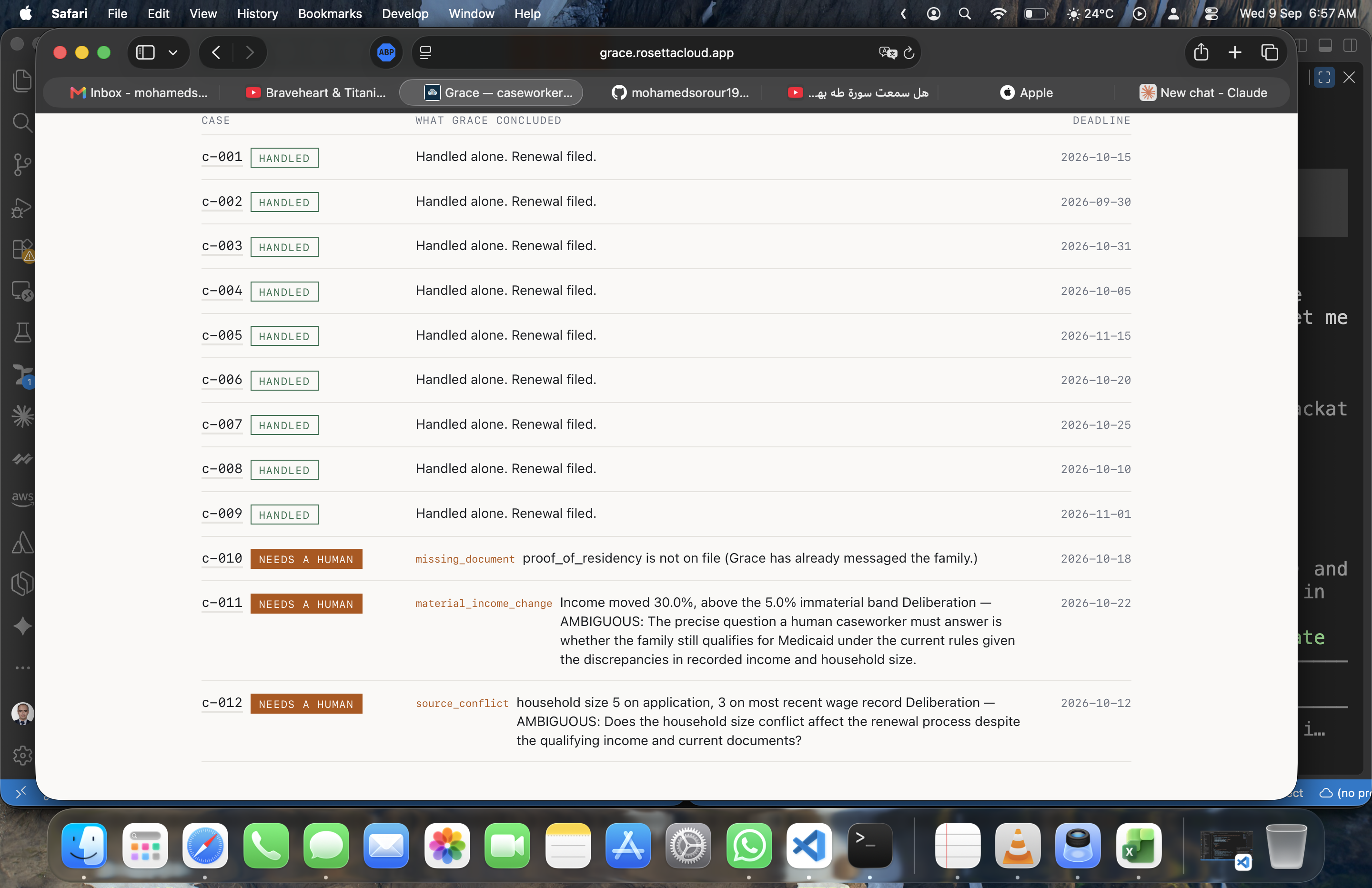
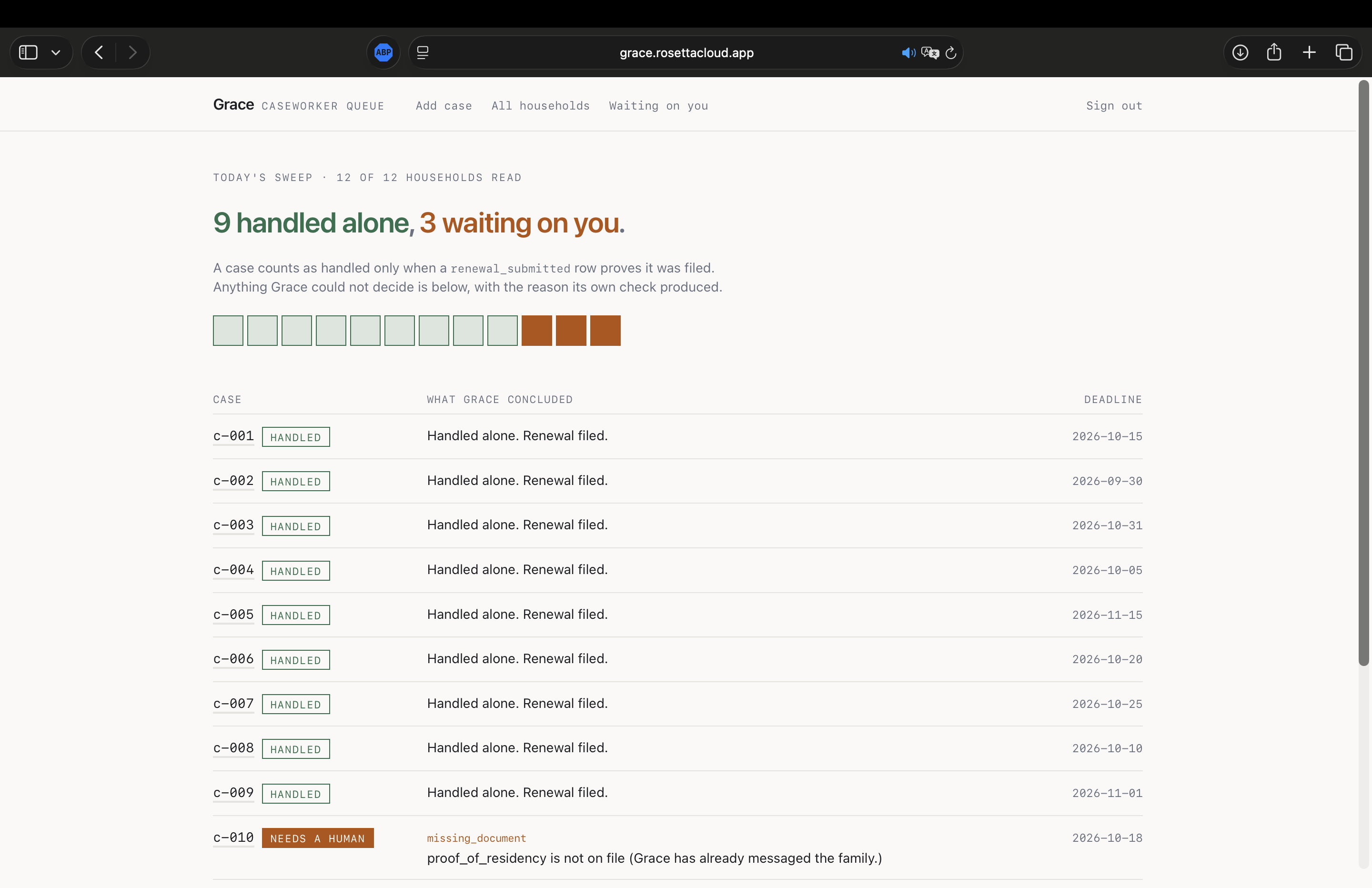
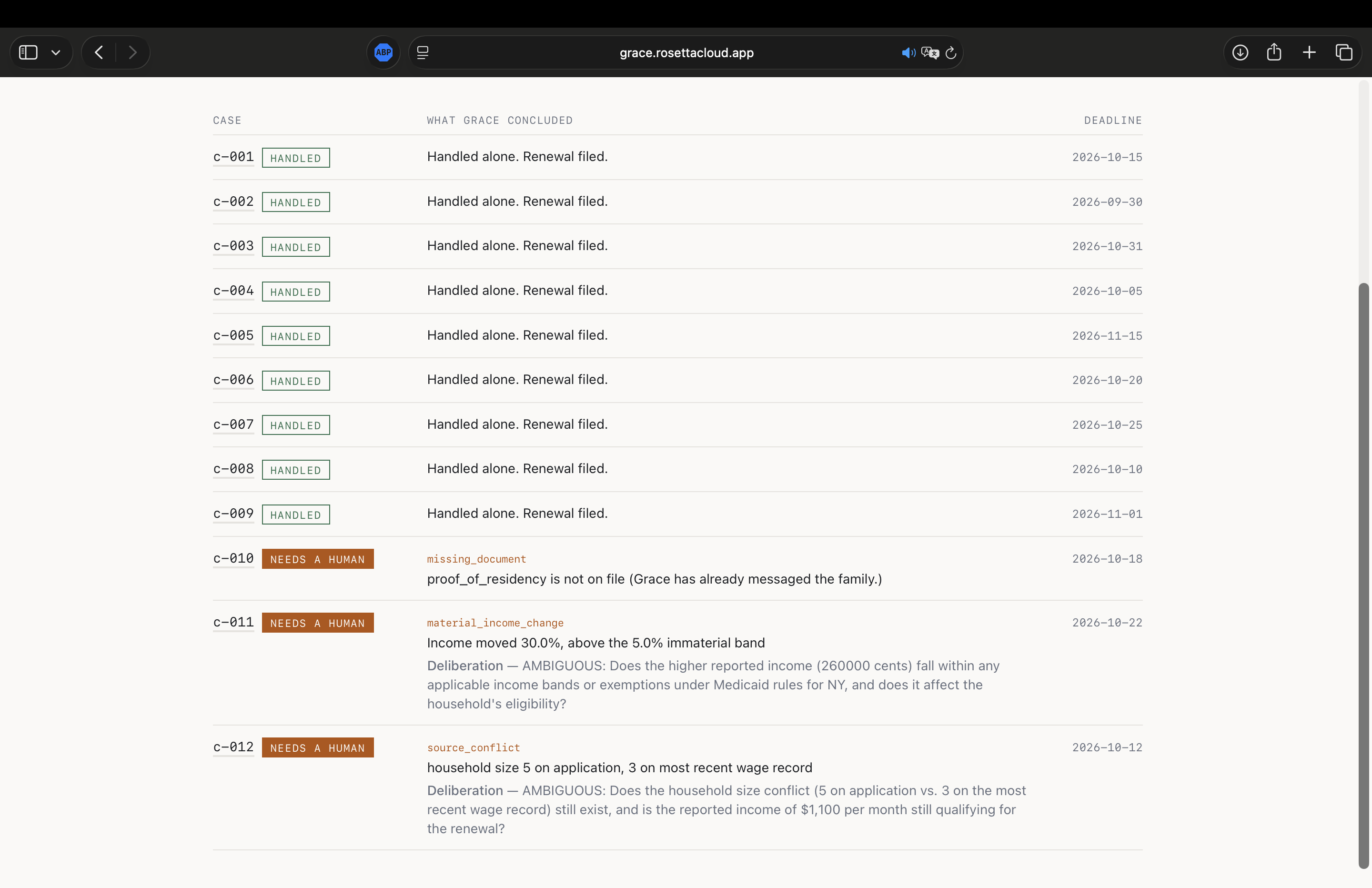
Across twelve seeded synthetic households it handles nine alone and escalates three, each with a typed reason a caseworker can act on: a missing proof of residency, a material income change, two sources that disagree. Those counts are confirmed by reading DynamoDB, not by trusting a log line.
It is for caseworkers at community clinics, food banks, and school family-support offices, tracking recertification windows for hundreds of households across programs with different clocks. They enrol a household once; Grace watches the clocks from then on. Nobody opens an app to do this work, so it runs as a background process and surfaces only at the decision.
How we built it
A daily EventBridge schedule starts a Step Functions sweep that invokes Grace on AgentCore Runtime once per household. Inside, all three Strands multi-agent patterns, each where it is actually the right tool:
- A Graph is the deterministic spine — intake, document checks, decide. Deadline math is a tool, not an agent: deterministic work does not need a model.
- A three-agent Swarm runs only on ambiguous cases: an advocate, an adversarial verifier, and a referee, on three different Amazon Nova models. Two instances of one model agreeing proves nothing, and nothing should referee its own argument. The nine clean households never pay for it.
- Agents-as-tools drafts the family's message in a nested agent with no tools and no access to the case, so translation chatter never enters the eligibility reasoning — and the agent that writes the words cannot send them.
AgentCore Memory carries what each sweep concluded into the next one; a recertification cycle is annual, so a fact is only useful if it survives eleven months. A remembered lesson reaches the advocate — the agent whose job is to argue — and never the gate.
The gate is the point. authority.py is pure Python, no model and no I/O, wired in as a Strands
steering handler that runs before every state-changing call. Three layers, strongest first:
- Capability absence. Privileged tools are not in the agent's tool list at all for a case that has not passed verification. There is nothing to disobey.
- Identity from the session, never the conversation. Every household-scoped tool takes zero arguments. A prompt injection has no parameter to poison.
- A deterministic gate, and any error during verification escalates. Fail closed.
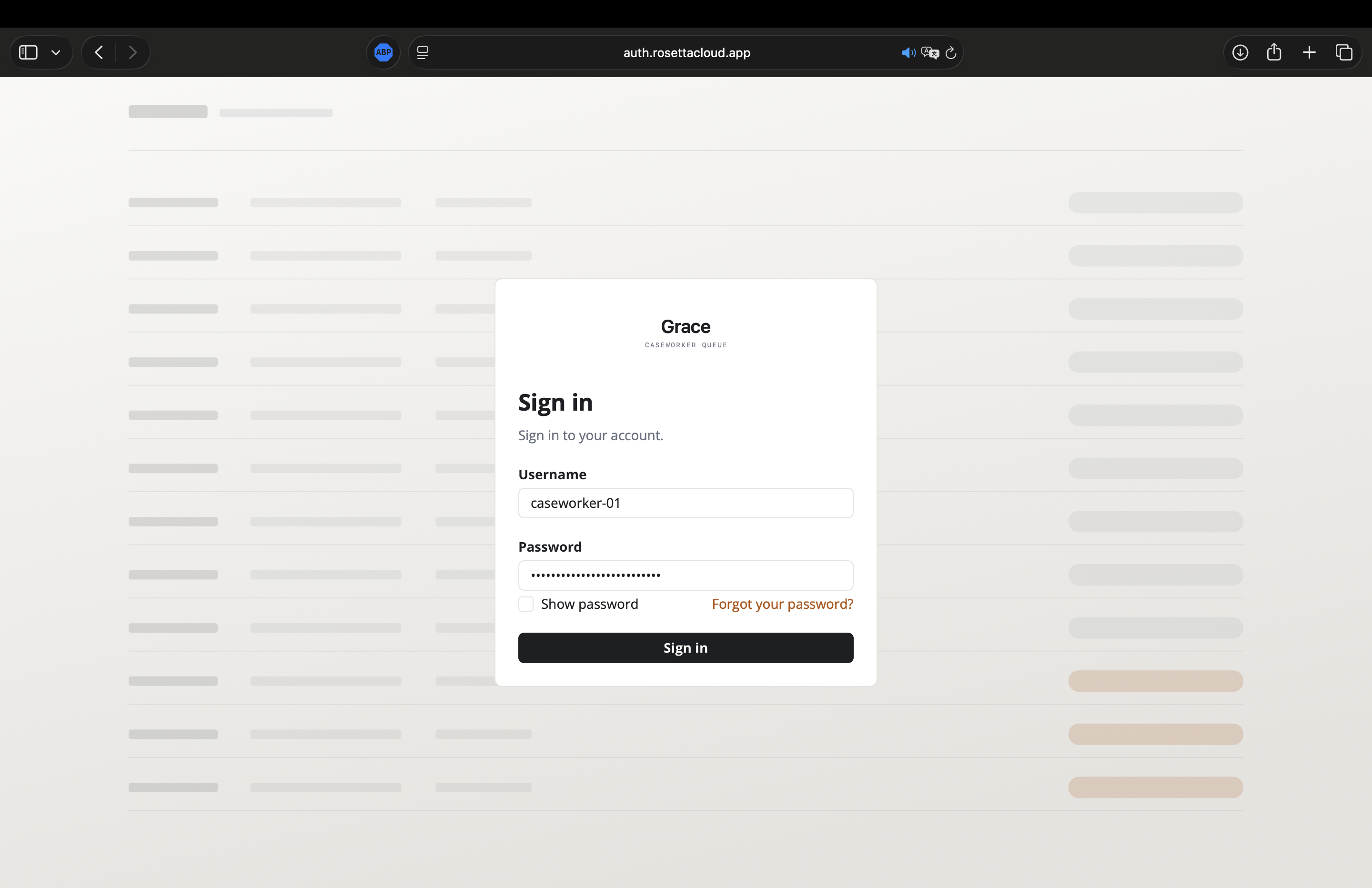
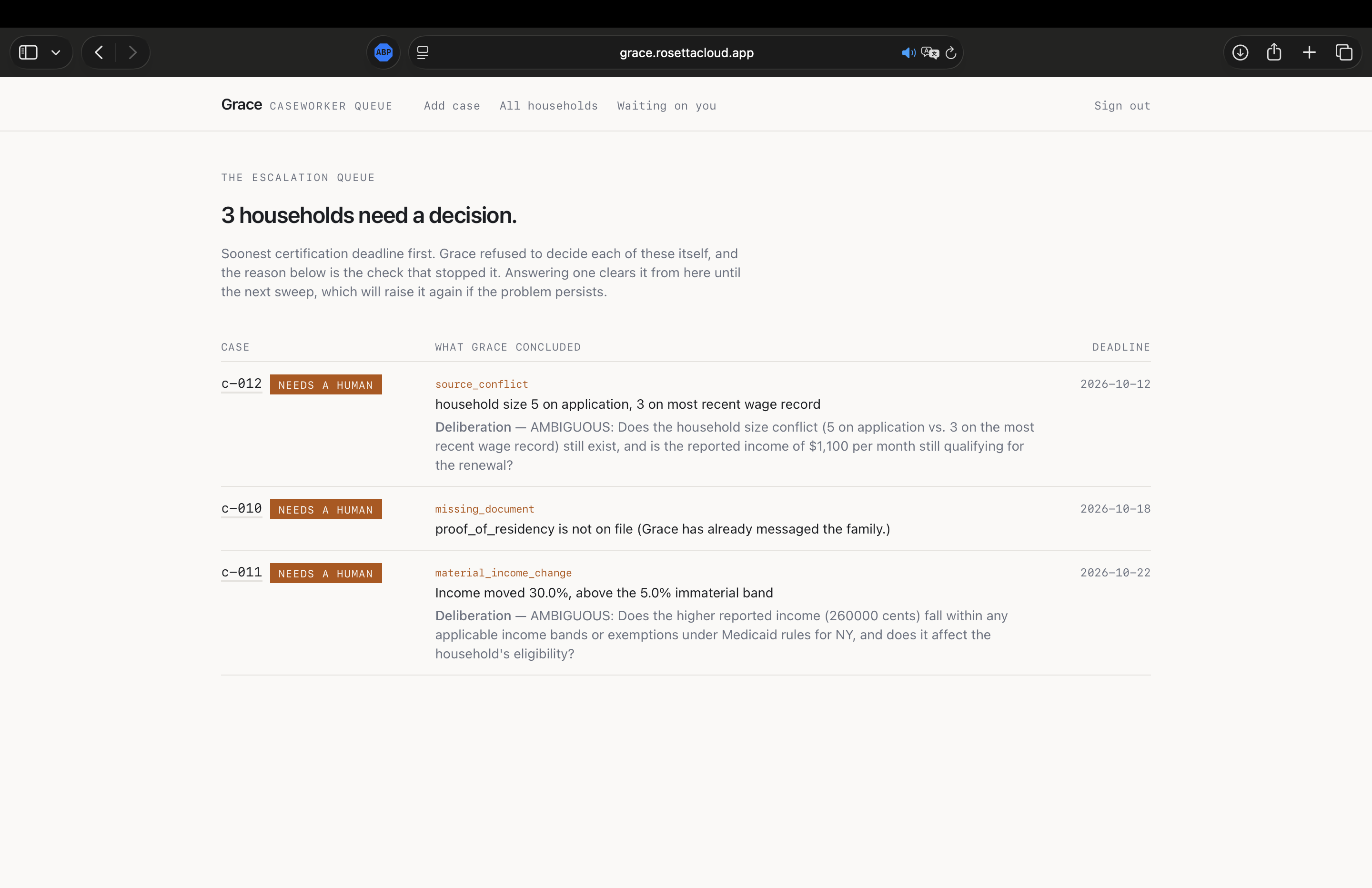
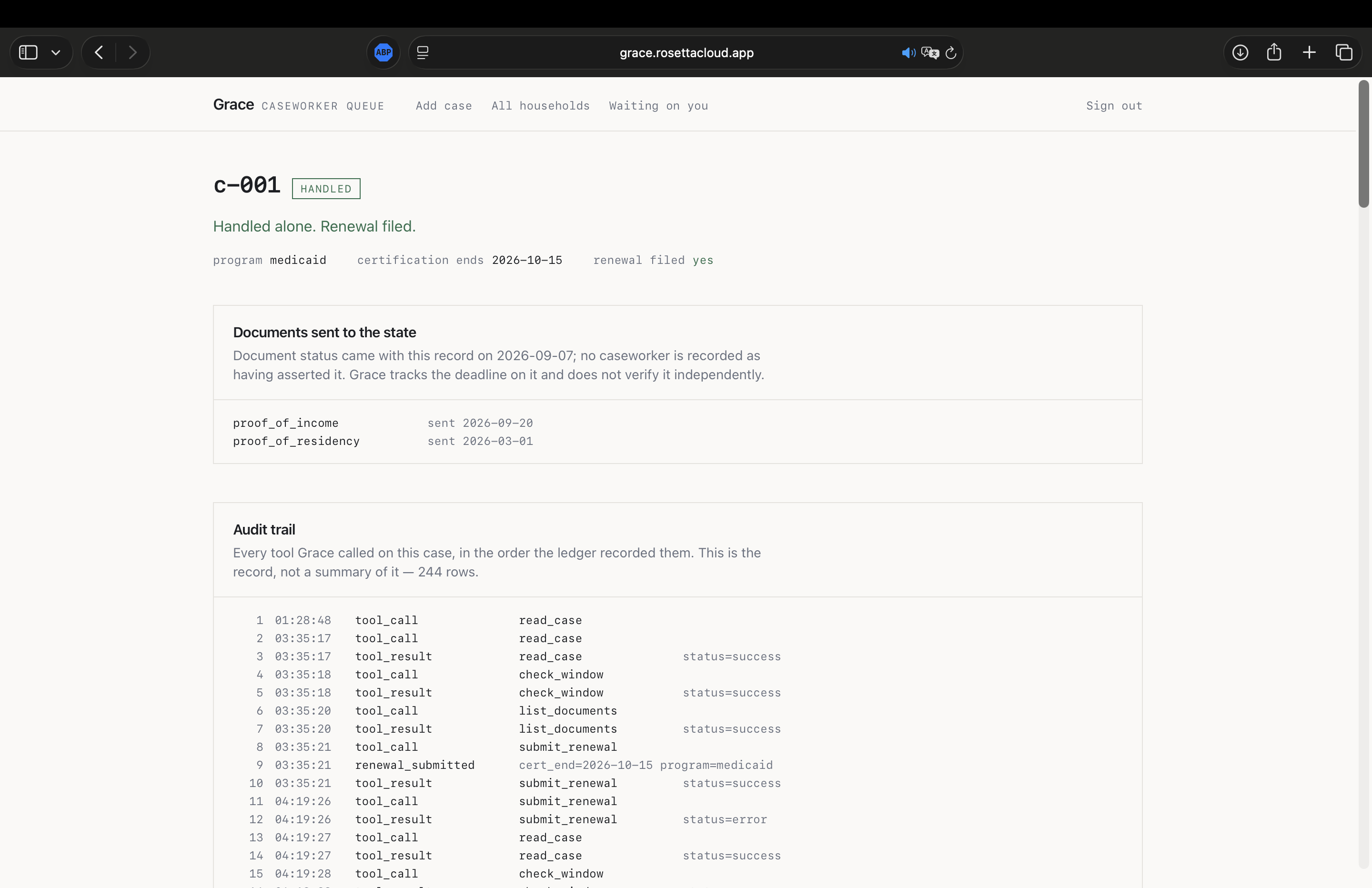
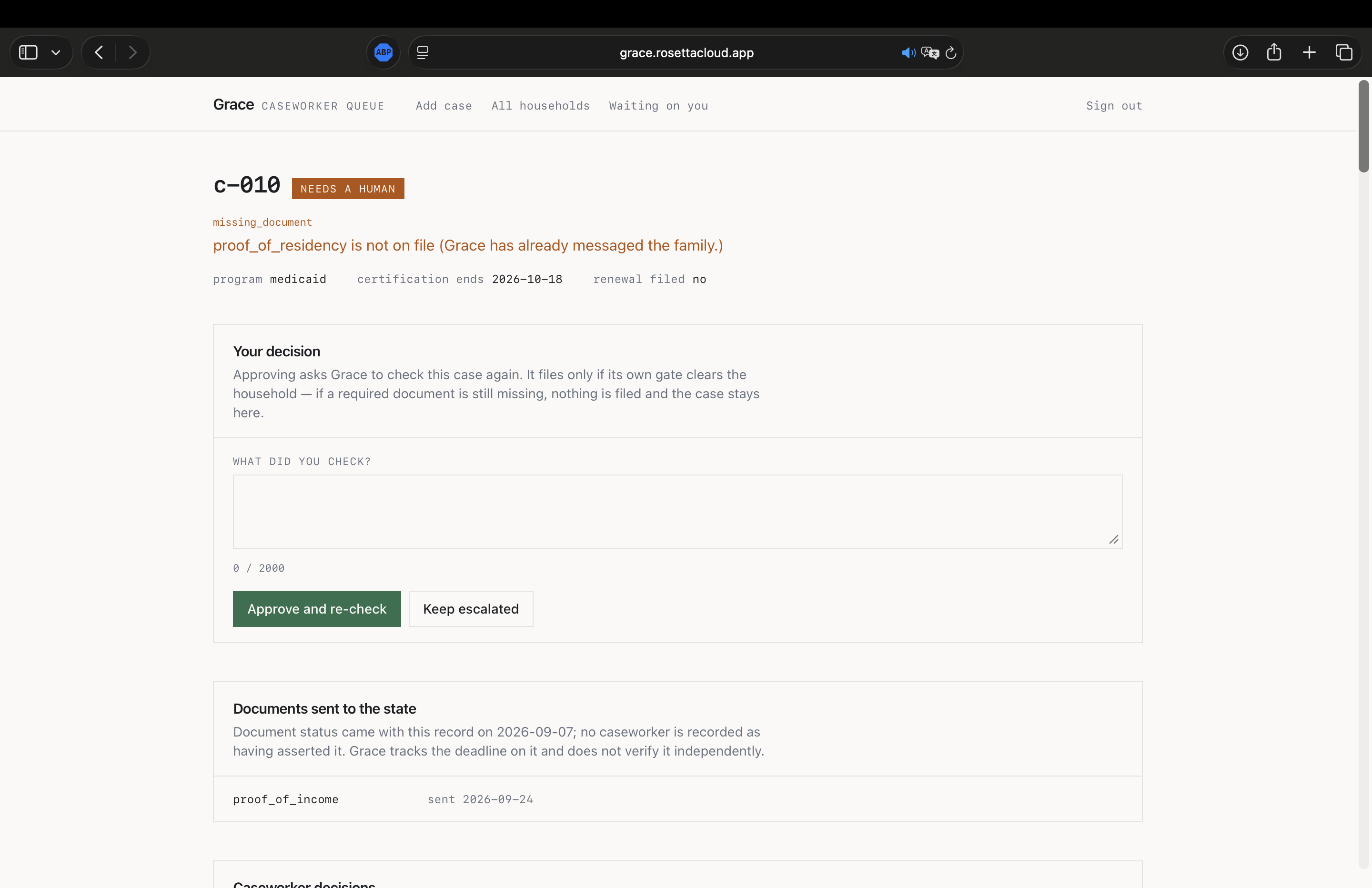
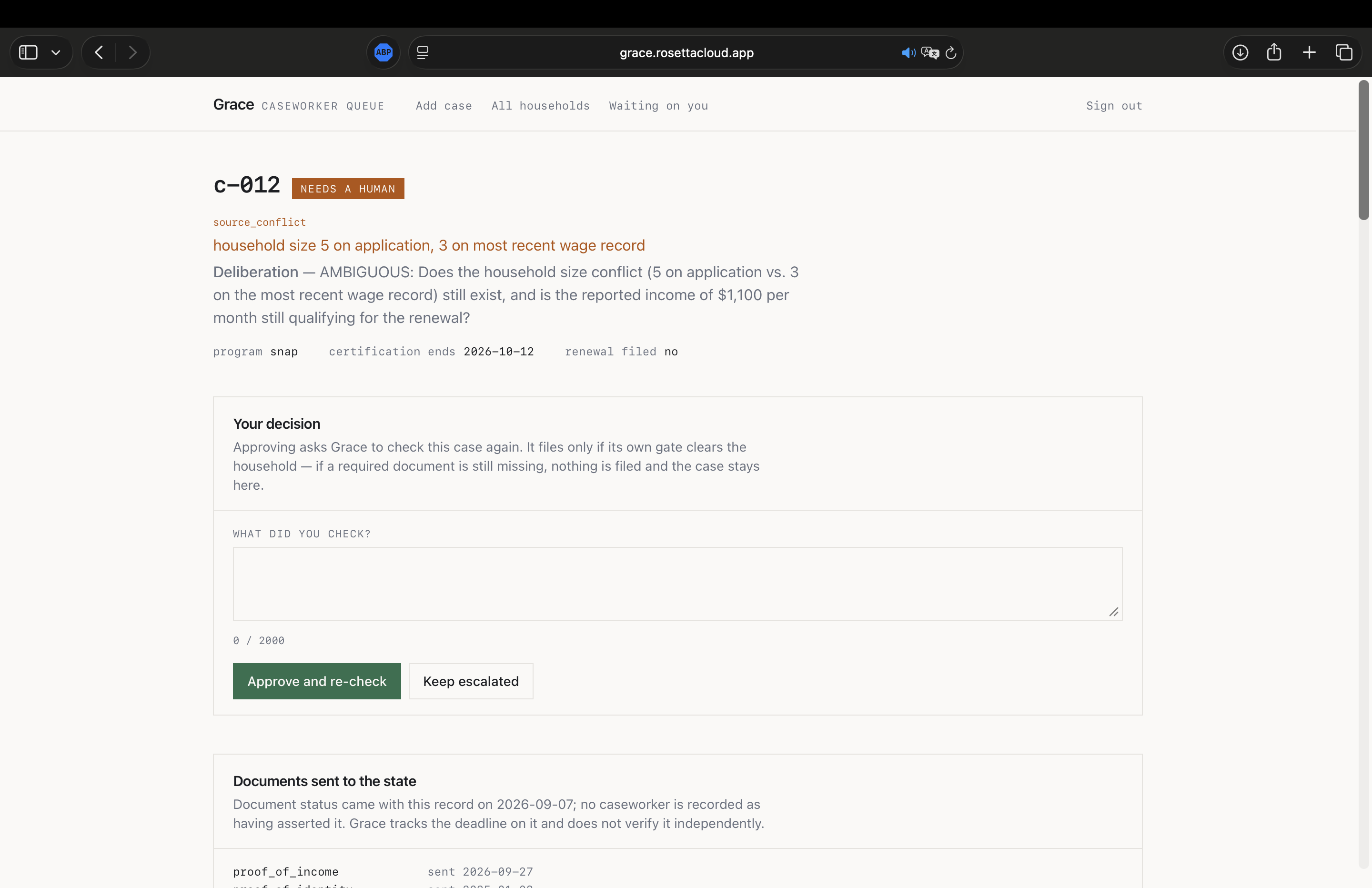
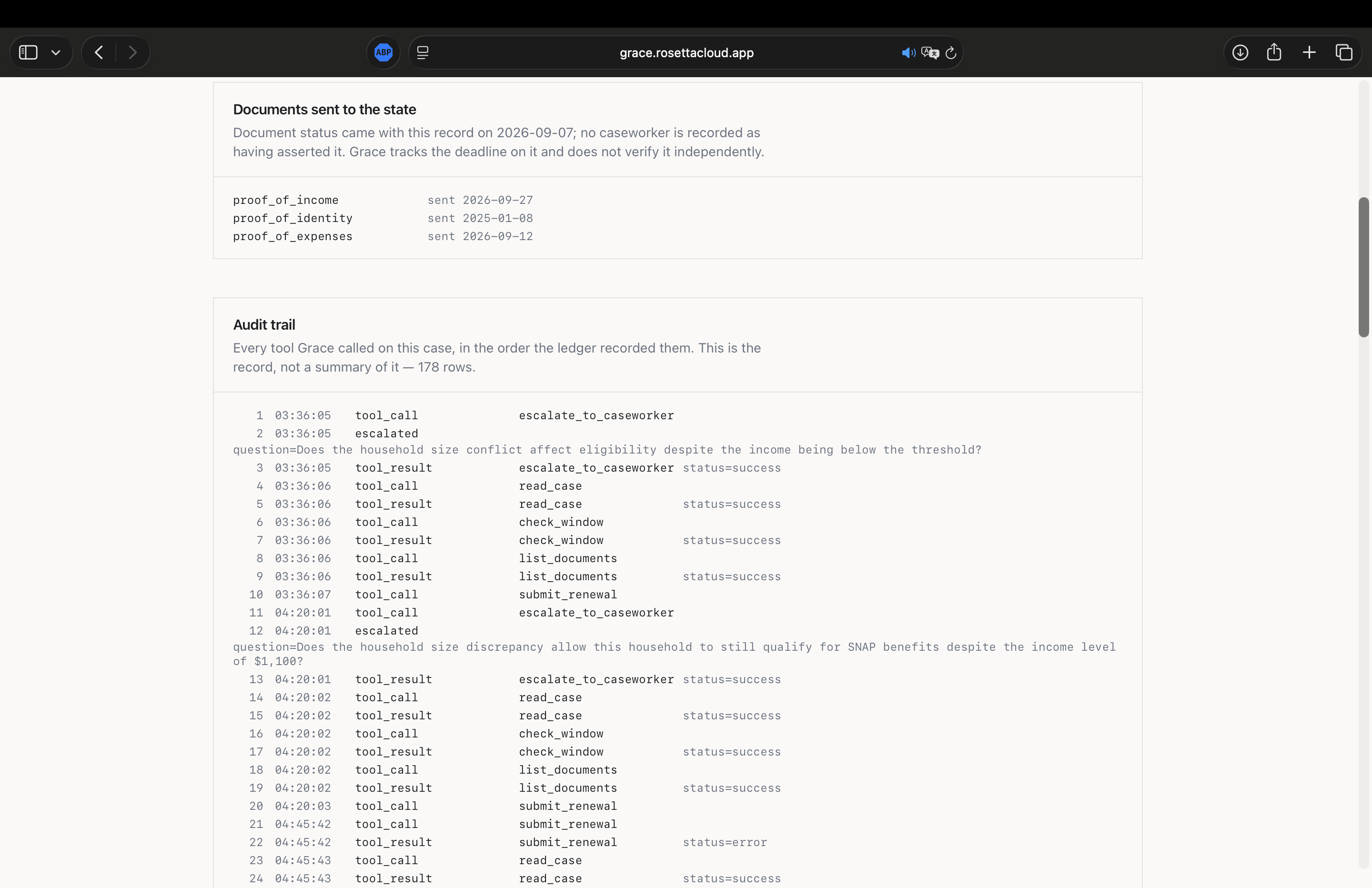
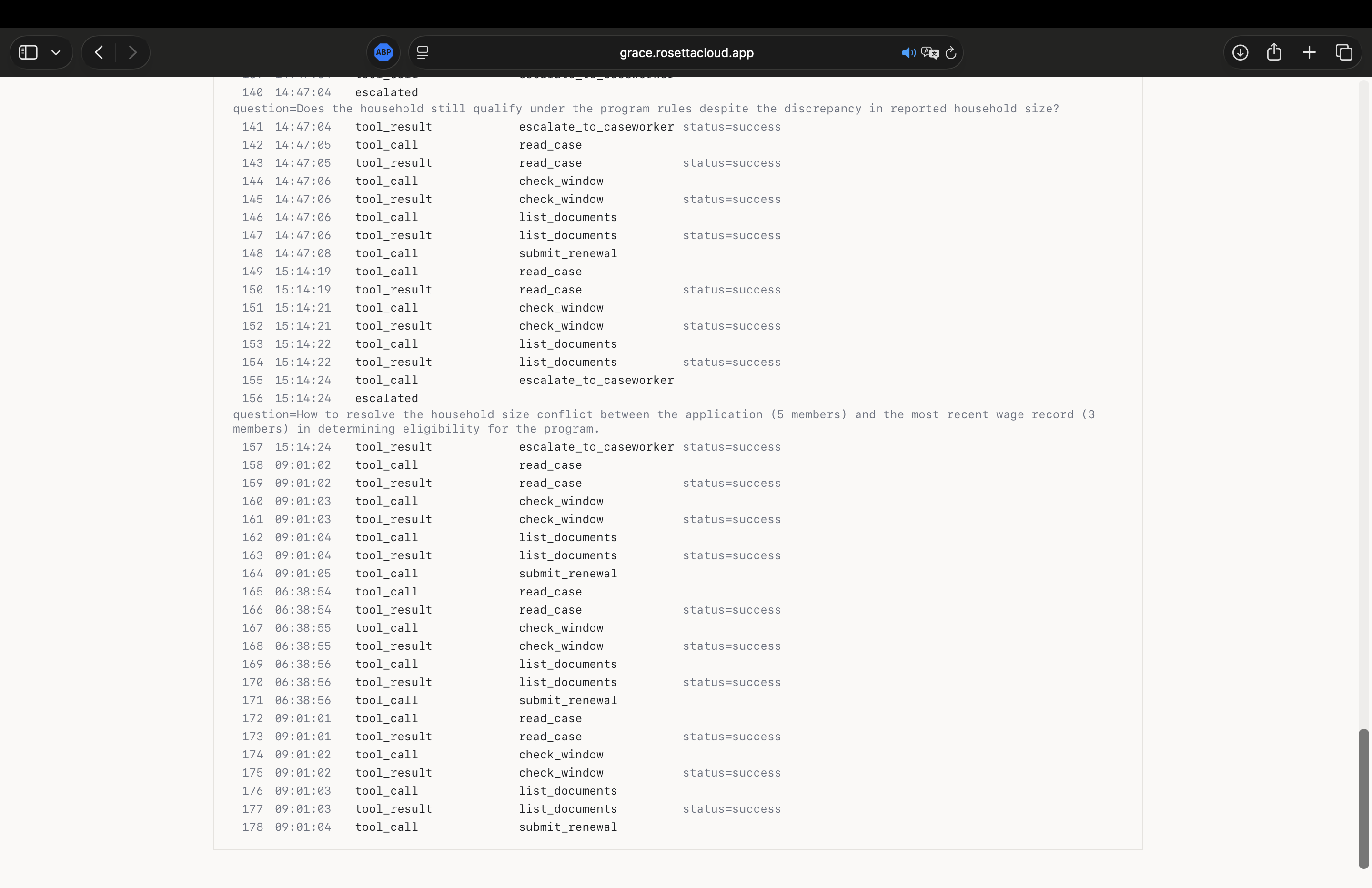
Caseworkers sign in through Cognito to a Next.js dashboard on Amplify SSR: the sweep at a glance, the escalation queue, one household's full audit trail, and an approve/deny control. Approving bypasses nothing — it records the decision and re-invokes Grace so the gate re-evaluates the case facts. It is deliberately not a "resume", because resuming a paused agent with any affirmative answer just approves whatever it was blocked on.
Challenges we ran into
A green build proves nothing about a running system. Five separate deploy defects survived
SUCCEED builds. Marking the AWS SDK as an external package made it absent at runtime, so every page
returned 500 with a valid session, failing on a module name nobody published. Amplify environment
variables never reach the SSR runtime at all. Each one had to be found by probing the deployed app at
request time with a real session, not by reading a build log.
The worst bug never failed. A household added through the intake form was invisible to the daily
sweep — and it was two defects wearing one symptom. The deployed container image was four days older
than the code that could read the new record shape, and the EventBridge schedule carried a hardcoded
list of twelve case ids, so the caseload was frozen at the moment the provisioning script last ran.
The schedule stayed green, every execution reported SUCCEEDED, and the 9/3 count stayed correct.
That is precisely what made it invisible. It was found by asking a question no dashboard answers: is
the thing I deployed the thing I wrote?
Tests that could not fail. A parametrized safety test ran on three escalating households, but two of them never execute a gated action — escalating is the point — so the loop that did the checking never ran, and the test passed having asserted nothing while still paying for real Bedrock calls. Elsewhere, a test proving the escalation gate could not be bypassed passed with the gate deleted, because a different branch produced the same outcome for every input. The habit that came out of this: prove a new test fails against the code it was written to catch, and remove the other branches' alibis before believing a safety assertion.
A household surname reached CloudWatch. Not through any logging call. read_case returned a
display name → the swarm's referee quoted it in its deliberation prose → that became the escalation
reason → the reason was the Lambda's return payload → Step Functions logged the payload. Span
redaction covers span content, and a Step Functions execution payload is not span content. The fix was
capability absence rather than filtering: read_case no longer returns the name at all, which closes
every downstream path at once. Then the already-written rows had to be scanned and stripped
separately, because fixing the source does not clean what was already written.
A model filed a renewal it had been told not to file. Told "never submit a renewal when a required document is missing", one Nova model read the case, saw the document was missing, filed anyway, and then said "I made the same mistake again." Other models obeyed the identical prompt — which is the point. Grace does not rely on a model choosing to obey.
Accomplishments that we're proud of
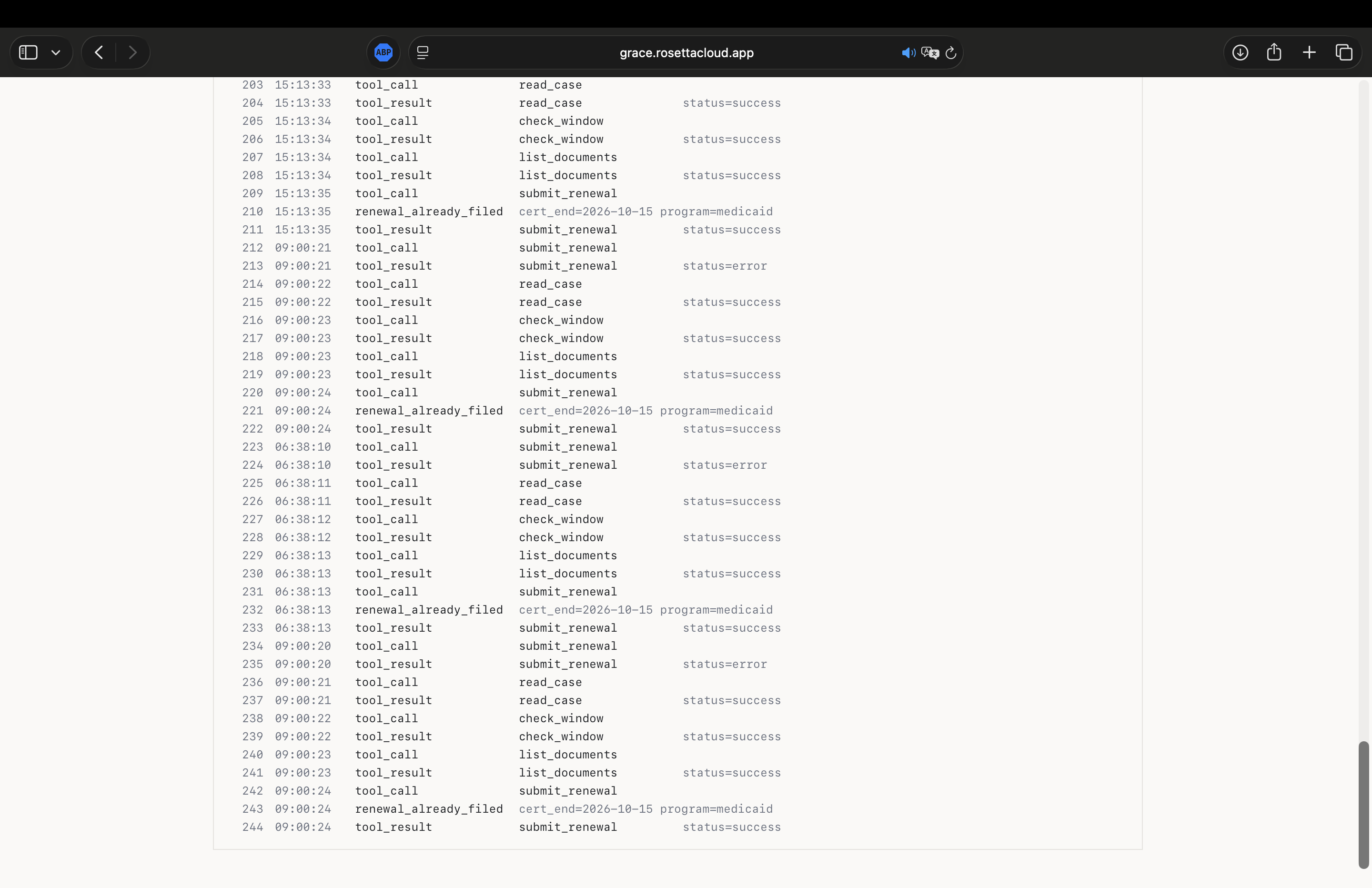
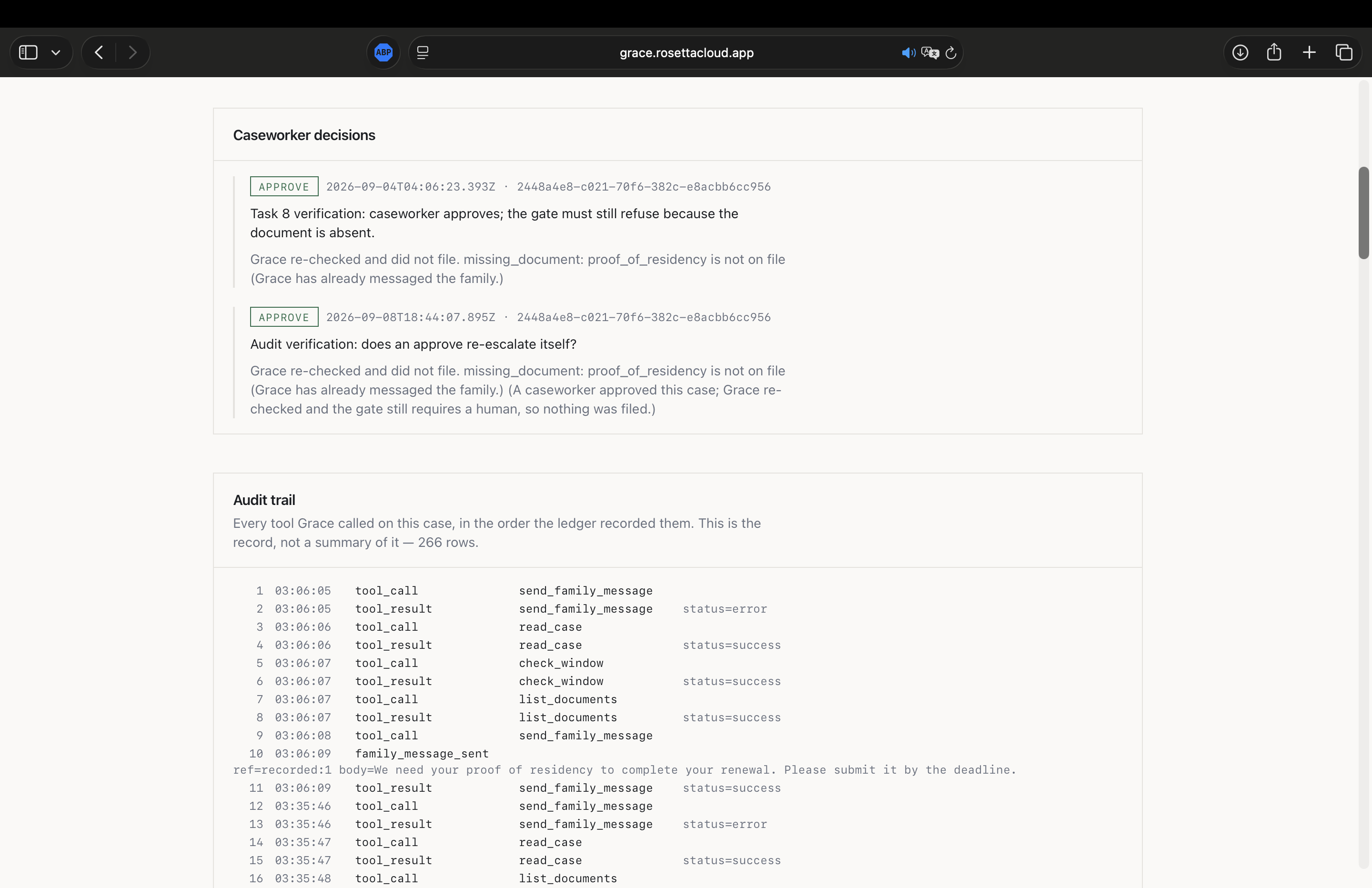
The safety claim is executed, not argued. A real caseworker session approved the household missing
a proof of residency on the deployed system. Grace re-checked and filed nothing — confirmed from
DynamoDB, where renewal_submitted for that household is still zero while its decision rows exist. A
human said yes and the gate still said no.
It runs unattended. The daily schedule has fired every day since deploy, every execution
SUCCEEDED, and both invariants held through every one: renewals filed for exactly the nine clean
households, and no escalating household ever filed.
Every rule-pack number names its authority — and says when it has none. Three of thirteen
parameters are federally mandated and quoted. The other ten carry authority: "policy choice" with a
note on what the regulation does and does not establish. The sharpest entry is negative: SNAP's
immaterial-income band is a percentage, and 7 CFR 273.12(a)(1)(i)(A) sets a dollar threshold, so a
percentage band has no federal basis at all and the pack says so. An uncited number that decides
whether a family keeps coverage is indistinguishable from an invented one.
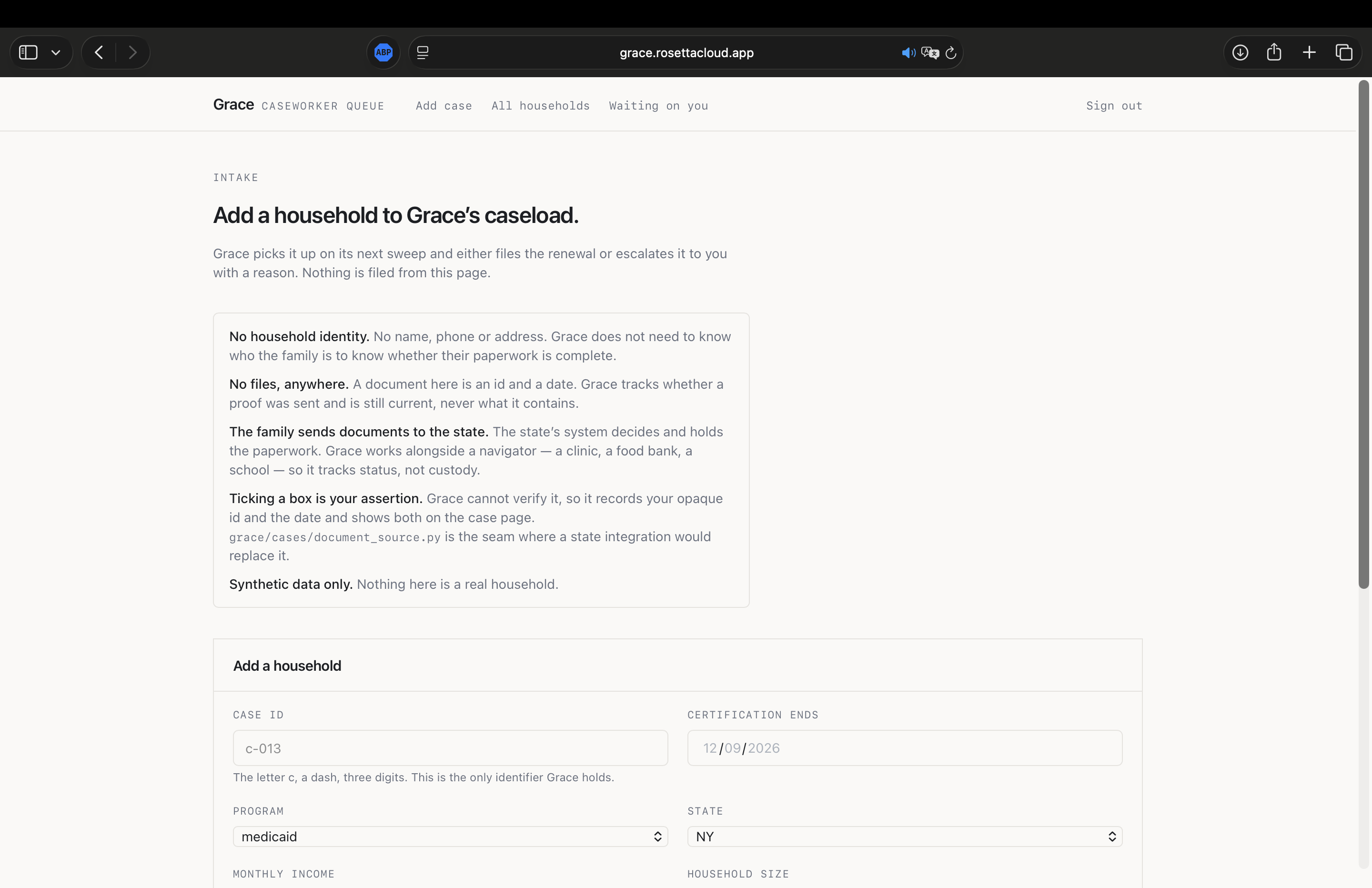
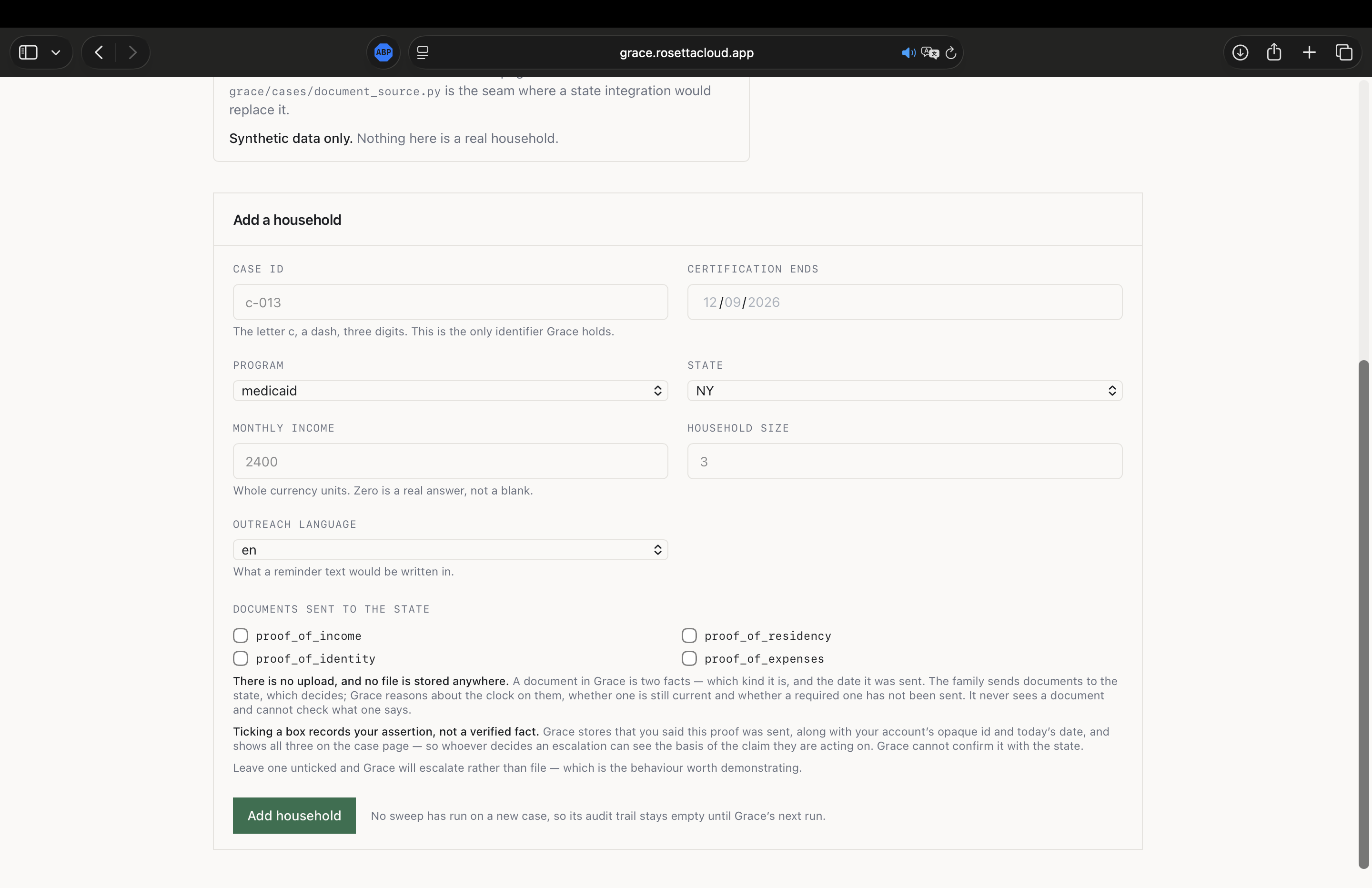
No household identity exists anywhere a model or a log can reach. The intake form refuses to collect a name, phone, or address — with an allowlist, so it cannot be walked around with a field name nobody anticipated. The dashboard labels document status as asserted by an opaque id, with "Grace does not verify it independently" on screen, because a claim Grace never confirmed should be labelled as one for the person about to act on it.
We named the one AgentCore surface we did not ship. Four, not five. Gateway is deferred with its reason. Claiming five would be the single thing that turns a working entry into a dishonest one.
What we learned
"The API accepted my configuration" and "the control does what I think" are different claims.
Enabling point-in-time recovery on a table silently failed one run in three while the script exited 0.
The fix was a read-back as the sole arbiter of success. The same shape appeared in IAM: omitting
WriteAttributes from a Cognito client does not withhold write access, it grants everything — and
probing the obvious attribute produced a refusal from a different guard, which would have confirmed
the wrong mechanism. To verify a control, perform the action it should prevent against a target where
only that control can refuse.
A docstring asserting that some other layer performs a check is not evidence that it does. A comment vouched for session verification on every page. Grepping for the function found it in two routes and zero pages: an unsigned, unparseable literal string in a cookie returned 200 with every household record. The claim had been true when it was written, and stayed in place while the pages were built around it.
Fail-closed is not always the safe instinct — it depends on what the code is deciding. A steering handler's exception is swallowed by the SDK and the tool then runs ungated, so every fallible call there must fail closed. But a hook's exception is re-raised and converts an already-approved tool call into a failed one — so failing closed on an observability question would mean losing a renewal to keep a trace ID. Failing closed on verification protects the family; failing closed on telemetry harms them.
When two surfaces disagree, first ask whether they are answering the same question. The dashboard reported "3 waiting on you" while the queue showed 2. Neither was wrong — one counted what Grace escalated, the other what remained undecided. A reader cannot audit two right answers; they can only stop trusting the page. The fix was not to pick a number but to make the disagreement unrepresentable: one computed field both surfaces read.
When an experiment appears to eliminate a hypothesis, list what else differs between the probe and the real case. Memory recall returned nothing for two days. The right hypothesis was tested with a trivial probe that also returned nothing, so it was recorded as eliminated — and a whole verification section was written blaming the service. Two things differed between probe and production and only one had been varied.
What's next for Grace
The state integration, which is a legal instrument rather than code.
grace/cases/document_source.py already defines the seam: a DocumentSource protocol whose
distinguishing method is provenance(), because every source must be able to say how it knows. The
real implementation deliberately raises rather than returning an empty result — to the gate, "no
documents" is the positive claim that a family has sent nothing, so a polite stub would escalate all
twelve households for reasons that are not true. It needs a per-state data-sharing agreement and
credentials issued under it. AgentCore Gateway is deferred for exactly this: an outbound call to a
system Grace does not own.
Ex parte renewal modelling is the lever that actually prevents the 69% — and it is something the state does, from wage and tax data Grace cannot get. Building it now would mean simulating a capability Grace does not have.
Real SMS, once an origination number and sender-ID registration exist. The channel already sits behind an interface with a transcript implementation as the always-works path, so the demo never depends on delivery.
CloudWatch trace correlation, if AgentCore Runtime ever installs an in-process tracer provider.
Every ledger row already carries a trace_id field; its value is null, honestly, because tracing
genuinely was not configured. The packages that would fill the gap are ones this project refuses,
because they would trade a verified safety property for a nicer screenshot.
Built With
- amazon-bedrock
- amazon-bedrock-agentcore
- amazon-cloudwatch
- amazon-cognito
- amazon-dynamodb
- amazon-eventbridge
- amazon-nova
- aws-amplify
- aws-lambda
- aws-step-functions
- boto3
- next.js
- python
- react
- strands-agents
- tailwindcss
- typescript

Log in or sign up for Devpost to join the conversation.