-
-
Discreet Mode
-
Main Screen

Inspiration
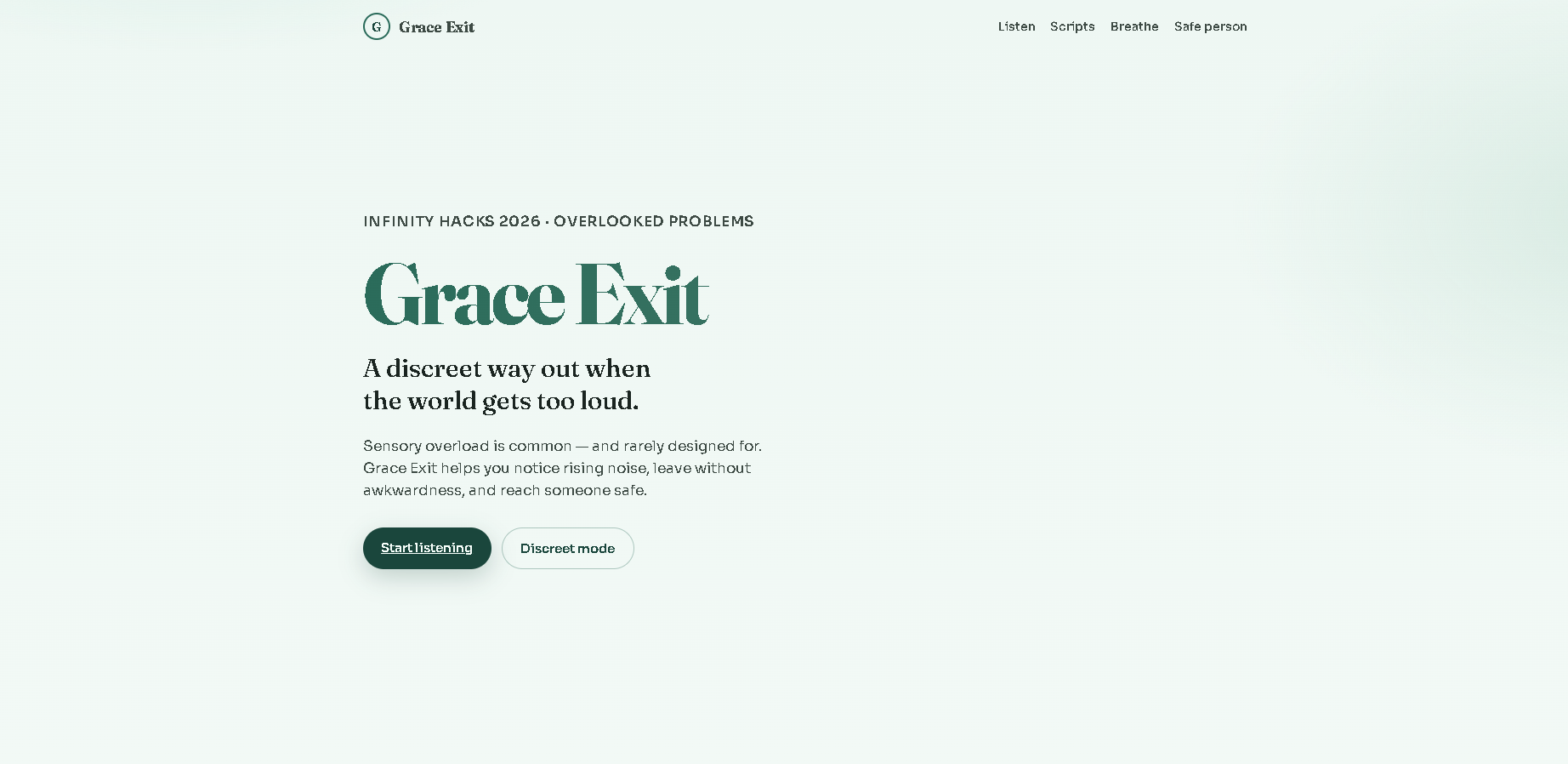
Infinity Hacks asked for problems people usually overlook. Sensory overload kept coming up in conversations with friends who are neurodivergent, anxious in crowds, or simply exhausted by loud spaces — and almost none of the tools built for them help with the hardest part: leaving. Most products in this space offer meditation or journaling. Those are useful later. In the moment, you need something quieter and more practical: a way to notice that the room is getting too much, a sentence you can send without oversharing, and a path to someone safe if you need it. Grace Exit started from that gap.
What it does
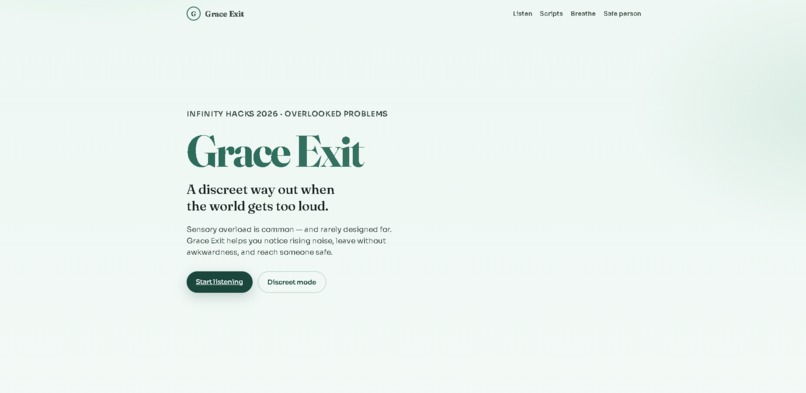
Grace Exit is a small, privacy-first web app for getting out of overwhelming environments with less friction.
- Noise check — optional microphone meter that estimates how busy the room feels. Audio never leaves the device.
- Exit scripts — short, polite lines for social settings, work, stores, class, and family. One tap to copy.
- Breathing reset — a simple timed guide when you need about a minute to stabilize.
- Safe person — one contact stored locally, with quick text or call actions.
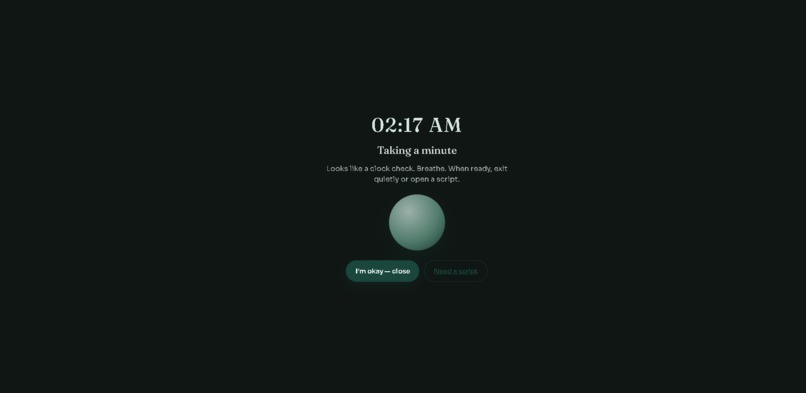
- Discreet mode — a clock-style overlay so opening the app can look like checking the time. There are no accounts, no backend, and no uploaded data.
How we built it
The project is a client-only React and TypeScript app built with Vite. Ambient noise uses the Web Audio API on the user’s device. The safe contact is saved in localStorage. The interface is intentionally light: one page, clear sections, and a calm visual system meant to feel steady rather than stimulating.
That constraint was deliberate. If the tool itself feels heavy, it fails the people it is supposed to help.
Challenges we ran into
Phone microphones vary a lot, so a “decibel” reading is never perfect across devices. Treating the meter as medical truth would have been dishonest. We framed it as relative guidance and kept the copy focused on how the user feels, not on a single number. Another challenge was tone. Exit scripts had to be polite without sounding robotic, and discreet mode had to be useful without pretending to be something it is not. Small wording choices mattered more than expected.
Accomplishments that we're proud of
We shipped a complete, demoable product around an overlooked need instead of stacking features for their own sake. The app stays private by design, works without a server, and covers the full loop from noticing overload to leaving to checking in with someone. That felt more aligned with the hackathon’s brief than a larger but emptier build.
What we learned
Meaningful accessibility work is often about social friction, not just interfaces. The technical pieces — audio analysis, local storage, a clean React layout — were straightforward compared with writing copy that respects someone’s dignity in a stressful minute. We also learned that constraint helps: a narrow problem produces clearer product decisions.
What's next for Grace Exit
- Installable PWA for faster access offline
- Custom exit scripts in the user’s own voice
- Optional haptic or visual alerts when noise spikes
- Lightweight caregiver check-in flows for people who want them
- Better calibration guidance across different devices

Log in or sign up for Devpost to join the conversation.