-
-
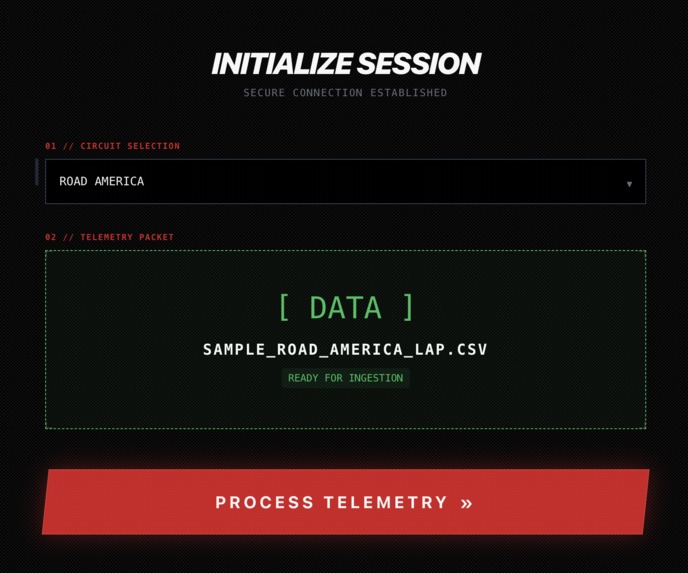
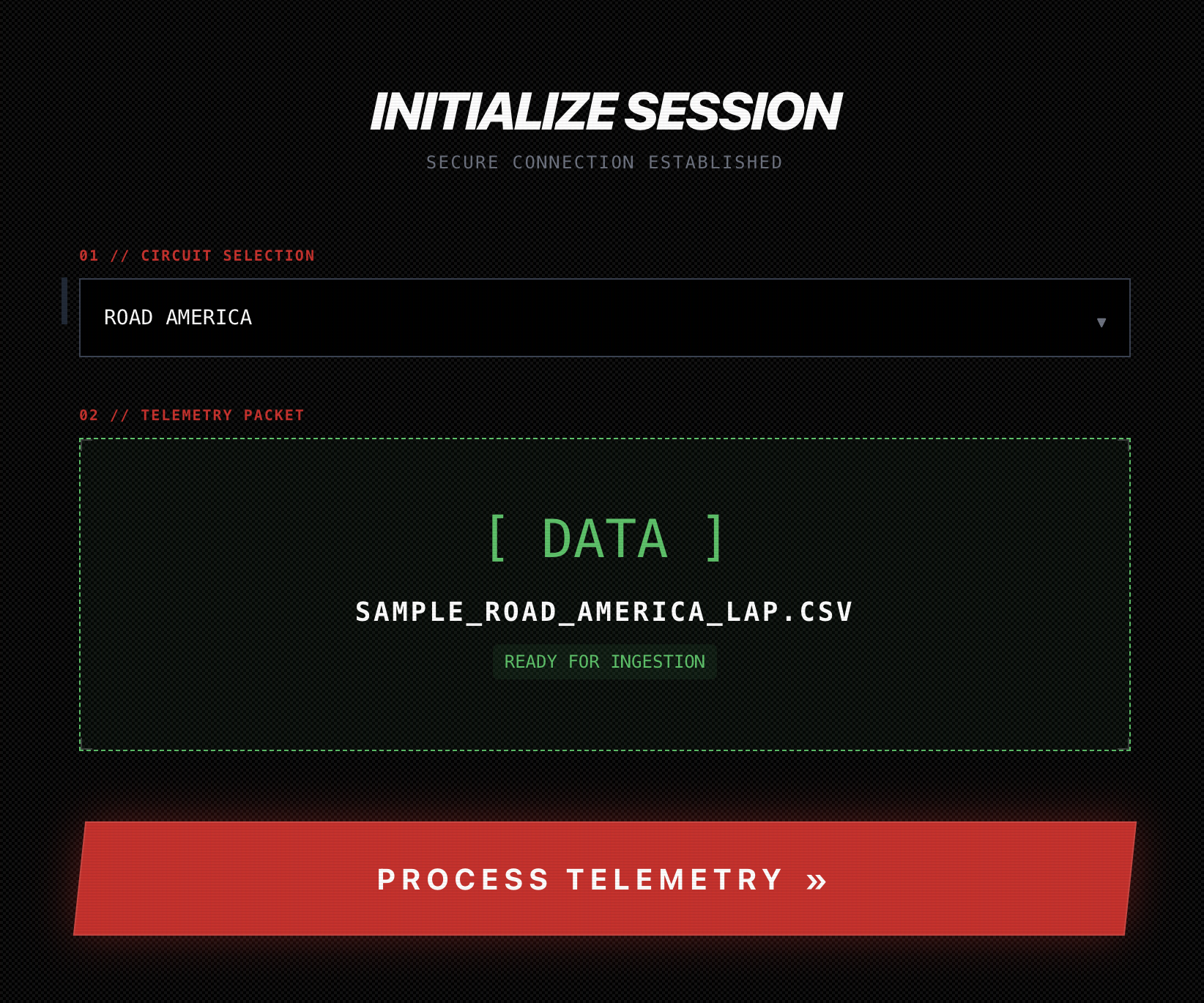
Upload Page
-
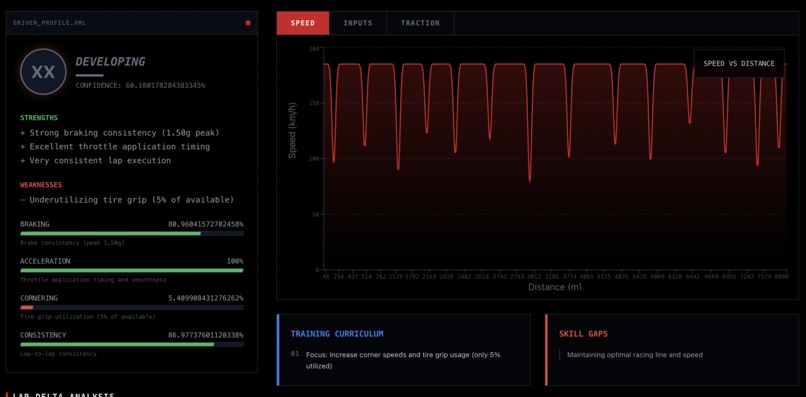
Lap analysis #2
-
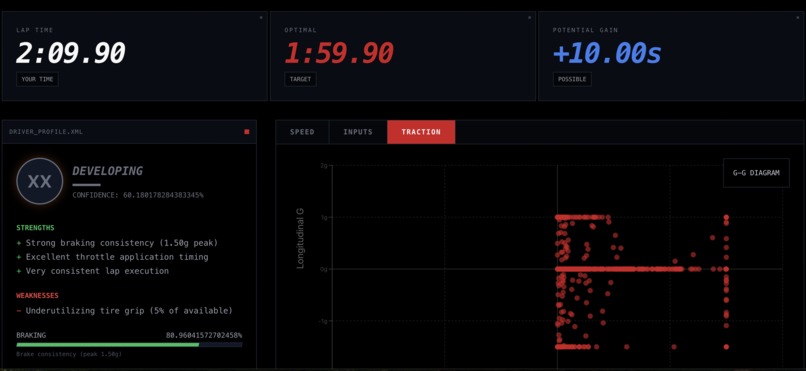
Lap analysis #1
-
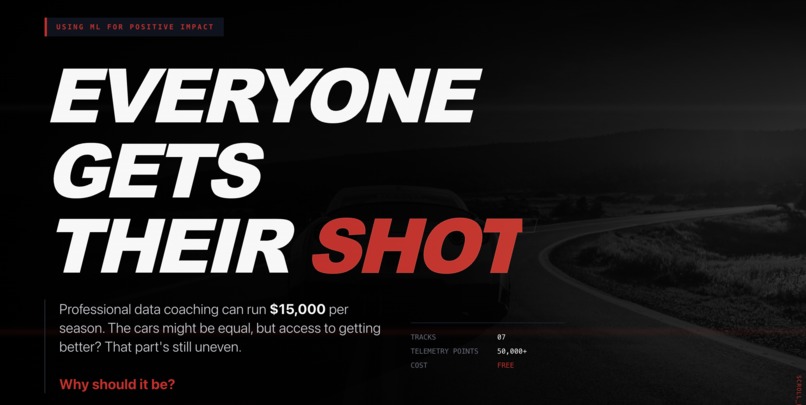
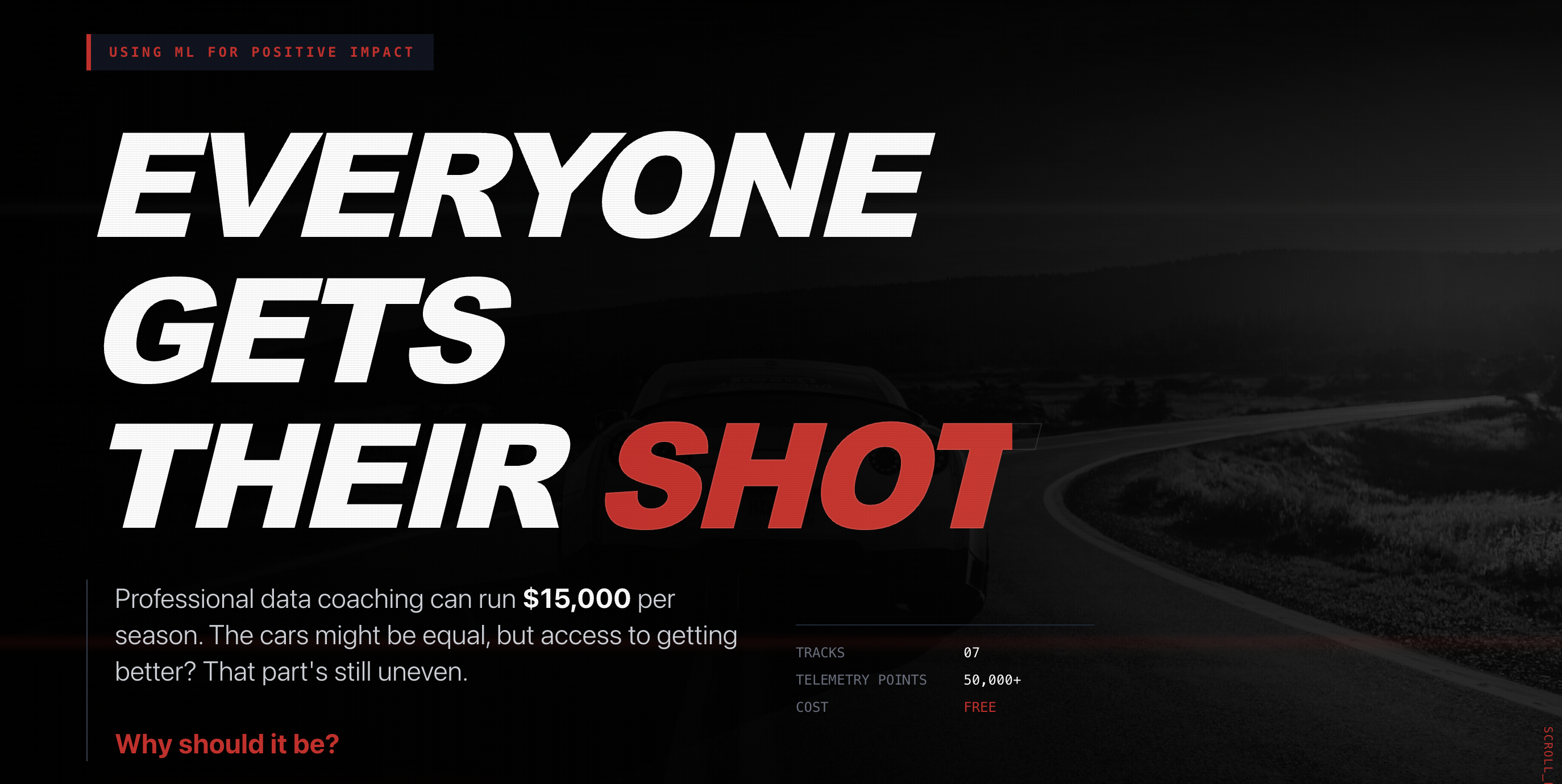
Landing


Inspiration
One and only reason behind our work : because motorsport has an access problem. We know the GR Cup is fixing this the right way with same cars and controlled parts but coaching is still a privilege in this industry: professional data coaching costs $5,000 to $15,000 per season.
Our team studies advanced machine learning and physics modeling and we know this tech should be used towards positive changes and we think ML can actually bring a lot of impact, this is a cause that matters a lot to us (good use of the technology).
We built this because we care about the difference that good information makes in the life of a driver. What if we could try to give every driver a tool that explains their performance with the clarity of an experienced coach?
Upload your lap data (real or sim) and get back the analysis from a professional coach based on the GR Cup data. Physics calculations, driving style profiling, actionable recommendations are available to you all based on championship data from TRD datasets that you kindly provided.
What it does
“We can ingest data as fast as physically possible, process it however we need to, and present it in a visual way that lets people make decisions quickly … In racing, milliseconds matter.”
Our system completes full lap analysis in 530ms: GPS projection to UTM coordinates, arc length parameterization for spatial alignment, corner detection from curvature analysis, time delta computation against optimal lines and neural network classification of driving style from 50 behavioral features.
Upload your lap file from any data logger (AiM, RaceBox, TRD format, whatever you have) and you get back a complete breakdown: where you lost time, which corners need work, how your driving style compares to championship pace and specific things you can practice to get faster.
We used championship data from TRD's Road America races (240 laps, 30 drivers, full 100Hz telemetry) to build baseline models. The physics mechanism calculates racing lines with vehicle dynamics equations: tire friction limits, weight transfer, power curves, aerodynamic effects. We calculate track curvature using differential geometry then solve for maximum corner speeds. Every recommendation comes from comparing your data against what actually won races.
The output tells you exactly what to do "Move your brake point 12 meters deeper in Turn 5, you're losing 0.3 seconds there." Corner by corner analysis shows entry speed, apex speed, exit acceleration compared to championship pace. The system identifies your driving archetype (Aggressive, Smooth, Technical, Conservative, Adaptive) and explains which traits help you and which hold you back.
How we built it
Our starting point was 2,847 laps from the 2024 GR Cup Championship with multiple tracks and 30 professional drivers. All drivers were anonymized and the top performers became our benchmark.
At the centre of the system is a Physics Informed Neural Network that understands the car’s physical limits. This network has vehicle dynamics, including mass, power, tire grip and weight distribution, as well as cornering physics such as lateral acceleration, friction limits, braking, and traction. It also accounts for thermal and tire behavior, predicting how grip changes with temperature and load. The PINN outputs optimal trajectories along the track, including speed, braking, throttle, and gear selection for every point.
We trained the model in multiple stages. The network learned fundamental car behavior, such as friction limits and acceleration, through physics pretraining. Next we combined physics with driver data teaching the network to match optimal lap trajectories while respecting physical constraints. We fine-tuned the model with edge cases including cold tires, wet patches and traffic.
We also built a secondary neural network that analyzes driving style. Using 50 features derived from telemetry like braking, throttle, cornering patterns and G-force usage, the model classifies laps into five archetypes: Aggressive, Smooth, Technical, Conservative and Adaptive. Trained on labeled championship laps, this classifier achieved 87.9% accuracy on unseen data.
Backend
Python 3.11, FastAPI, PyTorch, NumPy, SciPy, scikit-learn, pandas, pyproj. Privacy by architecture. You upload telemetry, we analyze it in memory, return JSON, forget everything. https://gr-garage-coach-api-ce18088c2f04.herokuapp.com
We handle multiple data formats: TRD CSV (comma delimited with specific headers), AiM XRK files (binary format, requires custom parser), RaceBox CSV (different column names), generic formats (flexible column).
GPS coordinates come in latitude/longitude. We project to UTM with pyproj for accurate distance calculations in meters.
Frontend
React 18, TypeScript, Tailwind CSS, Recharts. Drag and drop file upload to get your analysis feedback. The results display in sections like summary stats, time delta breakdown, corner by corner analysis with visualizations, driving style profile, coaching recs. https://mlgaragecoach.vercel.app/
Challenges we ran into
Different data loggers at different rates, GPS has varying precision and you can't compare laps using timestamps because speed varies. We needed spatial alignment to compare what happens at the same point on track, not the same moment in time.
The solution was arc length parameterization. We compute cumulative distance traveled using the integral s(t) = ∫||r'(τ)||dτ. In discrete form, we calculate distance between consecutive GPS points (Δs = √(Δx² + Δy²)), then build cumulative sum so we transform irregular time series into uniform spatial series. Now we can interpolate any telemetry channel to regular 1 meter intervals and compare apples to apples.
Early on we realized the model could fit the numbers without actually understanding the driving which meant its advice would be meaningless if we didn’t handle the inputs carefully. The PINN was complex to train becuause we had to balance lap data with physics respecting tire grip limits, engine power and the car dynamics.
Accomplishments that we're proud of
We're very proud and happy to participate in this hackathon to begin with! We've developed 5+ racing systems that got developed and this was by far the most interesting in terms of data and tracks.
The team is proud that our optimal lap simulation predicts actual GR Cup championship times within 0.10% for the winner. We showed the system to a professional data coach that we approached on LinkedIn with 15 years experience and he worked with IMSA teams. His said that the recommendations are genuine and match the data.
And one important thing to us is that the time delta visualizations look exactly like professional coaching software (Pi Toolbox, MoTeC i2). Corner by corner breakdowns match how real coaches segment sessions and it works with all formats. Users can upload whatever they have because the format converter we have built maps columns, detects units and missing channels.
We're the most proud of succeeding to develop this as a team and we used all our individual skills with our common passion (racing) to get this product out and working.
What we learned
We thought we understood racing with apex late, trail brake into corners, maximize exit speed but then we analyzed real championship data and kind of discovered the gap between theory and practice especially because EVERY DRIVER IS DIFFERENT. And maths doesn't work like that so we had to adapt.
We had to account for the human side: each driver has a style, strengths and weaknesses. That’s where the Driver DNA system became really important to this project. When we built the model to classify and understand driving styles, we could personalize the coaching so the system doesn’t just spit out numbers and actually teaches each driver how to get faster in a way that suits them.
Making pure physics within technology was something that we're used to but capturing human differences was the biggest challenge. But at the end of the day it got us to develop our favorite part of the product which is the part that makes GR Garage Coach special.
What's next for GR Garage Coach
Our vision for GR Garage Coach is big to be honest. At the moment the system can give data into the hands of every driver for free but this is still too simple for us based on what we can do and what we want to achieve so we hope this is just the beginning.
The first step is advancing the PINN as we need it to handle more complex track conditions and extreme driving scenarios. To work on this we need to expand our training dataset and implement curriculum learning so the model gradually masters harder scenarios without losing physical accuracy.
We're also going to improve the Driver DNA system as we plan to integrate behavioral features so the coaching can be personalized down to the level of individual corners.
The telemetry pipeline itself needs to become smarter because we handle multiple formats but future updates will includ automated ingestion that recognizes any standard or custom logging format, aligns it spatially, and cleans it for analysis instantly. We’ll combine this with parallelized computation and memory-efficient data structures so even large sessions process quickly, preserving privacy by never storing raw telemetry.
On the backend, we are optimizing inference. predictions take seconds on CPU but we're headed towards live feedback like live lap analysis which means quantized model deployment, GPU acceleration where available.
If given the opportunity, we also would like to interview coaches like we've done on LinkedIn to have better data training for our model and precise feedback to give the drivers and a general better understanding of what actionable coaching requires.
We want GR Garage Coach to become the open source and free software for motorsport. We want it to be a tool every aspiring driver can rely on without cost or access and we need you for that!
Built With
- css
- fastapi
- numpy
- pandas
- pyproj
- python-3.11
- pytorch
- react-18
- scikit-learn
- scipy
- tailwind
- typescript


Log in or sign up for Devpost to join the conversation.