-
-
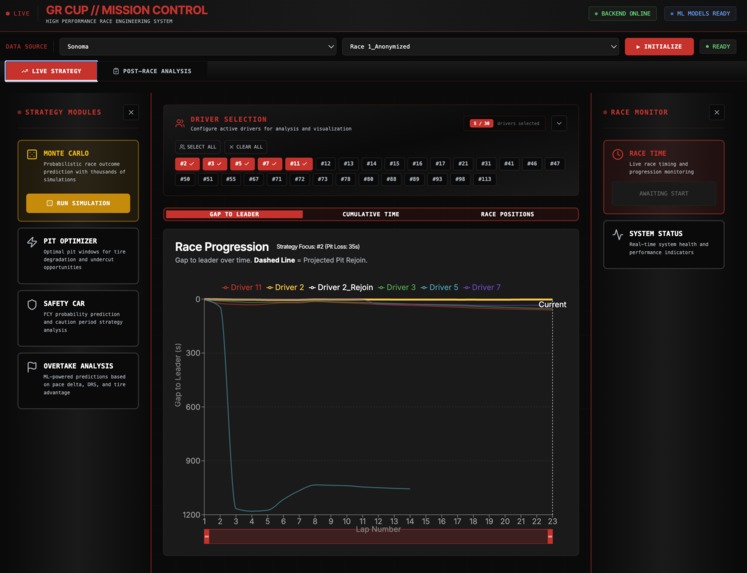
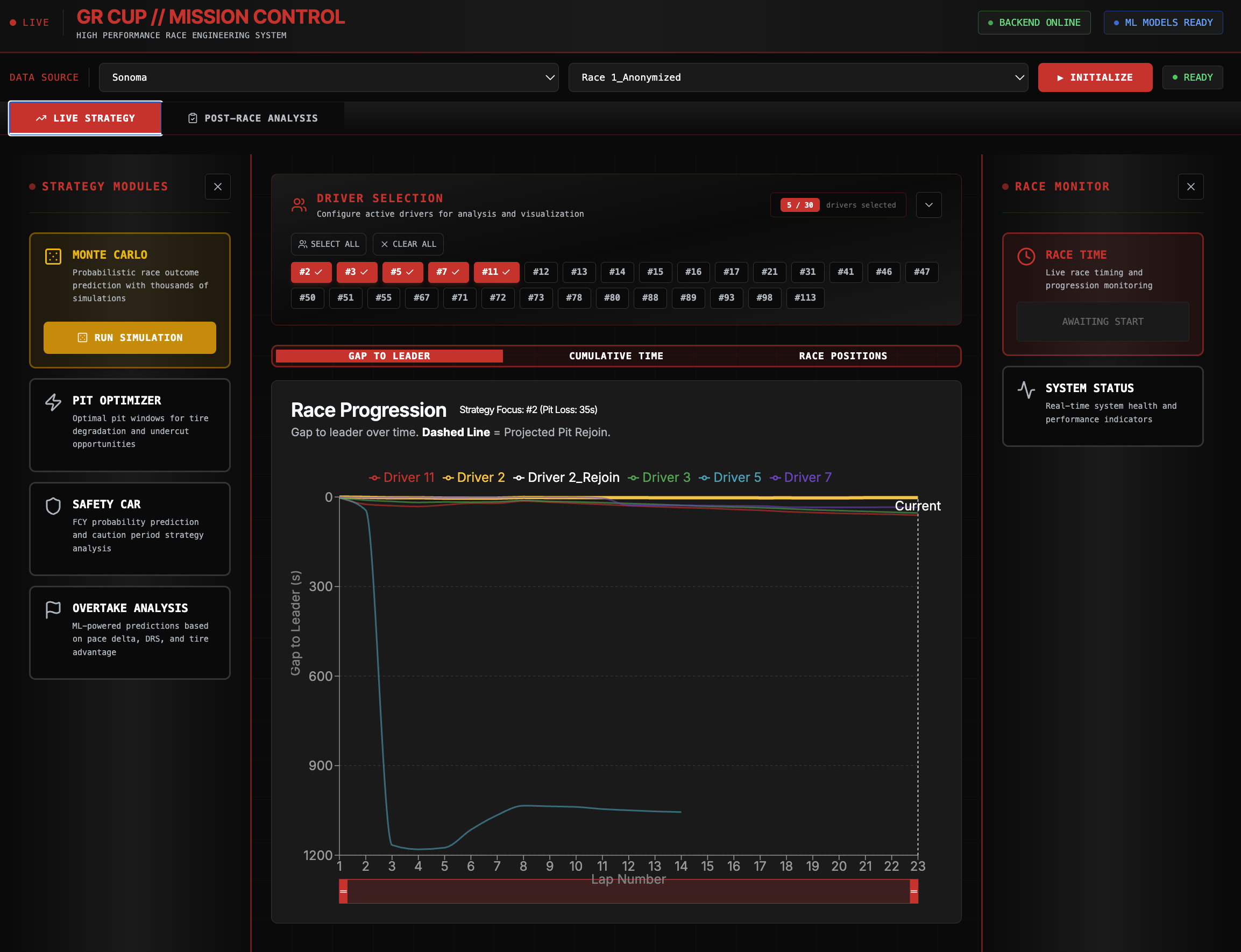
Live Strategy Page
-
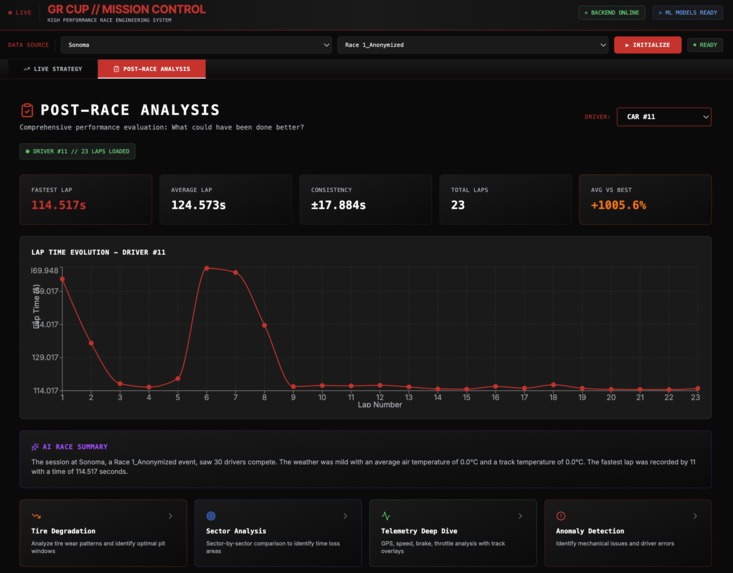
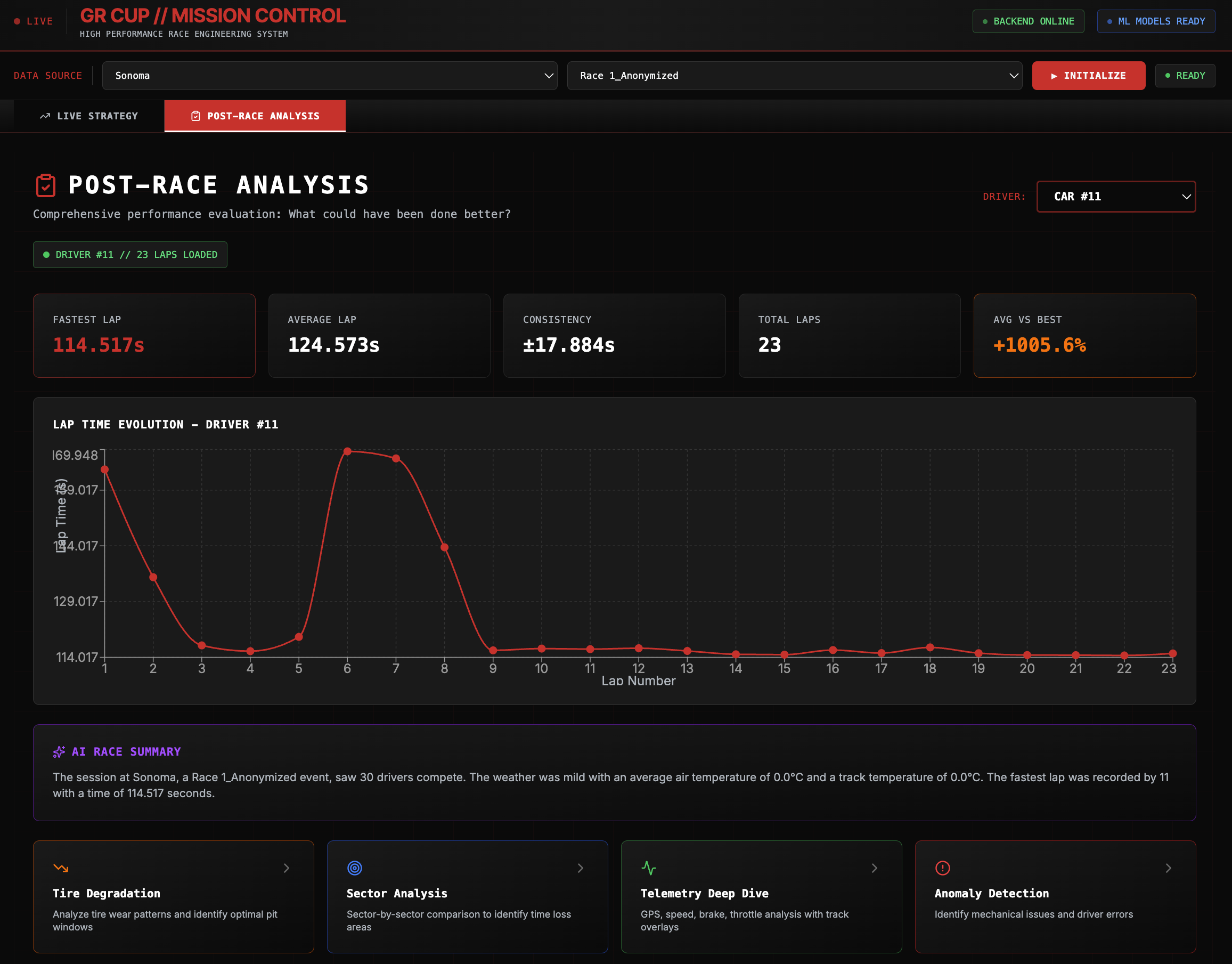
Post-Race Analysis
-
-
-
-
-
-
The Inspiration
As passionate Formula 1 fans, we've always been fascinated by the sophisticated race engineering that happens behind the scenes—real-time telemetry analysis, predictive strategy models, and AI-powered decision support. When we discovered the Hack the Track Challenge 2025 by Toyota Gazoo Racing North America, we saw an opportunity to bring this level of sophistication to grassroots motorsport.
The challenge was clear: build something that makes GR Cup teams faster and smarter. But as we explored the 30GB dataset—7 venues, 14 races, 17.7 million telemetry rows—we realized the real problem wasn't just data analysis. It was answering critical race-time questions:
- "Should I pit now or wait two more laps?"
- "Can I overtake the car ahead with this pace differential?"
- "How should I prepare for a safety car in the final third?"
These split-second decisions separate podium finishes from mid-pack results.
How We Built It
Phase 1: Data Pipeline & Architecture
We started with a robust technical foundation:
Backend: FastAPI (Python 3.11) for high-performance API endpoints Frontend: Next.js 16 + React 19 + TypeScript for a modern, responsive interface ML Stack: PyTorch, XGBoost, scikit-learn for predictive models
The first breakthrough came when we successfully ingested and normalized all 30GB of data. We built a resilient data pipeline that handled multiple CSV formats, encoding issues (UTF-8-BOM), and missing columns. By week's end, we had clean data ready for machine learning.
Phase 2: ML Algorithms & Intelligence
We deployed six specialized ML algorithms:
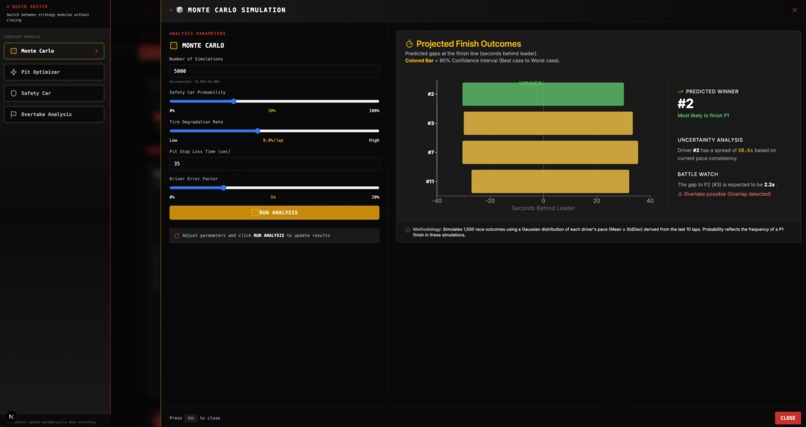
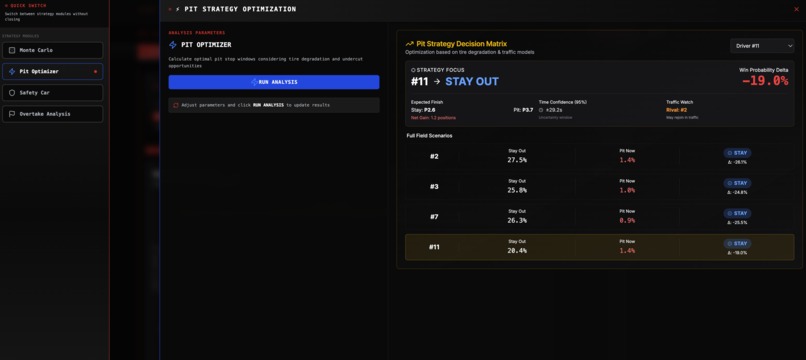
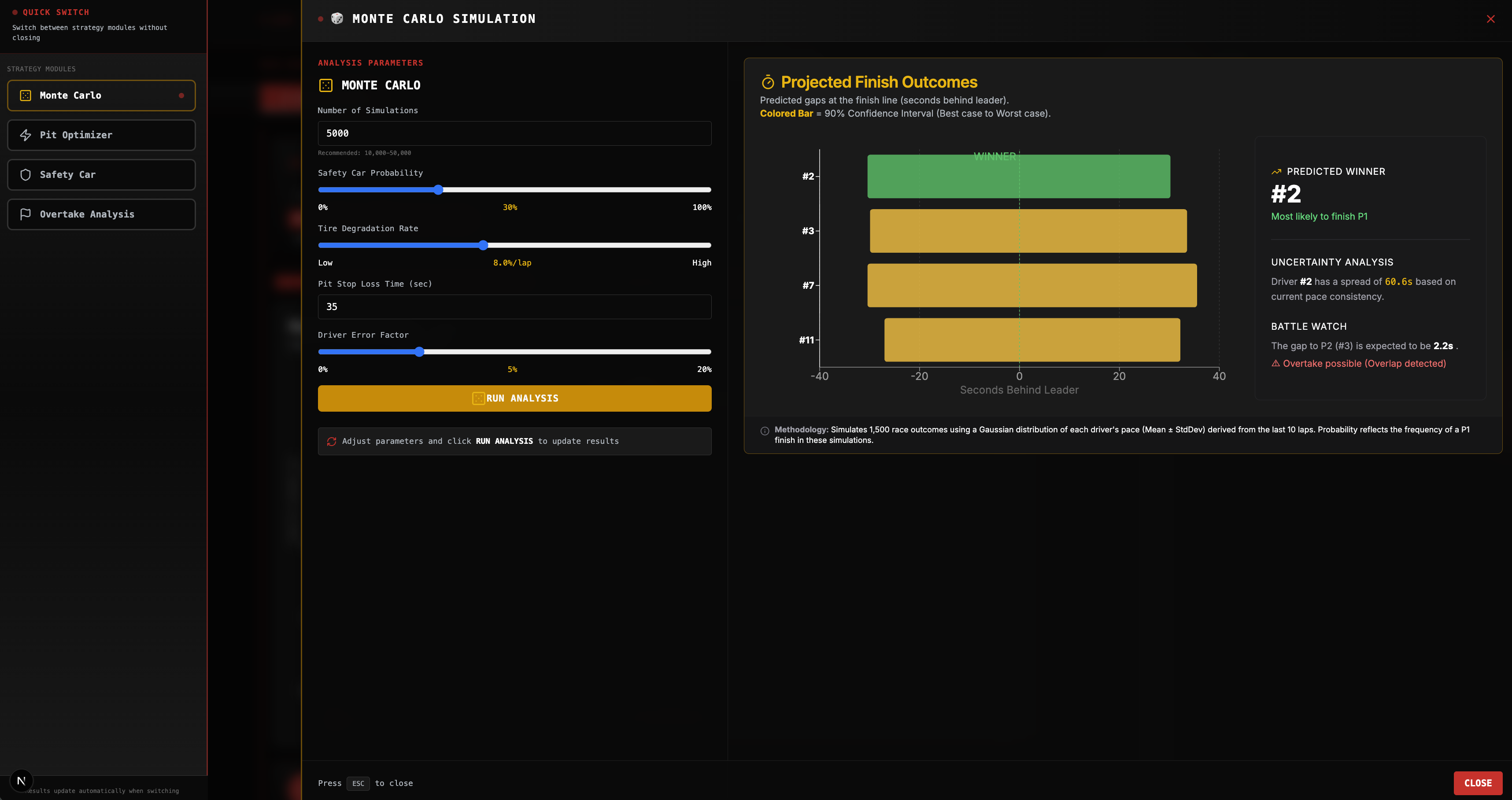
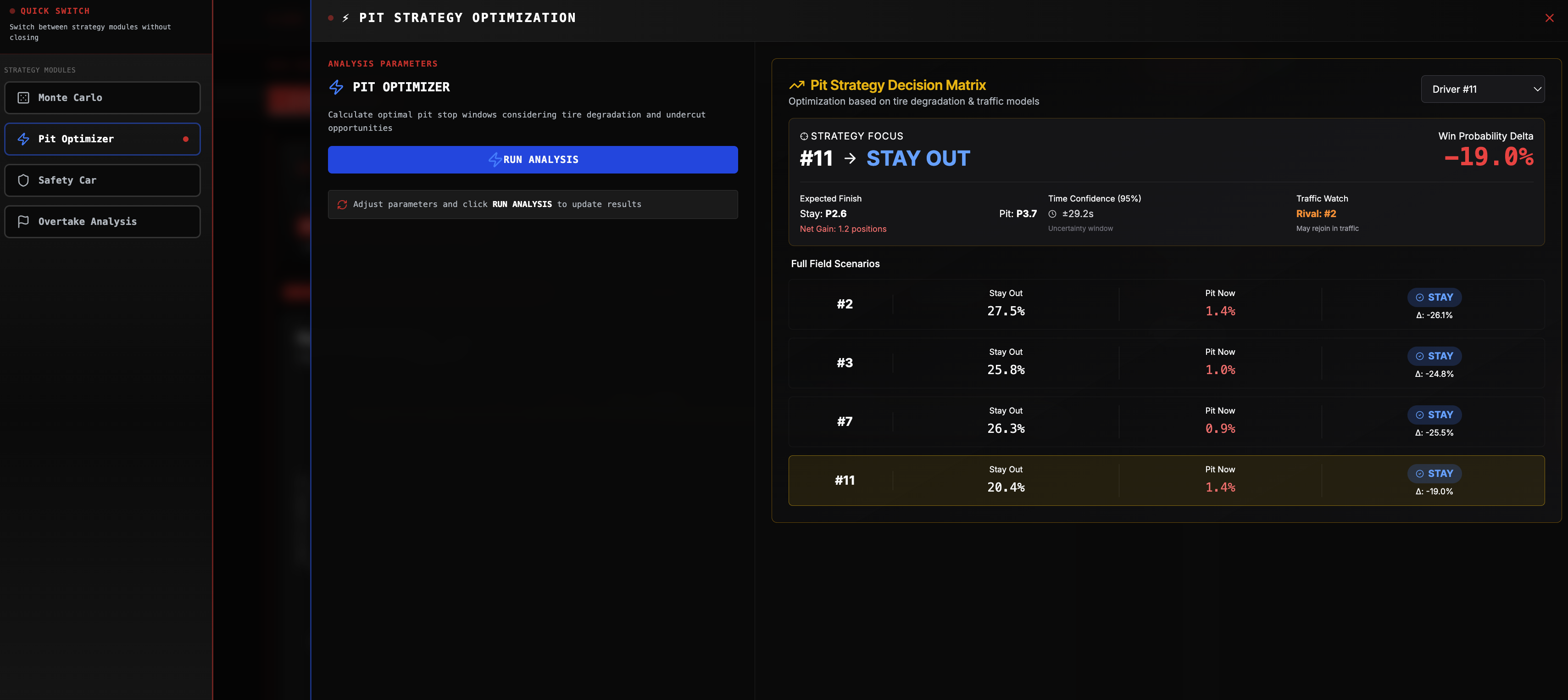
Monte Carlo Pit Optimizer - Runs 5,000 race simulations in $<$ 2 seconds
- Models pit loss: $t_{\text{pit}} = t_{\text{base}} + t_{\text{traffic}} + t_{\text{service}}$
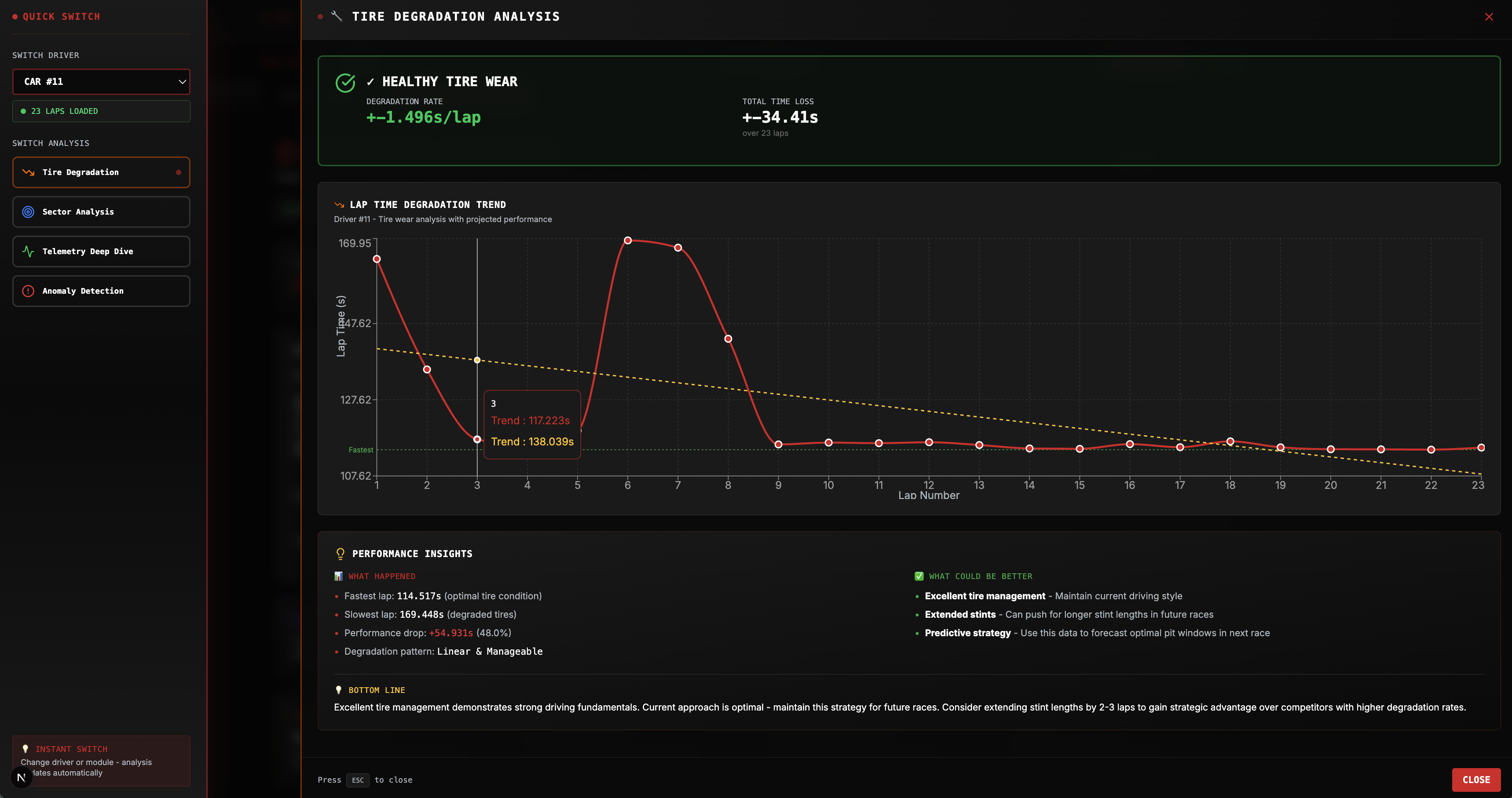
- Accounts for tire degradation: $\Delta t_{\text{lap}} = k \cdot \sqrt{n_{\text{laps}}}$
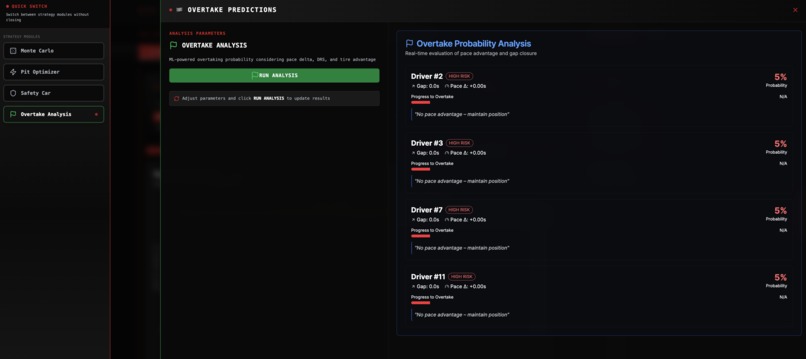
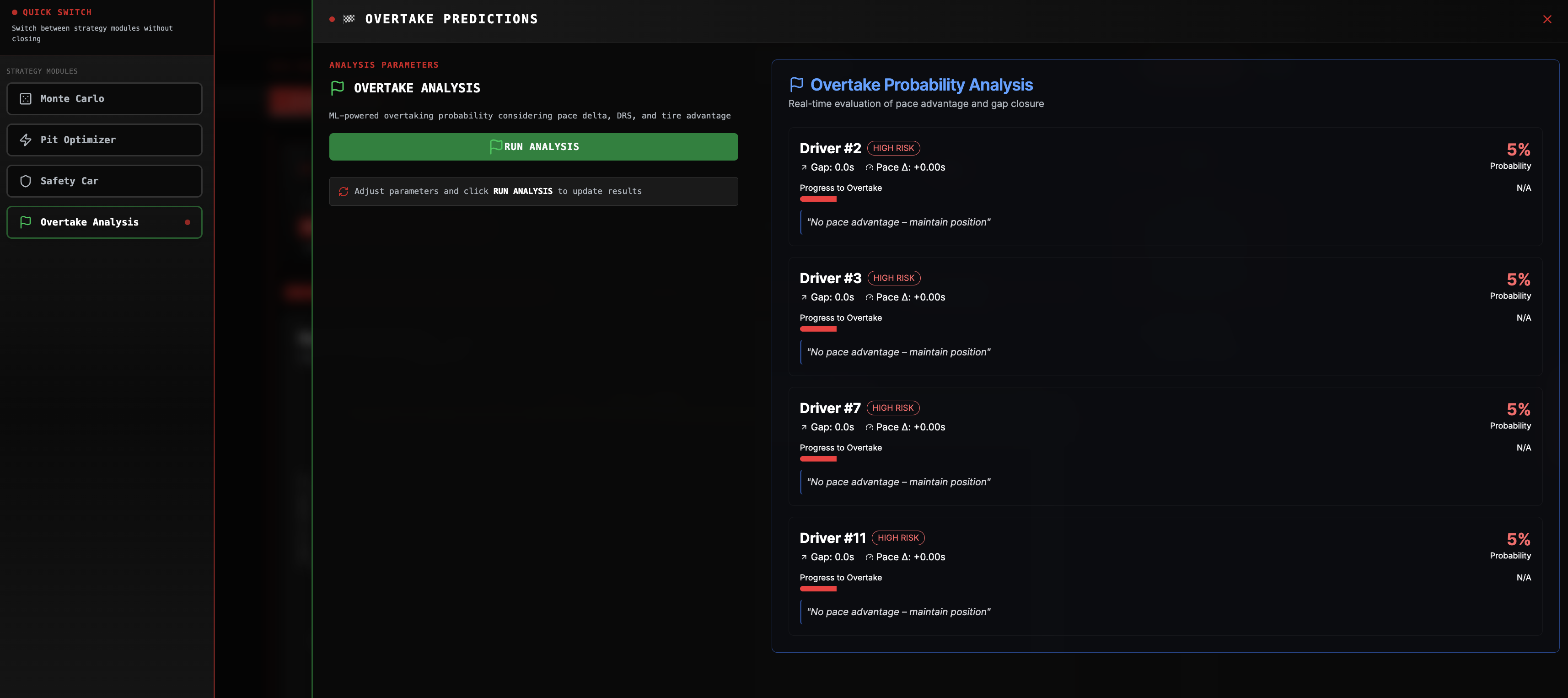
LSTM Overtake Predictor - Hybrid neural network + physics model
- Analyzes pace differential: $\Delta v = v_{\text{attacker}} - v_{\text{defender}}$
- Considers DRS zones, braking points, track characteristics
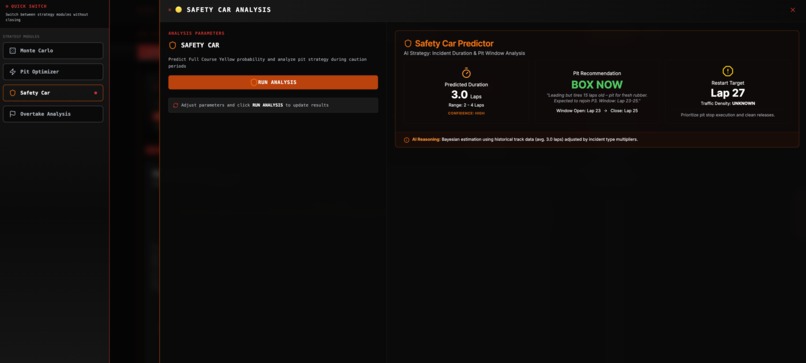
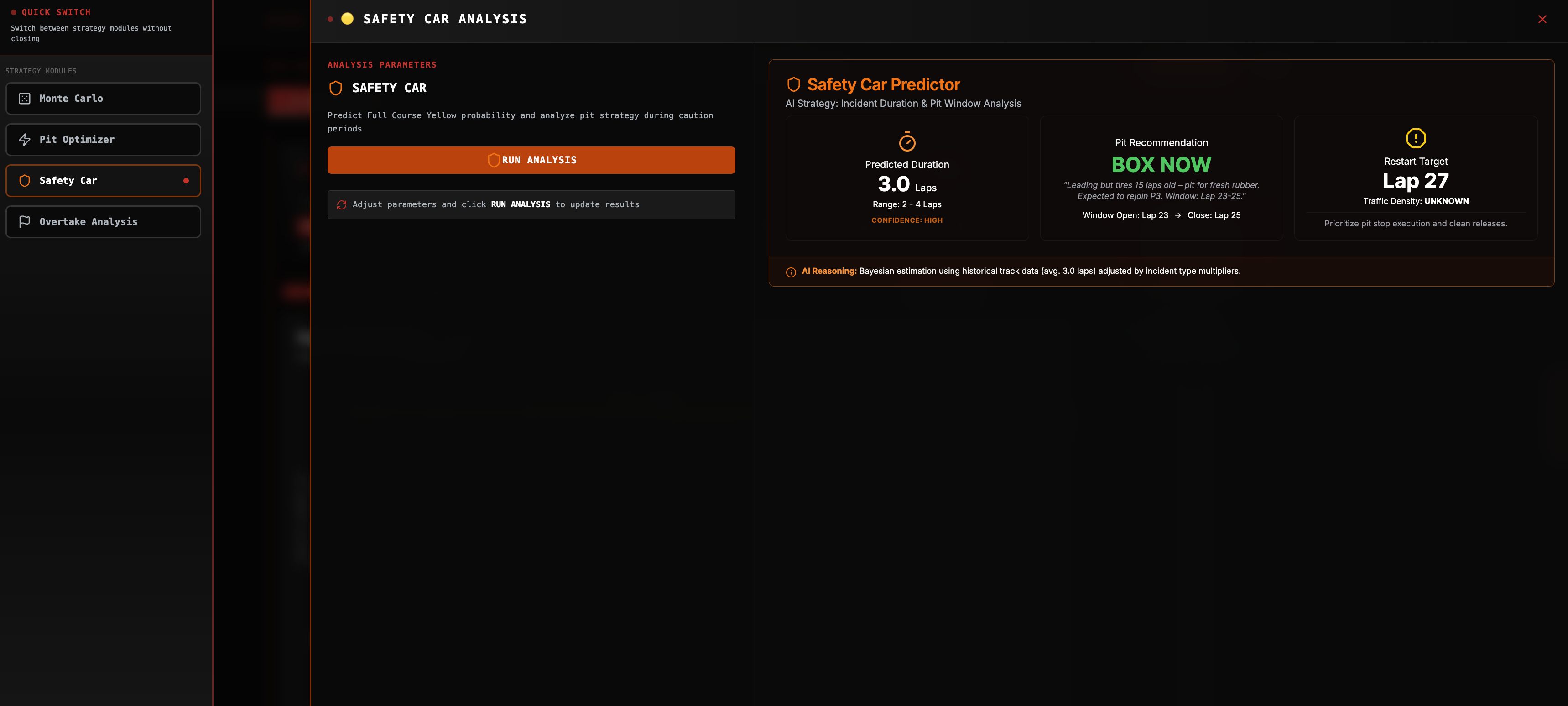
Bayesian Safety Car Predictor - Estimates FCY duration from flag patterns
Random Forest Qualifying Predictor - 98.4% accuracy on lap time forecasts
K-Means Driver Clustering - Identifies performance patterns for coaching
Isolation Forest Anomaly Detector - Flags mechanical issues early
But algorithms alone weren't enough—we needed actionable insights delivered under pressure.
Phase 3: User Interface & Experience
We designed three operational modes:
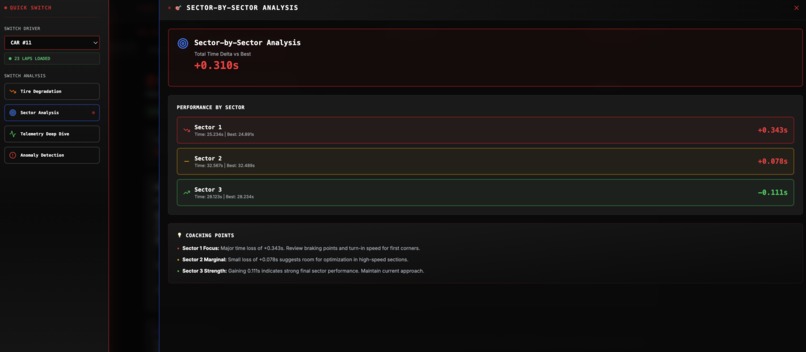
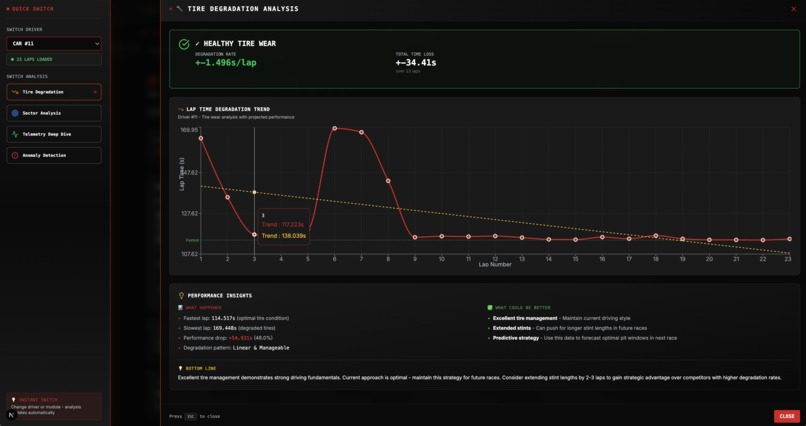
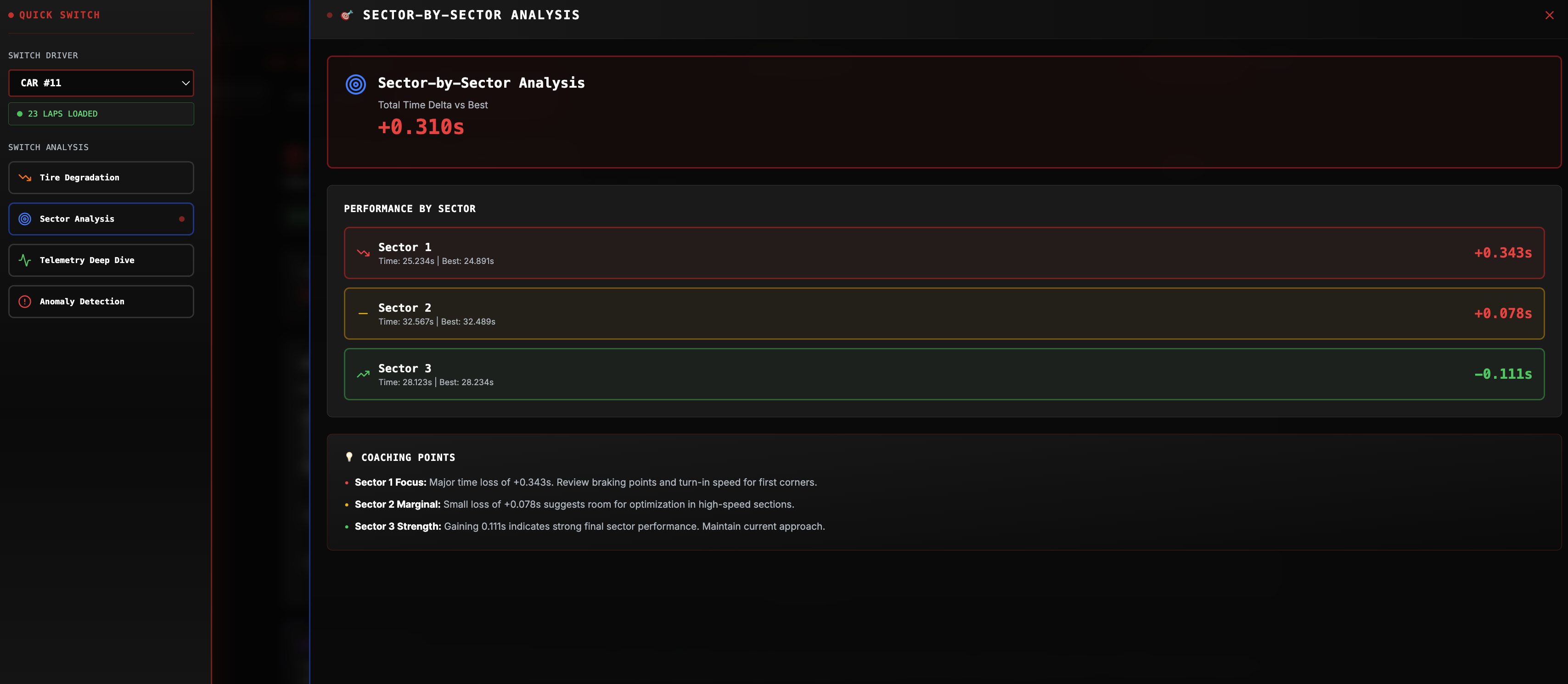
Live Strategy - Real-time Monte Carlo simulations, safety car analysis, and overtake predictions during races Driver Insights (The Oracle) - Predictive analytics and performance benchmarking Post-Race Analysis - Automated tire degradation analysis, sector breakdowns, and race summaries
The interface underwent multiple iterations optimized for pit wall environments: high contrast for outdoor visibility, large touch targets for gloved hands, information density without clutter.
Soon, we had a working platform—but not a polished product.
Phase 4: Production Polish
This is where we learned the difference between "works" and "works well."
Integration Bug Hunt: We discovered API calls hitting /api/v1/api/v1/sessions/ (duplicate prefix). Three hours of debugging and refactoring fixed all endpoints.
Health Monitoring System: Built real-time health checks (20-second polling) that verify backend status and ML model readiness. Green means go. Red means wait.
Hardcoded Values Audit: We found 507+ hardcoded values scattered across 78 files. We centralized everything into constants.ts with track-specific configurations:
- COTA: 38s pit loss (long pit lane)
- Barber: 32s (short pit lane)
- Road America: 35s (standard)
UX Refinement: Fixed race condition bug where race summaries wouldn't appear on driver changes. Implemented context tracking. Fixed modal scrolling issues.
Final Metrics:
- ✅ 11 files refactored
- ✅ 13 documentation files (~3,000 lines)
- ✅ 3 UX bugs squashed
- ✅ 60+ constants defined
- ✅ Production-ready deployment
What We Learned
1. Predictive beats descriptive Showing what happened is easy. Telling teams what's about to happen is valuable.
2. UX is not optional The best algorithm in the world is useless if race engineers can't use it under pressure. Every modal, button, and loading state matters.
3. Production-ready means production-ready Real-time health checks, centralized configuration, track-specific parameters, error handling, documentation—these aren't "nice to have," they're the difference between a demo and a product.
Challenges We Faced
Data Quality: Inconsistent column names, multiple encodings, missing values across 7 venues Solution: Built robust data loader with format auto-detection and normalization
Real-Time Performance: ML inference needed to be fast enough for live race use Solution: Optimized models, implemented caching, pre-computed track-specific parameters
UX Under Pressure: Race engineers need instant clarity, not information overload Solution: Multiple design iterations, collapsible panels, auto-generated insights
Production Readiness: Hackathon code vs. deployable product Solution: Comprehensive refactoring, health monitoring, centralized configuration
The Impact
GR Cup Digital Brain is a production-ready platform that teams can deploy today. We've processed real data from 7 venues, trained models on 17.7 million telemetry rows, and built a system that predicts pit windows, overtaking opportunities, and safety car impacts with F1-level sophistication.
But more importantly, we've proven that professional-grade race engineering can be democratized. You don't need a million-dollar budget or a team of data scientists. You just need the right tools.
The Future
We've built the foundation for something bigger:
- Live telemetry streaming - Real-time GPS, speed, and brake data during races
- Multi-team benchmarking - Compare performance across the entire grid
- Voice interface - "Hey Digital Brain, should I pit now?"
- Custom model training - Teams train AI on their own historical data
For now, we're proud of what we've built: a production-ready AI race engineer that turns data into podiums.

Log in or sign up for Devpost to join the conversation.