-
-
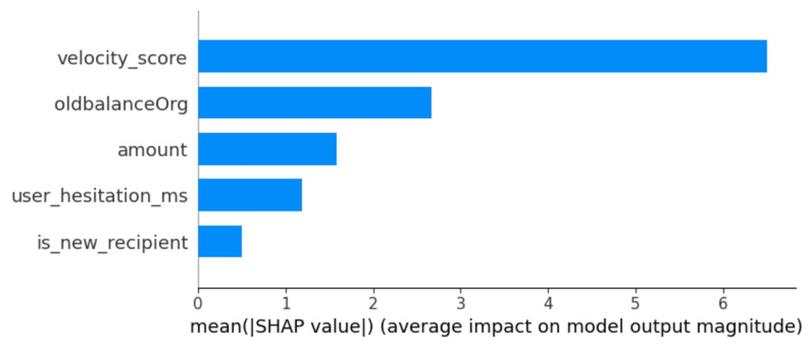
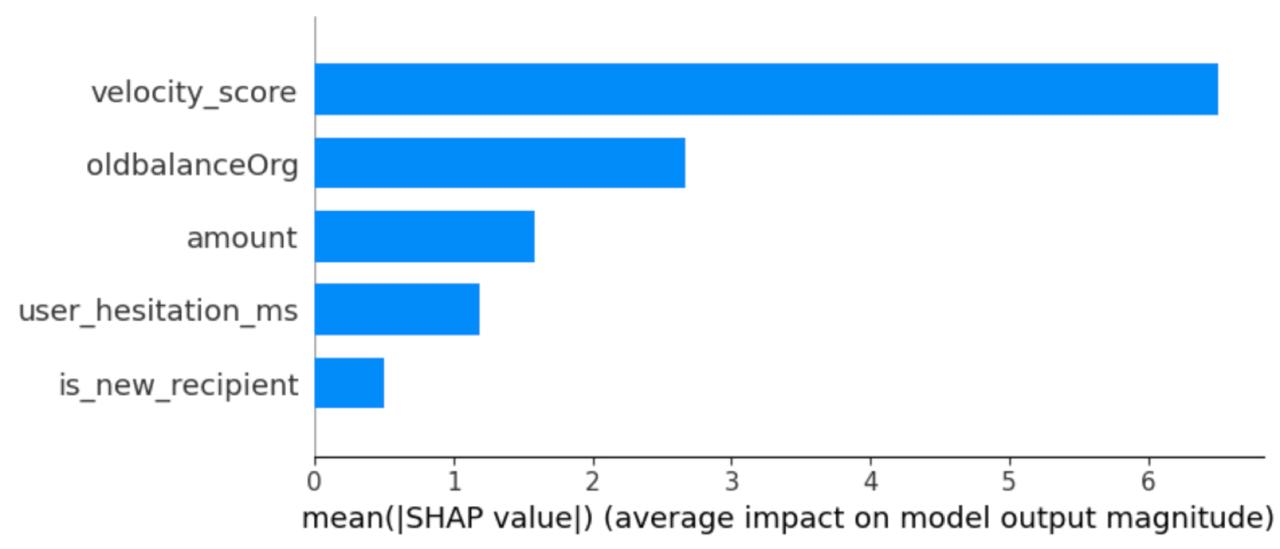
SHAP Explainability of my model (in github Repository)
-
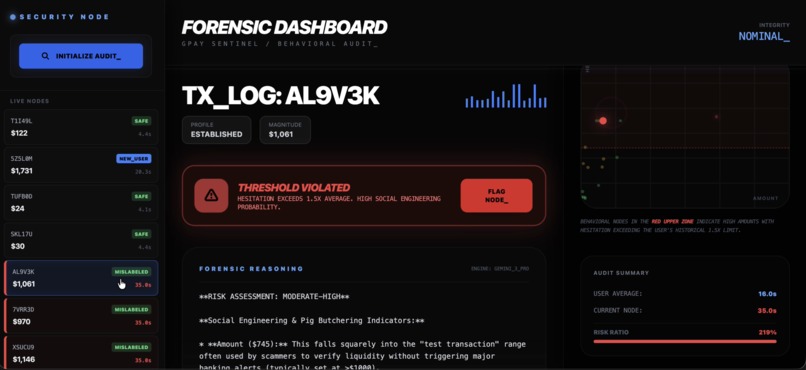
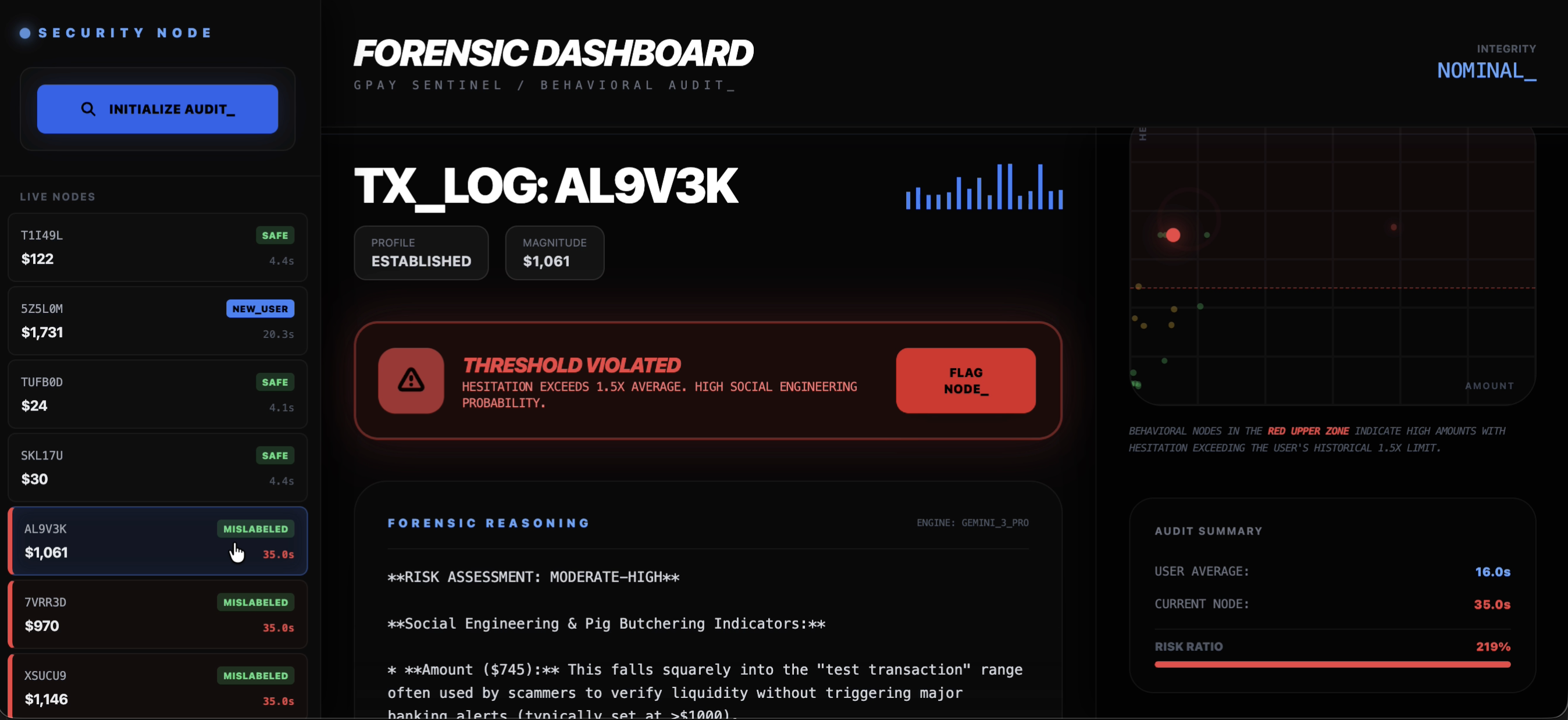
Dashboard Layout (using Google AI Studio)
Inspiration
The idea for GPay Sentinel came from seeing how easily people are manipulated by "Coached Scams." Even with the best encryption in the world, a scammer can still win just by staying on the phone with a victim and telling them what to do. As a recent Master’s graduate, I wanted to prove that we can detect these "invisible" scammers by looking at human behavior, specifically the hesitation and patterns in how we touch our screens when we are under pressure.
What it does
GPay Sentinel is an intelligent security dashboard designed to stop "coached" scams by monitoring real-time behavioral biometrics. While traditional security focuses on credentials, this system tracks user "velocity"-the speed and rhythm of a transaction to detect when a victim is being manipulated by an external fraudster. By applying a 1.5x Hesitation Rule, the app identifies significant deviations from a user's historical baseline and uses Gemini 3 Flash to generate a live "Voice Briefing" for security operators. This AI-driven audio summary explains the specific risk patterns detected, such as coaching or social engineering, while a Hybrid Edge-to-Cloud architecture ensures the system remains fully operational locally even if cloud connectivity is limited.
How I built it
I built a Security Operator Dashboard that acts as a second pair of eyes for GPay. The Behavioral Engine: I used a machine learning model (XGBoost) to track how fast a user usually completes a transaction. The 1.5x Rule: If a user suddenly becomes 1.5 times slower than their normal speed, the dashboard flags it in bright red. This "Hesitation Spike" is a classic sign of someone being coached by a scammer on another device. Gemini 3 Flash: I used Gemini as the "Expert Auditor." It takes the data and turns it into a spoken briefing. Instead of an operator reading boring logs, they hear the AI say: "Warning: User is hesitating. This looks like a coaching scam."
Challenges I ran into
The Overfitting Challenge & The "Model Swap" During the development of the core behavioral engine, I faced a significant technical hurdle: Overfitting. My initial XGBoost model, trained on a limited dataset of simulated transaction logs, achieved near-perfect accuracy on training data but struggled to generalize to new, "noisy" user behaviors. It was essentially memorizing specific patterns rather than understanding the underlying psychology of hesitation. To solve this, I pivoted from relying purely on a "rigid" machine learning model to a Heuristic-AI Hybrid. I simplified the core logic to the 1.5x Hesitation Rule; a robust, statistically-backed threshold, and used Gemini 3 Flash to handle the nuance. This allowed the system to be flexible enough to handle real-world "noise" while staying incredibly accurate at spotting the specific stress signatures of a coached scam.
Accomplishments that I'm proud of
I am incredibly proud of developing the "1.5x Hesitation Rule," a simple yet powerful behavioral metric that can distinguish between a routine payment and a high-stress "coached" scam. Successfully integrating Gemini 3 Flash to turn cold, raw transaction data into a natural-language Voice Briefing was a major win; it transforms the operator experience from staring at spreadsheets to receiving active intelligence. Finally, I’m proud of building a Hybrid Reasoning system at the eleventh hour-turning a technical limitation (API quotas) into a professional "Edge Mode" feature that ensures the app never crashes during a critical security audit.
What we learned
This project was a deep dive into the reality of Production-Grade AI. I learned that while a model might perform well in a notebook, real-world deployment requires handling latency, rate limits, and "noisy" human data. I also learned the importance of Resilient Design; building a fallback layer taught me that a great engineer doesn't just build for the "happy path" where everything works, but also for the "failure path" where the API is down. Most importantly, I learned how to translate a theoretical concept into a functional, user-centric tool for the GPay ecosystem.
What's next for Gpay Sentinel
Beyond multimodal biometrics and tremors, the roadmap for GPay Sentinel includes several key expansions: Environmental Context: Using ambient light sensors or microphone "noise signatures" (locally processed) to detect if the user is in a high-stress environment, like a busy public space or being shouted at, which are common tactics used by scammers to rush victims. Collaborative Fraud Intelligence: Creating a "Trusted Contact" loop. If a high-risk alert is triggered, GPay Sentinel could automatically ping a pre-approved trusted family member to "Verify" the transaction, adding a human layer of protection that scammers can't bypass. Adversarial AI Training: As scammers start using AI to generate more realistic "coaching," I want to use Generative Adversarial Networks (GANs) to simulate new scam patterns. This will allow the Sentinel model to stay one step ahead of evolving social engineering tactics.

Log in or sign up for Devpost to join the conversation.