Inspiration
While reviewing government scholarship schemes, we noticed a recurring problem:
many students are technically eligible but still get rejected due to misunderstood rules, missing clauses, or document-level mismatches.
Government portals usually answer “Am I eligible?” but rarely explain “Why?” or “What can still go wrong?”.
This gap often leads to trial-and-error applications, delayed benefits, or permanent rejection—especially for first-generation applicants.
This project was built to bridge that gap by making government rules clear, executable, and explainable.
What it does
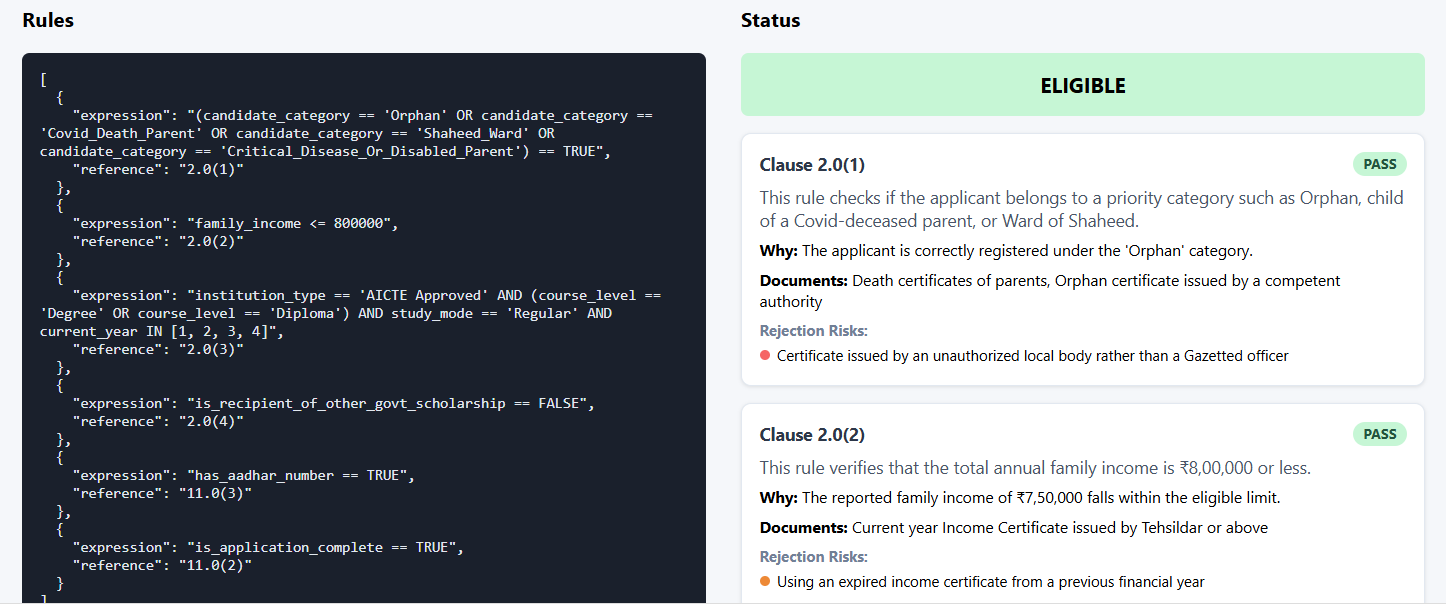
GovRulex is an explainable eligibility and rejection-risk auditor for government scholarships.
It:
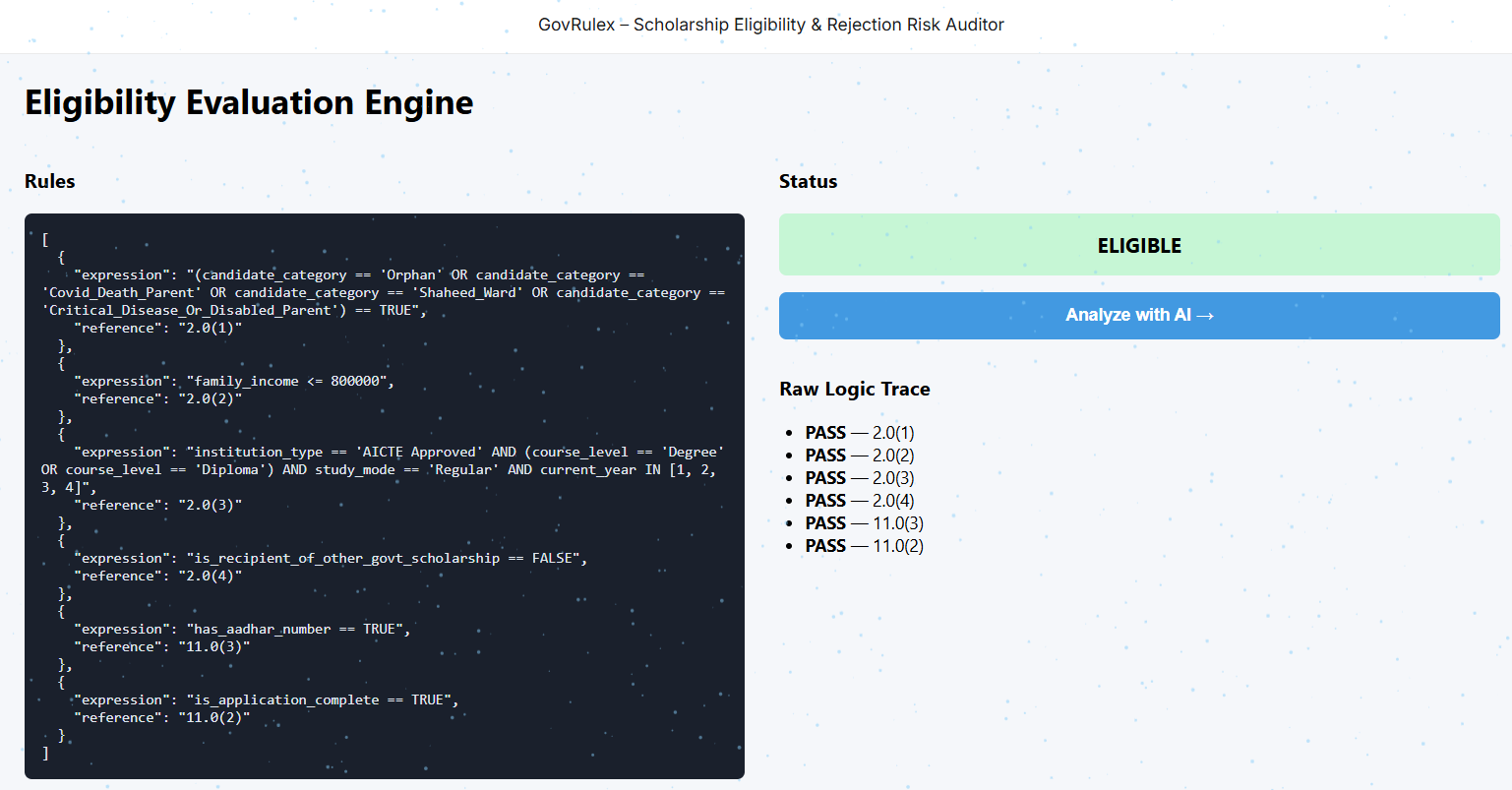
- Converts official policy clauses into deterministic boolean rules
- Evaluates eligibility at clause level (PASS / FAIL)
- Explains why a rule passed or failed in simple language
- Lists required documents for each clause
- Highlights real-world rejection risks such as document validity, wording issues, or verification mismatches
- References exact clause numbers from official guidelines
Instead of only showing ELIGIBLE or NOT ELIGIBLE, GovRulex helps applicants understand how to apply correctly the first time.
How we built it
The system is designed in three clear layers:
1. Rule Engine (Deterministic Core)
Government guidelines are translated into executable boolean expressions that strictly evaluate user inputs.
2. Evaluation Layer
Each clause is independently evaluated as PASS or FAIL, and overall eligibility is derived purely from rule outcomes.
3. Explainability & Risk Layer (AI-assisted)
AI is used only after evaluation to:
- Explain outcomes in simple language
- Surface common rejection risks tied to each clause
- Maintain strict separation from eligibility logic
This architecture ensures correctness, transparency, and trust.
Gemini Integration
GovRulex uses Gemini 3 as a controlled explainability layer, not as a decision-maker.
After the deterministic rule engine evaluates eligibility, Gemini 3 is invoked to enrich the results with human-readable metadata. The application passes Gemini the already-computed PASS/FAIL outcomes, clause references, and user inputs, along with strict system instructions that prohibit recomputation or rule alteration.
Gemini 3 is used to:
- Generate concise explanations of what each clause checks
- Explain why a specific user passed or failed a rule
- Identify common real-world rejection risks related to document validity, wording, or verification issues
- Produce structured JSON output consumed directly by the UI
Importantly, Gemini does not determine eligibility. All eligibility decisions are computed deterministically before Gemini is called. This design prevents hallucination, ensures auditability, and aligns with governance-grade reliability requirements.
By using Gemini 3 purely for explainability and risk surfacing, GovRulex combines the strengths of deterministic systems with the accessibility of AI-driven natural language explanations.
Challenges we ran into
- Translating ambiguous policy language into unambiguous executable logic
- Preventing false negatives caused by naive string parsing or condition ordering
- Designing explainability without providing legal or advisory guidance
- Balancing AI assistance with deterministic correctness and auditability
Each challenge reinforced the need for engineering rigor over conversational shortcuts.
Accomplishments that we're proud of
- Built a clause-level eligibility engine instead of a generic chatbot
- Achieved deterministic, explainable outcomes with zero eligibility hallucination
- Identified real-world rejection risks often missed by applicants
- Designed a system that complements existing government portals rather than replacing them
What we learned
- Many eligibility failures are procedural, not logical
- Deterministic systems build more trust than conversational ones in governance use cases
- AI is most effective as an explainer, not a decision-maker, in public policy
- Clause-level transparency significantly improves user confidence and accuracy
What's next for GovRulex – Scholarship Eligibility & Rejection Risk Auditor
- Extend support to additional scholarship and welfare schemes
- Improve document-level validation and checklist guidance
- Add multilingual explainability for wider accessibility
- Explore integrations with educational institutions and help centers
The long-term goal is to reduce preventable rejections and make public welfare systems more accessible and transparent.
Source of Rules & Policy Reference
The eligibility rules implemented in this prototype are derived directly from official government guidelines.
- Scheme: AICTE – SWANATH SCHOLARSHIP SCHEME FOR STUDENTS (NSP)
- Official Guideline (PDF):
AICTE SWANATH Scholarship Scheme Guidelines – NSP - Official Scholarship Portal:
National Scholarship Portal – All Scholarships
Each rule in GovRulex references the exact clause number from the guideline to ensure traceability, correctness, and auditability.
The system does not reinterpret policy; it executes the rules as written and explains outcomes post-evaluation.
Note: The demo is hosted on Google AI Studio. First-time viewers may be prompted to sign in with a Google account and grant standard AI Studio access before viewing the app.

Log in or sign up for Devpost to join the conversation.