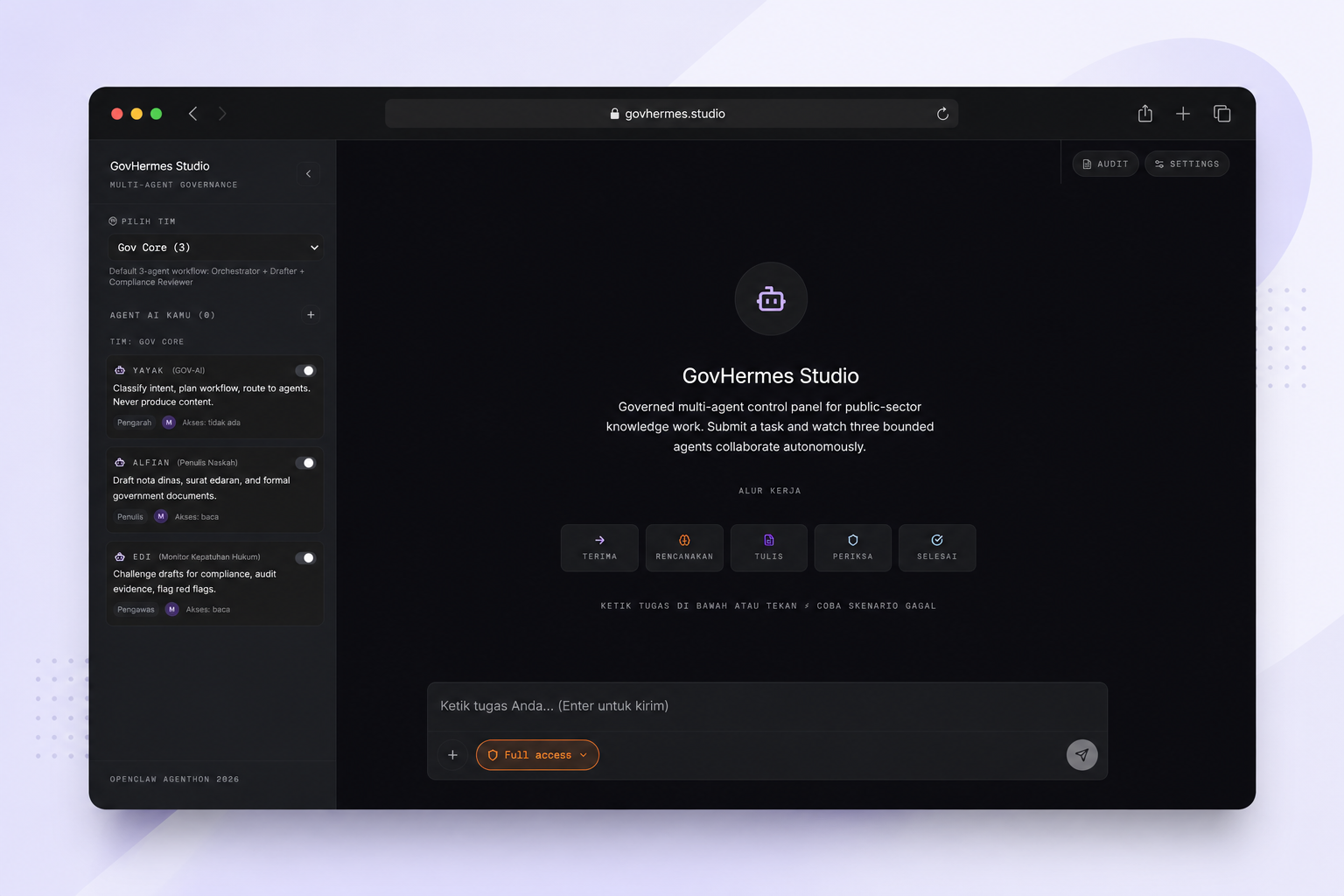
GovHermes, What is this?
Government teams deal with a lot of routine work like drafting internal memos, preparing coordination requests, checking compliance risks, and turning discussion points into actionable follow-ups. Most AI tools can help write faster, but they usually stop at chat. They do not show who did what, what source was used, who approved the result, or why a draft should be trusted.
We built GovHermes because we wanted to explore a better model for public-sector AI work not just a chatbot, but a governed multi-agent system with clear roles, visible boundaries, and an audit trail. The idea was simple, one request goes in, then a team of agents handles planning, drafting, reviewing, and finalizing in a way that feels structured enough for government workflows.
What it does?
GovHermes is a governed multi-agent workspace for routine government knowledge work.
A user submits a task, such as drafting a short nota dinas for a coordination meeting. The system then routes that request through three bounded agents:
- an Orchestrator that plans the workflow,
- a Document Drafter that prepares the draft using knowledge base references,
- and a Compliance Reviewer that checks risks, assumptions, and completeness before approval.
The product makes the whole workflow visible. Users can see the plan, the handoff between agents, the tool events, the final artifact, and the audit trail tied to a trace ID. If the reviewer finds missing information or compliance issues, the workflow can stop and block the final output instead of pretending everything is fine.
How we built it?
We designed GovHermes as a lightweight but convincing demo for the OpenClaw Agenthon. The product direction focused on one strong workflow instead of a broad platform.
On the product side, we defined a single hero scenario around drafting a government-style memo, reviewing compliance risk, and producing action items. We turned that into a structured artifact covering the brief, PRD, user stories, user flow, and formal requirements.
On the system side, we shaped the experience around a clear multi-agent contract:
- the Orchestrator plans and routes only,
- the Drafter reads from a small local knowledge base before writing,
- the Reviewer can approve or block the result,
- and every important action is recorded in an audit log.
For the interface, we pushed the design toward a document-first command center rather than a generic SaaS dashboard. The layout was kept clean, single-column, and restrained so the story reads more like a serious institutional tool than a flashy landing page.
Challenges we ran into
The hardest challenge was not writing copy or designing screens. It was making the concept feel genuinely agentic instead of just dressed-up chat.
We had to be strict about boundaries. If the Orchestrator can also generate content, the whole governance story becomes weak. If the Reviewer cannot block a workflow, then the “multi-agent” setup is mostly theater. That forced us to think carefully about authority, workflow states, and what should happen when a run fails or gets blocked.
Another challenge was balancing hackathon speed with product clarity. In a short build window, it is tempting to make something that looks impressive on the surface. We chose to spend more effort on the system contract, auditability, and workflow logic, because that is what makes the idea credible.
Accomplishments that we're proud of We are proud that GovHermes does not position itself as “AI that writes documents faster” and stop there. The stronger idea is that it turns routine public-sector work into a governed workflow with visible planning, drafting, review, and traceability.
We are also proud of the product framing. The project now has:
- a clear hero workflow,
- a defined three-agent architecture,
- a spec-aware product artifact,
- and a stronger story for autonomy, compliance, and real-world deployability.
Built With
- amazon-kiro
- framer-motion
- hermes-agent-api
- next.js
- react
- tailwind-css
- typescript
- vitest

Log in or sign up for Devpost to join the conversation.