Inspiration
Government circulars are often lengthy, complex, and written in formal language that is difficult for students, employees, and citizens to quickly understand. Many people miss important deadlines and policy updates simply because the information is not easily digestible. We wanted to build a solution that simplifies official communication and makes governance more accessible to everyone.
What it does
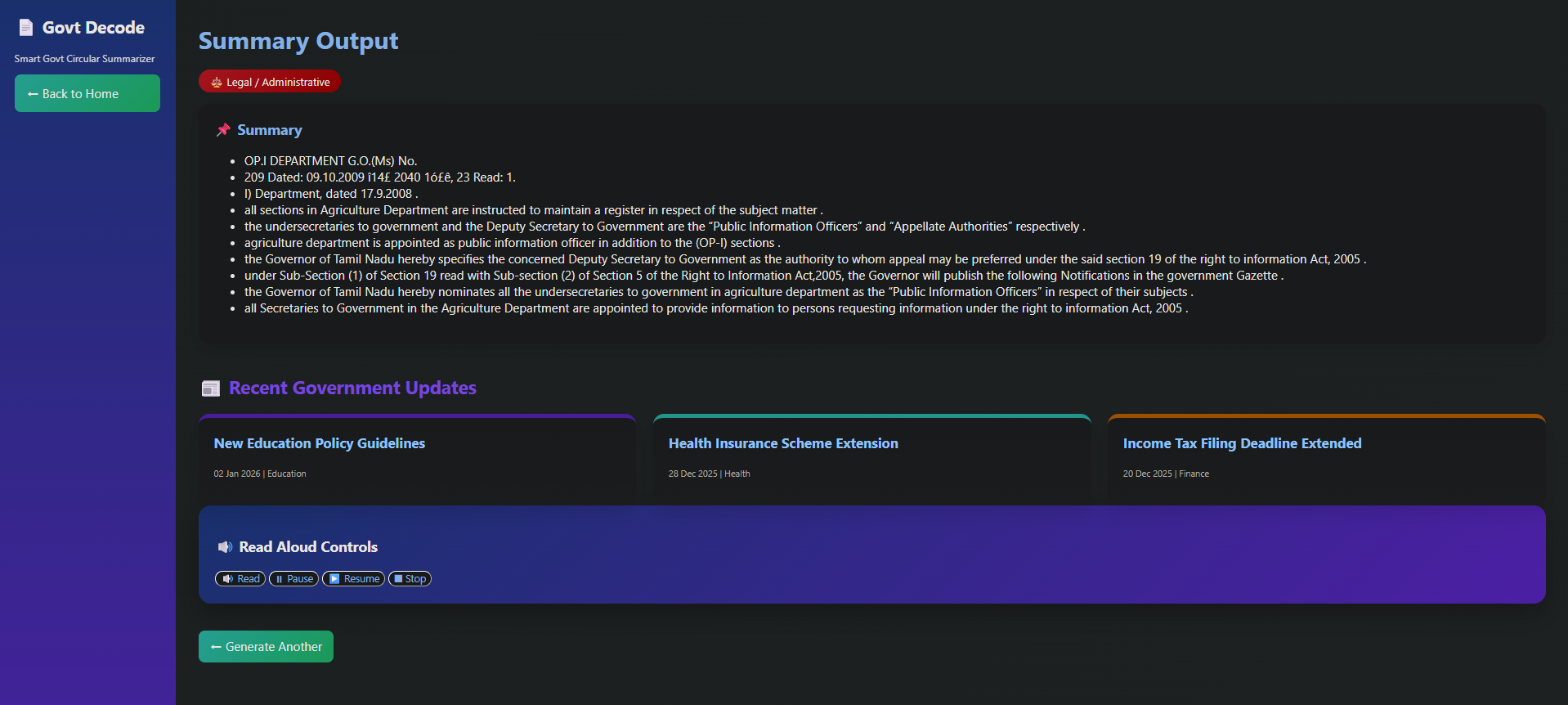
Government Circular Summarizer is an AI-powered application that converts lengthy government circulars into concise, structured summaries. Users can upload PDFs or paste text and choose between short, medium, or long summaries. The system extracts key points such as important dates, deadlines, eligibility criteria, and major announcements. It also categorizes circulars (Education, Finance, Health, etc.) and can provide text-to-speech for better accessibility.
How we built it
We built the system using Python for backend processing and Natural Language Processing techniques for summarization. Transformer-based models were used to generate accurate summaries. PDF parsing tools were integrated to extract text from uploaded documents. The frontend was developed using HTML, CSS, and JavaScript (or React) to provide a simple and user-friendly interface. The application connects the frontend and backend using APIs for seamless data flow.
Challenges we ran into
One of the main challenges was handling long and unstructured government documents. Some circulars contained scanned images instead of selectable text, requiring OCR integration. Maintaining summary accuracy without losing important legal details was another challenge. We also worked on improving date detection and highlighting key information effectively.
Accomplishments that we're proud of
We successfully built a system that can summarize complex government documents into clear, structured formats. The application reduces reading time significantly while maintaining essential information. We are proud of implementing multi-length summaries, automatic date highlighting, and category classification in a single platform.
What we learned
Through this project, we learned how transformer models work in real-world applications. We improved our understanding of NLP pipelines, text preprocessing, and PDF handling. We also learned the importance of user-centric design when building solutions meant for public use.
What's next for Government Circular Summarizer
In the future, we plan to add multilingual support for regional languages, improve summarization accuracy using fine-tuned models, and deploy the system as a mobile application. We also aim to integrate real-time government portal scraping to automatically fetch and summarize newly released circulars.

Log in or sign up for Devpost to join the conversation.