-
-
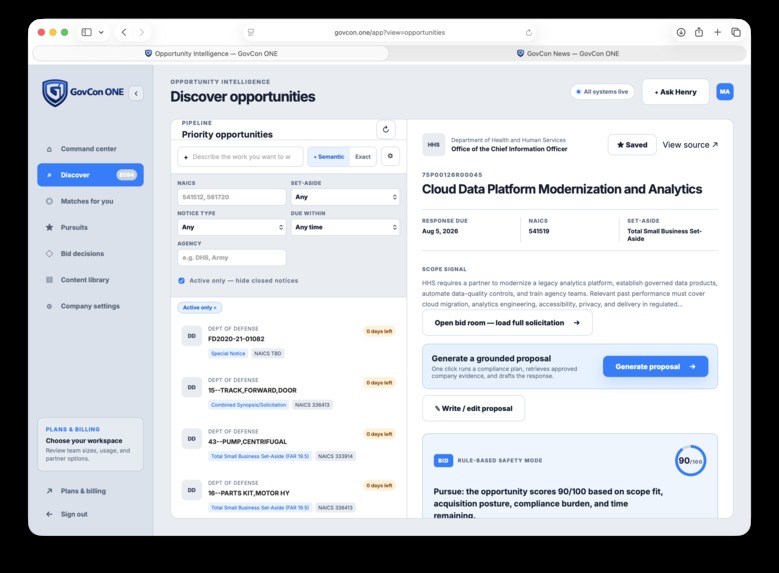
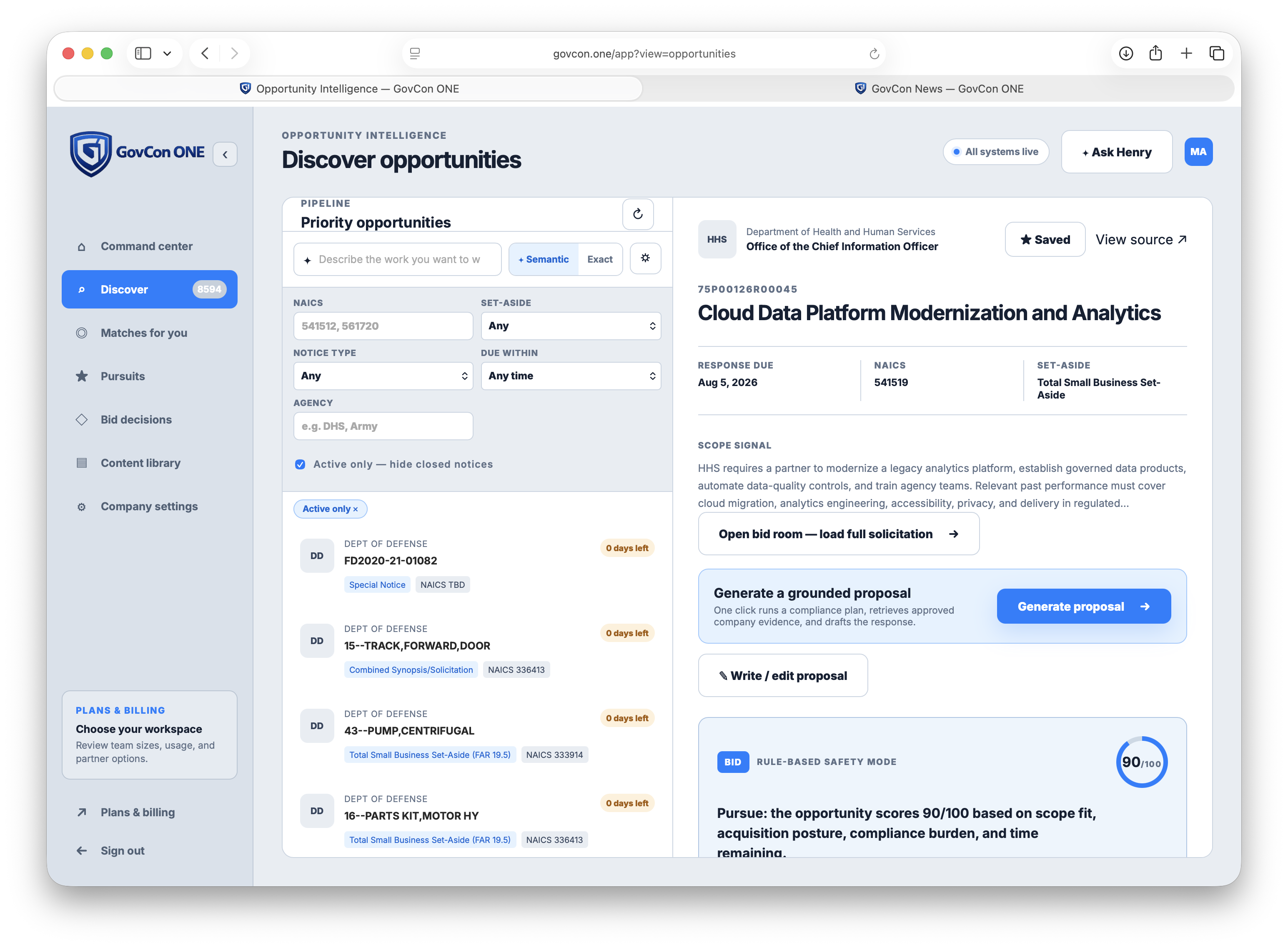
sam.gov style opportunity search + semantic search
-
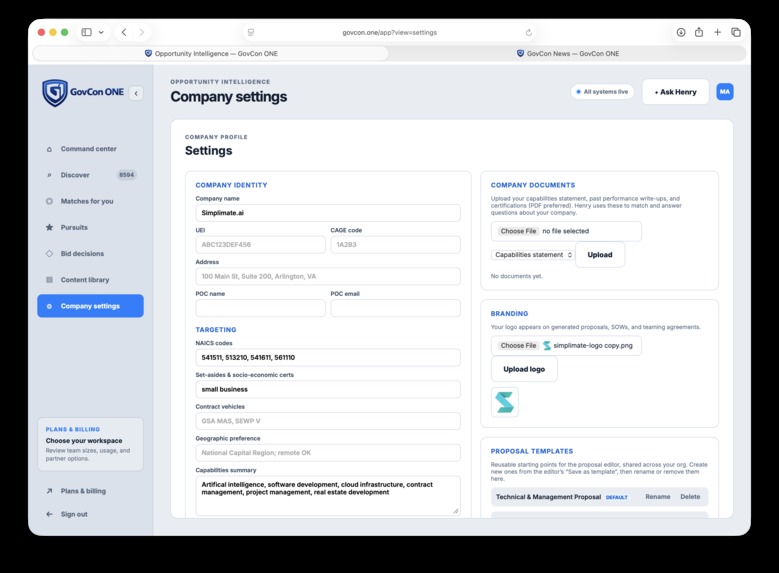
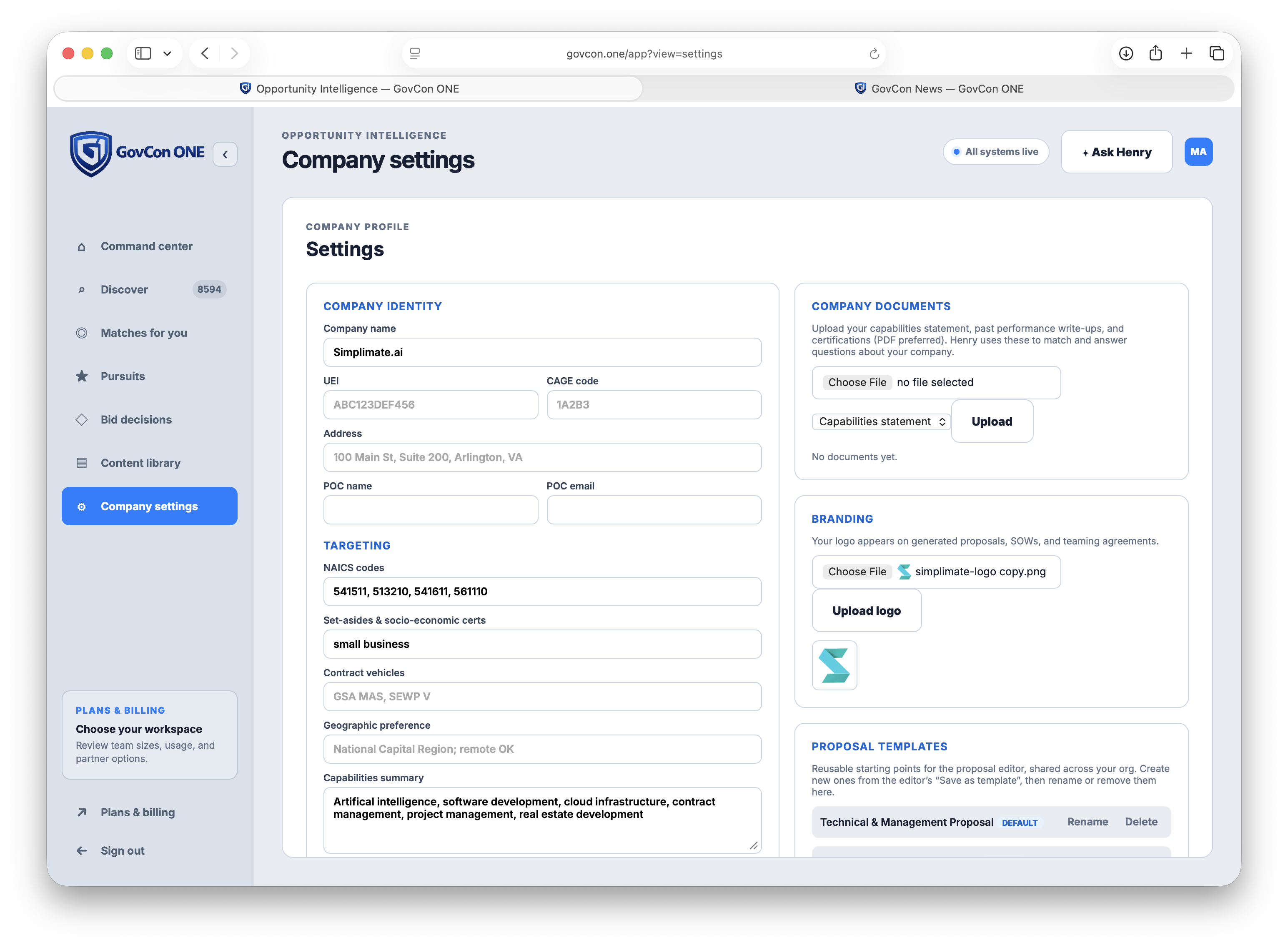
set company settings to auto-matched with opportunities
-
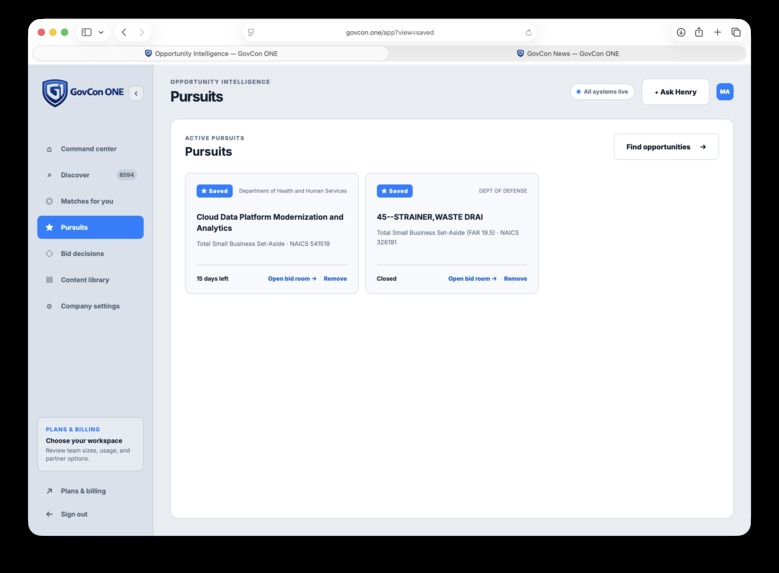
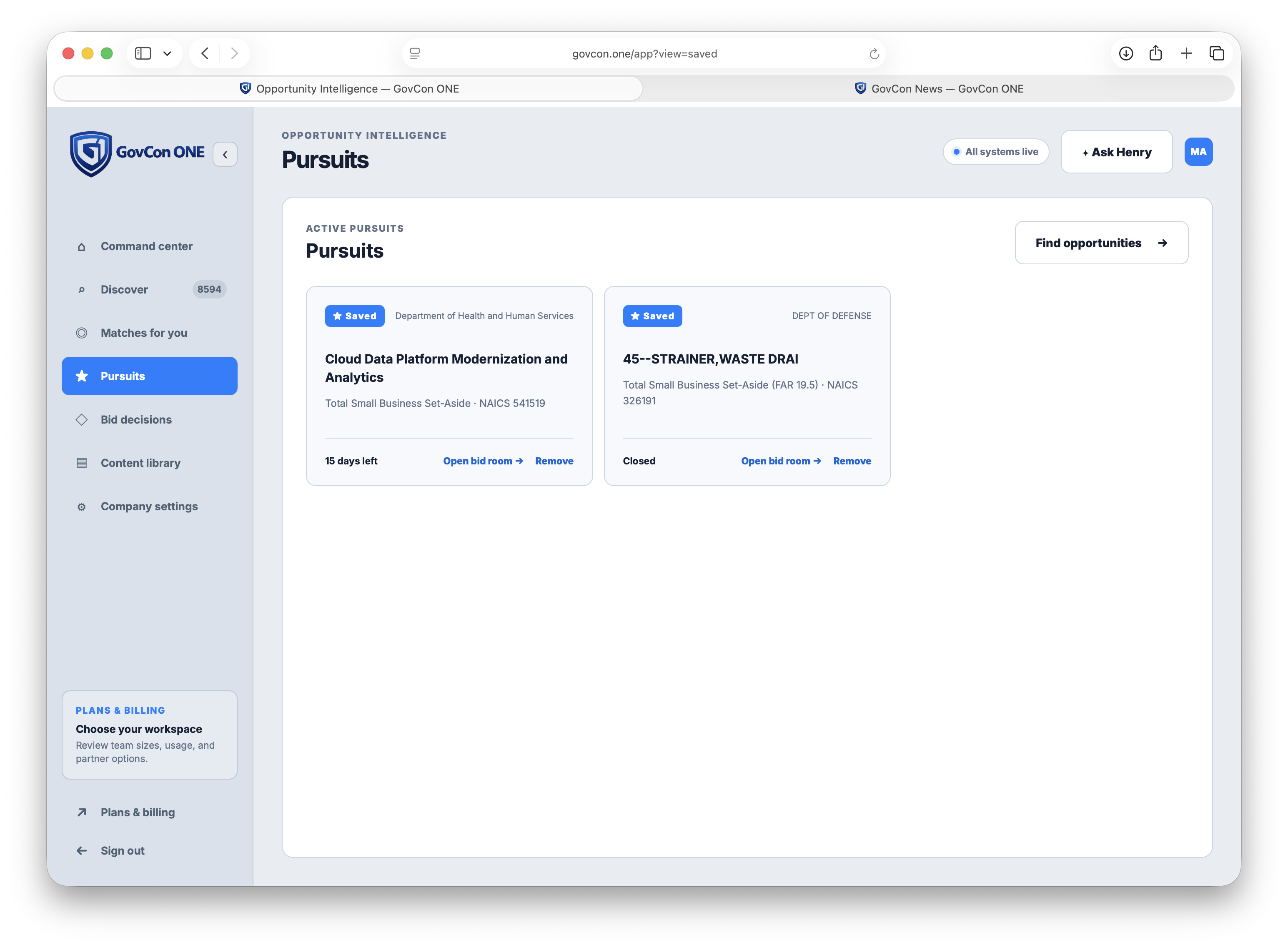
save opportunities without having to download tons of docs to your local machine
-
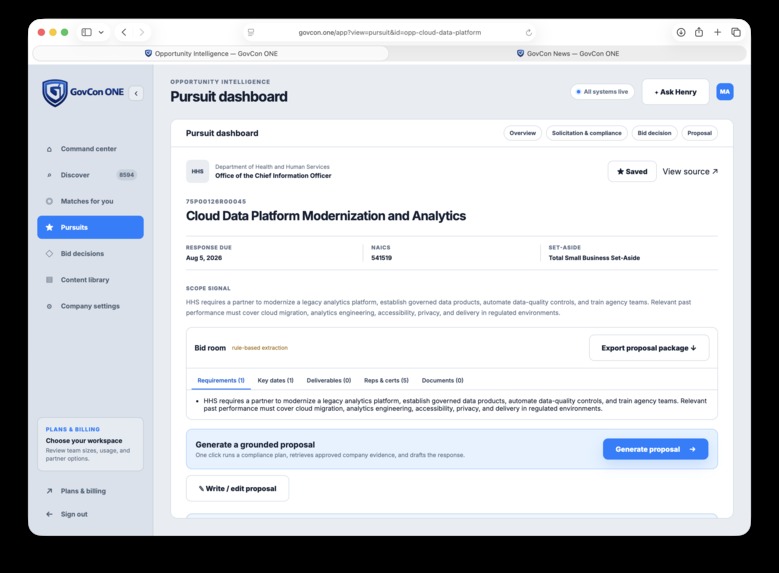
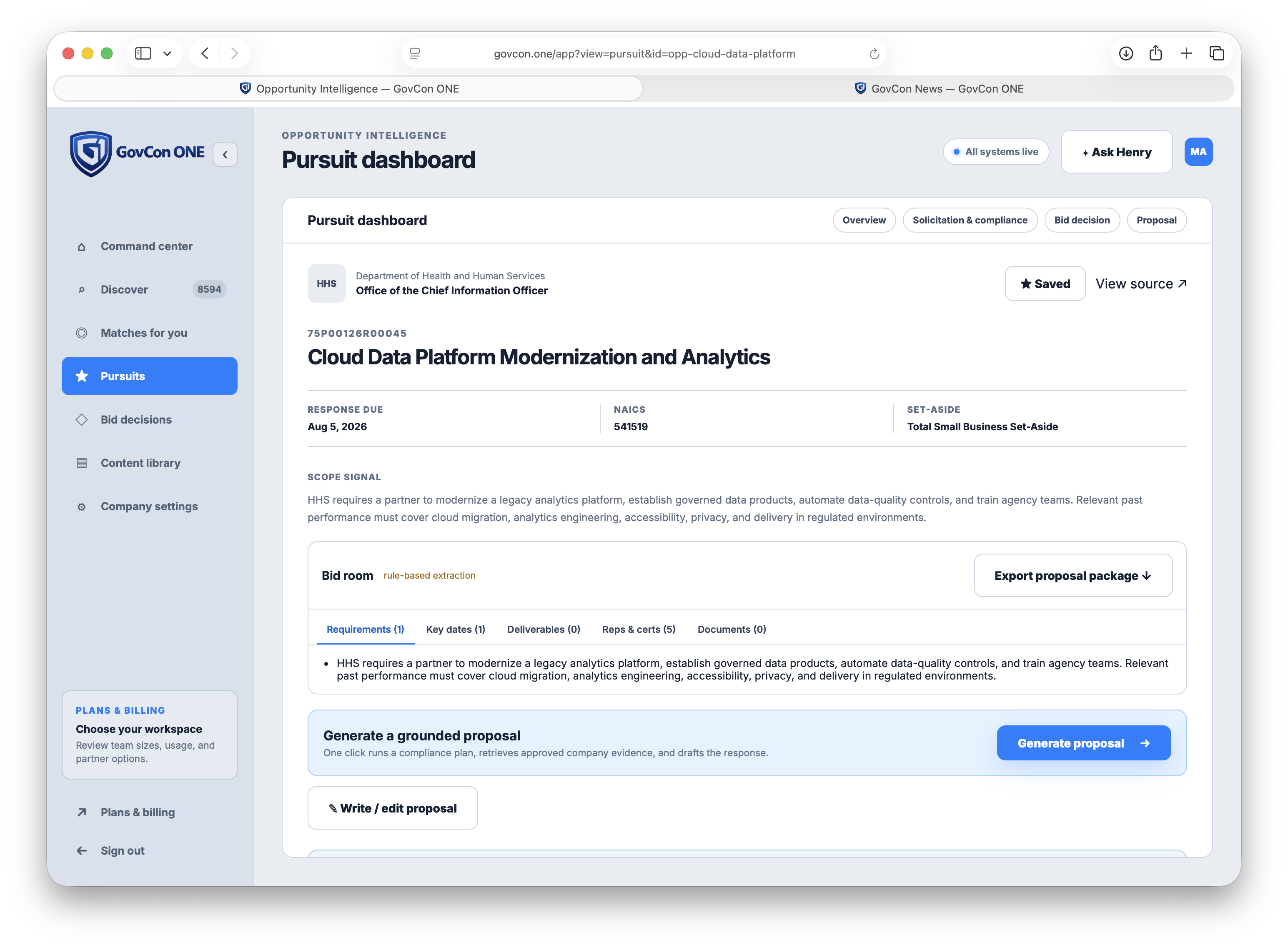
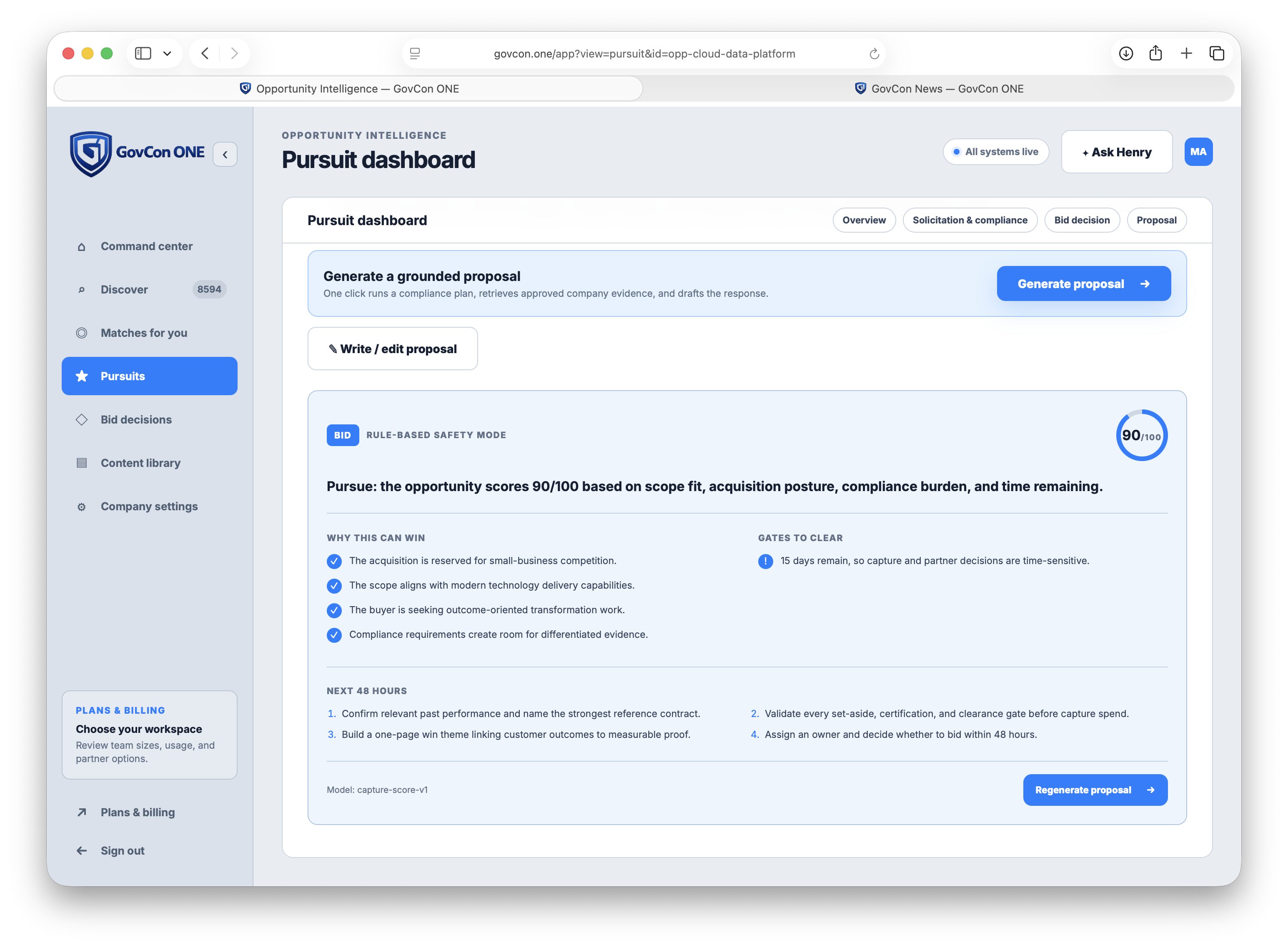
quickly acertain if a solicitation is worth your time/energy to even read, generate a compliant proposal skeleton based on the indiviual req
-
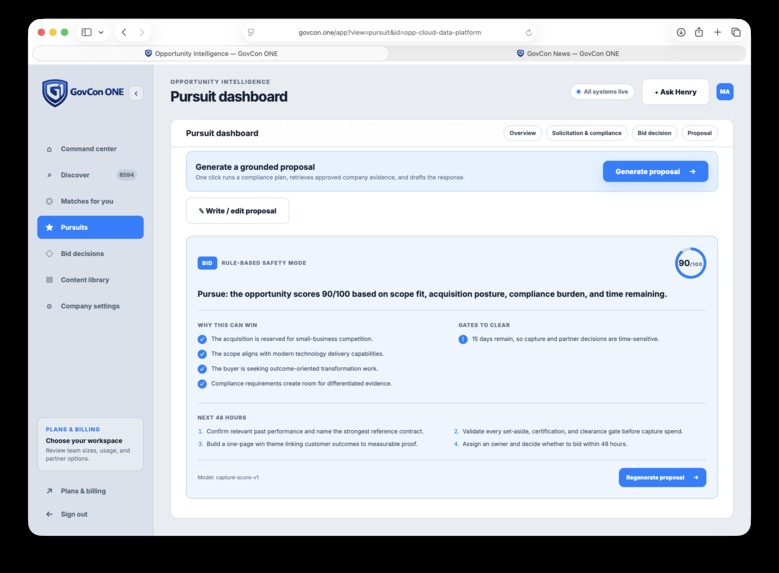
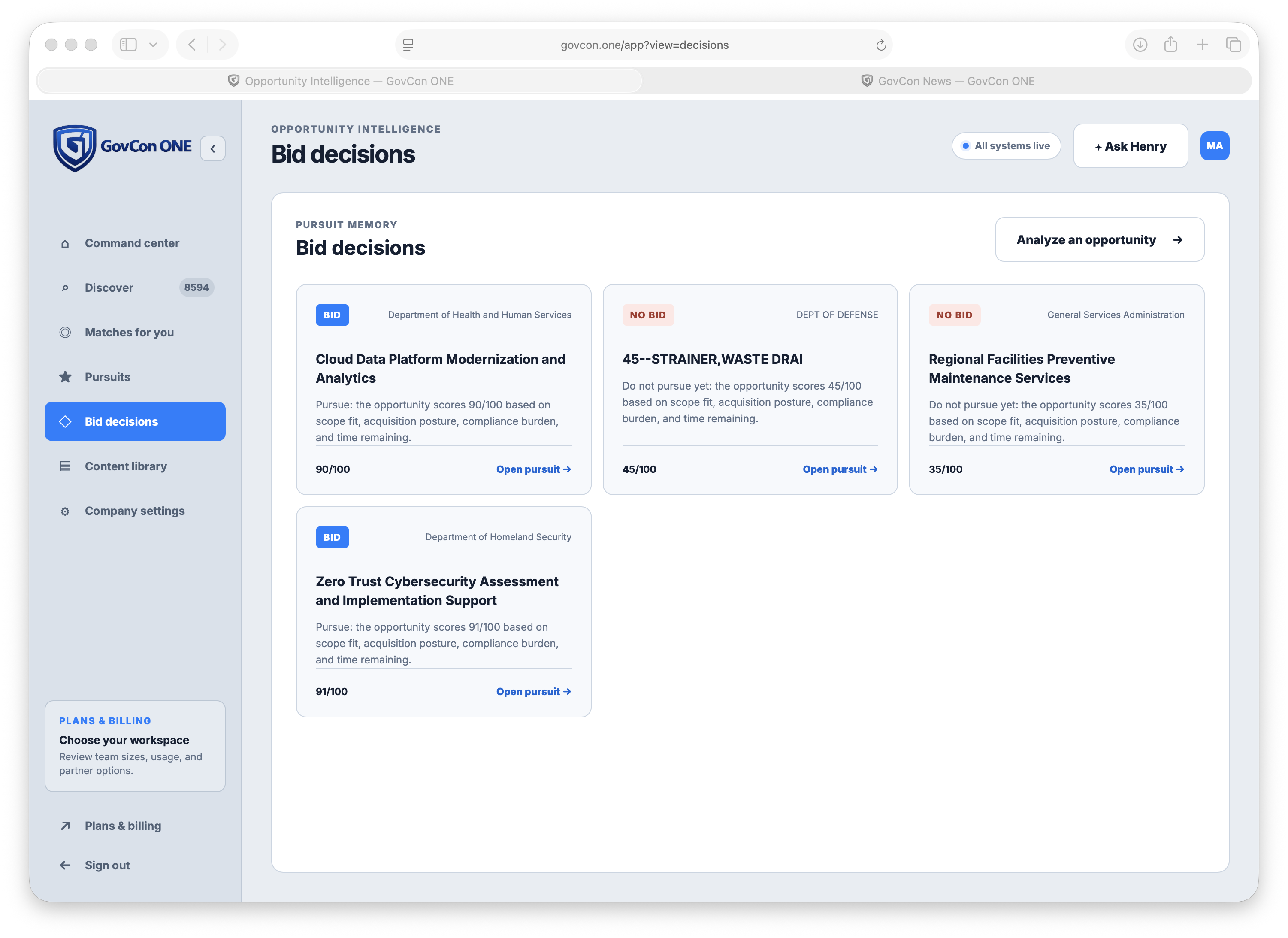
AI based bid/no bid decision module with rule based fallback, and rationale
-
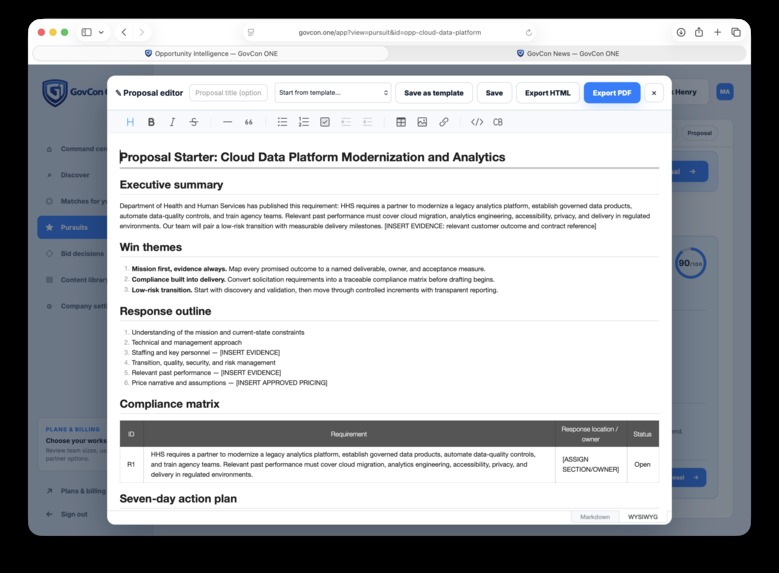
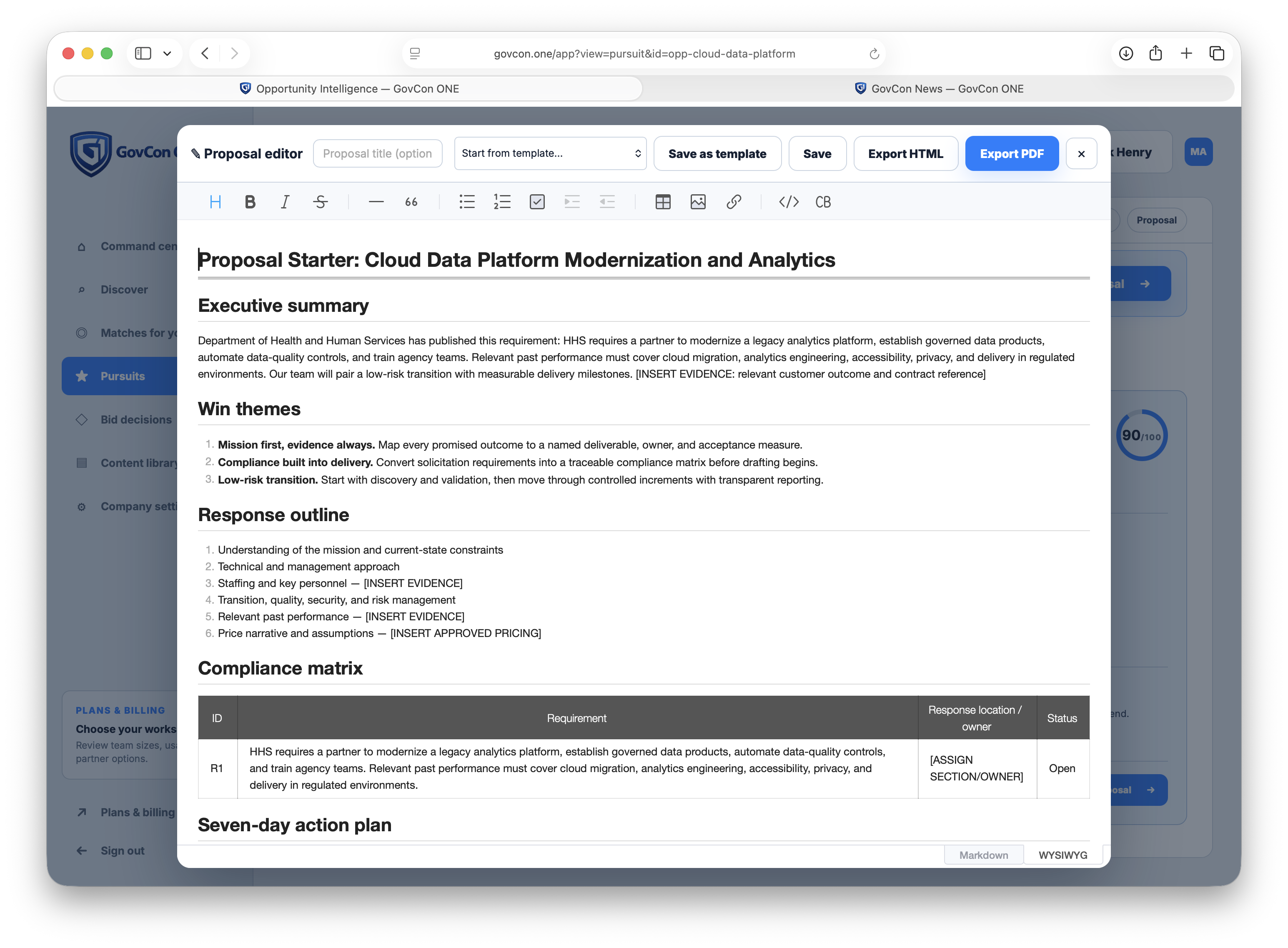
wysiwyg and markdown editor to build proposal, future release will one-shot proposal build after all reqs are met
-
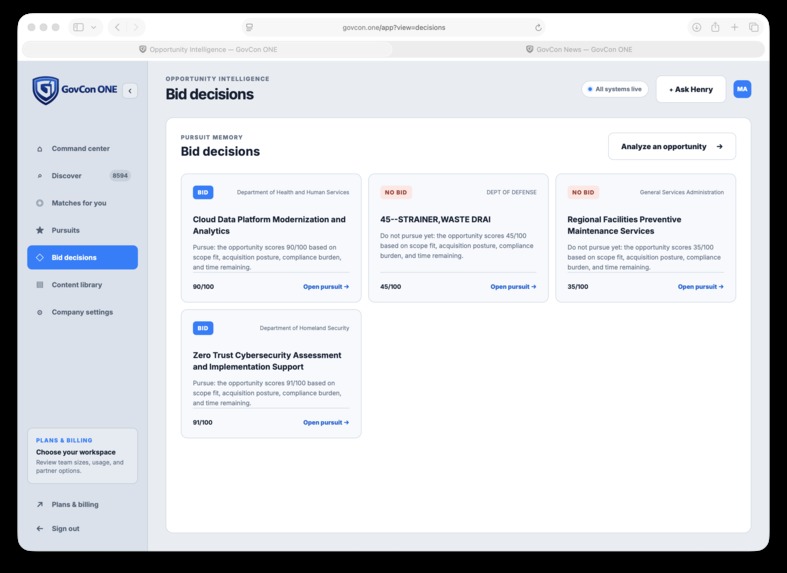
bid/no bid results sheet for opportunities you've asked henry about
-
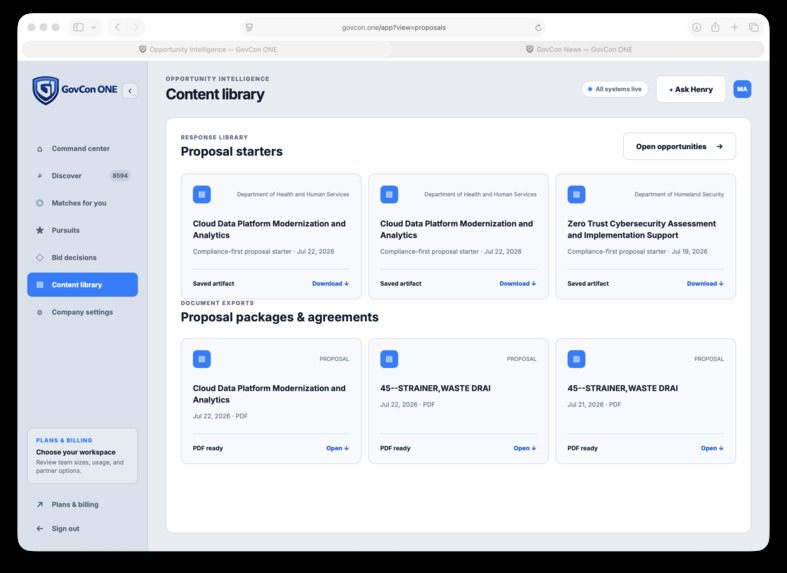
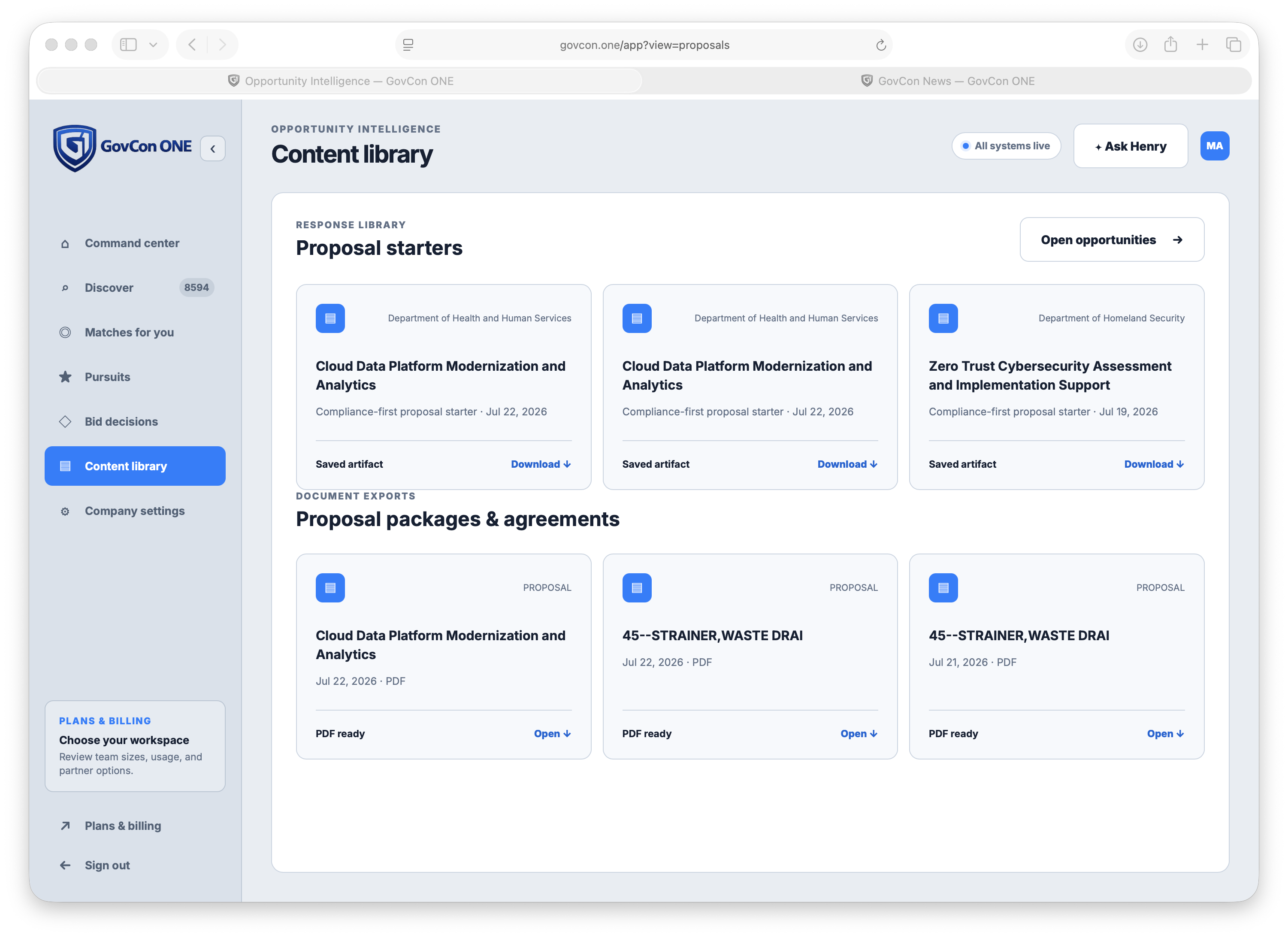
user artifacts persisted
Inspiration
After trying my hand at middleman contracting, I realized the opportunity was there, but the tools and the amount of time it took to build a proposal, or even read the solicitation, was way too expensive. So I built the tool I wish I had when I was still actively in the space.
What it does
GovCon ONE searches a federal opportunity corpus, uses Cloudflare-native embeddings and Vectorize to retrieve related context, and sends an evidence-bounded pursuit brief to Gemma 4. The result is a clear BID, REVIEW, or NO BID recommendation with a 0–100 score, strengths, risks, next actions, and traceable citations to the supplied notice.
When the team chooses to proceed, Gemma 4 generates a compliance-first proposal starter containing an executive summary, win themes, a response outline, a seven-day action plan, and explicit [INSERT EVIDENCE] placeholders wherever company proof is missing. Decisions are stored in D1 and downloadable proposal artifacts are stored in R2.
How we built it
The full product runs as one Cloudflare Worker. Astro builds the marketing site and application UI into Worker Static Assets, while a Hono API handles the dynamic workflow. D1 is the relational system of record, R2 stores proposal artifacts, Workers AI runs @cf/baai/bge-base-en-v1.5, and Vectorize provides 768-dimension cosine similarity search.
Free Gemma 4 26B A4B through OpenRouter handles both structured strategic analysis and proposal drafting. Codex with GPT-5.6 was the engineering and product reasoning collaborator used to create this Build Week rebuild. An optional SAM.gov integration imports current public notices.
The model layer is fault-tolerant by design. If a provider is unavailable or a free endpoint is rate-limited, GovCon ONE visibly labels and uses a deterministic safety fallback. It never silently presents template output as model output.
How we used Codex
I revived a dormant project with Codex as the primary engineering collaborator. Codex audited the legacy monorepo, traced the Supabase/Fly/Docker coupling, checked the current hackathon and platform requirements, and helped make the key scope decision: replace a broad but unfinished CRM surface with one polished, end-to-end capture workflow.
Codex then implemented the Cloudflare-native architecture, D1 schema, R2 artifact flow, Workers AI/Vectorize retrieval, dual-model orchestration, Astro marketing site and app UI, deterministic safeguards, tests, deployment workflow, and submission materials. The project owner made the core product, positioning, cost, and deployment decisions and reviewed the resulting experience.
How we used GPT-5.6
GPT-5.6 was used meaningfully throughout the primary Codex build thread. It audited the dormant codebase, separated reusable product intent from obsolete infrastructure, reasoned through the focused SAM-to-decision-to-draft product scope, designed the Cloudflare-native architecture, implemented the rebuild, checked safety and fallback behavior, validated the deployment, and developed the submission narrative.
That contribution is fundamental to the submitted work even though GPT-5.6 is not a production API dependency. The primary /feedback Session ID (019f76a8-2a35-7d82-a4a6-d16bb8d3f219), the Codex transcript, and the dated Build Week commit diff document exactly what the collaboration produced. In the demo, we will show the repository transformation and explain the concrete architectural, product, and implementation work completed with Codex and GPT-5.6.
We used 5.6 Sol for the final hardening passing to make sure everything was copacetic for a public facing SaaS.
What changed during Build Week
The pre-Build Week repository contained:
- A large Express API and Node jobs service intended for Fly.io containers.
- Supabase/Postgres migrations and Supabase JWT coupling.
- Separate dev, staging, and production infrastructure configurations.
- An Astro early-access card and a default Vite/React debug screen.
- No coherent, judge-ready end-to-end product experience.
The Build Week work added or replaced:
- A single production Cloudflare Worker architecture.
- A new D1 schema and seed corpus.
- Native R2 proposal storage.
- Workers AI embeddings and Vectorize semantic retrieval.
- Free Gemma 4 strategic analysis and proposal drafting through OpenRouter.
- Meaningful GPT-5.6 Codex collaboration across the core rebuild.
- A complete Astro marketing experience and interactive app workspace.
- Live SAM.gov import support.
- Transparent deterministic provider fallbacks.
- New tests, documentation, demo material, and one-command deployment.
- Removal of Docker, Fly.io, Supabase, Pages-era functions, and environment-tier sprawl.
The last pre-hackathon commit is 4f3ce16dbb4b9c7536981a02126ad1b0874f778e dated April 2, 2026. The Build Week diff and commits after July 13, 2026 are the evidence of the new work.
Challenges we ran into
The main challenge was not translating syntax... it was deciding what deserved to survive. The old repository was a broad all-in-one GovCon operating system, but its UI was still a starter and its backend depended heavily on infrastructure that slowed iteration. We had to reduce the product to one differentiated workflow while preserving a credible path to grow.
The second challenge was model economics and eligibility. We chose not to add a separate OpenAI API dependency merely for the submission. Instead, the core architecture and product were genuinely built with Codex and GPT-5.6, while free Gemma 4 powers the production analysis and drafting path.
Accomplishments we are proud of
- The product is a coherent experience, not a collection of endpoints.
- Every infrastructure primitive is Cloudflare native and accessed through a Worker binding.
- The GPT-5.6 Codex collaboration is central to the rebuild and documented with session and commit evidence.
- The product remains runnable when an external provider is unavailable.
- The proposal workflow uses explicit evidence placeholders instead of hallucinating company qualifications.
- A judge can understand the problem, architecture, and value in under three minutes.
What we learned
The most valuable AI workflow is not always the one that writes the most text. For a small contractor, a well-supported decision not to bid can be worth more than an entire generated proposal. We also learned that simplifying infrastructure and product scope at the same time creates compounding gains: less code, fewer failure modes, a clearer story, and a faster user experience.
What's next
- Company capability profiles and reusable evidence libraries.
- Automated compliance matrices from uploaded solicitation packages.
- Partner-gap recommendations and teaming workflows.
- Opportunity change detection and amendment impact analysis.
- Outcome feedback loops that calibrate bid scoring against actual wins and losses.
Built With
- astro
- claude
- cloudflare-workers
- codex-with-gpt-5.6
- d1
- gemma-4
- hono
- openrouter
- r2
- sam.gov
- typescript
- vectorize
- workers-ai
- workers-static-assets


Log in or sign up for Devpost to join the conversation.