-
-
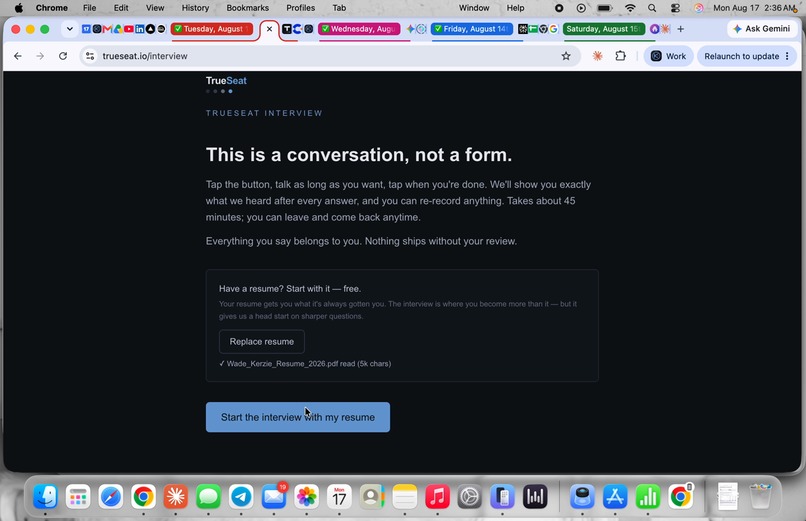
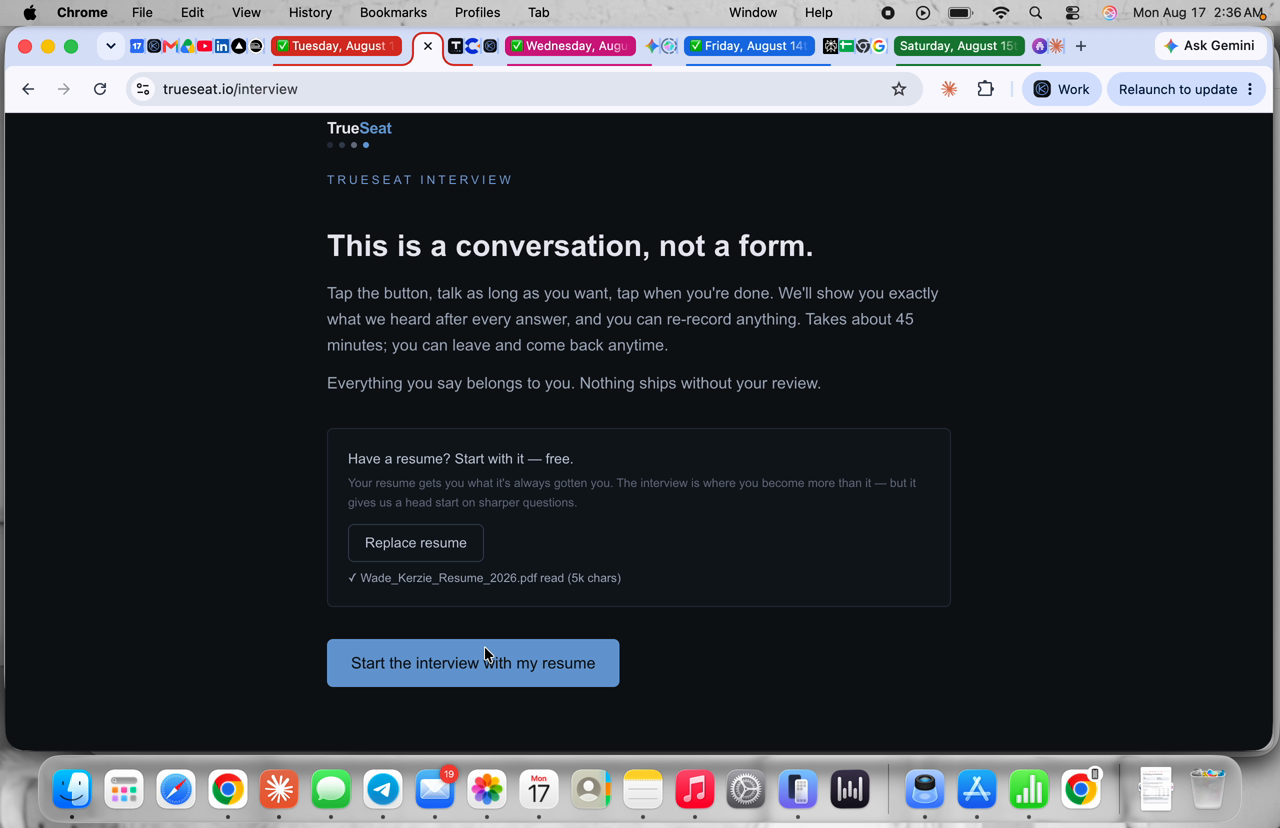
The free front door: your resume is read before the interview, then interrogated against reality.
-
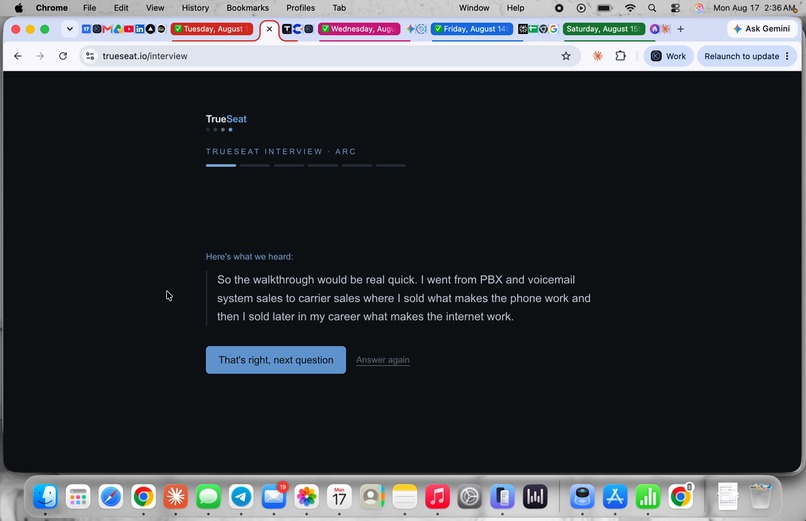
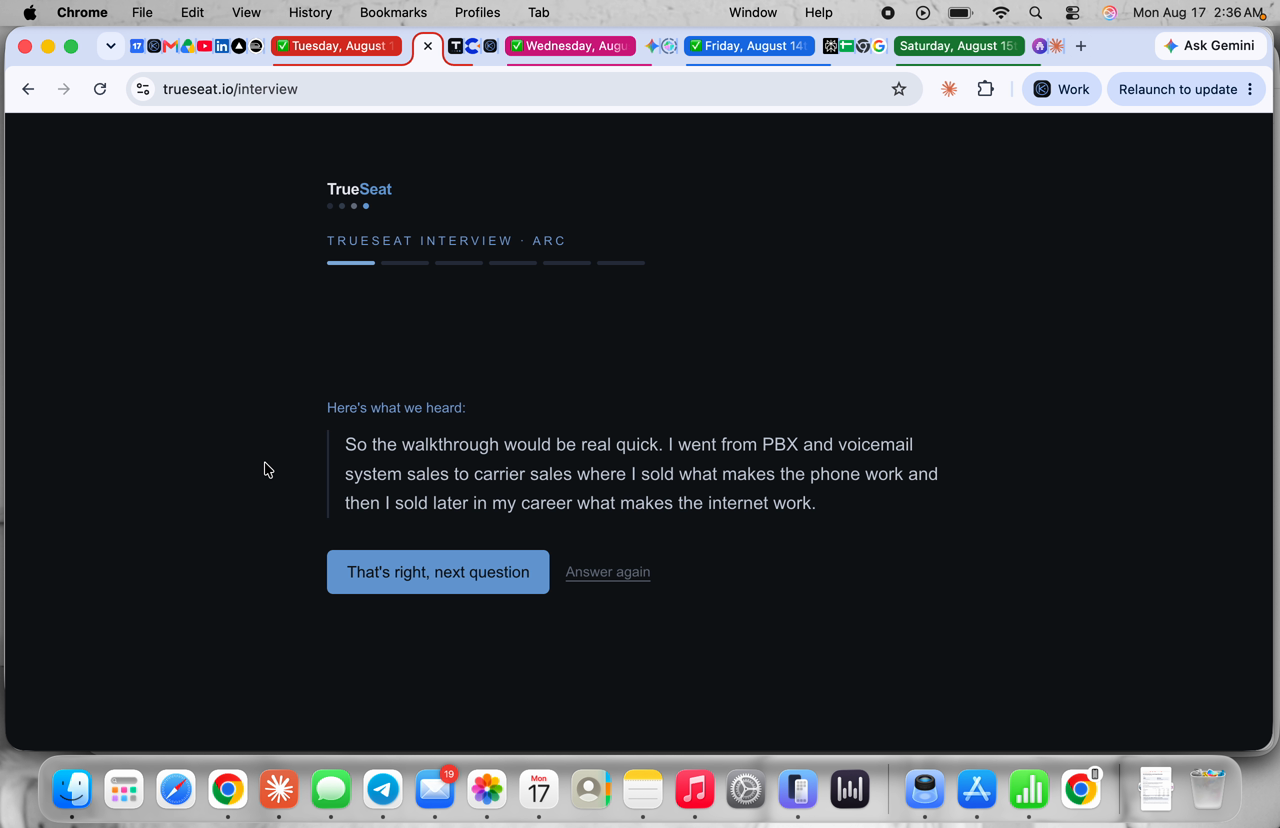
After every answer: here's exactly what we heard. Nothing ships without candidate review.
-
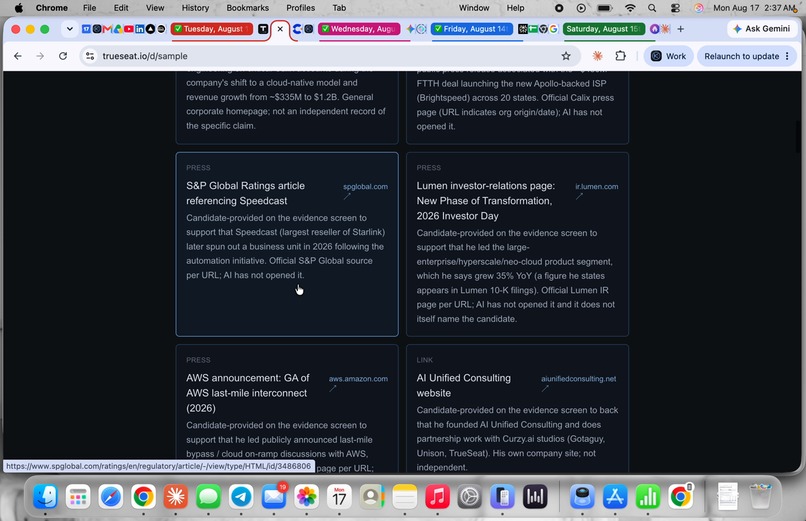
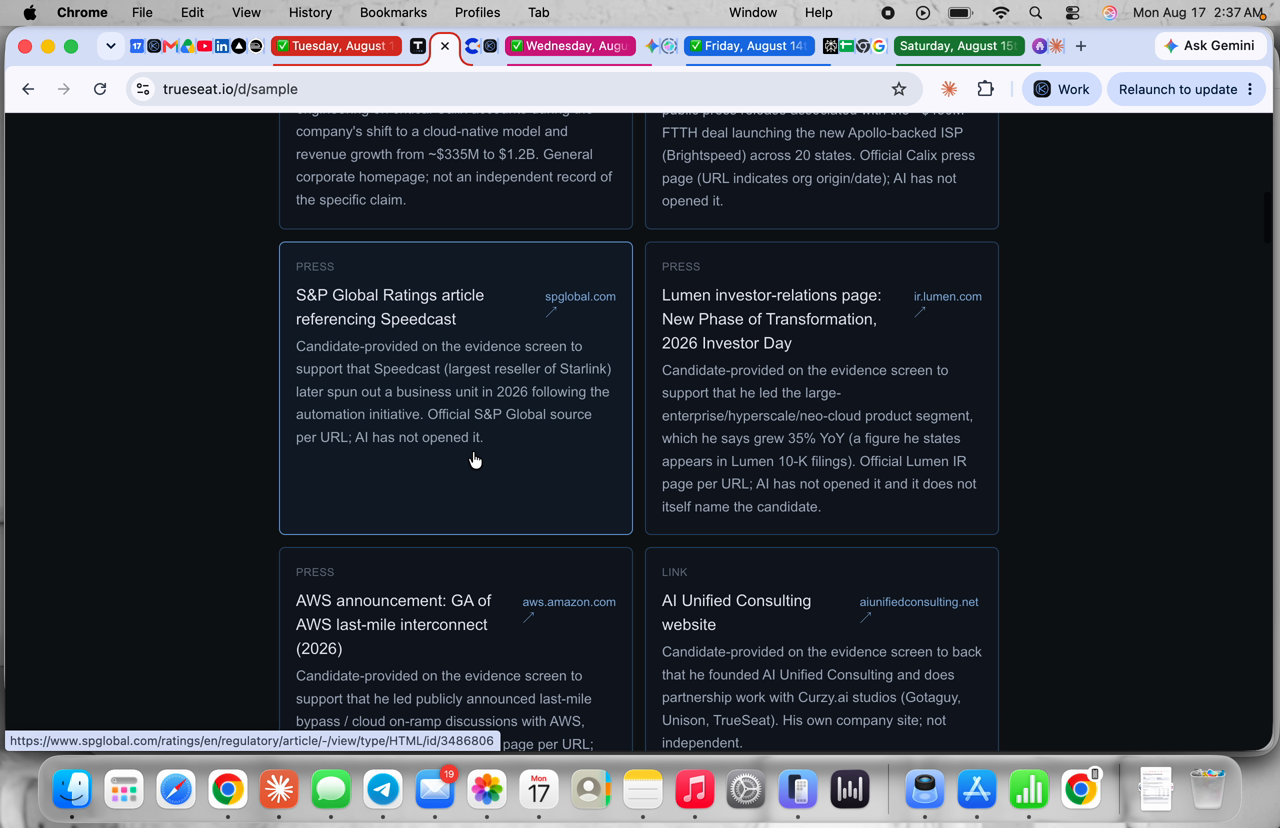
Evidence capture: pasted links become artifact cards with honest provenance notes.
-
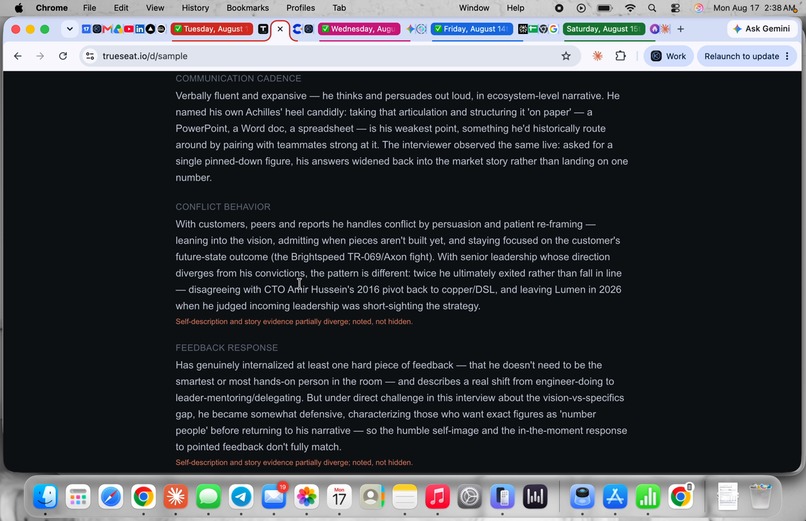
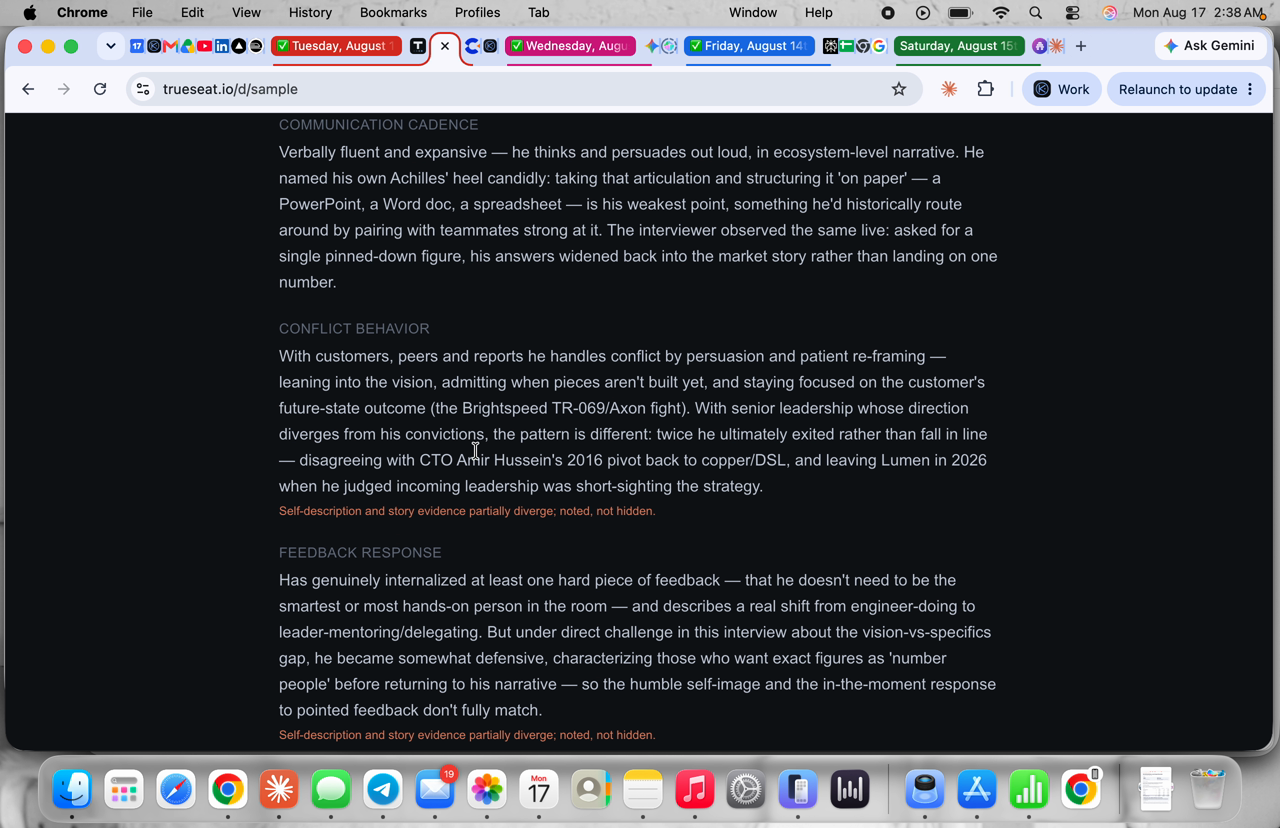
The Operating Profile: behavior inferred from stories, divergences flagged, never hidden.
Inspiration
Hiring runs on the least reliable document in business: the resume. Both sides know it. Companies spend the first six months discovering who they actually hired; candidates compress themselves into keywords to survive ATS filters. And the jobs being created in the AI economy increasingly don't have names yet - you cannot keyword-match a person to a job title that has never existed. We built TrueSeat because the interview a great colleague would give you after six months of working together produces a fundamentally better hiring record - one built on capabilities and evidence instead of titles and claims - and AI finally makes that interview affordable for everyone.
What it does
TrueSeat conducts a six-phase AI interview (voice-first, in the browser) and produces a sealed, evidence-backed capability dossier the candidate owns:
- Free front door: upload your existing resume (PDF/docx). The AI reads it before the interview and interrogates the gap between the document and the reality ("your resume says X - walk me through what actually happened").
- Every claim carries a verification tier: self-reported, artifact-backed, provenance-verified, witness-verified (5-minute AI reference interviews with former colleagues - live in production, and in testing the witness extraction correctly refused to confirm claims the witness hadn't actually seen).
- Evidence capture: when the interview ends, the AI lists the claims a link could back - a live product, a press mention, a public filing - and the candidate pastes links right there. Each link becomes an artifact card with honest provenance; unlinked claims stay visibly self-reported. Claims don't get to borrow credibility.
- Headline numbers are adjudicated: read back verbatim, confirmed by the candidate, never inferred.
- An Operating Profile captures how the person actually works (pace, conflict behavior, feedback response, autonomy needs) from stories, not quizzes, and generates a Manager Manual: the "how to work with me" doc great teams write six months in, available on day zero.
- A sealed constraints layer (compensation floor, geography, dealbreakers) makes matching honest; released only with candidate consent.
- The dossier is situated capabilities, not job titles - which is exactly what lets a person be matched to a role that didn't exist last year.
- The bridge feature emits honest, ATS-clean tailored applications from the dossier, so candidates stop rewriting themselves for every posting.
See it live: the public sample at trueseat.io/d/sample is a real interview-generated dossier (published with the candidate's consent), and the demo video walks the full loop in under three minutes.
How we built it (AI-native by architecture - all live in production)
- Gemini (gemini-3.5-flash) is the ears [load-bearing Gemini API + Google Cloud]: every voice answer flows through trueseat-ears, our Cloud Run service (us-central1, key in GCP Secret Manager, shared-secret gated). Gemini produces the verbatim transcript plus first-pass claims, stories, and behavioral signals.
- Claude Opus is the brain: adaptive interview orchestration (it genuinely pushes back - in testing it told a candidate "you skated past my actual question") and structured-output extraction into a strict JSON-Schema dossier ontology, ajv-validated before anything is stored.
- Next.js on Vercel (trueseat.io), Supabase (sessions + dossiers, RLS), resumable cross-device interview sessions, dynamic dossier pages at /d/ with a draft-pending-review gate - nothing ships unreviewed.
- The repo was created July 15, 2026, inside the submission window; first production deploy the same day; the full interview-to-dossier-to-URL pipeline verified in production July 16. Submission day is day 33.
- AI-native operations: the AI conducts the interview, extracts the dossier, generates the hosted evidence page, and emits the bridge applications. Humans steer, review, and buy.
- The company itself is AI-operated. One founder - a 30-year sales operator, not a developer - and zero employees. AI wrote every line of the codebase, deploys it, conducts the product's core service in production, generates the marketing content, and runs the operational checklists. The build log (commit history, July 15 to submission day) is the receipt: this business exists because AI-native operations work, which is the thesis of the prize.
Category impact (Entrepreneurship & Job Creation)
The category is fueling the tools that help new founders and economies thrive. TrueSeat fuels it from both sides of the hire:
- New founders can't afford hiring. A recruiter costs 20-25% of first-year base - $30,000+ for one hire - so early companies hire blind, and a bad first hire kills more new businesses than competition does. A verified capability dossier at $249 (candidate) plus a flat per-hire fee (employer, roadmap) gives a two-person startup the hiring evidence a Fortune 500 buys today.
- The jobs being created don't have names yet. The AI economy is minting roles no keyword database contains. You cannot title-match a person to a job that has never existed - but you can capability-match them, if the capabilities were ever actually captured. TrueSeat's dossier is situated capabilities with evidence tiers: matching infrastructure for jobs that are being invented.
- The economic redefinition: hiring's core document - the resume - has been claims all the way down for a century, and both sides pay for the mistrust (six months of discovery per hire, keyword compression per application). Moving the market's unit of exchange from claims to verified evidence is the fundamental redefinition this category asks for.
Business results (real receipts only)
Our submission rule, kept from day one: nothing here is aspirational-stated-as-actual. Every number is a real receipt, and empty is better than inflated.
- Revenue: $0 in arms-length customer transactions to date (May $0 / Jun $0 / Jul $0 / Aug $0). The $249 dossier and $199 founding-cohort Stripe payment links are live; no arms-length sale has closed yet.
- Related-party disclosure: the completed production interviews and dossiers to date are business partners and family testers. They are disclosed as related-party / free-test and counted as $0 revenue - including the public sample dossier.
- Expenses to date: trueseat.io domain $37.99/yr; Supabase $10/mo; Cloud Run + Gemini API and Anthropic API at prototype volume; Vercel $0 incremental (existing plan); marketing spend $0.
- Users: 3 dossiers in the production database; 1 complete end-to-end interview-to-dossier candidate (related party, disclosed above). No testimonials yet - the only completed interviewee is a related party, and we won't count what doesn't count.
- Production evidence available to judges: public repo (github.com/wadekerzie/trueseat, first commit July 15, 2026), Cloud Run request logs (trueseat-ears), Gemini and Anthropic API usage dashboards, Supabase table counts, Vercel deploy log.
Challenges
The hard design problem wasn't technical: it was building personality capture that stays behavioral and job-relevant. Every instrument in this space drifts toward clinical labels and four-letter taxonomies. Our rule is stories only - the operating profile is inferred from what the person actually did under deadline, in conflict, taking feedback, then cross-checked against their self-description, and any divergence is flagged, not hidden. Same discipline on evidence: the extraction pass is forbidden from describing a link it hasn't seen, so provenance always says "the candidate states this URL shows X." An honesty product has to be honest about what IT knows, too.
The technical potholes were the fun kind. Google Front End silently reserves /healthz on run.app domains, which made a perfectly healthy Cloud Run service look dead until we served /health as well. pdf-parse crashed Vercel's serverless runtime looking for DOMMatrix, so resume parsing moved to unpdf. Vercel refused to deploy anything for a day because commits were authored under an email GitHub hadn't verified. And the Gemini model we started on was retired for new API keys mid-build - we shipped on gemini-3.5-flash instead.
The most encouraging failure: in production testing, our witness micro-reference flow caught that a test "reference" was a peer rather than the claimed manager, and declined to confirm things that witness couldn't have seen. The verification layer being hard to fool is the product working.
What's next
Flip the payer. Candidates build dossiers nearly free; employers subscribe and pay a flat per-hire fee - a ~90% cost reduction versus the recruiter's 20-25% of base salary, with a better artifact: verified evidence instead of a screened resume. Symmetric employer interviews and blind matching follow: the hiring manager answers the same nine operating dimensions, and the match report says what no interview surfaces in time ("this manager checks in daily; this candidate does their best work under weekly check-ins") before either side spends an hour on a call. And an AI-readiness score - candidate-owned, like everything else in the dossier - because most newly created jobs require directing AI, and candidates deserve to know and show where they stand.
Built With
- claude-api-(anthropic)
- cloud-run
- gemini-api-(google)
- google-cloud
- next.js
- node.js
- postgresql
- stripe
- supabase
- typescript
- vercel

Log in or sign up for Devpost to join the conversation.