-
-
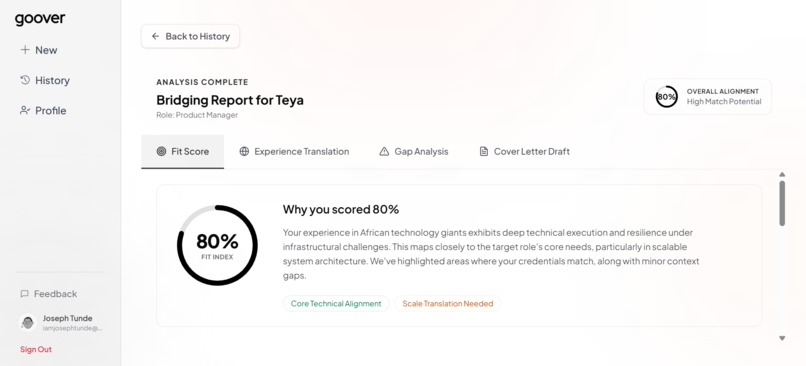
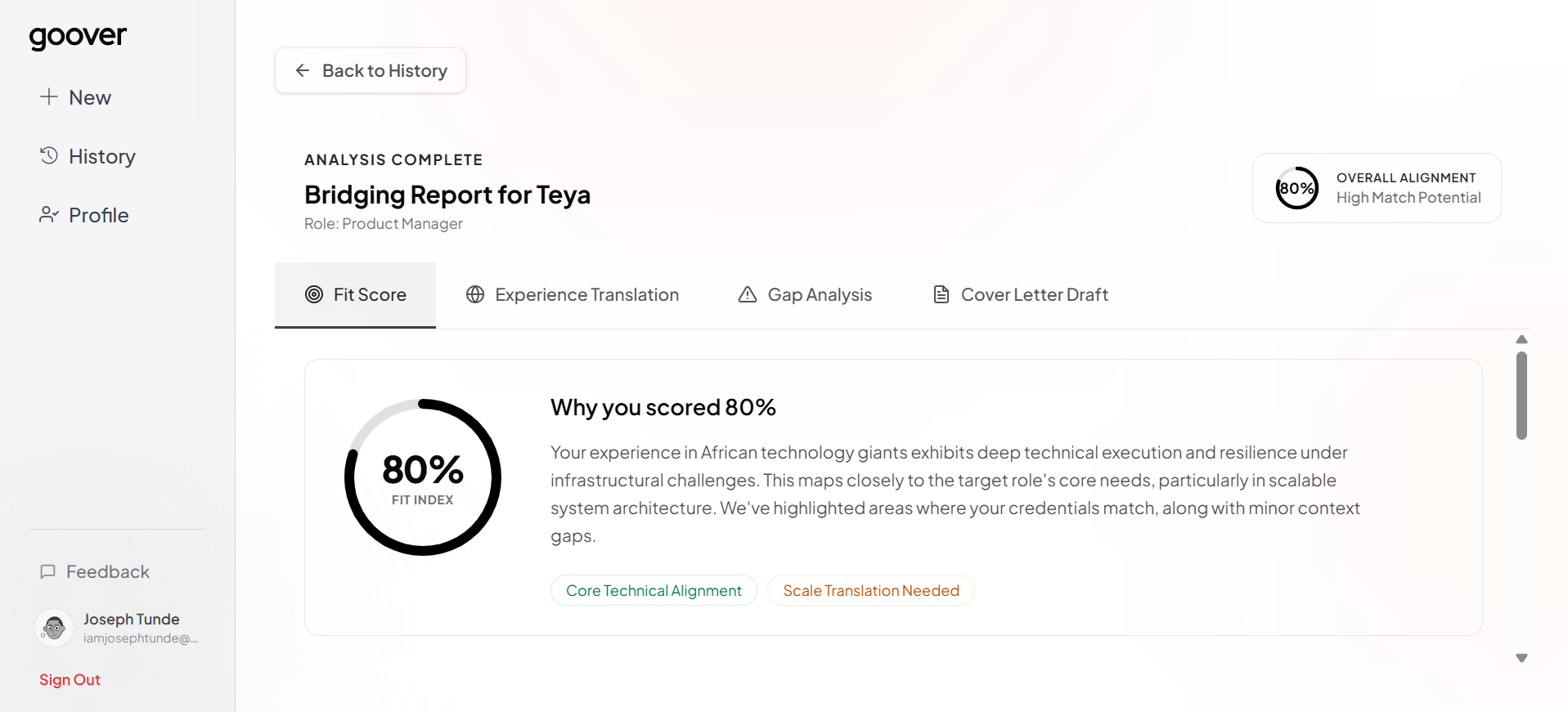
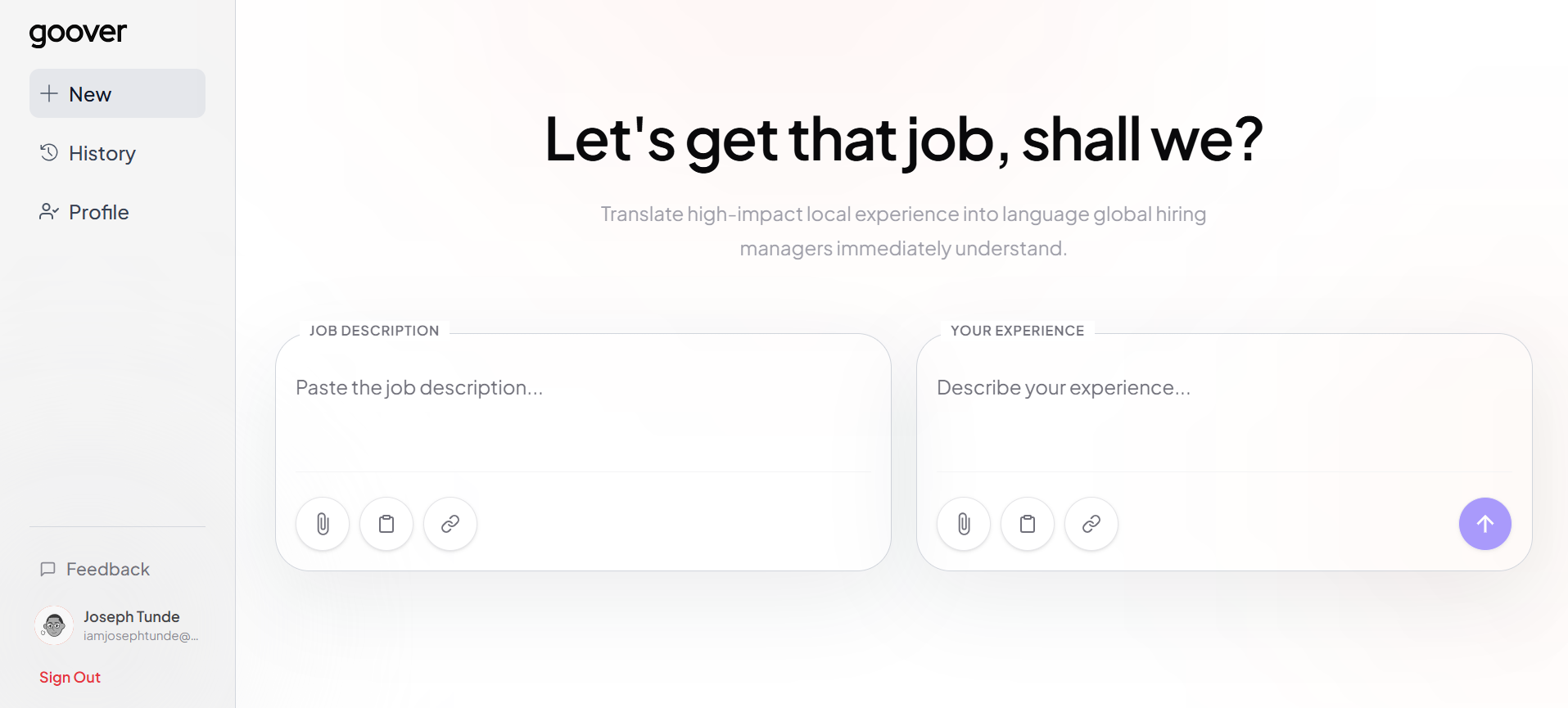
Goover's analysis interface
-
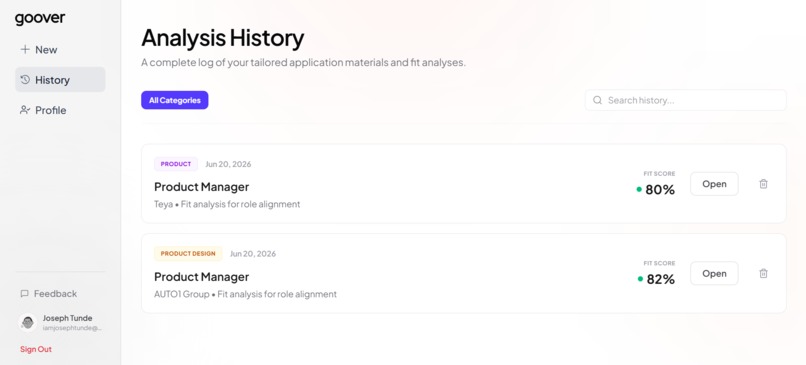
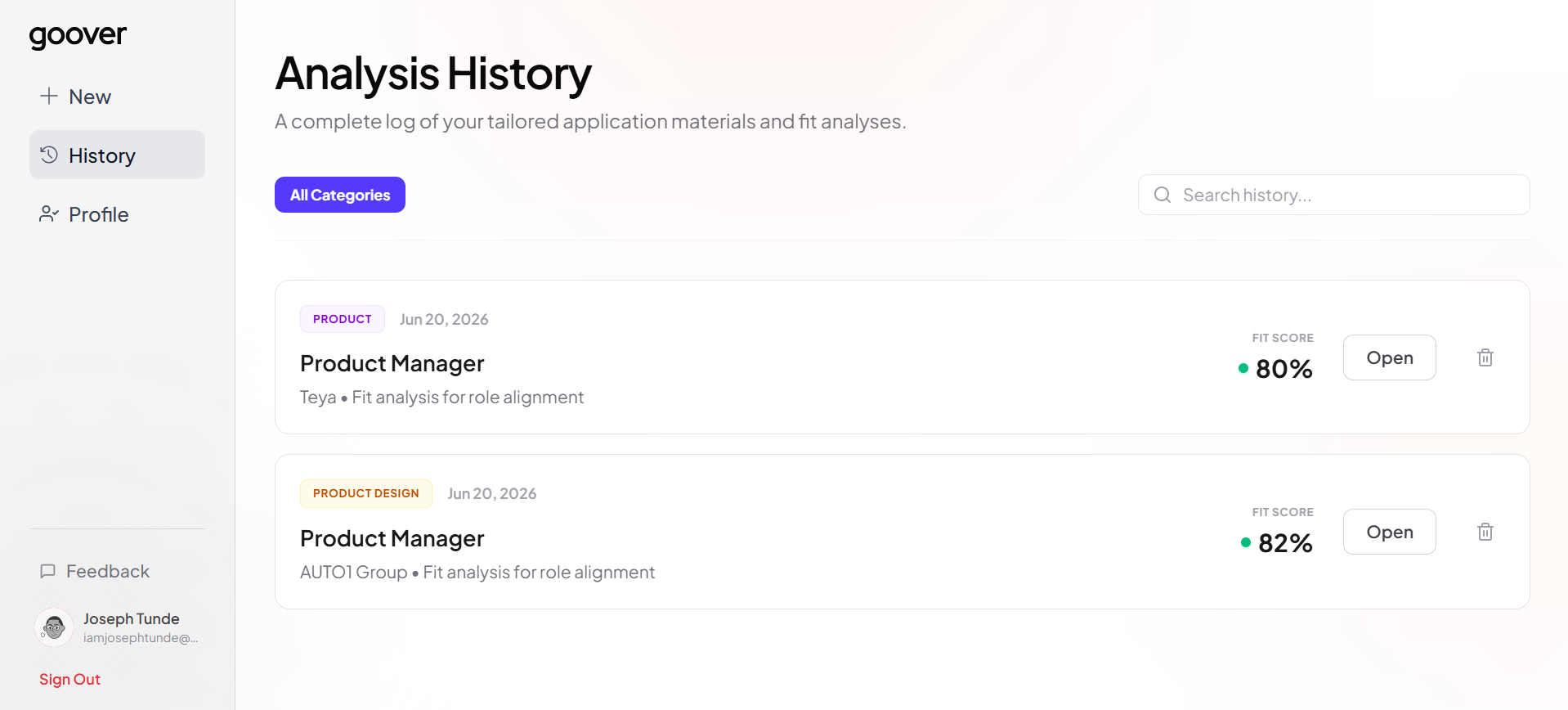
Goover analysis history interface
-
Inspiration
I am a Product Manager based in Lagos, Nigeria, with 3.5 years of experience shipping AI-powered products, logistics platforms, and multi-sided marketplaces. For the past several months, I've been applying to international PM roles, and I kept running into the same wall. I found out it wasn't just about my experience. It was the translation. A hiring manager in Amsterdam or London reads "cargo logistics marketplace in Lagos" and their mental model fails them. They don't have the context to understand that building a multi-sided marketplace in Nigeria, navigating unreliable infrastructure, cash-dependent operators, low smartphone literacy, and informal sector dynamics, is objectively more complex than building the same product in Berlin or San Francisco. I was losing opportunities not because of what I'd built, but because of how it was being read. I built Goover because I needed it. And because I knew I wasn't the only one.
What it does
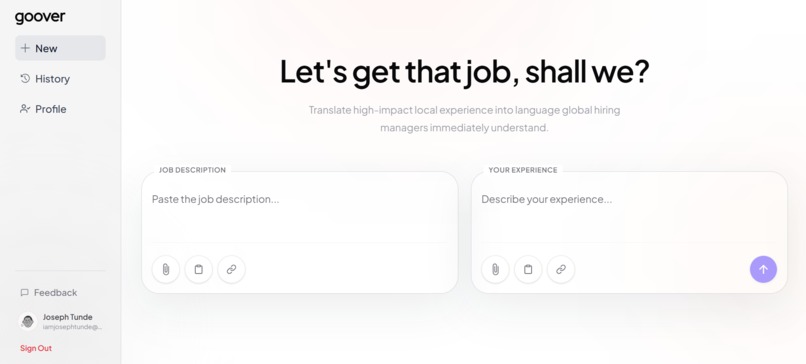
Goover is an AI co-pilot for African professionals applying to international roles. The core loop is simple: Paste a job description. Paste your experience summary. Goover returns four outputs:
- Fit Score (0–100%): an honest, calibrated assessment of how well your background maps to the role. Not inflated to make you feel good. Precise enough to actually guide your preparation.
- Experience Translation: specific bullets from your African market experience, reframed in the vocabulary that global hiring managers immediately recognise and value. "Managed USSD payment flows" becomes "designed payment infrastructure for unbanked user segments across alternative payment rails." Same experience. Legible context.
- Gap Analysis: an honest assessment of where your background falls short of the role requirements, and a concrete, actionable step to address each gap before your interview.
- Cover Letter Draft: a full tailored cover letter that leads with your African market context as a genuine competitive advantage, not something to apologise for or hide. A stranger can land on the URL, paste their details, and get all four outputs in under two minutes. That's the whole product.
How we built it
Stack I used: Frontend: React + Vite, deployed on Vercel Backend: Supabase Edge Functions (serverless, no exposed API keys) AI layer: Gemini API via Supabase Edge Function (will add Claude and other models in future) Analytics: Novus.ai Design: Stitch-generated UI, customised in React
The architecture is deliberately simple. The user fills one form, the frontend calls a Supabase Edge Function, the function calls the Gemini API with a heavily engineered prompt, and returns structured JSON that the frontend renders into four distinct output components. The real build was the prompt. The application code took days. The prompt engineering took weeks of iteration. The difference between a useful translation and a generic AI rewrite is entirely in how precisely you encode the domain knowledge — African market constraints, global PM vocabulary, scoring philosophy, cover letter rules — into the model's context. That's where the product actually lives.
Challenges we ran into
Prompt engineering was harder than expected. Getting the LLM to return genuinely insightful translations, not just vocabulary swaps required building an entire knowledge base into the system prompt: specific African market constraints, a translation vocabulary table, scoring calibration guidelines, and explicit rules for what not to do (no "fast-paced environment," no inflated scores, no fabricated metrics). JSON reliability: early versions of the prompt caused the model to wrap responses in markdown code fences, breaking the frontend parser. Solved by adding explicit rules in the prompt and a fence-stripping sanitiser in the Edge Function before parsing. API rate limits during development: the free tier of the development API hit rate limits during testing. Naming: turns out naming a product is harder than building it. Every name I considered was either taken, trademarked, or conflicting with an existing brand. I went through multiple rounds of naming before landing on something ownable.
Accomplishments that we're proud of
The prompt is the accomplishment I am most proud of. It encodes something that no generic AI tool has: a deep, specific understanding of what African market experience actually looks like, what constraints produce what skills, and how to translate those skills into language a VP of Product in Amsterdam immediately respects. The translation vocabulary table alone, mapping "NEPA / power outages" to "designing for infrastructure resilience in low-reliability environments," mapping "informal operators" to "informal sector integration", took more product thinking than any feature I built. I am also proud that the product is genuinely honest. The fit score is calibrated to be accurate, not encouraging. The gap analysis names real gaps with specific actions.
What we learned
The real product thinking in an AI-powered tool is in the prompt and context knowledge, not the code. The engineering to wire up an API call, parse JSON, and render four output cards took a few days. The thinking required to encode enough domain knowledge into a prompt to produce outputs that are actually better than what a user could get from ChatGPT in three minutes, that's where the real work is. That's a lesson I'll carry into every AI product I build after this: the model is not the moat. The specific judgment baked into how you use the model is. Build the thing you actually need. The reason this product has a clear problem statement, a specific user, and a coherent output is because I am the user. Every product decision was easy because I could ask myself: "Would this have helped me last Tuesday?" That clarity is worth more than any framework.
What's next for Goover
Immediate (July – September): Email capture and saved analyses, so users can track their applications over time and come back for more. Real usage data from Novus.ai will tell us which of the four outputs users value most and where the session drops off.
Medium term (October – December): Interview prep — likely questions generated from the job description, calibrated for what international companies actually probe in PM interviews. Job tracker and market insights. LinkedIn headline and summary rewriter. A freemium model: three analyses free per month, unlimited on Pro.
Longer horizon: Goover started as a tool for African PMs. The translation problem is not unique to PMs — it applies to any African professional crossing into a global market: designers, engineers, lawyers, finance professionals, etc. The same core product, with profession-specific prompt layers, serves all of them.
The data moat: the real asset Every analysis run through Goover teaches the system something that no competitor can replicate without running the same volume:
- Which African experience descriptions translate most effectively for which global role types
- Which gaps are most common for African PMs targeting European fintech vs. US product roles vs. Southeast Asian tech companies
- Which fit score ranges correlate with actual interview invitations (once we close the feedback loop)
- Which cover letter structures produce the highest response rates by geography and industry
Over 12–18 months of real usage, Goover can becomes the world's largest structured dataset of African professional experience mapped to global role requirements. That dataset is impossible for anyone to replicate without the user base, and impossible to build without the product.
The biggest opportunity is B2B: selling to African tech bootcamps, PM communities, and university career centres who have the same problem at scale. One partnership with a bootcamp of 200 students beats 200 individual subscriptions.
The vision: Andela built a $1.5 billion company doing one thing: being the human translation layer between African engineering talent and global companies. They needed offices, vetting teams, and account managers to do it. It took them a decade.
Goover does the same thing, but for every profession, not just engineering, self-serve, in two minutes, powered by AI.
The market is every African professional who has ever lost an international opportunity not because of what they built, but because of how it was read. That market is 1.4 billion people and growing. Goover starts with PMs in Lagos. It ends as the default infrastructure layer for African professional mobility globally.
Built With
- novus
- react
- sentry
- supabase
- tailwind

Log in or sign up for Devpost to join the conversation.