-
-
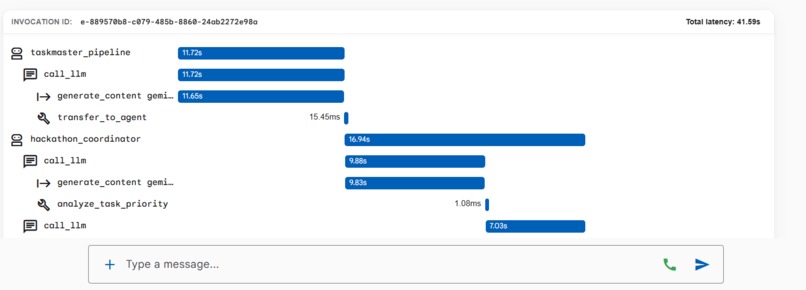
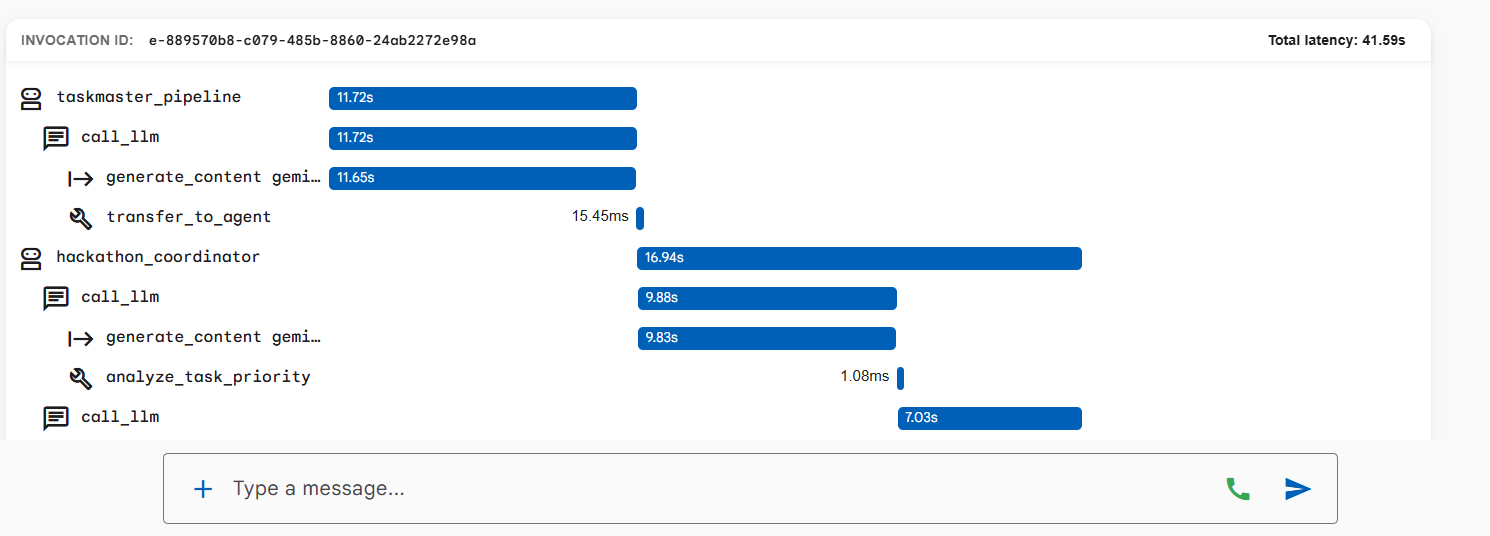
ADK Web UI trace showcasing the sequential execution flow from the taskmaster_pipeline root agent down to the hackathon_coordinator.
Inspiration Developing comprehensive, production-ready educational platforms and course content usually requires tedious manual effort—coordinating syllabus structuring, quiz generation, technical task breakdown, and content triage. We wanted to eliminate this friction by creating an autonomous, intelligent system that can handle multi-step educational workflows seamlessly. Inspired by modern agentic workflows, we set out to build an automated pipeline capable of turning raw project requirements or source material into structured educational modules and execution plans.
What it does The Multi-Agent E-Learning Platform Workflow Engine is an autonomous multi-agent system that ingests project prompts or course descriptions and orchestrates specialized AI agents to deliver structured results. It automatically evaluates task priorities using custom Python functions, coordinates agent handoffs, and produces clean engineering checklists and course breakdowns.
How we built it Framework: Built using the Google Agent Development Kit (ADK) to establish robust agent pipelines and session management.
AI Engine: Powered by Gemini (Flash models) for fast, highly accurate content generation and structured reasoning.
Multi-Agent Architecture: Designed a sequential pipeline featuring:
taskmaster_pipeline: The root coordinator overseeing execution flow.
hackathon_coordinator: Handles request triage and executes custom Python tools (analyze_task_priority) for automated logic evaluation.
detail_writer: Acts as the technical lead, turning priorities into production-ready specifications and checklists.
Infrastructure: Wrapped the application with FastAPI/Uvicorn, integrated the ADK Web UI playground for real-time trace telemetry, and containerized it with Docker for seamless deployment.
Challenges we ran into Agent Orchestration and Routing: Fine-tuning the handoffs between the coordinator and the writer to ensure clean delegation without overlapping context.
Environment Configuration: Navigating Windows-specific process execution policies and asynchronous event loops during local server setup.
Tool Latency Optimization: Ensuring custom Python function tools executed within milliseconds inside the agent execution lifecycle.
Accomplishments that we're proud of Successfully building and visualizing a fully traceable multi-agent system using the ADK Web UI playground, complete with detailed execution latency graphs and tool logs.
Writing custom function tools that seamlessly integrate with Gemini's function-calling capabilities.
Containerizing the entire multi-agent workflow into a production-ready Docker setup.
What we learned The immense power of separating responsibilities across specialized multi-agent teams rather than relying on a single monolithic prompt.
How the Google Agent Development Kit (ADK) dramatically accelerates the development lifecycle of agentic applications.
The importance of deep execution telemetry and trace inspection for debugging agent behaviors and tool calls.
What's next for Google_hackathon_agent Expanded Ingestion Sources: Scaling the engine to ingest raw PDFs, video transcripts, and textbook chapters directly.
Automated Quiz Generation: Expanding the detail_writer to autonomously generate interactive module quizzes alongside course outlines.
Full Cloud Hosting: Deploying the containerized workflow engine to a live cloud environment (such as Google Cloud Run) for public accessibility.
Built With
- api
- artificial-intelligence
- automation
- cloud-computing
- containerization
- developer-tools
- docker
- e-learning
- education
- fastapi
- gemini
- generative-ai
- google-adk
- machine-learning
- multi-agent-systems
- productivity
- python
- software-architecture
- workflow-automation

Log in or sign up for Devpost to join the conversation.