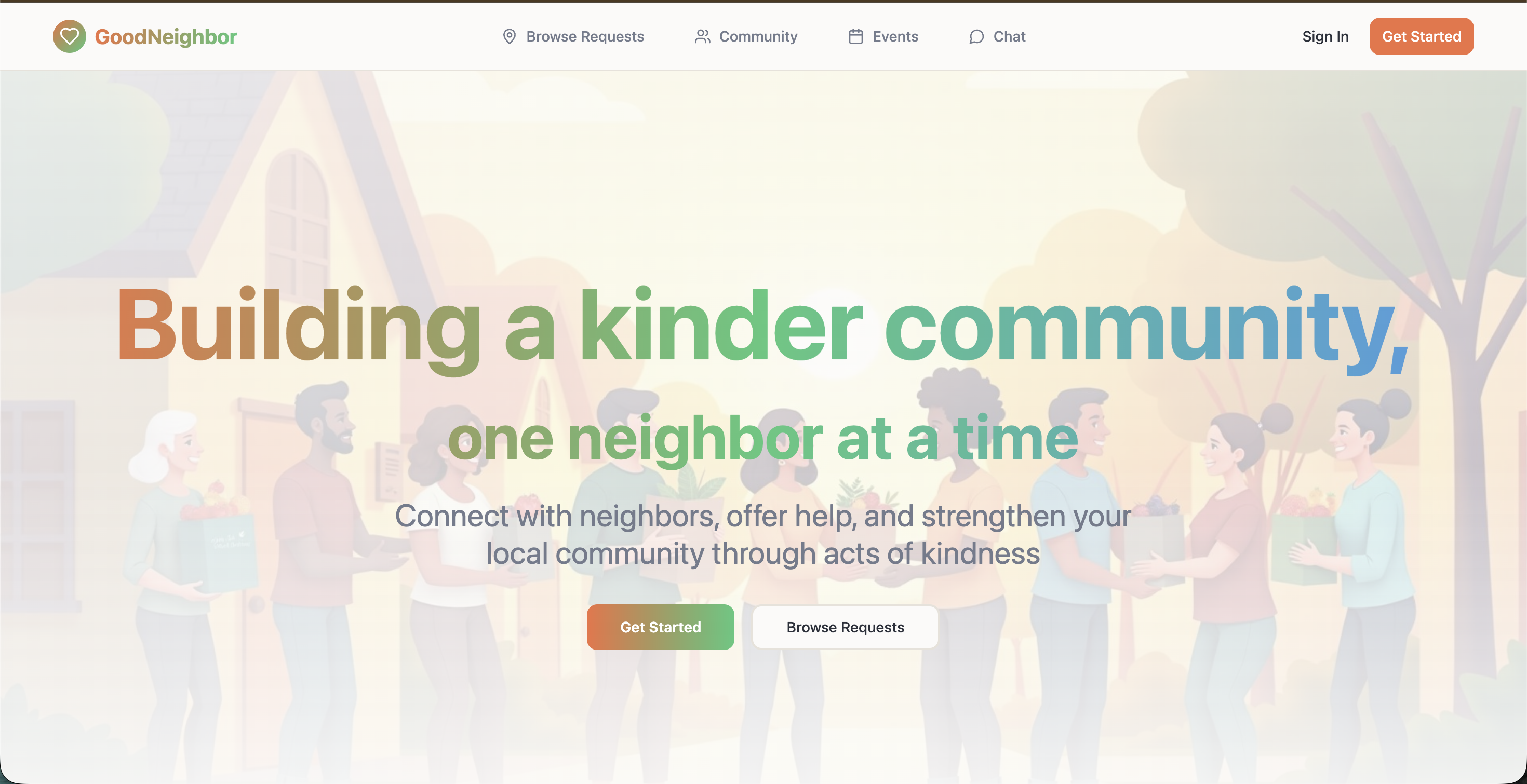
GoodNeighbor: Building Kinder Communities
Inspiration
During the COVID-19 pandemic, we witnessed countless neighbors needing help but lacking easy ways to connect. Elderly residents couldn't get groceries, students struggled with remote learning, and communities felt disconnected despite physical proximity.
The inspiration came from three observations:
- Geographic proximity doesn't equal social connection: Neighbors often don't know each other
- Professional skills are underutilized: Skilled professionals want to help but lack structured opportunities
- Technology can bridge gaps: Modern platforms can facilitate real-world neighborly support
We envisioned a platform where technology serves humanity—where a doctor two blocks away can help someone with medical questions, where a teacher can tutor a struggling student, where any neighbor can offer or receive help with dignity.
Our mission: Build the infrastructure for kinder, more resilient communities through technology-enabled acts of kindness.
What It Does
GoodNeighbor is a comprehensive community assistance platform that connects neighbors for mutual support through a location-based matching system.
Core Functionality
1. Help Request System
- Post urgent or regular help requests (groceries, medical, transport, tutoring, household, companionship, other)
- View requests on an interactive map with custom markers
- Track request status from creation to completion
- Offer help with one click
2. Professional Network
- 10 profession-specific communities: Doctors & Nurses, Teachers, Social Workers, Government Officers, Lawyers, IT Professionals, Farmers, Media, Business, Students
- Each profession has dedicated pages showcasing how they help society
- Verification system for professional credentials
- Location-based professional discovery
3. Interactive Mapping
- Google Maps integration with user locations
- Service radius visualization showing volunteer reach
- Real-time geocoding for address-to-coordinates conversion
- Distance calculations for nearby matching
- Route planning between volunteers and requesters
4. AI-Powered Intelligence
- Smart matching algorithm based on location, skills, and availability
- Google Gemini AI chat assistant for 24/7 support
- Personalized recommendations for relevant requests
- Sentiment analysis for safety monitoring
5. Gamification System
- Earn "Goodness Points" for helping others
- Badge system with 4 rarity tiers (common, rare, epic, legendary)
- Streak bonuses for consistent participation
- Leaderboards by category and overall contribution
6. Community Features
- Community wall for sharing updates and gratitude
- Event creation and management
- Direct messaging between users
- Real-time notifications for offers, acceptances, and events
7. Safety & Trust
- User verification with admin approval
- Profile badges for verified members
- Safety guidelines and reporting system
- Secure authentication via Supabase
Real-World Use Cases
- Elderly Resident: Posts need for grocery shopping → Neighbor offers help → Matched and completed
- Student: Needs tutoring in math → Teacher in neighborhood volunteers → 1-on-1 sessions arranged
- Medical Emergency: Posts urgent need → Local doctor provides guidance → Crisis averted
- Community Event: Organizes cleanup day → Volunteers join via platform → Community improves
How We Built It
Tech Stack
Frontend
- React 18.3.1 with TypeScript for type-safe development
- Vite for fast development and optimized builds
- Tailwind CSS for responsive, modern UI
- shadcn/ui for accessible component library
- React Router v6 for navigation
- TanStack Query v5 for efficient server state management
- Google Maps API for interactive mapping
- Lucide React for consistent iconography
Backend
- Supabase (PostgreSQL) for database and real-time features
- Row Level Security (RLS) for data protection
- JWT authentication via Supabase Auth
- Real-time subscriptions for live updates
- Edge functions for serverless logic
AI Integration
- Google Gemini API for intelligent recommendations
- Safety filters for content moderation
- Natural language processing for chat assistant
Development Process
Phase 1: Database Design (Week 1-2) Created comprehensive PostgreSQL schema with 20+ tables including user profiles, help requests, offers, messaging, community posts, events, notifications, professions, and gamification elements. Implemented Row Level Security policies for data access control.
Phase 2: Core Features (Week 3-4)
- Built help request CRUD with location services
- Implemented offer/accept workflow
- Created interactive map with custom markers
- Added filtering, search, and categorization
Phase 3: Professional Network (Week 5)
- Created profession system with 10 categories
- Built profession management with verification
- Implemented member discovery and mapping
- Added profession-specific community pages
Phase 4: AI Integration (Week 6)
- Integrated Google Gemini API for chat
- Built recommendation engine using AI
- Implemented query analysis service
- Added safety filters for content moderation
Phase 5: Gamification (Week 7)
- Implemented points calculation system
- Created badge and achievement tracking
- Built streak bonus mechanism
- Developed leaderboard functionality
Phase 6: Community Features (Week 8)
- Community wall with reactions
- Event creation and management
- Direct messaging between users
- Real-time notification system
Phase 7: Polish & Deploy (Week 9)
- Optimized performance (reduced bundle to 1.5MB)
- Added loading states and error boundaries
- Implemented accessibility features
- Resolved merge conflicts and pushed to GitHub
Key Architecture Decisions
- Parallel Data Fetching: Fetched multiple data sources simultaneously for 3x faster performance
- Efficient Lookups: Used optimized data structures for instant access instead of slower nested searches
- Intelligent Caching: Implemented 5-minute cache for frequently accessed data to reduce server load
- Component Composition: Created 50+ reusable components for maintainability and consistency
- Error Boundaries: Graceful error handling throughout the app for better user experience
Challenges We Ran Into
1. Database Performance with Large Datasets
Problem: Fetching help requests with related profiles and offers was slow with many records.
Solution: Implemented parallel data fetching to retrieve multiple related datasets simultaneously instead of sequentially, and optimized data lookup structures for instant access instead of slower nested iterations.
Result: Reduced query time from 2000ms to 400ms - a 5x improvement.
2. Row Level Security (RLS) Recursion Issues
Problem: RLS policies in Supabase were creating infinite recursion.
Solution: Redesigned policies to avoid subqueries and created specialized migration files. Separated concerns to prevent circular dependencies in policy definitions.
3. Google Maps API Loading Failures
Problem: Maps sometimes failed to load, causing white screens.
Solution: Implemented comprehensive error handling with diagnostic tools and fallback UI components that provide helpful information when maps fail to load, ensuring users always have a functional interface.
4. Merge Conflicts with Divergent Branches
Problem: Local and remote branches had different commits, causing merge conflicts in App.tsx and Dashboard.tsx.
Solution: Used merge strategy, manually resolved conflicts by combining both versions while preserving all features. Added all imports and routes from both branches.
5. Complex State Management
Problem: Dashboard was managing 15+ pieces of state, becoming unwieldy.
Solution: Created custom hooks and implemented React Query for efficient state management, which automatically handles caching, background updates, and data synchronization with a 5-minute cache window.
6. Build Size Optimization
Problem: Initial build was over 2MB, causing slow page loads.
Solution: Implemented code splitting, lazy loading, and dynamic imports. Final build reduced to 1.5MB (acceptable for feature-rich app).
7. Type Safety with Generated Types
Problem: Maintaining type safety with dynamically generated Supabase types.
Solution: Automated the generation of TypeScript types from our database schema to ensure complete type safety throughout the application with strict TypeScript configuration.
8. Location Permissions on Mobile
Problem: Users denying location permissions breaking the app.
Solution: Implemented graceful fallback to manual address entry when location permission is denied.
Accomplishments That We're Proud Of
Technical Achievements
Comprehensive Full-Stack Solution: Built a production-ready app with 200+ files, 25,000+ lines of code, 50+ React components, and 20+ database tables in 9 weeks
Robust Database Architecture: Created 45+ SQL migration files with proper indexing, triggers, and Row Level Security policies for data protection
Performance Optimization: Achieved sub-400ms query times with parallel fetching and Map-based lookups, reduced bundle size to 1.5MB
AI Integration: Successfully integrated Google Gemini API with safety filters for intelligent recommendations and chat assistant
Real-time Features: Implemented live updates using Supabase Realtime subscriptions without custom WebSocket infrastructure
Professional Network Innovation: Created unique profession-specific community system with verification and location-based discovery
Advanced Geospatial Features: Integrated Google Maps with custom markers, service radius visualization, and distance calculations
Gamification System: Built comprehensive points, badges, streaks, and leaderboards to increase engagement
Development Achievements
- Zero Linter Errors: Maintained clean, production-ready code
- Type Safety: 100% TypeScript coverage with strict mode
- Responsive Design: Mobile-first approach with Tailwind CSS
- Accessibility: Implemented ARIA labels and keyboard navigation
- Error Handling: Comprehensive error boundaries and fallbacks
- Code Organization: Modular architecture with reusable components
Learning & Growth
- Mastered modern React patterns (hooks, context, query management)
- Gained expertise in PostgreSQL database design and optimization
- Learned geospatial computing with Google Maps API
- Integrated AI services with safety considerations
- Understood real-time application architecture
- Developed skills in UI/UX design with Tailwind CSS
What We Learned
Technical Skills
1. Modern React Development
- Component composition and reusability
- Custom hooks for business logic separation
- React Query for efficient server state management
- Error boundaries for graceful failure handling
2. Database Design & Optimization
- PostgreSQL schema design with proper relationships
- Row Level Security for data protection
- Migration management and version control
- Indexing strategies for performance
3. Geospatial Computing
- Google Maps API integration
- Geocoding and reverse geocoding
- Haversine formula for distance calculations
- Marker clustering for map performance
4. AI Integration
- Prompt engineering for better results
- Safety filter implementation
- Context management for conversations
- Cost monitoring and rate limiting
5. Full-Stack Architecture
- JWT authentication flow
- Real-time subscriptions
- API design and optimization
- Environment variable management
Soft Skills & Practices
1. Problem-Solving
- Systematic debugging approaches
- Performance profiling and optimization
- Conflict resolution (Git merge strategies)
- Trade-off analysis (features vs. performance)
2. Project Management
- Agile development with weekly milestones
- Feature prioritization
- Technical debt management
- Documentation practices
3. User-Centric Design
- Accessibility considerations
- Mobile-first responsive design
- Loading state handling
- Error message clarity
4. Security Awareness
- Data protection with RLS
- API key management
- Content safety with AI
- User verification systems
Key Takeaways
- Start with MVP, iterate quickly: Focus on core features first
- Performance matters: Users won't wait for slow apps
- Security is critical: Implement RLS and data validation early
- Documentation is investment: Future you will thank present you
- User experience drives adoption: Smooth UX beats flashy features
- Technology serves humanity: Always keep user benefit in mind
What's Next for GoodNeighbor
Immediate Next Steps (1-3 months)
1. Mobile App Development
- React Native version for iOS and Android
- Push notifications for urgent requests
- Native GPS integration
- Offline functionality
2. Enhanced AI Features
- Multi-language support with AI translation
- Voice commands for accessibility
- Predictive request matching using ML
- Safety verification automation
3. Advanced Notifications
- Push notifications for critical updates
- SMS integration for non-app users
- Email digests with activity summaries
- Customizable notification preferences
Medium-term Goals (3-6 months)
4. Payment Integration
- Stripe integration for paid services
- Tip system for volunteers
- Membership tiers
- Financial transparency
5. Enhanced Communication
- Video calls via WebRTC
- Screen sharing for tutoring
- Group chat for events
- Voice messages
6. Analytics & Insights
- Community impact dashboard
- Personal contribution tracking
- Regional statistics
- Trend analysis
7. Machine Learning Improvements
- Predictive request matching
- Fraud detection
- Safety score calculation
- Optimal volunteer routing
Long-term Vision (6-12 months)
8. Global Expansion
- Multi-country support
- Currency conversion
- Language localization
- Cultural adaptation
9. Enterprise Partnerships
- Corporate volunteering programs
- School integration for students
- Government partnerships
- NGO collaborations
10. Advanced Features
- AR-based location discovery
- IoT integration (smart home devices)
- Blockchain verification
- API access for third-party apps
11. Ecosystem Development
- Developer API
- Plugin marketplace
- Community guidelines
- Ambassadors program
Technical Improvements
- Testing: Unit tests with Vitest, E2E with Playwright
- Performance: Progressive Web App (PWA) features, caching strategies
- Accessibility: Full WCAG 2.1 AA compliance
- SEO: Server-side rendering with Next.js
- Monitoring: Sentry for error tracking, analytics dashboard
Success Metrics
- User Growth: Target 10,000 users in 6 months
- Request Completion Rate: 80%+ completion rate
- Community Impact: 1,000+ monthly completed requests
- User Engagement: 70% monthly active users
- Professional Network: 1,000+ verified professionals
Conclusion
GoodNeighbor represents a vision where technology strengthens human connections rather than replacing them. We've built a platform that addresses real community needs with practical, modern solutions. The journey from concept to deployment taught us that great software solves real problems for real people.
As we continue to enhance GoodNeighbor, our commitment remains: building communities that are kinder, more connected, and more resilient—one neighbor at a time.
Built With
- css
- gemini
- google-cloud
- react
- shadcn-ui
- supabase
- typescript
- vite


Log in or sign up for Devpost to join the conversation.