Inspiration
A Ring doorbell sees more than its owner's home. It also sees the pavement, the street and the house across the road. Ring lets owners hide those parts with privacy zones, but they have to notice the problem and draw every zone by hand, and most never do.
This matters. In 2021, in Fairhurst v Woodard, a UK court found that a homeowner whose Ring doorbell and cameras recorded his neighbour's home had broken data protection law, and treated him as a data controller.
We wanted a tool that respects the neighbours as much as the owner: a non-security use of a security camera.
What it does
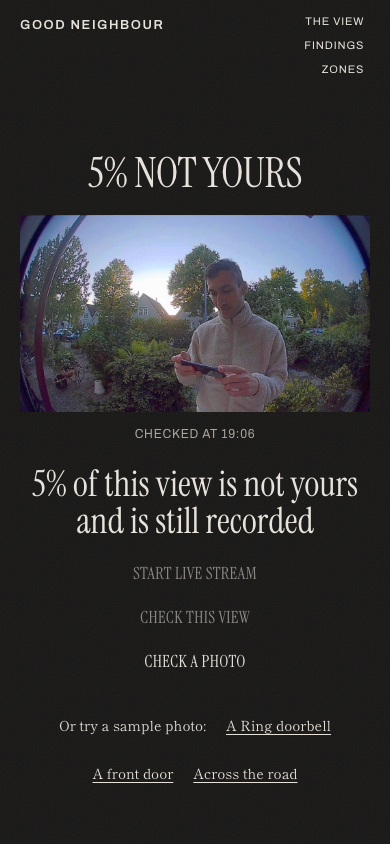
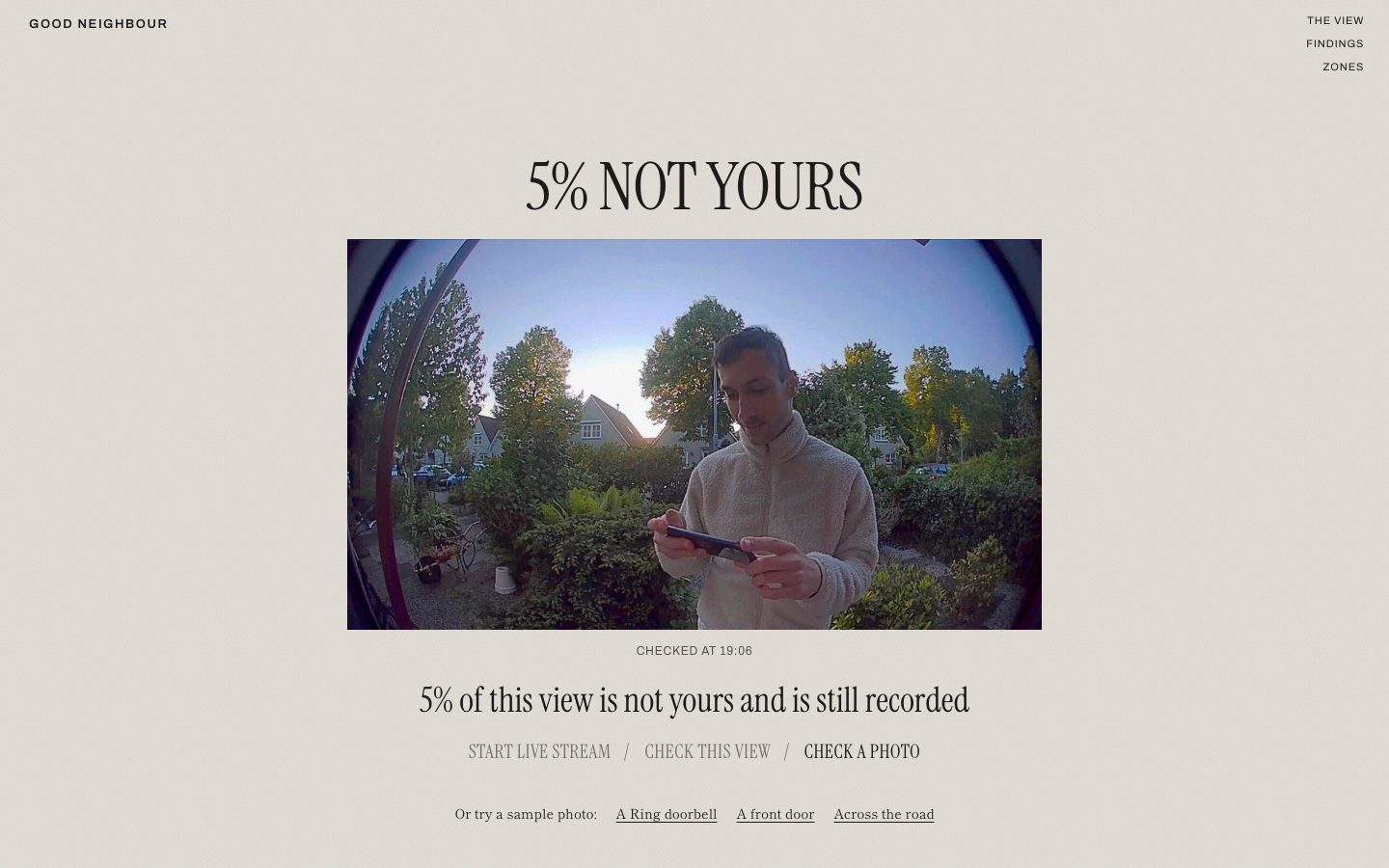
Good Neighbour looks at what the camera actually sees and answers one question: how much of this view is not yours, and is it still being recorded?
- It plays the camera's live stream in the browser through the Ring API (WHEP), or checks a photo or screenshot the owner chooses.
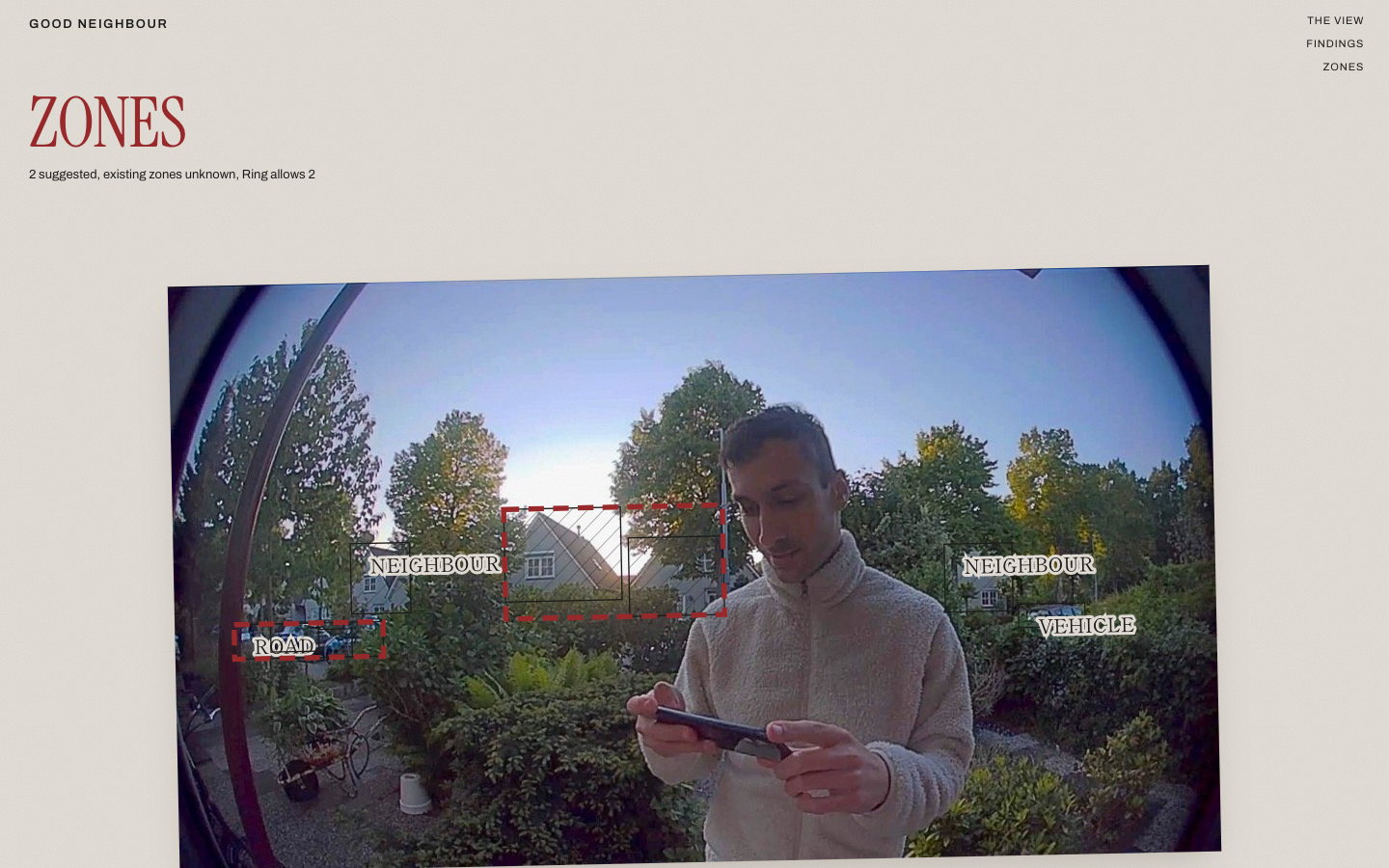
- When the owner presses Check this view, one frame goes to Qwen3-VL on Amazon Bedrock, which marks three kinds of area that are not the owner's: road (street or pavement), neighbour (another household's building, door, window, garden or driveway) and vehicle (on the public road).
- At the same time, it reads the camera's existing privacy zones and its encryption setting from the Ring API.
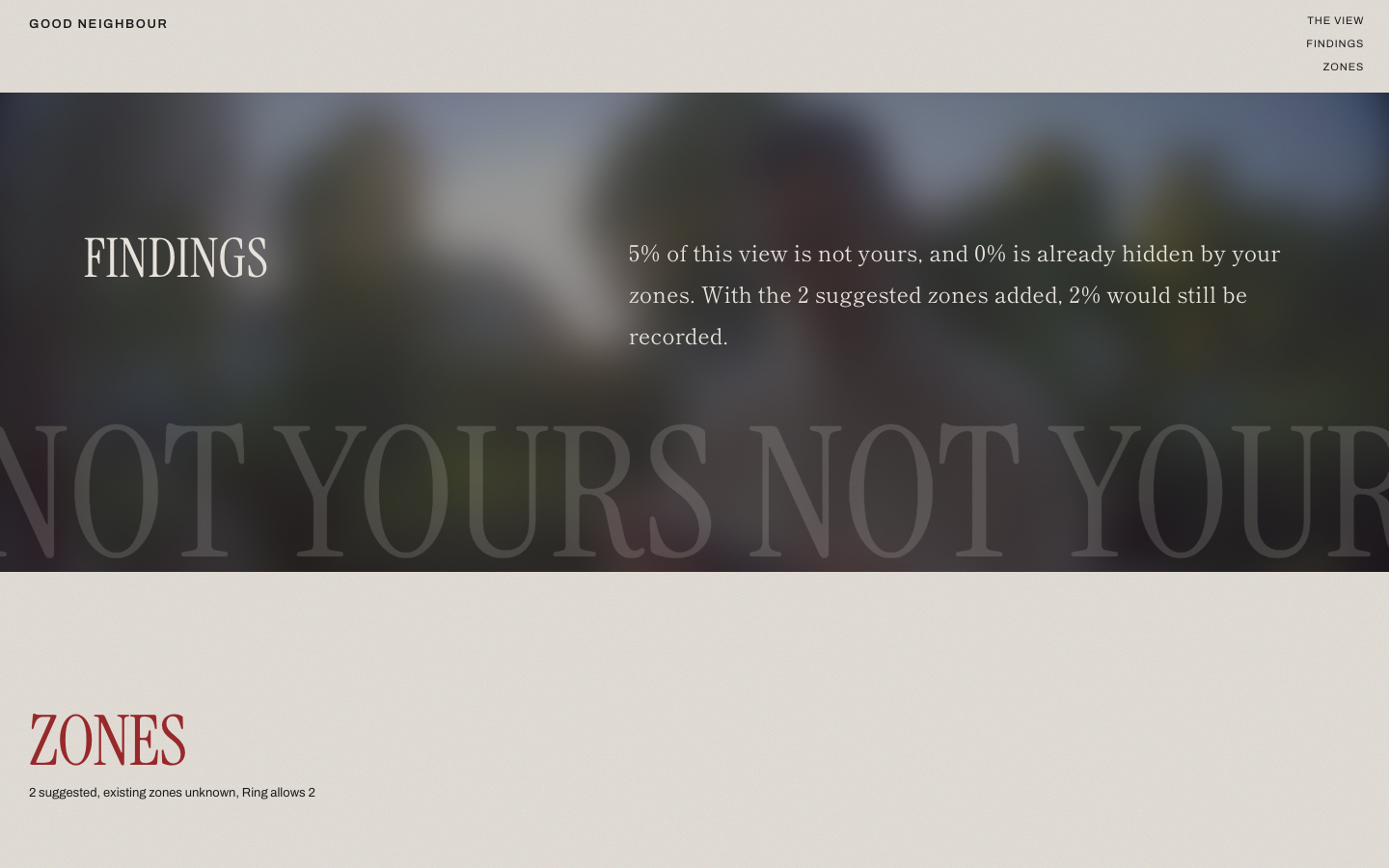
- It works out how much of the view is not the owner's, how much of that is already hidden, and how much is still recorded.
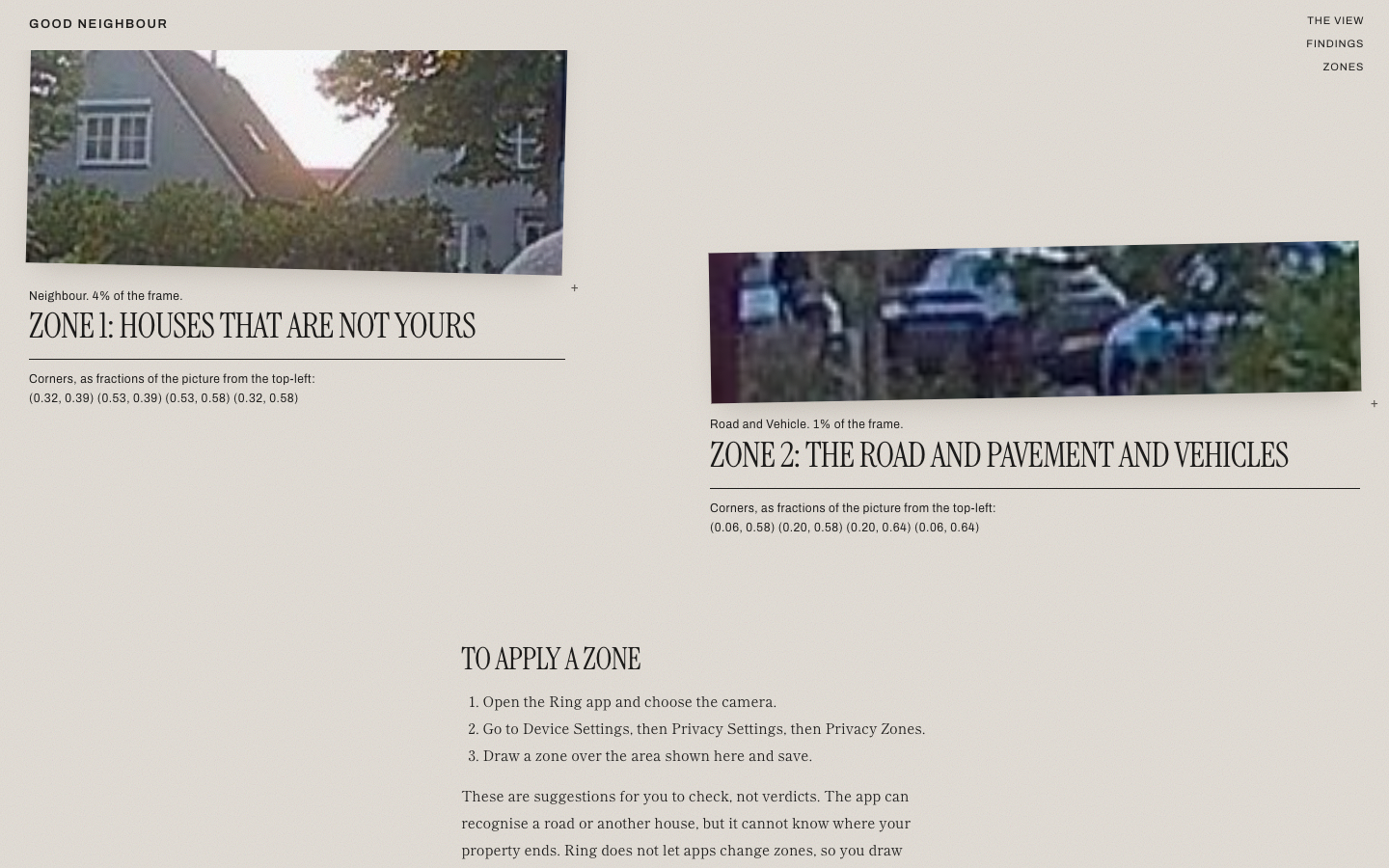
- It suggests up to the number of privacy zones the camera has left (Ring allows two per camera), placed to hide as much as possible. Each comes with its corners, a preview of what would still be recorded, and the steps to add it in the Ring app.
It is honest about its limits. It never claims to know where a property ends, so it calls its zones suggestions. A failed check is never shown as a clean result. Cameras with Ring's new TAKE encryption, whose video apps cannot see, are detected, and the owner is asked for a screenshot instead. Nothing is stored.
How we built it
- Next.js 15 and React, with API routes as a thin server between the browser, the Ring API and Bedrock. The live stream started from Amazon's
ring-api-helloworldstarter (credited in the README); everything else was built during the hackathon. - Ring API: device discovery, device configurations (privacy zones, motion zones and the
e2e_encryptionflag) and the WHEP live stream. The hosted copy has no Ring account of its own: a visitor pastes a Ring access token, which stays in their browser tab and is used only to call Ring. - Amazon Bedrock: the Converse API with API-key authentication. We scored seven vision models (Amazon Nova Lite, Nova 2 Lite and Nova Pro, Qwen3-VL, Llama 4 Maverick, Pixtral Large and Gemma 3) with our own evaluation script and chose Qwen3-VL. We then built a 144-photo labelled benchmark, tuned the prompt on part of it, and checked the result on photos the tuning never saw.
- Geometry in plain TypeScript: the model's boxes and Ring's zone polygons are compared on a grid of 100 × 100 points across the picture, each point tested against the zones with ray casting. The headline figure is
$$\text{still recorded} = \frac{\text{points that are not yours and not inside a zone}}{\text{all points}}$$
- Zone suggestions: a small search picks the zones that hide the most within Ring's limit of two.
- Tested: 86 automated tests cover the geometry, the reader for the model's reply (including broken JSON), the reader for Ring's zones and encryption flag, the pasted-token checks, and that the documentation only names files that exist.
- Hosted on Vercel, with a per-visitor limit and a hard cap on Bedrock calls, so a public copy cannot run up costs.
Challenges we ran into
- Ring's privacy zones are read-only, so the app cannot fix the problem it finds. We turned that into a design choice: the owner stays in charge and draws each zone, guided by the app.
- The location of the zones was undocumented. The guide names
privacy_zonesbut not where it sits in the reply. We found it atdata.attributes.image_enhancements.privacy_zoneson a live camera. - Model accuracy varied hugely. On Ring's own sandbox porch, Nova Lite marked 77% of the owner's steps and parcel as "road", while Qwen3-VL correctly marked nothing. Measuring every option before choosing was essential.
- Close-up houses were missed. A house that fills the picture can look like the owner's own. Two prompt lines that tell the model where the camera is fixed most of these, but proving they added no false alarms took 51 more test photos.
- TAKE encryption became Ring's default during the hackathon and hides live video from apps, so we added the screenshot path.
- The sandbox stream ends after about 20 seconds, which looks exactly like a network fault. We learned to tell the two apart from the connection log.
Accomplishments that we're proud of
- On 144 labelled photos, it finds 96% of what is not the owner's (95% range: 92 to 98%): 98% of roads, 98% of vehicles and 94% of houses. It wrongly marks only 4 of 64 empty scenes.
- Two prompt lines raised the share of houses found from 82% to 94% without adding false alarms, confirmed on scenes held back from tuning.
- The live check works end to end on the hosted copy, with any Ring developer's own camera.
- A calm design that reports and suggests rather than accuses, in light and dark mode, on desktop and phone.
What we learned
Vision models are good at spotting roads and cars, but weaker at houses, especially a house that fills the frame and can look like the owner's own. Telling the model where the camera is (on the owner's house, so any house it faces belongs to someone else) fixed most of that. Only testing on scenes kept back from tuning showed that the fix did not add false alarms.
Built With
- amazon-bedrock
- css
- next.js
- node.js
- qwen-vl
- react
- ring-api
- typescript

Log in or sign up for Devpost to join the conversation.