-
-
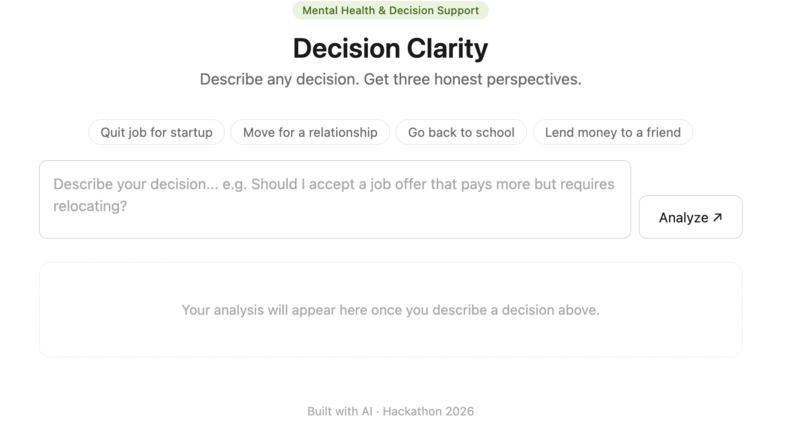
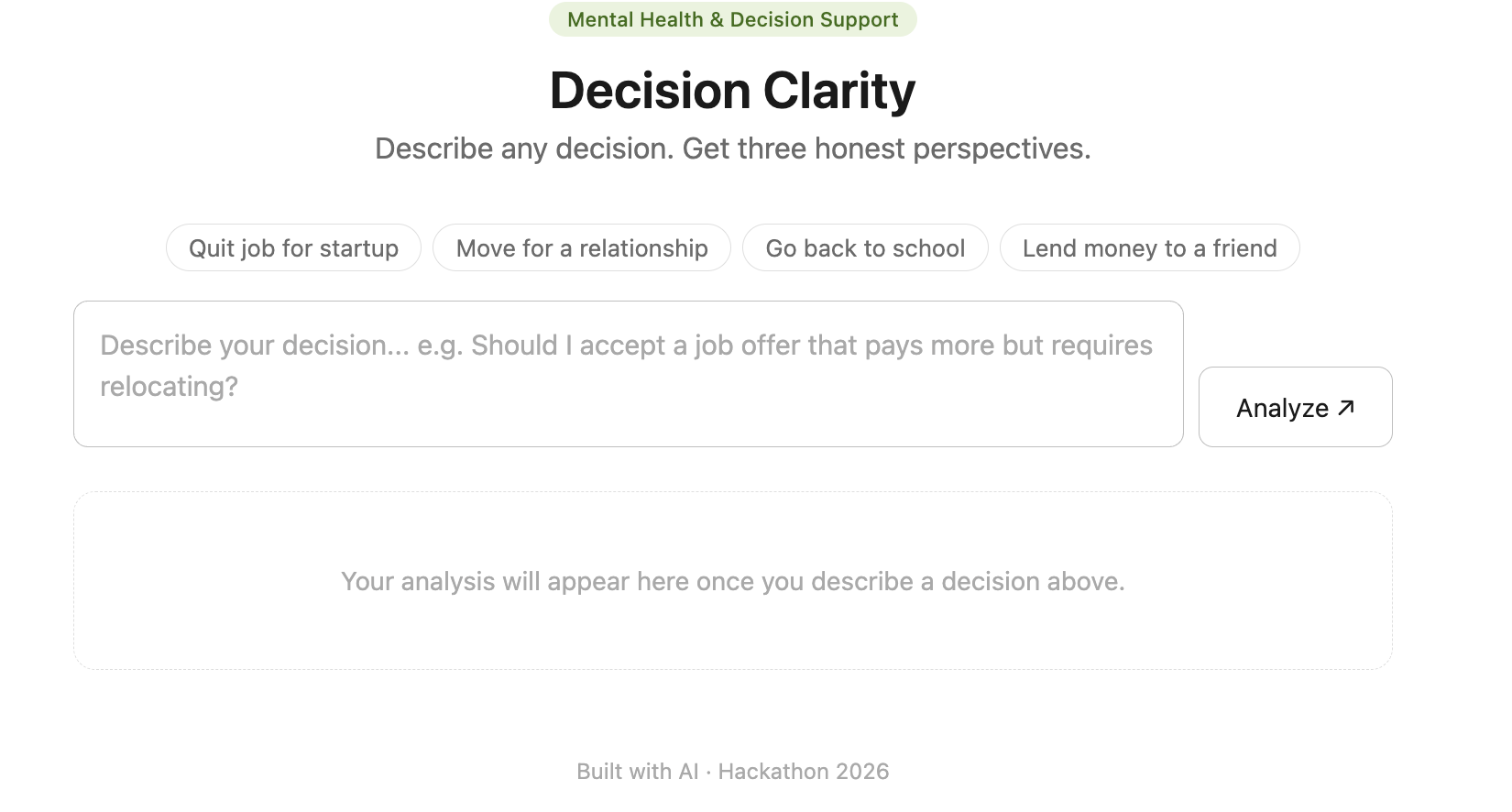
Basic Interface
Inspiration
We kept coming back to the same problem: people don't make bad decisions because they're irrational — they make bad decisions because they're overwhelmed. Most of us have experienced lying awake at 2am spiraling over a choice, replaying the same thoughts without getting anywhere. Therapists and life coaches use structured frameworks like scenario planning and pre-mortems to cut through that noise — but those resources aren't available to everyone. We wanted to make that kind of clear, structured thinking accessible to anybody, for free, in under a minute.
What it does
Decision Clarity takes any decision you're wrestling with and breaks it down into three honest perspectives: the best case scenario, the most likely realistic outcome, and the worst case. Instead of giving you advice or telling you what to do, it helps you see the full picture so you can think for yourself. It also surfaces follow-up questions to help you dig deeper into the parts of the decision you might be avoiding.
How we built it
We built it as a single-page web app using vanilla HTML, CSS, and JavaScript — no frameworks, no backend, no dependencies. The AI responses were designed and crafted to reflect realistic, grounded thinking across common life decisions. We focused heavily on the user experience: the interface needed to feel calm and trustworthy, not clinical or overwhelming. It's fully responsive, supports dark mode, and works on any device.
Challenges we ran into
The hardest part was tone. It's easy to write responses that sound either too optimistic or too scary — but neither is useful. We went through many iterations to find language that was honest without being alarming, and realistic without being discouraging. We also had to resist the temptation to give advice. The whole point of the tool is to help people think, not to think for them — staying on that side of the line required constant discipline in how we wrote every response.
Accomplishments that we're proud of
We're proud that the tool genuinely feels different from a chatbot. It doesn't talk at you — it creates space for you to think. We're also proud of how accessible it is: no account, no subscription, no technical setup. You open it and it works. For something designed to reduce anxiety, it was important that using it didn't create any friction of its own.
What we learned
We learned that the most valuable thing AI can do in mental health contexts isn't to have all the answers — it's to ask better questions. The follow-up prompts at the bottom of each analysis turned out to be just as important as the three perspectives themselves. We also learned how much design affects trust. Small things like loading animations, calm colors, and clean typography made people feel safer engaging with difficult topics.
What's next for Good Decisions
We want to add a journaling layer so people can track decisions over time and revisit outcomes — turning the tool into a personal growth record, not just a one-time analysis. We're also exploring a "second opinion" mode where you can input your gut feeling and the AI stress-tests it. Longer term, we'd love to partner with school counselors and community mental health organizations to bring structured decision support to people who need it most.

Log in or sign up for Devpost to join the conversation.