About the project
Inspiration
I've always felt that many mobile idle games eventually feel more like staring at a spreadsheet than playing an actual game. I wanted to change that. Goo Monsters Tycoon was born from my desire to create a "two-thumb toy feel"—a game where every single interaction feels tactile, bouncy, and immediately rewarding. I leaned heavily into an aesthetic I like to call "cozy weirdness" or "gross-cute". Instead of just watching numbers go up, I wanted players to genuinely care about building, nurturing, and optimizing a bizarre, squishy ecosystem of funny mutants.
How I built it
Operating as an independent creator, I knew that behind the cute, squishy monsters, I needed a rock-solid mathematical foundation. So, I started by drafting a comprehensive Game Design Document (GDD) to map out a data-driven economy that wouldn't break after ten minutes of play.
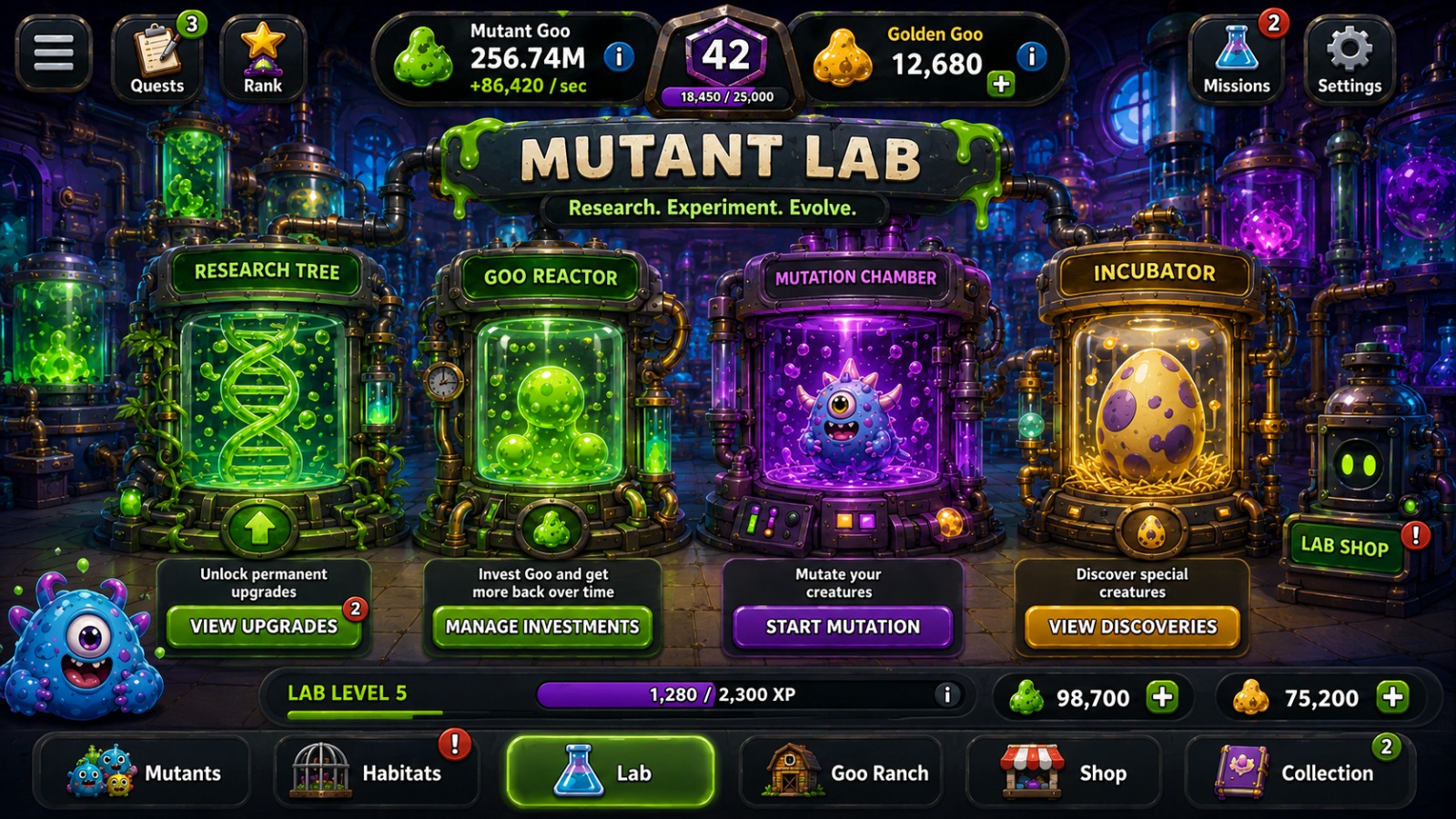
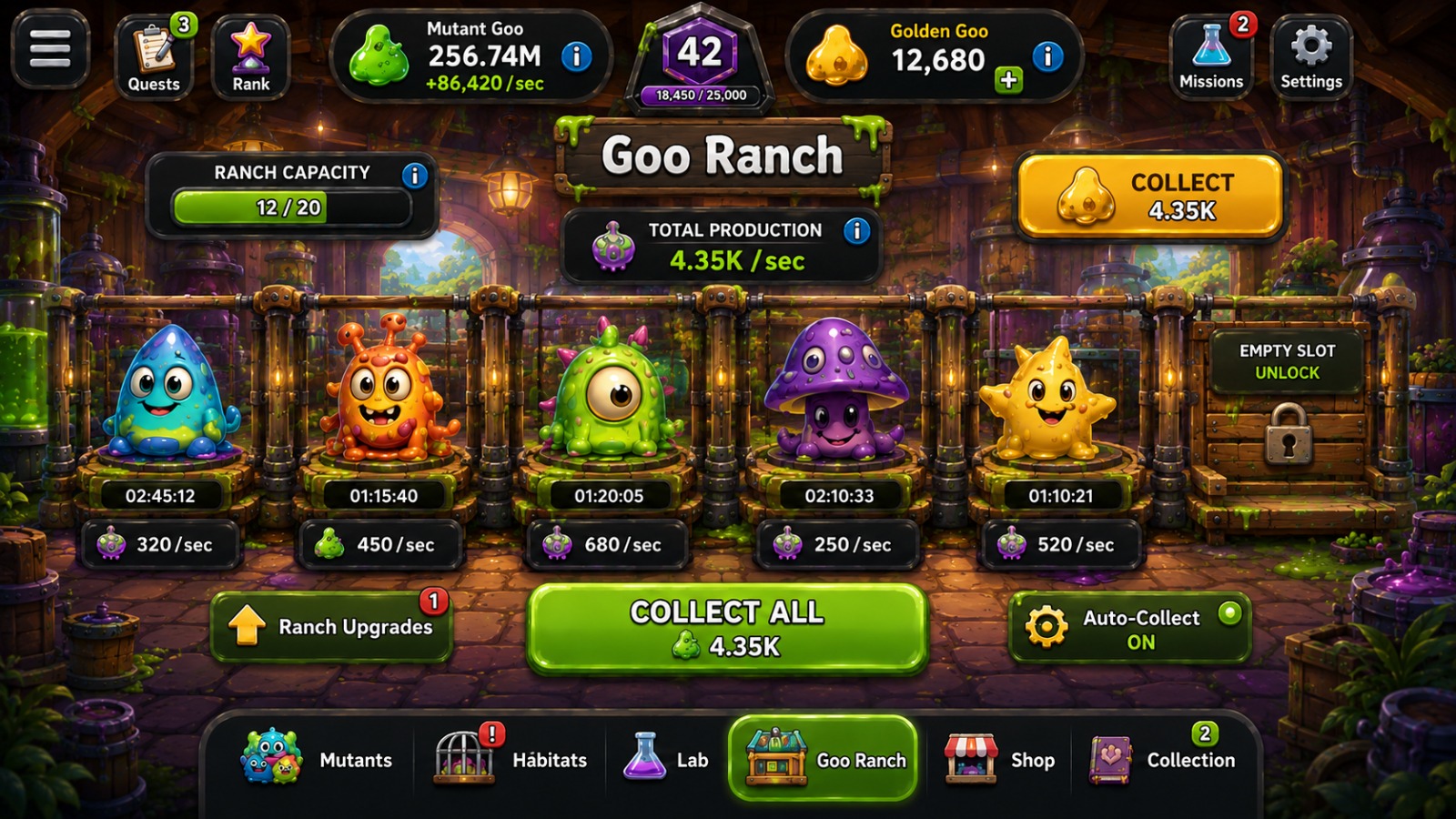
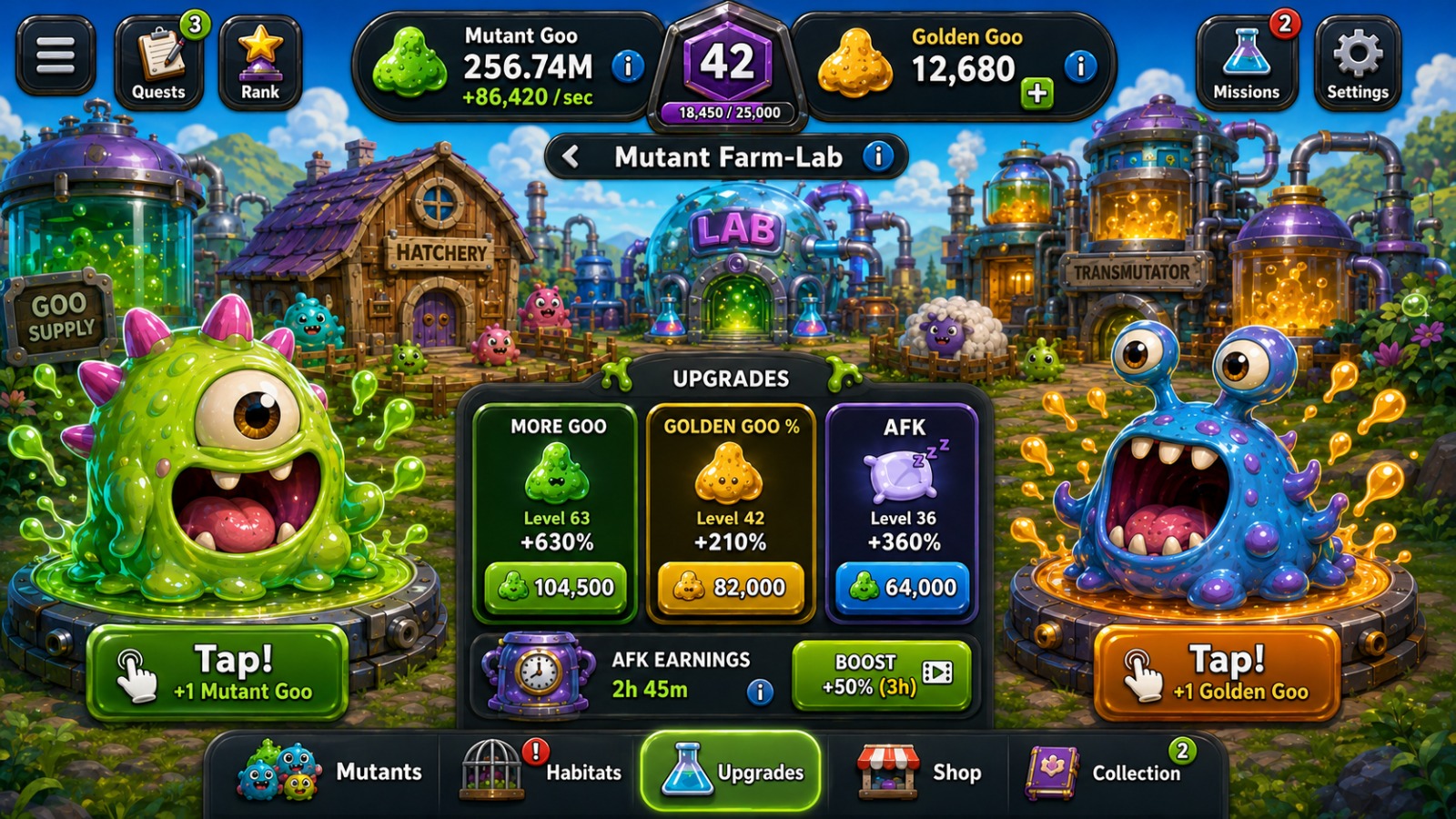
To make sure players wouldn't get overwhelmed by too many menus, I mapped out a strict 15-minute "Player Journey". This helped me introduce mechanics organically—first the active two-thumb tapping, then the AFK Goo Ranch at minute 3, and finally the strategic Mutant Lab at minute 5. Visually, I focused my UI Concept Package on a landscape layout that puts the creatures right under the thumbs, keeping the deeper management panels sleek and out of the way.
Challenges I ran into
My biggest enemy during design was "tap fatigue". It’s dangerously easy to make a clicker game that simply tires out the hands. I tackled this head-on by opening up the AFK Goo Ranch by minute 3 of the player's first session, allowing them to switch from frantic tapping to strategic, passive management.
Another massive headache was making sure the Farm, Ranch, and Lab didn't feel like three disconnected mini-games. I solved this by tying absolutely everything back to my core soft currency: Mutant Goo. Every upgrade purchased, no matter which screen the player is on, feeds back into the exact same unified progression loop.
What I learned
Scope control is everything. As a solo developer managing every aspect of the project, it was tempting to try and add creature fusion, multiplayer friend visits, and massive seasonal events right from the start. But I learned that by aggressively cutting down to a Minimum Viable Product (MVP), I could pour all my focus into the core experience. I realized that if the very first 5 seconds—tapping a monster and watching it squish—doesn't feel amazing, no amount of complex late-game features will save the retention loop.
The Tycoon Math
Since I built a management simulator, balancing the economy was crucial to avoid runaway inflation. To keep progression satisfying, I modeled the upgrade costs on a carefully controlled exponential curve. For any given stat upgrade, the Goo cost $G_n$ at level $n$ scales according to:
$$G_n=G_0 \cdot r^n$$
Where $G_0$ is the base cost and $r$ is the growth rate constant. Tuning this $r$ value against the automated AFK production of the Goo Ranch was my secret sauce to making the game feel like a rewarding journey rather than a grind.
Built With
- canva
- chatgpt
- claude


Log in or sign up for Devpost to join the conversation.