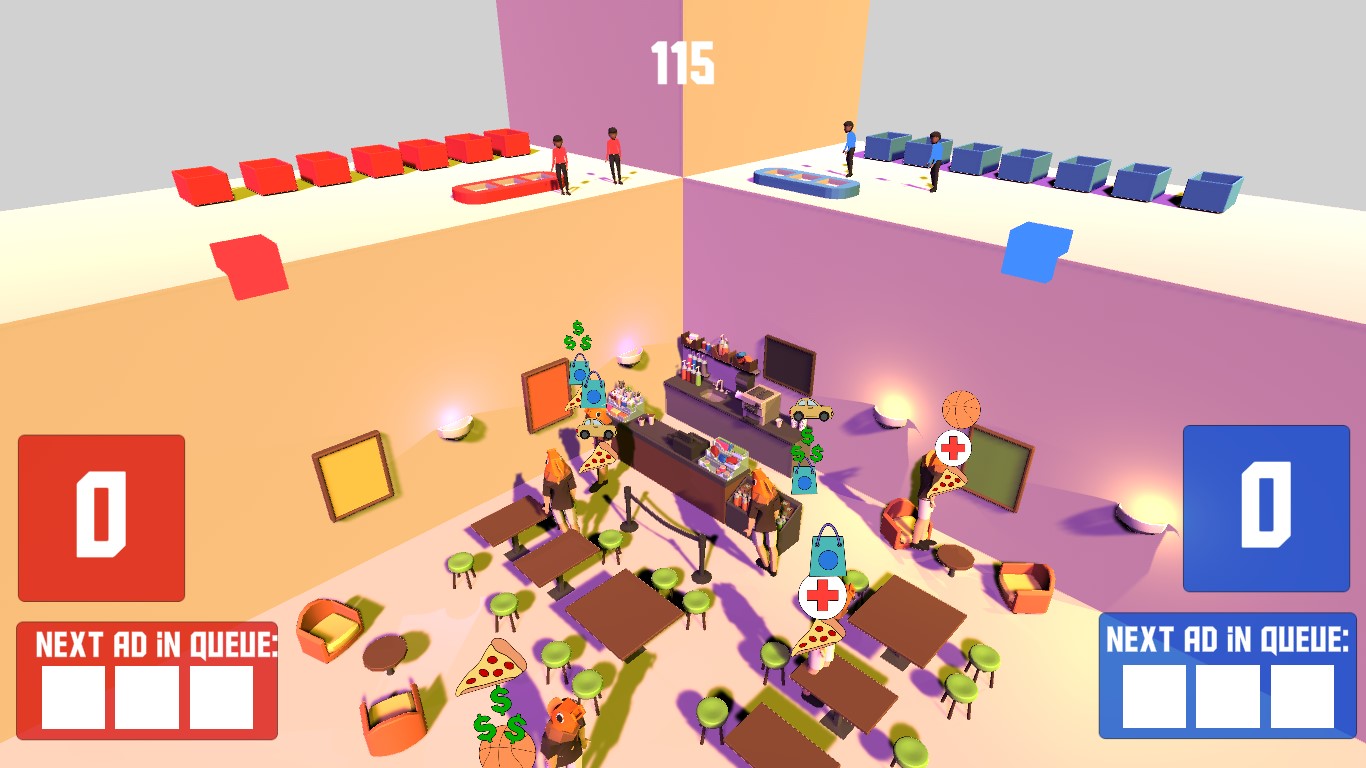
(Edit: Thank you so much to the event organizers for a fantastic hackathon, and to the judges for awarding us with Best Game! This project was so exciting for all of us, and we definitely want to keep working on it going forward.)
Inspiration
Upon entering the hackathon, the members of team BeeSickle had no clue what we could expect to make. Inspired by the concept of hacking, we searched the depths of our minds for any knowledge on cybersecurity. After a riveting round table discussion, the base idea of Gone Phishing was created.
What it does
Gone Phishing is a low-poly isometric fishing game that mixes the concept of phishing, a fraudulent attempt to obtain sensitive information, with the literal physical act of fishing. Players compete in teams of two to construct Bait and phish from a pool of potential victims milling about in the cafe below. The Bait is a custom advertisement used to lure/scam the target comprised of three Desires. The Player must first pick up Topic Blocks corresponding to the fish’s shown desires from storage bins and place them in Ad Template to create a Bait. Then they are able to actually fish for their target. The more the player’s ad matches with the target’s interests, the higher chance the target will take the bait. Whichever team phishes more people in the time limit wins.
How we built it
All 3D models were done by our team members in Maya and Blender. The cafe scene was assembled in Maya, and then brought over to Unity, where all game scripting took place. We have four programmers, so we were able to split up much of the mechanics into separate scripts to work on individually, and we used Unity Collab to integrate everything. For character animations, we used a motion capture suit, which allowed us to enhance and expedite the animation pipeline. We recorded over 30 animations in motion capture and were able to apply them to the 3D character models quickly.
Challenges we ran into
Combining all the systems together was very difficult, and we all had to have a relatively good understanding of each other’s scripts. We also had to keep good track of all the things that needed to be done, so that everything was accounted for. For example, we had to make a state machine for 11 animations for all of the fish people in the cafe, which was extremely complex. Also, there were some bugs we were never able to figure out. The icons on top of each fish in the cafe were supposed to have a backdrop, but we weren’t able to get the sprite backdrop to show behind the icons. Additionally, there were a lot of firsts for members of our team, so we all had to learn a lot to do what we wanted.
Accomplishments that we're proud of
We’re proud that we were able to finish a mostly functional version of the game with a clean level of polish. The cafe was well modeled considering the time limit, and we did not find a large number of runtime bugs. We’re also happy that our game is quite similar to our original vision from the beginning of the hackathon, and that we achieved this despite the large number of bugs we encountered on the way.
What we learned
In working with a brand new team, we were able to learn a great amount of teamwork and communication skills. Our members had to go through the entire game creation pipeline, starting from how to create games using Unity 3D, source control, and extending to setting up proper infrastructure between game systems.
What's next for Gone Phishing
In the future, we plan on expanding and polishing the look and feel of the game in addition to implementing a hacking mechanic. Each team will consist of a hacker and a phisherman (whereas currently each player can both fish and create ads). The fish in the cafe will only have one or two visible desires. The hacker will reveal people’s hidden desires by completing mini games and hacking into their Company accounts, while the phisherman phishes for victims.


Log in or sign up for Devpost to join the conversation.