Inspiration
Night shoots are especially vulnerable to small schedule problems becoming expensive and unsafe failures. A delayed setup, a hard location curfew, worsening weather, or an exhausted crew can quickly affect every remaining shot.
Golden Hours was created to give independent film crews a practical control room for those decisions. The goal is not to let AI make production decisions automatically. Instead, the system makes risk visible, explains possible interventions, and keeps the production team in control.
What it does
Golden Hours allows a production team to:
- Load a call sheet using pasted text or a real PDF/image file.
- Extract structured production information using Google Cloud Vertex AI and Gemini.
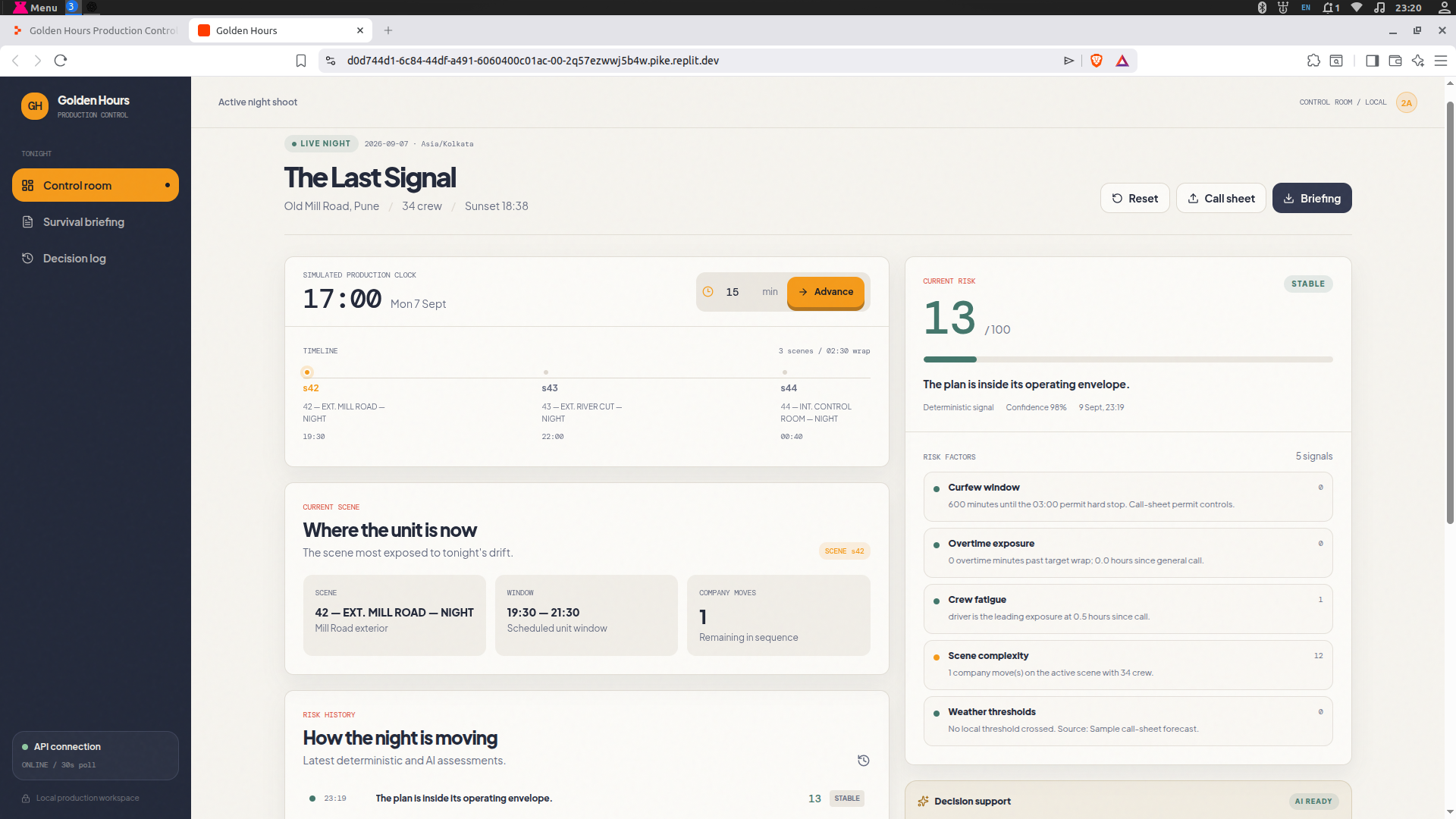
- Advance a simulated production clock.
- Track curfew proximity, overtime, fatigue, weather, and scene complexity.
- Calculate a deterministic and auditable production risk score.
- Review AI-generated intervention options.
- See the projected impact of each option before applying it.
- Require explicit confirmation before any intervention changes the plan.
- Maintain a decision and risk history.
- Generate a survival briefing and contingency checklist.
- Export the current call sheet, risk history, decisions, rule library, and briefings as a ZIP archive.
How we built it
Golden Hours is a full-stack TypeScript application built with React, Vite, Node.js, and Express.
The application uses:
- Google Cloud Vertex AI with Gemini for call-sheet extraction and intervention explanations.
- Multimodal inline data processing for real PDF, PNG, JPEG, and WebP call sheets.
- Deterministic server-side TypeScript logic for numeric risk calculations.
- A grounded rule library for conservative regional production planning defaults.
- OpenAPI as the API contract source of truth.
- Generated React Query and Zod clients for frontend/backend consistency.
- Replit Agent and Replit workflows for development and hosting.
- An in-memory shoot state designed for the hackathon demonstration.
The system is divided into four main agents:
- An Ingestion Agent extracts a strict call-sheet structure.
- A Risk Agent calculates production risk using deterministic rules.
- An Intervention Agent explains practical options using Gemini.
- A Plan Agent requires confirmation and records the applied decision.
Challenges we ran into
The most important challenge was deciding where AI should and should not be trusted.
AI is useful for interpreting an uploaded call sheet and explaining practical options, but it should not silently control numeric risk calculations or change a production plan. We therefore kept the numeric scoring, projected impact bounds, confirmation flow, and audit records server-owned and deterministic.
We also had to support real call-sheet files rather than relying only on a sample fixture. PDF and image uploads are sent to Vertex AI as actual multimodal input, and the application validates the extracted structure before replacing the active shoot.
Another challenge was representing regional production constraints responsibly. Golden Hours includes conservative planning defaults for locations such as Los Angeles, Atlanta, New York, London, and Toronto, but clearly treats them as planning guidance rather than legal advice. Actual permits, contracts, union rules, and local laws remain authoritative.
Accomplishments that we're proud of
We are proud that Golden Hours demonstrates a complete production workflow rather than just an AI chat interface.
The application:
- Uses real multimodal call-sheet ingestion.
- Keeps numeric risk scoring deterministic and auditable.
- Shows projected consequences before applying an intervention.
- Requires explicit operator confirmation.
- Records decisions and risk history.
- Produces a useful survival briefing.
- Exports a complete audit archive.
- Includes upload limits and rate limiting for AI-backed endpoints.
- Includes a public MIT license and a secret-free source archive.
- Has a dedicated hackathon video demonstrating the real application workflow.
What we learned
We learned that a useful agentic system needs clear boundaries between interpretation, calculation, recommendation, and action.
The strongest design was not to make the AI fully autonomous. Instead, we used AI where language and multimodal understanding are valuable, while keeping safety-sensitive calculations and state changes deterministic and reviewable.
We also learned that auditability improves the product. A production manager should be able to understand why risk changed, which intervention was selected, who confirmed it, and what the projected impact was.
What's next for Golden Hours
The next step would be to connect Golden Hours to real production systems and live data sources.
Possible additions include:
- Persistent multi-user production workspaces.
- Authentication and role-based permissions.
- Live weather and location data.
- Calendar and scheduling integrations.
- Permit and union-rule integrations.
- Notifications for curfew, overtime, or weather thresholds.
- More regional rule packs maintained with production professionals.
- Historical analytics across multiple shoots.
- Integrations with call-sheet and production-management tools.
Built With
- agent
- ai
- archiver
- cloud
- css
- express.js
- framer
- gemini
- motion
- node.js
- openapi
- query
- react
- replit
- tailwind
- tanstack
- typescript
- vertex
- vite
- zod

Log in or sign up for Devpost to join the conversation.